Catching Up on MediaPolicy – Local TV independents demand Meta bargain despite news ban – Radio Canada’s Amazon deal roils in Quebec – the clock ticks on Bell Media’s future

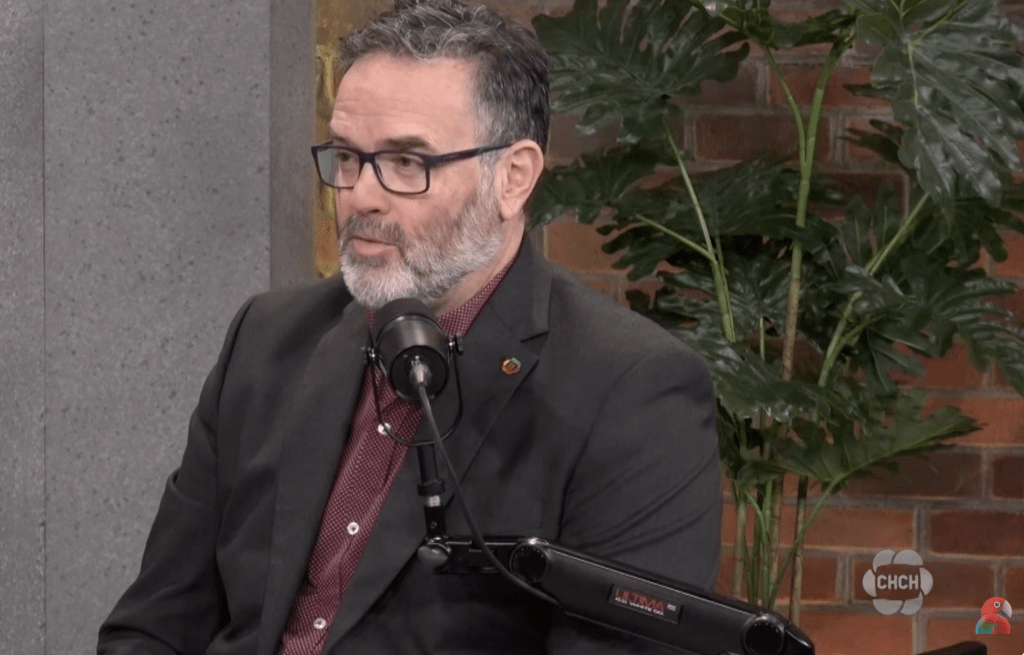
CHCH News Director Greg O’Brien

March 8, 2026

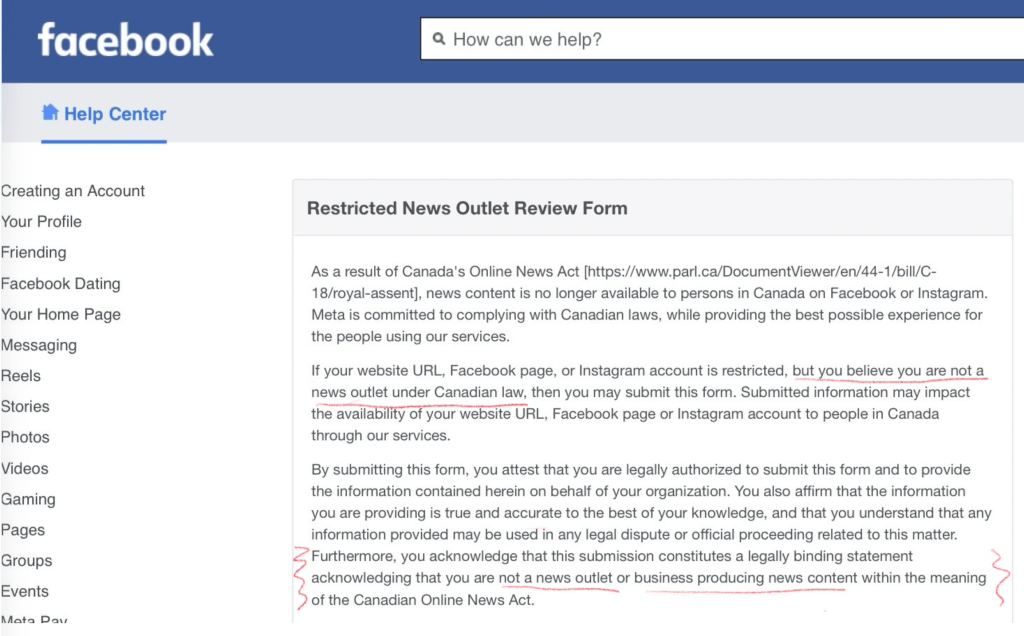
Just before the new year, the CRTC hit the pause button on its staff investigation into Meta’s leaky ban on news content posted to Facebook and Instagram, declaring a wait-and-see. 

CRTC VP Broadcasting Scott Shortliffe issued the brief notice on December 3, 2025, noting Meta’s efforts to remove user posts of Canadian news and stating that the Commission would continue monitor the news ban.

On February 4th, the LITS coalition of 15 independently owned television stations filed an application to the CRTC asking the regulator to confirm that Meta, despite its news ban announced in August 2023,  continues to  “make news available” in Canada through either the replication of news content or linking to it on Facebook and Instagram. The broadcasting companies, which include Hamilton’s CHCH and Victoria’s CHEK, want the CRTC to order Meta to bargain with news outlets. 

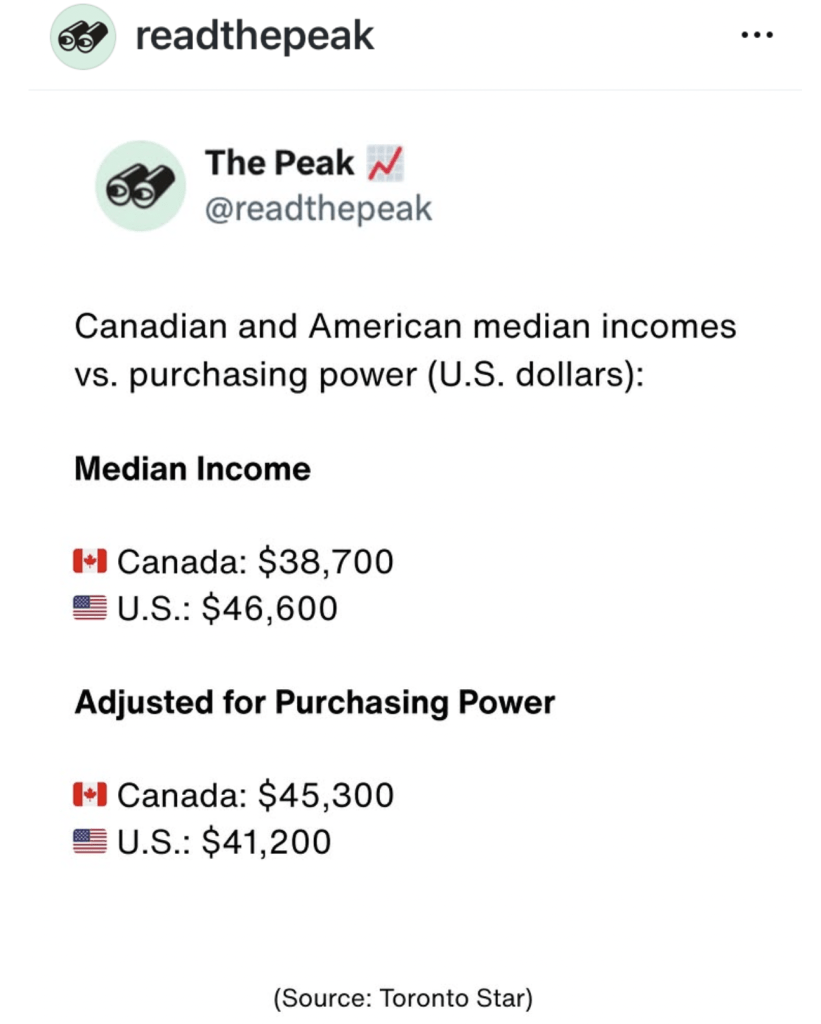
MediaPolicy wrote about this issue previously here and here, pointing out the regular news posting activities of Canadian digital outlets Telelatino, The Peak (on Instagram but not Facebook) and Narcity on both platforms.

Narcity publisher Chuck Lapointe claimed in a LinkedIn post to have an agreement with Meta to exempt his publication from the news ban.

Aside from these exempted news publishers, the LITS application to the CRTC cites a long list of news posts from Meta user accounts, often linking back to content posted on YouTube. The application offers the CRTC a number of examples of user-posted content from news sites that directly compete for audience with digital content published by the television stations on their websites. According to LITS, some of the posts were removed after several months, others remain.

CHCH News Director Greg O’Brien also points to Facebook permitting regular posting of video clips from the Rogers City-TV Breakfast Television morning show in Toronto, in direct competition with CHCH’s own morning show. 

It’s a legality worth noting that the Online News Act does not narrowly define the “news content” that Meta must bargain for as hard news or political reporting. The Act describes news content as original reporting on “matters of general interest and reports of [Canadian] current events, including coverage of democratic institutions and processes.”

Asked why he thinks Meta is platforming CityTV’s Breakfast Television but blocking CHCH, News Director O’Brien said “we can’t understand this and can get no answers from Meta. Breakfast Television and [CHCH] Morning Live are competing morning news shows. We are banned from Instagram and Facebook and BT is not. It makes no sense and is unfair. Global Television’s morning show also has an Instagram page. It makes me think Meta has some side deals with them.”

LITS counsel Peter Miller expressed a similar concern when asked why it was the small independent television stations raising this issue with the CRTC on their own, so far. 

“It’s also possible that Meta has done deals with large players.  Certainly the recent stance [Meta has] taken with government —-drop the [Online News] Act and we’ll do deals that include [licensing of] AI—- suggests they’d rather only have to concern themselves with bigger news players. And the survival of smaller independent players and news media diversity generally is the most at risk here,” Miller told MediaPolicy. 

Further details of LITS allegations can be downloaded below.

***

Another day, another controversy for CBC/Radio-Canada.

The Corp’s decision to broadcast its 24-hours national news television channels on Amazon Prime for a monthly subscription fee has been heavily criticized in the press, Québec’s Culture Minister and by federal and provincial political parties in Québec. 

The criticism is that CBC is partnering with a foreign tech platform that is overwhelming Québec audiences with English-language content. 

Making it worse, say critics, the same live news content is not available on Radio-Canada’s ici tou.ca (the CBC says that is coming to tou.ca, it’s already available on CBC Gem). 

La Presse cultural columnist Mario Girard was so incensed that he speculated he might be unable to defend Radio-Canada funding in the future. 

“In short, if we follow the logic of this agreement with Prime Video, Radio-Canada will be selling content (largely paid for by Canadian taxpayers) to an American giant that will, in turn, siphon off profits to further crush Canadian private media,” wrote Girard in his regular column.

CBC content is available on a number of non-Canadian platforms, on its YouTube channels in particular, as the public broadcaster follows the audience leaving, or never considering, conventional television. As well, media content is increasingly discovered on apps that are gated by foreign-owned operating systems installed in smart televisions and other connected devices.

This week the Hamilton-based and Canadian owned online distributor Parrot TV announced it is adding the ad-supported CBC National News Channel, CBC Vancouver and CBC Toronto to its other live news channels CHCH-TV and Newfoundland TV.

Besides the CBC news channels, Amazon Prime also carries live Canadian news channels on paid subscription from CTV, Global, and Rogers City-TV, but not Québecor’s TVA.

Update 14/3/26 – Radio-Canada has paused its deal with Amazon Prime until such time that it can offer its news channels on tou.ca.

***

Bell Media has responded to speculation about its long term licensing of Warner Brothers Discovery’s HBO content on Crave, now that Paramount has won its takeover bid for WBD. In a declaration kept short and sweet, Bell claimed its HBO deal was good for “the foreseeable future.” 

Paramount has announced its intention to merge HBO into its own subscription service Paramount Plus and also fold in its advertising supported app, PlutoTV. 

The expiry date of Bell’s licensing deal for HBO’s content remains a commercial secret. If I was a shareholder, I would want that secret told.

In the meantime, Bell must be planning to pivot hard to rebuilding its Crave platform into an engine fuelled by its own Canadian IP. There’s an excellent interview of Bell’s content VP, Justin Stockman, by Irene Berkowitz, exploring how Bell hopes to build on the success of hit shows like Heated Rivalry, Sullivan’s Crossing and Empathie.

***

If you would like regular notifications of future posts from MediaPolicy.ca you can follow this site by signing up under the Follow button in the bottom right corner of the home page; 

or sign up for a free subscription to MediaPolicy.ca on Substack;

or follow 
@howardalaw on X or Howard Law on LinkedIn.

COMMENTS ARE WELCOME. But be advised they are public once I hit the “approve” button, so mark them private if you don’t want them approved. 

I can be reached by e-mail at howard.law@bell.net.

This blog post is copyrighted by Howard Law, all rights reserved. 2026.
Catching Up on MediaPolicy – Meta’s “Faustian bargain” – Paramount, so much winning – Millennial beer buddies have at it on ‘Elbows Up’

February 28, 2026

Meta’s ban on Canadian news and the rumour mill about the federal government being interested in fixing it has dragged on for several months. 

It seems that Meta and Ottawa are talking about something that touches upon licensing of news content for Meta’s AI tools, age verification for social media accounts, the Online News Act, and Meta’s news ban on Facebook and Instagram.

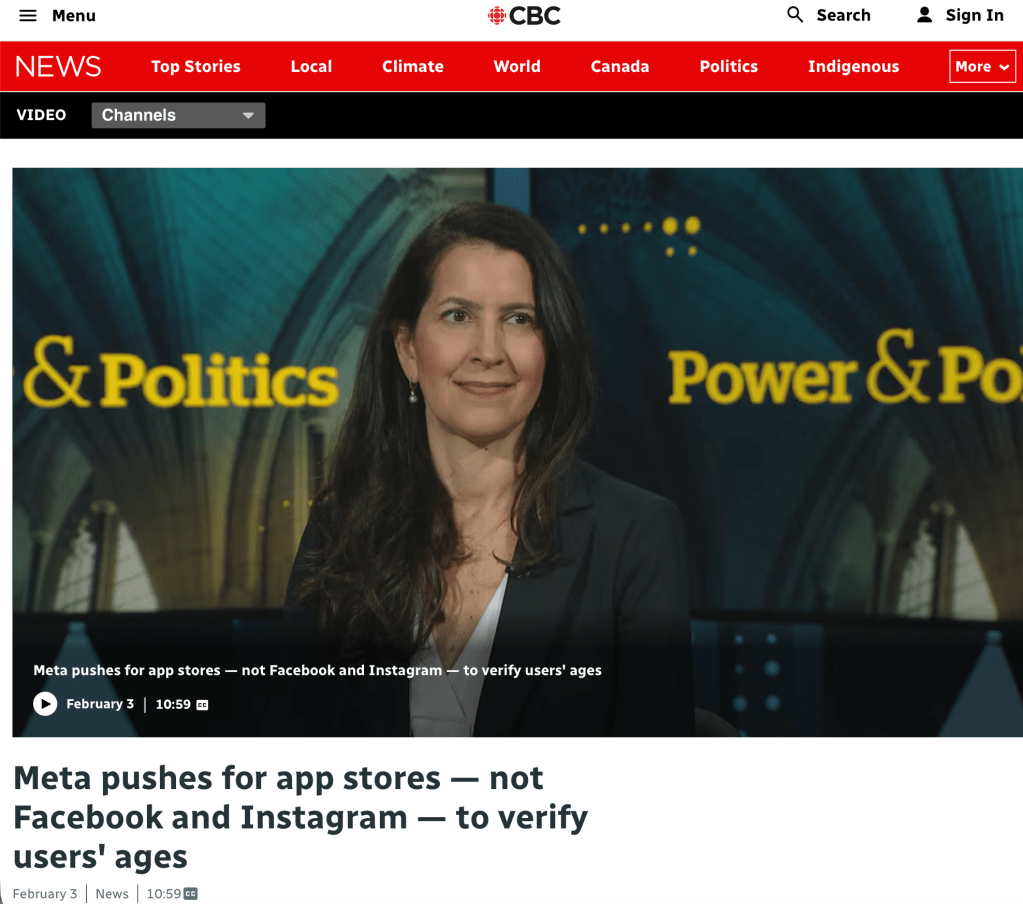
Earlier this month, Meta spokesperson Rachel Curran was invited to a ten-minute spot on David Cochrane’s CBC news hour to discuss Meta’s pitch to have the federal government impose age verification responsibilities on app stores (Google and Apple) rather than apps (Meta).

At the eight minute mark they pivot to the news ban and Meta’s recent chats with the Liberal government.

“We would love to have news back,” said Curran, which doesn’t exactly square with her adamant position that as an advertising-driven business they get no commercial value from news content.

Her read-out of Meta’s talks with the Liberals was that the government agreed with Meta’s view.

That’s an astonishing claim —not denied by the government as yet— given that the Online News Act was built on precisely the opposite foundation, the government’s policy conclusion that Facebook monetizes news content and exploits its commanding market position in social media to shortchange news publishers in what would otherwise be a fair market in licensing payments for news snippets and hyperlinks. 

A more nuanced answer from Curran might have been that Meta is willing to pay for news content from some news publishers, but not from most others, and therefore a mandatory licensing regime doesn’t make sense. 

The idea that some news content generates ad revenue for Meta, but some content does not, is a value proposition that could be true but it has never been proven one way or another and Meta has no intention of putting it to the test.

The Online News Act gave Meta a chance to prove such a claim by negotiating different price points for different news outlets. But prevented by the Online News Act from cherry picking news outlets, Meta instead chose the nuclear option of a news ban.

Now we’re back to “Go” on the Monopoly board and Meta wants to cherry pick deals with chosen news outlets for the ingestion of news content into the training of its AI tools.

Curran tried to obscure the cherry picking by making the shamelessly false statement that the Online News Act is preventing Meta and news outlets from engaging in negotiations over AI content (the Online News Act only regulates “making news available” to the public and would require amendments to apply to content licensing for the training of AI tools). 

Alternatively, Meta wants news content in order to offer AI products that mimic search engines and embed news links in its chat replies. Yes, that might well be covered by the Online News Act and so Curran would be right, the Online News Act is an obstacle to implementing Meta’s evolving global model of monetizing third party content without licensing it.

But the important take-away here is that Meta is pitching a deal to Ottawa: repeal the Online News Act, let Meta cherry pick a few Canadian news outlets for licensing deals, and in return Meta will allow news publishers and their content back onto Facebook and Instagram.

The President of the Canadian Association of Journalists Brent Jolly dubbed this “a Faustian bargain,” but a more descriptive characterization would be “total capitulation by Ottawa.”

Removing the news ban would certainly help some news publishers, especially start-ups, who are still willing to put their business faith in Meta-controlled distribution. But the political value of the Liberals of taking such a lop sided deal seems minimal.

***

The battle to buy Warner Brothers Discovery is over.

This week the WBD board accepted Paramount’s improved $31 per share offer as “superior” to its tentative deal with Netflix, which declined to bid higher. It’s an $111 billion USD deal in the end.

You could spend the rest of your weekend reading analyses of the dramatic bidding war. For something short and punchy, here is Aakash Gupta’s X post. 

The deal is supposed to catapult Paramount into a far better competitive position with the streaming thoroughbreds Netflix, Disney, YouTube and Amazon, improving upon its current also-ran position. With a mountain of debt financing sitting on Paramount’s post-merger balance sheet, major layoffs and studio production cost controls are a good bet. 

Prior to the improved share bid, Paramount tried to satisfy the WBD board and its major shareholders with a key promise to buy its laggard cable assets (including CNN) and other guarantees around break-up fees and the reliability of its debt financing. In the end, it had to pay more.

Netflix didn’t want to pay more and may have been listening to the chorus of critics who thought they were overpaying, even with a lower per share price and Netflix stock swaps for WBD shareholders.

One interesting view was that Netflix might get more bang for its buck buying Spotify instead of a bigger share of the video streaming market through WBD’s prestige HBO content, WBD’s other IP brands and its massive movie archive.

Paramount is ultimately owned by Larry Ellison, third richest man on the planet and tight-with-Trump. The New York Times has a useful overview of Ellison’s budding media empire in technology, movies, cable news, and TikTok USA. 

There will be at least two story lines for MediaPolicy readers to follow once the deal is closed. 

The first is what happens to CNN News. In less than a year, Ellison has acquired control of CBS News and now CNN. 

CBS News is already being repositioned towards a more conservative audience. 

CNN —disparaged for years by Republicans as the “Clinton News Network”—  seems a good candidate for being starved for cash, stripped for parts or transformed into Fox News 3 unless Ellison is shrewd enough to hang on to a centre-left audience for advertisers. Certainly his friend in the White House expects a conservative CNN.

On the latter point, Ellison may have jotted down notes on Jeff Bezos’ business misjudgment in humbling the Washington Post to appease Trump.

The other story is Canadian: will Ellison renew or let the HBO  licensing deal with Bell Media expire and offer HBO as a stand-alone streaming service in Canada (in a bundle with Paramount Plus, or separately). (Update 2/3/26 – Paramount has announced that HBO and Paramount Plus will be merged into one streaming service.) 

If Bell loses the profitable HBO content stream, its entire broadcast enterprise becomes very weak, possibly an intolerable drag on its bottom line. 

This merger drama started by WBD CEO David Zaslav isn’t quite over of course. There are anti-trust hurdles for Paramount, even with a friendly government in Washington DC. 

The Attorney-General of California Rob Bonta is talking out loud about challenging the deal. But anti-trust is notoriously a long shot both in timeline and chances of success.

Regardless, the deal may not close for a year, an election year,  and the Congressional Democrats are not going to let this merger go gently into the night.

***

In December I wrote about the book Elbows Up, an anthology of centre-left English Canadian and Indigenous voices responding to Donald Trump’s annexation threats.

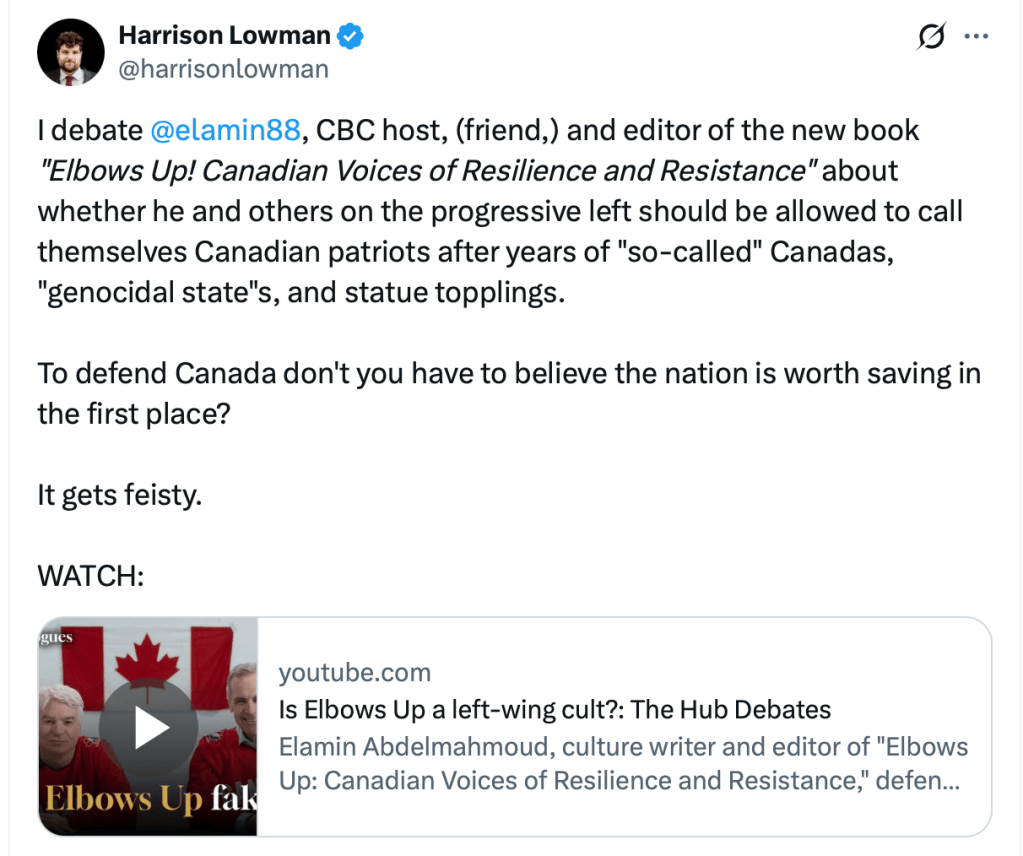
I wasn’t deeply impressed by the book and said so. But I recommend an entertaining follow up: The Hub’s Harrison Lowman video interview of the book’s editor, CBC Radio host Elamin Abdelmahmoud.

Lowman had the same problem with the book that I did: no conservative voices and more than a generous dose of settler-state vocabulary that seems at odds with forging the ecumenical political bonds and links required for resisting US hegemony.

His guest had no good answer for the parochial exclusion of conservative perspectives on a common Canadian challenge, the threat of annexation: he weakly implied a lack of interest from conservatives to meet his time sensitive call-out for contributions. 

But Abdelmahmoud is quick-witted to say the least, and he did a good job of explaining the importance of Canada and Canadians integrating the Indigenous perspective of dispossession, domination and death into our national consciousness of who we are, what we want to be, and, as pointed out in the book, why Trump’s threats provide a perfect opportunity to advance our reconciliation project.

Lowman and Abdelmahmoud, conservative and progressive bookends, are good friends in their private lives and listening to the interview is like sitting back and appreciating a robust argument over beers. That makes it an almost perfect metaphor for the national conversation we might have. 

***

If you would like regular notifications of future posts from MediaPolicy.ca you can follow this site by signing up under the Follow button in the bottom right corner of the home page; 

or sign up for a free subscription to MediaPolicy.ca on Substack;

or follow 
@howardalaw on X or Howard Law on LinkedIn.

COMMENTS ARE WELCOME. But be advised they are public once I hit the “approve” button, so mark them private if you don’t want them approved. 

I can be reached by e-mail at howard.law@bell.net.

This blog post is copyrighted by Howard Law, all rights reserved. 2026.
Catching Up on MediaPolicy – the new season of Stursberg’s CBC – the federal budget – Le Devoir’s Meta work around – Australia will regulate Netflix

Image by OpenAI

Are you not entertained? Richard Stursberg wants CBC audiences to say yes

November 8, 2025

This week MediaPolicy posted a guest column from Richard Stursberg, the former Vice President of CBC’s English language service, reflecting on the public broadcaster’s recently announced Five Year Plan

You won’t be sorry you spent five minutes with it. It’s a compelling read. Stursberg is one of the few commentators who puts as much emphasis on CBC’s entertainment programming as he does the news service.

Stursberg sets a simple performance bar for the CBC: is it good television? And then he offers a hypothetical new season(s) of great shows that could meet that standard and bring a real buzz to the CBC’s CanCon offerings, while satisfying our Canadian cultural cravings. 

The CBC just got its $150 million booster shot in the federal budget. That money fulfilled an election promise. The 11% increase to the $1.4 billion Parliamentary grant (70% of CBC’s overall $2 billion revenue) won’t necessarily go into a bigger budget for entertainment programming: the Five Year Plan prioritizes local and regional news reporting. But it does give the public broadcaster more options. 

The CBC’s new money was the Carney government’s sole increase to cultural funding in this week’s budget. Culture and Identity minister Steven Guilbeault told the Globe and Mail that the public broadcaster had also been spared from the “15% savings” spending review announced by the government several months ago.

Budget announcements for the Canada Media Fund, the Canada Music Fund, TV5MondePlus, Telefilm, the National Film Board and Special Measures for Journalism (community weeklies) are all multi-year extensions of supplemental funding previously put in place by the Justin Trudeau government.

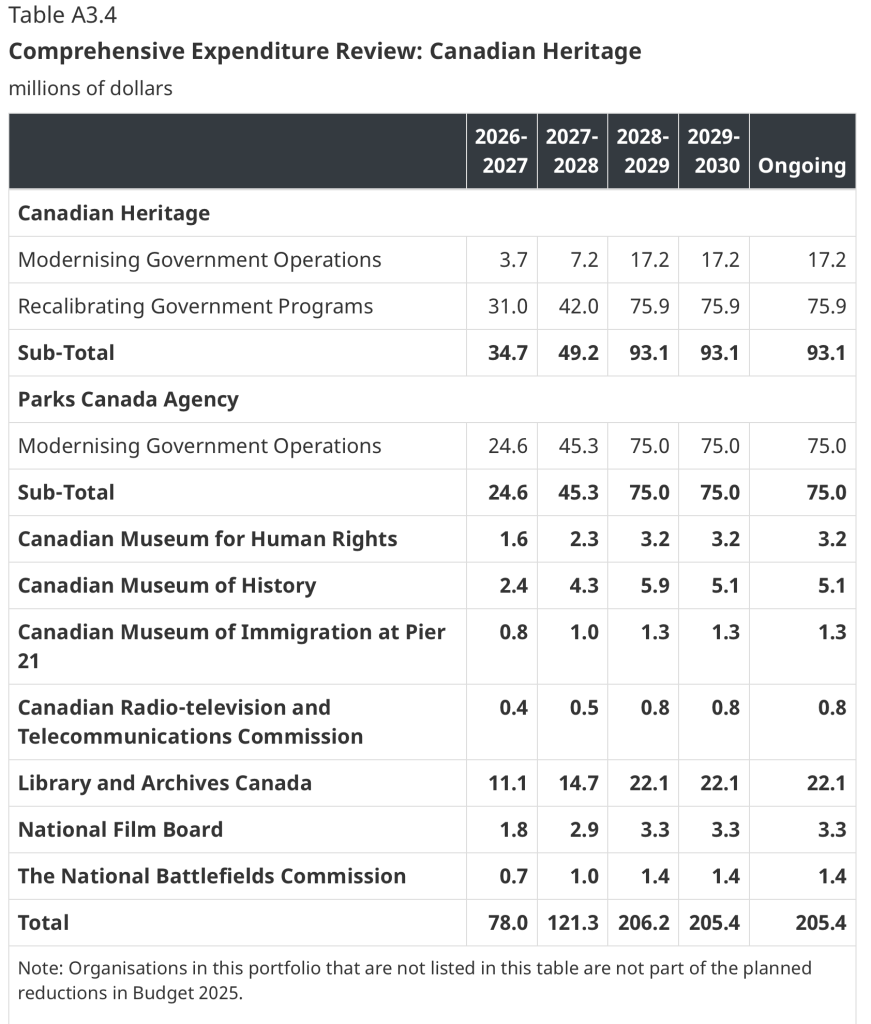
On the other hand, the budget document includes projected cuts to Canadian Heritage expenditures which might be either civil servant salaries or “recalibrated” program spending. Guilbeault pointed out to the Globe that the $93 million savings figure was 5%, not 15% of expenditures.

The numbers on recalibrated programs might include the scheduled reduction of the federal labour tax credit from 35% to 25% of journalist salaries on January 1, 2027. As well, Guilbeault told the Globe the government was exploring a merger of the Canada Media Fund, Telefilm and the National Film Board.

The budget document included a brief note that changes are in the works for the Canadian Periodical Fund that subsidizes weeklies and magazines (the government only told me that the details would be communicated at a later date).

The status quo on cultural funding shouldn’t be surprising, given other priorities in 2025.

Still, TV and radio news outlets were miffed that the government didn’t end its arbitrary exclusion of broadcasting companies from accessing federal aid for their online news websites that —-but for the television and radio properties operated by their parent companies—- would be eligible for the $75 million pool of journalist salary subsidy available to all online news outlets. 

***

There’s a useful explainer posted in Paula Clark’s Substack about the Blacklock’s Reporter litigation with the federal government over Parks Canada’s sharing of a paywall password obtained from an individual subscription, giving unlimited access to every article in the Reporter’s database. 

The watchdog news website was in court last month, appealing a controversial trial ruling in favour of the government which appeared to bless the government’s actions and give short shrift to copyright protection. 

Among the many legal frailties of the trial judge’s decision is that it appears to expand the public right of “fair use” sharing of quotations or text snippets to authorize redistribution of full articles and, thanks to the password sharing, Blacklock’s entire news archive.

It’s a legally complicated appeal, which is why’s Clark’s piece is helpful. 

***

As you know, in 2023 Meta responded to Parliament passing the Online News Act by banning most news content from Facebook and Instagram in Canada (a news outlet can pay Meta to post content as an advertisement).

The ban hit the many Canadian news outlets relying heavily upon Meta platforms for content distribution. While the news blackout probably impacted free sites harder, paywalled sites were affected too.

The marketing director at Le Devoir is claiming a measurable success in making up for the lost distribution by working a lot harder at its direct engagement with readers, especially demonstrating the value of content to new subscribers.

Meta hasn’t entirely given up on Canadian news journalism of course. Just last week The Hub published a well argued commentary advocating against the federal government pursuing a digital sovereignty strategy. Meta sponsored the article.

***

The Australian government has moved the yardsticks on implementing something like Canada’s Online Streaming Act for Netflix and the other foreign video streamers, a move it has been mulling over since early 2023.

The legislation hasn’t been tabled with details yet, but the announcement suggests the streamers will have to spend 7.5% of their Australian revenues on local entertainment programming. Australian-owned television companies are already required to meet spending quotas for local content and they see the new law as a measure to “level the playing field.” 

The news coverage of the announcement is unclear as to the impact of the legislation, as Netflix already invests in video production shot in Australia. It may depend upon the definition of local Australian content.

Significantly for Canadian observers, Australia is not proposing that the foreign streamers make financial contributions to Australian programming through contributions to third party production funds. 

A report by the Australian Broadcasting Corporation speculates on whether the announcement will provoke a reaction from the Trump administration.

***

If you have the twenty minutes, I recommend Natalia Antelava’s incendiary interview of Google’s Richard Gingras in Coda, just for sheer entertainment if not enlightenment. Gingras is Google’s former VP of News and is currently the board chair of Canada’s Village Media.

Antelava goes after Gingras for some of Google’s controversial decisions in foreign autocracies, like agreeing to Vladimir Putin’s demand to spike a voting app set up for the Russian 2021 elections by the dissident, Alexei Navalny, who later died, possibly poisoned, in a Putin prison.

However on the main interview topic of the power asymmetry between Google and the news industry, Gingras sticks to his story that Google’s relationship with publishers is collaborative, not exploitive, which requires him to engage in some grimace-inducing denialism about Google’s abuse of market power over news outlets in Search and digital advertising, both of which have been ruled illegal monopolies by US courts.

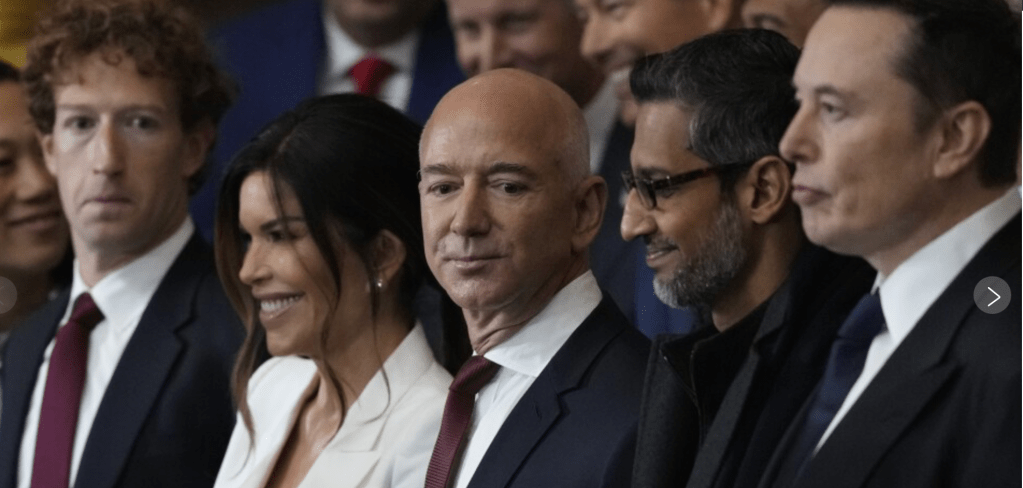
Another tidbit: Gingras claims that Google CEO Sundar Pichai was embarrassed by the now famous line-up of tech CEOs attending the Trump inauguration and suggests the photo op was “cleverly staged” by the White House.

“That’s the last photo Sundar ever wanted taken,” says Gingras. “We don’t support this administration.”

Only the ballroom.

Associated Press photo of Tech CEOs Zuckerberg, Bezos, Pichai and Musk.

***

If you would like regular notifications of future posts from MediaPolicy.ca you can follow this site by signing up under the Follow button in the bottom right corner of the home page; 

or sign up for a free subscription to MediaPolicy.ca on Substack;

or follow 
@howardalaw on X or Howard Law on LinkedIn.

I can be reached by e-mail at howard.law@bell.net.

This blog post is copyrighted by Howard Law, all rights reserved. 2025.