“Success is based on trusting our artists”: culture reporter Kate Taylor on CanCon then and now.

Kate Taylor, arts Columnist, for the Globe and Mail, is photographed at the Globe and Mail Centre on April 19, 2023. (Fred Lum/The Globe and Mail)

March 19, 2025

Two years ago I was mulling over deep thoughts about the “why” and “what is” of Canadian culture when I noticed that the Globe and Mail reporter Kate Taylor had just published a column on precisely that topic.

Upon reading Taylor I thought to myself, “yeah, like she said.”

Taylor is unusual in that her day job since 1995 has been writing about Canadian media, arts and culture for the Globe, while her side gig has been authoring award-winning novels. You write about what you know.

Another side-gig she had was in 2009 —the year before Netflix began streaming in Canada—- when she took a year’s leave to accept an Atkinson Fellowship, the published output was titled “Northern Lights: Keeping Canadian Culture Ablaze,” available as a download here.

She grappled with the eternal challenges of making popular Canadian culture and the broadcasting regulation that we rely on to solve the riddle of keeping our culture blazing in spite of the American cultural giant that threatens to block out our sun.

Here are just a few timeless headlines in Northern Lights:

Is a national Canadian culture important?

Digital Waterloo for Cancon rules

How to make the CBC viable in the digital age

MediaPolicy asked Taylor what she thinks now.

***

MediaPolicy: I was re-reading your 2010 Atkinson series and found it remarkable not only how accurately you foresaw the challenges faced by Canadian mass media in the decade to follow but how fresh the discussion seems in 2025. Fifteen years is a long time. What do you make of how Canadian media policy has used its time in the intervening years?

Kate Taylor: The Stephen Harper Conservatives wouldn’t touch these issues. Their Heritage minister James Moore used to say they are important to the broadcasting industry but not to the public. Harper himself poisoned the file by labelling cultural levies a “Netflix tax.”

Then, when they had the opportunity, the Liberals moved but too slowly. Sometimes you don’t want to be first out of the gate, and the Europeans have now set precedents.  For example, content quotas on Netflix’s European catalogue, that would be useful to Canada. But it took the Liberals a long time to find a minister who could politically champion the ideals behind cultural protections. They did not get it done and dusted before we were faced with the current situation, a trade war just as the CRTC is trying to implement a long-overdue update of the Canadian content regime to include the foreign streaming services.

I note that in the intervening years, the idea of a cash levy on Internet service providers, an obvious update on the levy on cable providers, has been abandoned. That’s too bad. That would have been one way to raise production funds from Canadian-owned sources, especially to support local news which has suffered badly from the collapse of local newspapers.

MP: There’s been a flurry of activity by the CRTC since the Online Streaming Act was enacted in April 2023. What do you make of some of their rulings? The good, the bad, the intriguing?

KT: I agree that the foreign streamers should be asked to contribute to production funds. I leave others to figure out whether the CRTC’s five per cent is fair or not, but I do note that the $200-million total is chicken feed for these companies. I don’t agree with asking them to help pay for local news; that seems opportunistic since it’s not news content with which they have flooded the Canadian market.

The CRTC has yet to deal with any quota on Canadian content in the streamers’ catalogues or for music services, and promotion and discoverability are as important as any content quota. It’s possible that if you got a healthy co-production relationship going, all this would be unnecessary because the streamers would want to promote programs in which they have a stake, but if you look to Europe, especially France, you can see how an insistence on quotas is producing some excellent programming.

The stumbling block is who owns the intellectual property in the show, since historically the Canadian system has insisted that the intellectual property for programming that benefits from the levies remains with Canadians. I would imagine that can be solved by some kind of negotiation on sharing percentages of intellectual property. 

The CRTC is now also beginning to address the definition of Canadian content. Many players want it loosened; makes it less cumbersome for them. These debates are usually about economic self-interest. Others argue we should switch from our industrial model –– Canadian content is content made by Canadian citizens in Canada– – to a cultural model: Canadian content tells identifiably Canadian stories and is set in Canada. I disagree. The United Kingdom uses the cultural model but we are a much less culturally homogenous place, and I think attempts to dictate or define Canadian-ness are bound to fail.

If you look at music, it’s obvious the only way to define a Canadian song is through the MAPL system or some equivalent. You are hardly going to tell songwriters their lyrics must feature Canadian references!

All systems produce the odd wacko anomaly that critics love to trumpet, but the main thing is to trust the creators. If they are Canadian, living and working in Canada, they will make Canadian content. Some of it will be bad; some of it will be great. That is the reality of cultural production. 

MP: Yes, defining Canadian content seems like pinning jelly to the wall. Canadian culture is characterized by both local expression and nationally emblematic totems and stories. You’ve written about this. Care to update your views?

KT: There’s an old line from a Broadway producer: if I knew what was going to be hit, I would only do those. Cultural production is a highly risky, unpredictable business and the Hollywood model is based on huge investments spread across global markets. In trade terms, one could accuse the United States of dumping cultural product in foreign markets. Historically, it cost a Canadian broadcaster far less to buy rights to a U.S. show then to produce a Canadian one.

Canada is actually very successful in international markets – we export both English-language television and music – and I think that success is based on trusting our artists. The more freedom you have to tell your own story or sing your own song, the more likely you are to produce something that will resonate universally.

I often point to the success of Letterkenny as an example. When it first appeared I thought its satire of a particular rural Canadian culture was so specific it might not translate abroad, but it did very well in the States.

I also think audiences like to see themselves in their culture and do hunger for specific local content. Look at the success with Toronto theatre audiences of The Master Plan, a satire about planning issues in the city of Toronto. 

A more powerful and ad-free CBC Gem could capitalize on this local-to-universal phenomenon.

MP: Yes that observation about the CBC was one of the take-aways I got from your Atkinson piece in 2010. You talked about the central role the CBC played in Canadian cultural production. So here we are in 2025. Let’s suppose I made you ship’s captain of English-Canadian CBC services. What are your orders?

KT: We all want the CBC to better, by which we really mean English-language television. CBC video content is a missed opportunity. We need an ad-free Canadian streaming service that offers the best of Canadian comedy, drama and documentary to viewers at home and abroad, a Brand Canada niche alternative to American streaming services. 

Of course, that costs money, and if CBC managers cling to advertising it is because they don’t trust government to fill the gap consistently. To escape the politics, the CBC needs stable steady funding on a minimum of a five-year basis in return for fulfilling agreed-upon goals – rather like the Charter that governs the BBC. 

Still, we need to be cautious about removing ads from the CBC so that it is not reduced to some kind of PBS North. Ratings do matter. They keep you honest and connected. There is a strong desire amongst some English-Canadian elites for the PBS model, a high-end public broadcaster fleshing out a talk-heavy news-dominated schedule with the occasional big-budget drama (always imported from the U.K. in the PBS case.) That works for the U.S. because it has a healthy private market delivering American content. In Canada, it would sideline the CBC even further, making it irrelevant to a majority of Canadians.

Also, the CBC needs to rebuild its local news capacity because of the collapse of local newspapers. That’s an example of market failure, where you want the public broadcaster to step in and provide a public good — but you need to fund it accordingly.

MP: Back to the trade war. Canada is having a nationalist moment right now and it might well be our biggest one. For sure it will last several years, so long as Trump is doing his 51st state thing. Do you see implications for Canadian attitudes towards mass media and culture? 

KT: As Canadians remember that we are a separate country, perhaps that will help citizens understand why we need cultural levies and cultural protections in the face of a neighbour now exposed as a bully.

Not many citizens, including some prominent media commentators, understand how the cultural industries work, the amount of investment it takes in multiple projects to generate one hit and the way Hollywood money can buy quality and promotion in a way that is impossible to match without some kind of Canadian content system. 

For decades that system produced Canadian programs and music that many Canadians enjoyed. It just needs to be updated for the streaming era.

***

If you would like regular notifications of future posts from MediaPolicy.ca you can follow this site by signing up under the Follow button in the bottom right corner of the home page; 

or sign up for a free subscription to MediaPolicy.ca on Substack;

or follow @howardalaw on X or Howard Law on LinkedIn.

I can be reached by e-mail at howard.law@bell.net.

This blog post is copyrighted by Howard Law, all rights reserved. 2025.

To broadcasters’ dismay, CRTC’s radio consultation doesn’t budge on airplay quotas

March 13, 2025

This week, the Canadian Association of Broadcasters let howl a primal scream of protest against the CRTC’s recent notice of consultation on radio broadcasting and audio streaming. In an open letter the CAB says the commission’s notice, full of “preliminary views” on key regulatory points, “absolutely missed the mark” and is so bad it should be rescinded and the CRTC should go back to the drawing board.

The CAB voiced a similar if toned-down protest in December 2022 when the commission issued its review of commercial radio. But that was more than two years ago in a declining radio industry. At the time, the commission promised to look at radio with fresh eyes once the Online Streaming Act was enacted.

Continue reading at Cartt.ca…

***

If you would like regular notifications of future posts from MediaPolicy.ca you can follow this site by signing up under the Follow button in the bottom right corner of the home page; 

or sign up for a free subscription to MediaPolicy.ca on Substack;

or follow @howardalaw on X or Howard Law on LinkedIn.

I can be reached by e-mail at howard.law@bell.net.

This blog post is copyrighted by Howard Law, all rights reserved. 2025.

Catching up on MediaPolicy – CBC’s Gaza coverage – New poll on Canadian TV content – Blue Rodeo works its ass off

CBC report from December 2023

March 1, 2025

This week MediaPolicy posted a report on a complaint filed directly with the CRTC by Honest Reporting Canada and the CIJA citing the CBC’s news coverage of Gaza as systematically anti-Israel and anti-Semitic. I don’t offer an analysis of their as yet unrebutted allegations.

But as audience complaints normally go first to the office of the CBC Ombudsperson I took the news item as an opportunity to provide examples of how the Ombud has navigated a steady flow of pro-Israel and pro-Palestine allegations of bias and bad journalism. It’s educating stuff.

By revisiting my earlier post here, I want to add another Ombud review that I overlooked.

It was a pro-Palestinian complaint about the CBC’s televised profile of the late Yahya Sinwar (before he was killed in combat by the IDF).

Sinwar was the Hamas mastermind of the October 7th massacre of 1,200 Israeli civilians, 250 hostage kidnappings and the solicited Israeli hunt and kill operation that resulted in perhaps 50,000 dead Gazans, innocents and terrorists alike.

The allegation was that the CBC report unfairly rendered Sinwar as a sinister and “psychopathic” figure without a matching effort to portray Israeli leaders and actions in a similar vein. (The “psychopath” label was applied by an Israeli journalist, not the CBC, the commentator acknowledging the term was too crude to be useful).

I found the Ombud’s response to the complaint compelling.

Most of all I appreciated his reminder that accusations of “one-sided” coverage need to be taken in the context of the CBC’s body of reporting work, not just one story:

Your third primary complaint was that doing this story represented a double standard, that Israeli officials were not scrutinized or described in similar ways as Yahya Sinwar. In this case, I must pause and say that in my experience, people’s perceptions of media coverage are greatly influenced by their own point of view on the issues at hand. 

In recent months, I have received hundreds if not thousands of complaints from people who would second your assertion that CBC privileges the Israel perspective and undermines the views of Palestinians. But I have also received hundreds if not thousands more from people who want to know why pro-Palestinian views and claims are accepted without challenge, and Israeli officials are challenged and doubted at every turn. 

I am not trying to turn your review into a broader thumbs up or thumbs down on CBC’s coverage of the Middle East. But I am saying that there are endless examples in that coverage of Israel being criticized, challenged or questioned. And that while you are entitled to conclude that the profile of Yahya Sinwar is evidence of a double standard, I do not share that view. 

Although there may not have been precisely the same type of profile done about Benjamin Netanyahu or other Israeli leaders, there have been many reports over time that have included highly critical commentary about them. It was the fact that CBC had done so little reporting on Yahya Sinwar that made this profile valuable to the audience.

The strength of the CBC’s Ombud’s open door policy for audience complaints is its thoughtful and educational analysis of good (or bad) CBC journalism, both as a body of newsroom reporting work and story by story. 

I won’t litigate in this space my personal support for Israel, or the caveats to that support, because this blog is about MediaPolicy, not Middle East policy.

But since October 7th I have perceived a widespread ignorance and lack of education about a hundred years of conflict over a contested homeland.

As in all things, we must do own research, a lot of it in this case.

***

The CRTC’s hearings on regulating video content kicks off on March 31st. It’s just published a third party research report that will add polling and focus group feedback to the public record. 

The commissioned report was authored by the Ottawa-based Phoenix SPI that has also done work for the federal Privacy Commissioner. 

The Phoenix drill-down is about audience views on Canadian programming, more specifically the genres of drama and news. The report combines a 1200-person poll with responses from 90-minute focus groups. The polls oversampled from rural, northern and official language minority communities. The focus groups targeted the same communities but also urban residents and members of equity seeking groups.

The polling numbers sometimes conflict with previous data culled from other sources. For example, outcomes from the Phoenix poll identify a higher market domination of video consumption by streaming platforms (73% of Canadians) with only 44% on cable television (whereas CRTC and Statistics Canada record about a 60% coverage of Canadian households). Whatever the correct figures are, the market dominance of US streamers should drive an even greater sense of urgency at the CRTC.

Since the Commission wants to know what kind of video programs Canadians “primarily watch,” it learned in this Phoenix poll that the leading genres are serial comedy/drama (68%) and news (61%). Happily, those are the CRTC’s top priorities for extra attention in content funding and distribution.

The poll also generated numbers on which objective and subjective elements of a revised definition of a Canadian television program were seen as important.

The poll appears to support the Commission’s bent towards the participation of Canadian producers, talent and crews ahead of identifiable Canadian themes, although it’s a nuanced difference and not black and white: 

There was focus group feedback on Canadian programming that came out a little garbled.

Canadian shows were appreciated as good quality, dismissing the stereotype of CanCon mediocrity. Feelings of pride, connectedness and a certain disdain for the sensationalism and narrative choices of US programming were pointed out.

But then a significant number of voices downplayed the importance of filming Canadian content on location in Canada. This “apparent contradiction” suggested that only quality Canadian content mattered to the participants, not shooting location. The US streamers might take some encouragement from that, but tens of thousands of Canadian television workers will not.

As for news programming, the poll offered surprising results on the choice of video platform, ranking online sources (combined text, video and audio) far ahead of television. This flatly contradicts recent polling. The discrepancy may end up being important to policy choices made by the Commission.

In the end, these polling numbers on news journalism paint a familiar picture:

  • Canadians rank “trust” as the overwhelming priority in choosing their news sources and give high approval ratings to their news outlets for accurate reporting. In the focus groups, the most commonly trusted news source was CBC/Radio-Canada, followed by the mainstream private media. In fact the participants “considered public broadcasters more trustworthy because they are publicly funded as opposed to privately owned.” Haven’t heard that for a while, have you?
  • Canadians have a tepid approval rating for the overall news ecosystem that includes both the sources they choose (and presumably trust) and those they don’t.

***

In the fall of 1985 a friend of mine dragged me to the Horseshoe Tavern in downtown Toronto to see a band I had never heard of. “You have to see these guys,” he said.

The band, Blue Rodeo, was unbelievably good. Rock-country fusion, just my thing. ‘Why are these guys still playing the Horseshoe and how have they not got a record deal?’ I wondered.

Forty years, sixteen studio albums, eleven Junos and a lot of bar venues later, the group is the subject of a new documentary streaming on CBC Gem, Lost Together.

“Blue Rodeo showed that other model,” offers band friend and former NOW publisher Michael Hollett. “Just work your ass off in Canada and you can have a great life as a musician.”

***

If you would like regular notifications of future posts from MediaPolicy.ca you can follow this site by signing up under the Follow button in the bottom right corner of the home page; 

or sign up for a free subscription to MediaPolicy.ca on Substack;

or follow @howardalaw on X or Howard Law on LinkedIn.

I can be reached by e-mail at howard.law@bell.net.

Catching Up on MediaPolicy – The CBC times two – CRTC launches its audio policy hearing – Juno News and press independence

Graphic courtesy of Sarah Blostein

February 23, 2025

The big media news of the week was Heritage Minister Pascale St.-Onge presenting a 10,000-foot “proposal” to better fund and govern the CBC. MediaPolicy offered an overview here.

The Minister’s recommendations have yet to be endorsed by the Liberal cabinet or contenders to replace Justin Trudeau as Prime Minister. As for St.-Onge, she’s quitting politics. 

Her proposal stole headlines with its bold plan to double Parliamentary funding from $33 to $62 per Canadian, a number she walked back immediately to $50, phased in over five years.

Pierre Poilievre was grateful for the opportunity, messaging that the Liberals were promising “another one billion dollars of your money” for the CBC. He then squandered the point with populist blarney to the effect that the money was “an extra incentive [for the CBC] to campaign day and night to re-elect the Liberal government to a fourth term. A reminder to believe nothing you see or hear on CBC.”

On the other hand, the leading candidates for the Liberal leadership have some thinking to do on how to respond to their colleague’s big idea. 

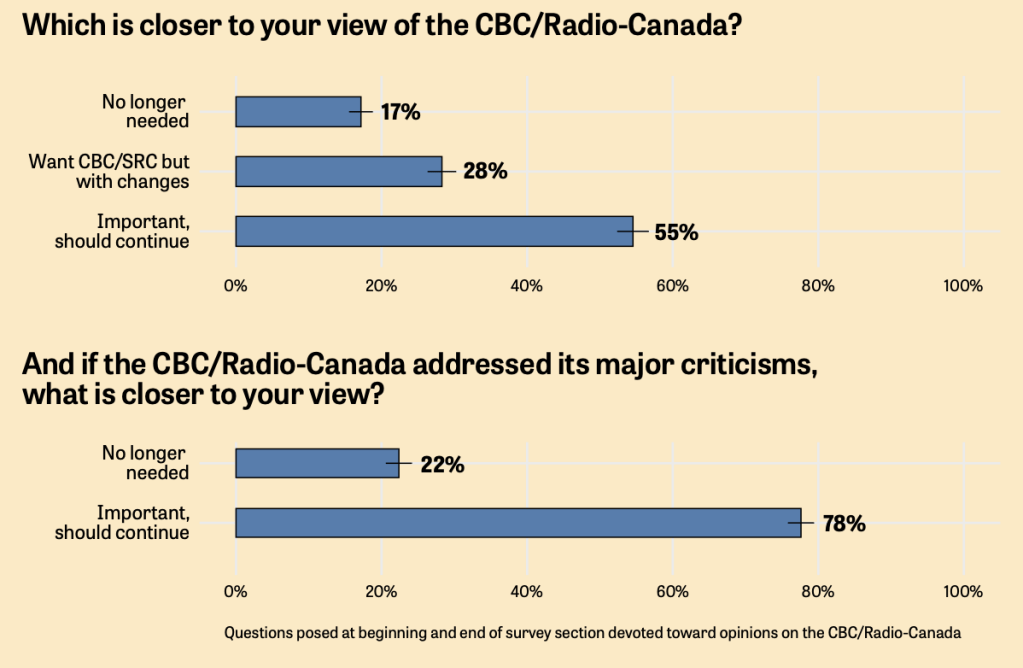
The McGill poll from October pegged 78% majority support for maintaining the CBC in the face of Poilievre’s threat to defund. Importantly, that 78% was tied to “changes” at the CBC (at some point we ought to poll what Canadians mean by changes).

But other results from the McGill poll are sometimes overlooked. Thirty-four per cent of the same pool of respondents said CBC needs more reliable funding, unchanged from previous polling in 2021. Perhaps surprisingly, the 34% is not skewed by regional differences but support for the CBC and better funding is higher among non-Conservative voters.

The political challenge for the Minister’s plan is that it’s front loaded with money, with the changes to come later. That’s why the pressure is on CBC/Radio-Canada CEO Marie-Philippe Bouchard to describe the changes. 

The political challenge for defunder Poilievre is that Donald Trump has put the CBC top of mind for many Canadians. We’ll wait for some polling on that.

***

Two weeks ago I posted an update on the CRTC’s regulation of foreign music streamers and, as promised, the Commission has announced a June hearing on audio services, radio and online.

Parliament handed the Commission a laundry list of tasks in implementing the Online Streaming Act, the most pressing of which is what’s expected of Spotify and the American music streamers and whether the declining Canadian radio industry can catch a regulatory break.

The Commission’s Notice of Consultation sports the usual hints of what it’s already thinking before the hearings begin. Its code words are “our preliminary view,” “we consider,” and “we propose.”

Here’s a rundown:

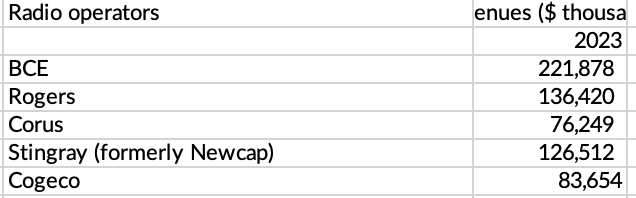
  • As the Commission ruled in June, the streamers are going to pay five per cent of Canadian revenues into funds for Canadian musicians and radio news. Perhaps to shore up its legal flank in the face of the streamers’ upcoming court challenge this June, the Commission plans to impose more significant cash contributions on Canadian radio networks that take in at least $25 million in annual revenue (the same earnings threshold as the Commission is applying to the foreign streamers).

CRTC Figures identify five radio broadcast groups exceeding $25 million in annual Canadian revenues

  • As for smaller radio broadcasters, the Commission seems ready to eliminate their half-per cent of revenue (0.05%) cash contributions to musician development funds. The current radio airplay quotas of 35% to 65%, however, are slated to remain.
  • The national pastime of debating the “MAPL” formula for a Canadian song that qualifies to fill airplay quotas will be revived but the Commission seems committed to the modest changes it proposed in 2022. Rules on Canadian co-writing of music and lyrics will be loosened. The Commission doesn’t seem convinced as yet that Canadian studio producers ought to join artists and songwriters in the talent club that satisfies the airplay quota.
  • The Commission is interested in strengthening on-air exposure for emerging Canadian artists and is open to a 5% airplay quota for artists in the first four years of their recording careers. 
  • Similarly, the Commission is interested, in fact very determined, to introduce a 5% airplay quota for Indigenous music.
  • In a typically opaque discussion of news programming, the Commission declares that “news is a priority” (indeed the Online Streaming Act says so) but unlike other policy items it offers no blueprint for how to make the priority into a reality on air. 

But the most difficult policy question is how to close the gap between radio broadcasters and online streamers with respect to the prominence and consumption of Canadian songs. 

As noted by the Commission, CanCon consumption is a mere 10% on streaming platforms operating in Canada, a far cry from the 35% to 65% radio airplay quotas. The consumption of streamed French language music is 8.5% in Québec.

What’s unmissable in the Commission’s public notice is how little it makes of these consumption outcomes, so dismal that they are directly proportional to the Canadian share of the continental market.

It’s safe to say that if the Commission was planning anything bold to address the outcome gap, it would have said so. Instead it says “more information is required to fully understand how online services can facilitate [CanCon] discoverability.”

***

The Liberal-tormenting True North has rebranded itself as Juno News and its boss Candice Malcolm had Pierre Poilievre on her show for a 37-minute video interview last week.

The Malcolm interview is in the vein of the Conservative leader’s famous chat with Canadian expat Jordan Peterson: it falls short of being a softball news interview, it’s more of a tag team narrative (for example, Malcolm responding to Poilievre’s comments as “excellent”). 

So naturally Malcolm introduced the topic of independent journalism.

What was interesting was that Poilievre passed on the opportunity to reiterate his plans for a scorched earth repeal of federal aid to journalism and said Canadians should wait to see his election platform.

Having said that, he expressed concern that some news organizations had been denied eligibility for federal aid for politically motivated reasons. 

All of this is difficult to read, but there seems to be some kind of policy cogitation going on behind the scenes and we will, as the Opposition Leader suggests, have to wait to see his election platform.

***

If you would like regular notifications of future posts from MediaPolicy.ca you can follow this site by signing up under the Follow button in the bottom right corner of the home page; 

or sign up for a free subscription to MediaPolicy.ca on Substack;

or follow @howardalaw on X or Howard Law on LinkedIn.

I can be reached by e-mail at howard.law@bell.net.

Catching Up on MediaPolicy – the DST is not a trade issue- the music cartels in Canada- redesigning journalism aid – from the Super Bowl to Manifest Destiny

It’s Flag Day.

February 15, 2025

Before catching up on MediaPolicy, there are two posts I offer up to you.

The first is my speech to the Digital Media at the Crossroads conference from last weekend. It’s a well salted explainer of the CRTC’s implementation of the Online Streaming Act on music streaming, its first efforts having drawn court appeals, trade threats and the launch of the “Scrap the Streaming Tax” campaign.

The Commission is going to announce a further public consultation on audio (including radio) this week.

The other post is an explainer of the federal Digital Services Tax that I wrote last year. Last week stories circulated in the press that the DST would be on the Trump retaliation list. If you didn’t have that on your bingo card, you should have. As detailed in my post, the DST is not a trade issue, it’s a tax issue.

The US digital giants offshore revenue from their Canadian operations (and do the same in other OECD nations) in order to minimize corporate tax.

The DSTs enacted in Canada and Europe are a response to that tax avoidance.

Former US President Joe Biden recognized that when he negotiated a tax treaty to fix it but US Congress refused to ratify it.

The tech bros appear to have backed the right horse.

***

The Public Policy Forum just published a report on local news journalism, The Lost Estate. The report comes out of the Michener Foundation’s conference last October. Written by journalism A-listers Alison Uncles, Ed Greenspon and Andrew Phillips, the report covers familiar ground about the extent of Canadian news deserts and news poverty.

The Report’s public policy recommendations have evolved beyond those recommended in 2017 by Greenspon’s Shattered Mirror study and the roster of federal programs aiding news journalism enacted since then by the Trudeau Liberals.

Here they are:

  • Work harder at getting philanthropic foundations, community organizations and individuals to utilize current tax write-offs for donations to news journalism.
  • Make it easier for news organizations to go non-profit, unlocking those charitable donations.
  • Mirror these contributions to the operational costs of running newsrooms with a public-private-philanthropic capital investment fund for community rescues of failing news outlets.
  • Legislate a requirement that moribund media organizations must give a four-month public notice of closure so that local investors can save the outlet (this would require both provincial and federal action).
  • Redesign Ottawa’s Local Journalism Initiative that funds 400 reporting jobs by matching federal funding to charitable fundraising, something that the recipient news organizations would be responsible for undertaking.
  • Redesign the federal reporter subsidy by requiring staff retention and rewarding new hiring.
  • Introduce an advertiser tax credit for expenditures in local media.
  • Encourage more governments to increase their advertising expenditures in local media.

If there is a theme in these recommendations it is to juice the market-facing incentives in current programs while not abandoning government aid.

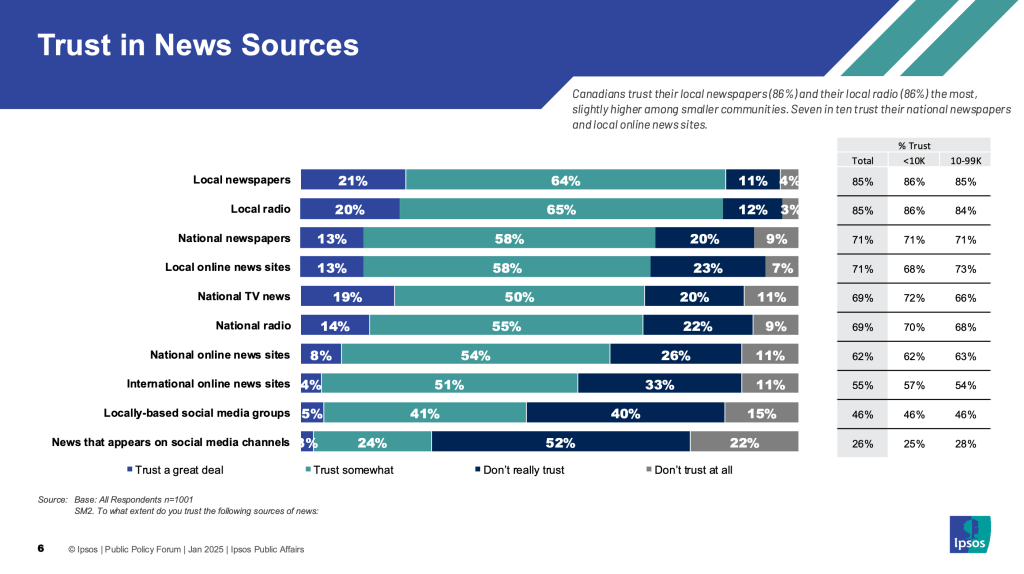
As an appendix to its Report, the Forum provided an Ipsos poll covering some familiar questions about public attitudes towards news journalism.

The results confirm a key trend in public opinion: mainstream media is highly trusted and information carried over social media is not.

On the other hand, two questions related to government subsidies to independent news journalism elicited concern that state sponsorship “might” stoke bias and a lack of independence from government.

The most trusted news sources are in fact the most subsidized by government, so give the public credit for agreeing with MediaPolicy: subsidies are a difficult to measure risk to public trust but so far not a harm.

***

I sometimes close this post by recommending content, but consider this more of a referral: the Hollywood-crafted and star-studded Super Bowl ads you didn’t get to see because the NFL sold the Canadian programming and advertising rights to Bell Media’s TSN.

Nobody quite does goofy the way that Hollywood can.

Are you not entertained? You decide.

***

Okay, changed my mind, I will recommend something serious.

I’m sure I wasn’t the only Canadian listening to Trump’s inauguration speech who noticed the President’s reference to “Manifest Destiny,” a long active but recently dormant part of America’s imperial DNA.

Here’s a good piece on that from the US National Public Radio news site.

***

From The Lost Estate Report:

FOR PHILANTHROPY

Expand issue definition: Philanthropy is growing rapidly in the United States around local news. In addition to the small handful of U.S. foundations that are interested in journalism and democracy, a second wave of foundations and donors that were funders of other issues — including domestic violence, hunger, homelessness and poverty — have come to realize they’re not going to make any progress if there’s no local news. Canadian philanthropists should follow suit.

Step up community foundation involvement: There are more than 200 community foundations across Canada, as well as thousands of private foundations. They are just now beginning to channel their impressive fundraising acumen towards local news initiatives: The Winnipeg Community Foundation, for instance, has funded reporting on religion by the Winnipeg Free Press, and the Toronto Foundation is one of several foundations that help to fund The Local. Community foundations should be encouraged to support local news coverage as part of their wider missions to encourage social vitality, community health and local democracy. More media organizations should be knocking on those doors, and more community foundations should be stepping up.

Help enable new local news models, including not-for-profits and charities: Major French-language news outlets such as La Presse and Le Devoir have become not-for-profits and then used that status to apply for Registered Journalism Organization status to take advantage of money from foundations and individual donors. Only four media organizations outside Quebec have done the same; that represents a major missed opportunity to develop a new source of revenue to support local news. RJO status would mean new startup ventures could accept philanthropic support or present an opportunity for community-based fundraising to claim back news outlets from the corporate chains that have abandoned local coverage.

Foundations can help with this step. Achieving charitable status can be complicated, but foundations can offer guidance on how to navigate the rules around registered philanthropic organizations, such as setting up “friends of” charities that can more easily raise money from supporters. If more outlets had charitable status, more foundation help could be unlocked for local journalism.

FOR GOVERNMENT

Reconceive the Local Journalism Initiative: Report for America in the United States provides a good model of a partnership with strategic intent that builds long-term capacity rather than plugging short-term holes. Its stated mission is to “strengthen our communities and our democracy through local journalism” and it funds reporters in local newsrooms for three-year terms, rather than the single year or less of the LJI. Among its other virtues: It provides training for journalists, unlike the LJI; its grants get smaller each year, shifting more onus each year on the news organization to finance its staff; and it helps news organizations learn how to fundraise within their communities. A homemade “Report for Canada” would roll in LJI funds to match those invested by philanthropy. This would provide the added governance benefit of distancing the program from the government of the day and placing authority in an independent board. Public contributions, as with academic granting agencies, would come in the form of multi-year funding.

Mandate a sales notice period: Communities should have an opportunity to rally support for news outlets that are threatened with closure by corporate owners. Specifically, there should be a notice period, perhaps 120 days, before a news operation can be shut down or sold to a non-local buyer. That would give communities time to gather support for local ownership. To help promote local buyers, governments can explore policy interventions that could include training and development, support with restructuring operations, access to expert resources, navigation support of federal and provincial programs, as well as low-cost or no-cost loans.

Tie the Labour Tax Credit to jobs: The LTC is the most important government program supporting news operations at the moment, worth an estimated $67 million in the 2024-25 fiscal year.[42] It should be continued, but with important changes. Organizations should not take money and cut content; the tax credit should carry an incentive to grow newsrooms and should be tied to the increase or preservation of editorial positions and other resources necessary to produce local content. The credit would be higher for those who increase their spending on journalism.

Drive local advertising with a tax cut: Along the same lines, local advertisers should receive a tax credit for spending their ad dollars with independent, locally owned media. As advertising dollars continue to flow to foreign-owned digital sites, depriving local media of funds they need, a tax credit would give advertisers a greater incentive to vote local while leaving the decision about which outlets get support to them, not government. Equitable tax credits for advertisers have the additional benefit of being more likely to withstand shifts in the political winds. That said, local advertising only helps if Main Street can withstand the competition from distant digital retailers, which presents a different set of challenges.

Direct government ad dollars to local news: Governments should earmark a portion of their substantial advertising budgets to local publishers and broadcasters. Ontario is showing the way by requiring that 25 percent of government ad budgets, including spending by four large provincial agencies, be directed to “Ontario-based publishers.” This program, which went into effect in September 2024, is explicitly aimed at “helping to support these publishers and their workers, who are creating local news content for people across the province.” Brought in by a Conservative government, it could be worth some $50 million a year to Ontario publishers. The federal government, other provinces and territories, and municipalities should follow suit. Governments are already spending substantial amounts on advertising and marketing. It makes no sense for them to talk about the need for vibrant local democracy and a healthy local news environment while they continue to funnel their own ad dollars to foreign-owned social media sites.

FOR PHILANTHROPY AND GOVERNMENT

Encourage capital formation: The best way to strengthen local news is to help it remain in local hands in whatever form entrepreneurs believe will work best in each community. In many cases, this will require capital. Programs to encourage capital formation for this purpose would go a long way to preserving the public good that is local news. A sustainable investment vehicle, co-funded by the federal government, provincial and territorial governments, the philanthropic sector, as well as NGOs, could draw lessons from government programs like the Social Finance Fund[43] and the Canada Rental Protection Fund,[44] where federal investment complements other public, private and philanthropic money. The government should explore any mechanism that makes crowding-in more effective, by utilizing a “first-in, last-out” methodology. For philanthropic organizations engaged in social impact investment, local journalism is a perfect match. The same is true for governments that have already put in place measures to encourage employee ownership or support.

***

If you would like regular notifications of future posts from MediaPolicy.ca you can follow this site by signing up under the Follow button in the bottom right corner of the home page; 

or sign up for a free subscription to MediaPolicy.ca on Substack;

or follow @howardalaw on X or Howard Law on LinkedIn.

I can be reached by e-mail at howard.law@bell.net.

MediaPolicy’s speech to Digital Media at the Crossroads: an update on regulating music streamers in Canada

February 13, 2025

Last weekend I did a little speed-dating at the 2025 Digital Media at the Crossroads conference. I had fifteen minutes to give an update on what’s up with the CRTC’s regulatory path for music streaming.

That wasn’t a lot of time. Things like “should we overhaul the ‘MAPL’ eligibility formula for Canadian songs?” just fell by the wayside. But I hope the conference delegates found it a useful summary.

***

I think the reason that I was invited here today is that I wrote a couple of blogs back in fall in response to the music streamers’ petition campaign “Scrap the Streaming Tax.” 

That campaign was launched by Digital Media Association, the American lobby organization that speaks for the foreign music streamers Spotify, Amazon, Apple and Google’s YouTube. The face of the campaign was Bryan Adams, our own legendary rock star.

In the next 15 minutes I’m going to give you a brief overview of what might happen in the CRTC’s implementation of the Online Streaming Act, Bill C-11 for the audio industry, in particular the music streamers. 

Last June the Commission handed down a cash levy of 5% of Canadian revenues to the music streamers — much to their dismay— and next month we expect a notice of consultation that should put discoverability of Canadian music squarely on the table. 

That’s assuming an election doesn’t sideswipe the Commission’s work.

I don’t have to tell any of the radio broadcasters in the room that audio is the neglected child of the broadcasting system, a much smaller ecosystem by revenue than its big brother television and video streaming.

It’s difficult to find an explicit policy discussion of why we regulate the broadcasting of music, whereas there’s plenty of that kind of public debate about television.

What video and audio have in common of course is that Canadian music, like Canadian television or any other kind of mass media, swims up current in a continental market dominated by large foreign-owned media giants. 

So we regulate in order to carve out an adequate space in the Canadian mass market for Canadian songs, composed and performed by Canadian artists.

I suggest that means we are not content that a handful of high achievers like Drake, The Weeknd, Justin Bieber and Tait McRae have become international superstars.

For Canadian music to have real prominence and presence in our domestic market we have to nurture a musician middle class in Canada, which is a small market, and especially Québec, which is an even smaller market. 

Ditto, ditto for Indigenous music.

If that’s why we regulate, we then have to consider what we’re up against in terms of the distribution of music in Canada, and the distribution of the money made from that.

Streaming is now the dominant distribution architecture .

And streaming is run by an oligopoly of foreign media companies.

Let’s just look at a couple of slides here.

You’ve probably seen this one: streaming saved the music industry from piracy and financial oblivion… and then became its master. 

Streamers are now the retail face of the recorded music industry and the ingestion point for two thirds of its income.

When streamers distribute that revenue they keep a third for themselves, half goes to labels and artists, and 15% goes to songwriters.

Canada is a rich market for a small country. Canadian consumers are significant streaming adapters on a per capita basis.

Two-thirds of Canadians are on streaming platforms, listening to about 15 tracks per day. Ninety per cent of Canadians under the age of 30 are signed up for streaming; it’s clearly the future of the industry for as far as we can project.

The streamers themselves may not be a tech bro oligarchy, but they are an oligopoly. And Spotify stands first, with twice as many paid subscriptions as its fellow giants.

What’s more, the streamer oligopoly negotiates licensing fees with another cartel, the major music labels. 

Such is the market power in the industry that carves up the revenue pie, which arguably results in more financial precarity for artists and songwriters than might otherwise be the case.

As I mentioned, Canada hits above its weight in music consumption but also is an overachiever in producing global superstars.

Check out this Spotify Top 10 artists list.

But the question for Canadian media policy is not whether a handful of Canadian stars become rich and famous, it’s whether we are filling the music distribution pipeline with enough good music to achieve an adequate share of the domestic music market for our own artists.

In short, the question is whether we can nurture a Canadian musician middle class where enough artists can make enough money over a long enough time to develop their craft and their audience.

Broadcasting regulation and adjacent public policy like the Canada Council address this problem on both the supply side and the demand side.

What do I mean by that?

We stimulate audience demand through radio airplay quotas and financial support, usually through media funds like FACTOR, for sound recording, live performance and marketing.

We stimulate the supply of musician income from music sales and licensing, radio royalties and support for other income generating gigs.

One of the frustrating things about public policy in this area is that for a variety of reasons we don’t have good data on musician incomes.

But we do have data on consumption of Canadian music, and when it comes to consumption on the biggest platform, music streaming, it’s underwhelming to say the least.

This slide shows that Canadian musicians have only a ten per cent share of the Canadian music streaming audience. 

Here are two benchmarks for that 10%. 

The unregulated market in theatrical release films has infamously resulted in a three per cent (one per cent in English Canada) revenue share for Canadian films in our own domestic market. 

At the other end, the CRTC’s radio airplay quotas range from 35% to 65% airplay for Canadian music or French language music.

There’s enough information about artist compensation from music streaming that we can estimate that a “musician” —which is a business with multiple artists and mouths to feed—  has to stream about 6 million songs annually on Spotify to earn $100,000 USD from all income sources.

And if you’re wondering how many Canadian bands achieve that 6 million, and who they are, you are out of luck. As I say, data poverty is really holding back public policy here.

The Canadian economist Gerry Wall looked into this a few years ago for Heritage Canada and concluded that, putting aside a few superstars, not enough Canadian musicians were making enough money. He concluded that ‘there has been a “hollowing out’ of the middle class of music creators.’ 

Then we have the dire case of Québec and French language music. If ever there was a canary in the coal mine for Canadian culture, the dramatic under consumption of French language music on streaming platforms would be it. 

The Canadian francophone market is obviously small at 8 million in population and some argue that the small market problem is compounded by streamer algorithms that are believed to confer prominence on songs that have reached at least one million plays, again a small market challenge.

The outcomes couldn’t be worse.

Eight per cent of streamed music in Québec is French language. 

The highest ranked streamed French language song, in Québec, is in 49th place.

Let that sink in.

I asked the Digital Media Association about that, and the publicist hired by DIMA for Scrap the Streaming Tax campaign issued a statement saying….that the global export market for French language music is strong and that the top French language song in North America belongs to Patrick Watson, a well-known Québécois artist.

As for the 8% outcome for French language music streamed in Quebec, the publicist opted not to return my email. 

How will our broadcasting regulator respond to these issues, the under consumption of French language streamed music and the broader problem of nurturing a Canadian musician middle class?

As you know, the Commission handed down a five per cent cash levy on the streamers this last June. 

I believe the streamers were genuinely gob smacked by this.

The Canadian content cash levy on radio broadcasters is a tenth of that, at 0.5%.

The music streaming tax in France is 1.2%.

The streamers should have expected something more than the half-per cent that radio broadcasters pay, since radio broadcasters make such dramatic airplay contributions to Canadian music.

And the streamers also knew that Sirius Radio, which has much softer CanCon airplay quotas than conventional radio, pays 4%.

But it didn’t assist the streamers that at every opportunity they have told Parliament and the Commission that they have no interest in taking any additional steps to make Canadian music more prominent in their playlists and streaming channels.

The trouble is, Parliament ordered it so.

Here’s the text of section 3(1)(r) of the Online Streaming Act, an amendment sponsored by the Bloc and supported by the NDP and the Conservatives in committee.

It says music streamers must use any means at its disposal to recommend and promote Canadian songs.

I’d suggest to you that “any means” includes integrating a higher prominence for Canadian songs into playlist algorithms.

But the CRTC, perhaps unintentionally because they were preoccupied with YouTube videos, appeared to rule this out within hours of the Online Streaming Act becoming law in April 2023. 

However, the federal cabinet left the door ajar on this in its Policy Direction to the CRTC in November 2023.

The streamers’ pitch on its current efforts to promote Canadian songs and Canadian artists is that if you ask for Canadian, you will get it. 

They will curate all-Canadian playlists. 

They will promote Canadian new releases. 

They will engage in musician development, sponsorship, and workshops. 

And they want those efforts to be the sum total of their promotion of Canadian content.

But under no circumstances do they want their proprietary and secret algorithms to be regulated for outcomes or anything else. 

That’s obviously a hard-line position, and perhaps that’s to be expected in the first sovereign country to propose regulated prominence outcomes in music streaming.

This is not like video streaming, where the EU plowed the regulatory furrow before we did.

It’s too bad we are so entrenched at this moment. 

There do seem to be win-win regulatory solutions. 

For example, Spotify has a third-party research paper posted on its website that suggests that reserving a prominent space on the home screen for local content works well for local artists and delivers better results for the streamer objective of keeping people listening longer and without interruption. 

There are obvious discoverability tools that the Commission could order including home screen prominence for local content and Canadian airplay quotas for the DJ-curated channels that the streamers carry, for example Apple Music does a lot of this.

But moving the needle of Canadian music consumption, especially in Québec, may require more dramatic measures.

So if we ever get to this Commission consultation on audio streaming I would expect a showdown on song curation and recommendation algorithms.

In the meantime, the streamers are engaged in an all-out campaign to sabotage Canadian regulation.

As you may know, they are challenging the 5% levy in court. They are running their publicity campaign in Canada.

My guess is they have given Conservative MPs an earful by now and are hoping Pierre Poilievre will become Prime Minister and “Kill Bill C-11.” And they are running to US legislators in Congress to put the Canadian Online Streaming Act in the trade war crosshairs. 

There’s so much drama and chaos in our relationships with American media companies and American Presidents, I wouldn’t want to predict what happens next. The velvet gloves are off. 

Like everything else in broadcasting regulation, we take it day by day. 365 days per year.

***

If you would like regular notifications of future posts from MediaPolicy.ca you can follow this site by signing up under the Follow button in the bottom right corner of the home page; 

or sign up for a free subscription to MediaPolicy.ca on Substack;

or follow @howardalaw on X or Howard Law on LinkedIn.

I can be reached by e-mail at howard.law@bell.net.

Catching up on MediaPolicy – Canadian culture first – Spotify the Colossus – the CRTC’s better late than never – The Shapiro Oracle speaks to Will Page

February 1, 2025

The illegal Trump tariffs begin today, heralding trade war.

Last week MediaPolicy posted an editorial of sorts, calling for elected politicians to greet America First with Canada First in trade negotiations over culture. 

A flimsy “cultural exemption” in our free trade deal with the US dates back to 1987. As intended, it offers no more than a speed bump to powerful US media and tech companies determined to dominate Canadian cultural consumption. It needs to be locked down.

How and when that happens in the permanent state of Trump chaos that we’ll endure for the next 1500 days isn’t clear.

Tariffs now, tariffs later,

tariffs done or undone.

How’s the weather in Newfoundland?

***

Spotify is feeling it. 

In this week’s corporate blog post, the Netflix-of-music-streaming stands triumphant.

As the colossus of the audio industry, Spotify is more than twice the size of any of its nearest competitors TenCent, YouTubeMusic, Apple and Amazon, with over 220 million paid subscribers. 

As the proud vanquisher of Napster and the torrent pirates, Spotify reports that every industry metric is looking up. Altogether, audio steamers have a half-billion paid subscribers signed up around the world. Spotify music VP David Kaefer says a billion is the next goal. 

Kaefer also says musician earnings are way up over the last ten years, with the top 10,000 musicians on Spotify —out of 10 million— earn at least $100,000 USD annually. That money is shared with band members and songwriters.

Spotify earnings are 25% of a typical “musician’s” total income, he estimates, adding to income from other streaming services, downloads and live performances. 

The “long tail” of music creators uploading to streaming platforms, to quote music economist Will Page, “is very long and very skinny.”

***

The CRTC is expected to announce in March a public consultation on a policy framework for audio streaming and radio.

On the streaming side, the cash contribution of 5% of Canadian revenues was established by the CRTC last June, so this new consultation will likely focus on other things; the discoverability and prominence of Canadian songs being the logical focus.

The Commission just now put out a request for proposals for a third party research study of the prominence and discoverability of Canadian audio and video content. 

Well, better late than never, no? The results won’t be reported until November and will be unavailable for the policy framework.

In response to a MediaPolicy inquiry, commission staff said the report findings would be available when the commission moves into its third phase of setting tailored regulatory terms and conditions for streamers in 2026.  

***

The recommended podcast for the week is an episode of Bubble Trouble, music economist Will Page’s platform. 

He’s invited media oracle Doug Shapiro onto his show. MediaPolicy often recommends Shapiro’s Substack page, The Mediator. 

If you follow either tech or media news in the most cursory way, you’re going to find this interview about the past, present and future of media as riveting as I did.

If podcasts aren’t your thing, I found a LinkedIn post from Midia Research’s Mark Mulligan who has some out of the box thoughts about how music streaming algorithms that chase listening time above all else will drive away some artists, hardcore fans, and discerning listeners, into the emerging ecosystem of Do-It-Yourself distribution.

***

Here’s an update on my January 1st post about polling conducted by TMU’s The Dais School of Public Policy. 

No thin skins for them, the folks at The Dais acknowledged the point I raised about how its annual survey questions failed to solicit the experiences of Jews and women with online hate. 

The Dais also saw some merit in my observations that their poll questions testing Canadians’ susceptibility to misinformation on the basis of political ideology were torqued towards right-wing conspiracies and misinformation. 

To its credit, The Dais is going to review these issues in preparation for its 2025 survey.

***

If you would like regular notifications of future posts from MediaPolicy.ca you can follow this site by signing up under the Follow button in the bottom right corner of the home page; 

or sign up for a free subscription to MediaPolicy.ca on Substack;

or follow @howardalaw on X or Howard Law on LinkedIn.

I can be reached by e-mail at howard.law@bell.net.

Catching up on MediaPolicy – Stursberg’s CBC advice – friends of ‘Scrap the Tax’ – Heritage report on Big Tech astroturfing

November 17, 2024

This week MediaPolicy hosted a guest column on the future of the CBC from Richard Stursberg, the author of The Tangled Garden: A Canadian Cultural Manifesto and the 2012 Tower of Babble, a memoir of running English language services at the CBC. The column welcomes the new President of CBC, Marie-Philippe Bouchard, with some advice.

Stursberg’s column follows an interview that MediaPolicy published recently with Chris Waddell about his book, End of the CBC?

You see exposed now, my naked agenda: more talk about how to reinvent the CBC and present an alternative to Pierre Poilievre’s promise to defund it. I hope to keep this going with more discussion on this platform.

***

Here’s one piece of my mind I offer about the CBC.

Pierre Poilievre has many political goals to be achieved by defunding the CBC, not the least of which is repaying donors so he can convince them his audacity is genuine.

The other purpose of “defund the CBC” is to effect a seismic shift in the media reporting universe. Silencing the CBC through defunding is the right-wing version of cancel-culture, something you might have heard is a bad thing. The reputed CBC “news bias” will be eliminated along with  the work of 3000 unwanted journalists.

For a thought provoking video clip, here is CBC news host David Cochrane putting forth a plausible hypothetical in a Canada purged of the CBC:

***

On November 15 the CRTC announced that it is commencing hearings on March 31, 2025 that will dive into the meatiest of remaining regulatory issues for video streamers under the Online Streaming Act Bill C-11. MediaPolicy will have more to say about that in mid-week.

Even though the federal cabinet gave the Commission until December 2025 to complete the regulatory “framework” for the bill, the Commission’s laborious pace is awkward given the Conservative election promise to repeal it.

On Friday the Commission made it clear that the best case scenario for completing its work including the specific requirements for online and traditional broadcasters is in 2026 and, as expected, it will pause this work the moment that the election writ is dropped.

That means voters in the a federal election to be held no later than October 2025 will be relying a great deal on what political parties say the legislation is about, rather than how it is actually implemented. We deserve better.

The campaign against C-11 continues uninterrupted.

As covered by MediaPolicy in these two posts, the coalition representing Spotify and the Big Tech music streamers recently launched the public campaign “Scrap The Streaming Tax,” a reference to the CRTC’s CanCon levy authorized by C-11. The Washington D.C.-based Digital Media Association (DiMA) behind the campaign was fortunate to land Canadian rocker Bryan Adams as an ally and supporter of the campaign.

Now DiMA has sponsored —-paid for—- an opinion column from The Hub’s Sean Speer in which Stephen Harper’s former policy chief proposes the repeal of Bill C-11.

The column, illustrated with art from DiMA’s “Scrap the Tax” campaign, signs off “this article was made possible by the Digital Media Association and the generosity of readers like you.”

***

The Parliamentary Heritage Committee has issued its final report on hearings convened in reaction to the political campaigns and news throttles conducted in Canada by Meta and Google in 2022 and 2023. The modest title of the proceedings was: “Tech Giants’ Intimidation and Subversion Tactics to Evade Regulation in Canada and Globally.”

Alas, the committee’s majority report (the Conservative MPs dissented) is anti-climatic. When the hearings commenced, MPs demanded that Meta and Google cough up e-mails that might reveal “astroturfing” alliances between the Big Tech giants and grassroots Canadian organizations opposing Internet legislation.

In the end, there is nothing in the report about those e-mails. It’s just as well. The Big Tech funding patrons and campaign alliances were openly acknowledged by those Canadian organizations.

The Committee made five recommendations for regulating Big Tech’s activities in Canada, four of which are addressed by the Liberals’ Online Safety Act C-63 that currently languishes in Parliament. 

The fifth recommendation is a reprise of the Heritage Committee’s 2017 proposal to “Close the Loophole” in section 19.1 of the Income Tax Act that exempts online advertising from the tax presumption against placing Canadian advertisements in foreign media operating in Canada. The policy idea is to encourage Canadian advertisers to reach online Canadian audiences through Canadian media.

A footnote: the Conservative Party’s dissenting statement declares its intention (or that of its committee MPs) to repeal the Online News Act, C-18. While the Party and its leader have repeatedly opposed and criticized the Bill that delivers $100 million annually to Canadian news organizations, this is the first time I have seen them commit to repealing it.

By coincidence, this week CBC News announced it is using its $7 million in Google money to hire 25 journalists in underserved regional markets with a focus on Western Canada.

***

The ability of Canadian governments to regulate Big Tech operations is always limited by the reality that we are a small country and the US is a big one that uses trade power to defend the interests of its corporations. Anything we want to do differently from the US in respect to Big Tech is difficult; anything the US Congress does on its own accord would be easier to mirror in Canada.

So the impact of the Trump and Republican victories in the recent election upon Big Tech is all important. The Washington Post published a summary of the live Tech regulatory issues in 2025 such as AI, child safety, and Elon Musk (he’s his own issue). 

The Post speculated that the selection of the new majority leader of the Republican Senate might be crucial to tech issues and indeed the job was captured by South Dakota’s John Thune, despite Musk’s vigorous opposition to his appointment. Thune is sometimes identified as a traditional Republican and more likely to work constructively across the aisle with Democrats.

***

If you would like regular notifications of future posts from MediaPolicy.ca you can follow this site by signing up under the Follow button in the bottom right corner of the home page; 

or e-mail howard.law@bell.net to be added to the weekly update; 

or follow @howardalaw on X or Howard Law on LinkedIn.

CBC: Welcome Mme.Bouchard, here’s some advice.

Guest Columnist Richard Stursberg

November 13, 2024

When you’re right, you’re right. And if you were right a long time ago, you’re vindicated.

It’s possible that former CBC executive Richard Stursberg is feeling just that, 13 years after leaving the public broadcaster where he served as the head of English language services from 2005 to 2011. 

At the CBC, Stursberg’s calling card was that “audiences matter.” His single minded mission was to capture for the public broadcaster, especially in English language television, an audience commensurate with its role as Canada’s leading cultural organization (and its billion dollar Parliamentary funding).

To outside observers, he seemed to be at odds with everyone and not really minding. First there was the lockout of CBC staff in 2005. Then he grabbed the rest of the organization by the scruff of the neck and piloted a revolution in the CBC’s entertainment programming, for example embracing audience-pleasing reality television (remember Battle of the Blades?).

With an all-Canadian line-up, in five years Stursberg moved the needle significantly in CBC’s share of the national television market, closing the gap with CTV and its prime time schedule of hit US shows. Then he fell out with his new boss, CBC President Hubert Lacroix. And so on: read all about it here in his memoir, The Tower of Babble, ranked by the Globe and Mail as one of the best books of 2012.

Along the way, he made some friends, allies and enemies. The enemies he cheekily dubbed “The Constituency,” an assortment of CBC traditionalists and media watchers who might also have been described as “those who rip Richard in public.”

After he left, the CBC lost NHL hockey rights to Rogers and with it a whole lot of eyeballs and connection with Canadian audiences. Netflix ate up market share for Canadian entertainment television. And then Google Search and Facebook devoured the digital ad market. Stursberg tells more of that story in another prize winner, his 2019 book, The Tangled Garden. The job of keeping CBC relevant today is twice as hard as it used to be.

These days Stursberg continues to have his fingers in different cultural pies. He is outspoken on his support for major reforms to the definition of Canadian content, favouring a “cultural theme” test of distinctive Canadian programming over the traditional headcount of Canadian talent.

As a past reinventor of the public broadcaster, it’s his 2024 views on the reinventing the CBC that are worth soliciting in its hour of crisis. As conservative commentator Harrison Lowman recently projected, “CBC, your days are numbered.”

MediaPolicy asked Stursberg, what is to be done? This guest column, his advice to incoming CBC President Marie-Philippe Bouchard, is his response.

***

Advice to the new President of the CBC, Marie-Philippe Bouchard

By Richard Stursberg

Welcome to the job.

Given your deep knowledge of public broadcasting you are ideally placed to do well, but you will have significant challenges. Here is some unsolicited advice on how you can succeed from one who also believes in the importance of the CBC/Radio-Canada. 

The Structure of the Corporation

First, your most important challenge will be English television. It is the central problem, not because Pierre Poilievre wants to shut it down, but because it has fallen to its lowest audience share ever. Put bluntly, with the exception of the recent Olympic Games, almost nobody is watching it. There are very few viewers for any of its shows, including news. Your presidency will succeed or fail depending on whether you can solve the problem of English television.

Second, it is important to understand the CBC is not a normal corporation and lacks a normal Board. It cannot decide its own fate. The overall strategy of the corporation has to be approved by the CRTC; and it cannot raise capital without the agreement of the Treasury Board. It lacks many of the powers of a normal corporation. This makes change very difficult. To succeed you will have to have the Minister of Heritage and the Prime Minister on-side for whatever you plan to do.

Should English TV be Fixed?

The Environment

The TV landscape in English Canada is in serious difficulty. The big conventional networks — CTV and Global — the major private sources of local and national news, have been shedding staff for over ten years and losing money. Their ability to commission Canadian drama and comedy is compromised. They are spending less and — for financial reasons — what they are doing is increasingly American in look and feel. 

The cable industry has been losing customers for many years and with them, the fees that they pay to specialty channels. As a result, they too are significantly cutting back their staff and ability to commission Canadian shows.

The groups that own the vast majority of the conventional and specialty broadcasters are in trouble. Corus, the parent of Global, is essentially insolvent. Bell Media, the parent of CTV recently wrote down its broadcast assets by just over $2 billion. It is not hard to imagine that in another five to ten years the English Canadian broadcasting industry will — with the possible exception of the sports channels — no longer exist.

Their loss will mean that CBC TV will be the only broadcaster still producing Canadian drama, news, comedy, public affairs and documentary shows. If we value hearing our own stories told in our own voices, there will likely be nowhere else to see them.

Social fragmentation

The emergence of algorithmically driven social media has encouraged polarization and social fragmentation. Canadians increasingly live inside filter bubbles that act as echo chambers. Disinformation, deep fakes and AI generated falsehoods have compounded the problem. The space of common ground and shared assumptions has grown ever narrower as distrust spreads like a stain across public discourse.

As divisions grow more fractious, it is increasingly important that there be places that can bind the country together and create shared understandings about who we are. They need to provide stories, ideas, news and art that allow Canadians to celebrate, explore, discuss and make sense of their country. And, they need to be true. Truth is an essential component of patriotism.

The CBC is the last great cultural institution in the country that is in a position to do this. It can only do so, however, if its programming is trusted and popular. Unless it reaches big audiences it cannot create the large scale shared space that will provide the counterweight to the endless fragmentation of social media. 

One initiative that the CBC might take is to address the challenge of disinformation by creating a news and public affairs portal that hosts not just its content but also that of all the other media in the country that are governed by traditional journalistic standards of truth and fairness. This could include other broadcasters, newspapers, magazines, on-line information sources and bloggers that are committed to ensuring the accuracy of their reporting. The portal’s promise — its brand — would be truth.

The other thing it must do is provide galvanizing programming that speaks directly to Canadians to foster debate and conversation about who we are and want to be. It must take on large projects that transcend the current divisions — whether regional, ideological or social —  and provide Canadians a place to laugh, argue and cry. This is very difficult to do.   

Can English TV be Fixed?

It will be very difficult. Your most important source of revenue aside from the Parliamentary appropriation is advertising, which has collapsed. At the same time, you are facing brutal competition from the vastly rich, foreign owned, unregulated streamers — Netflix, Apple, Amazon, etc.– who bear none of the costly cultural and social burdens that you do. 

Business as usual cannot succeed. To save English TV you will have to develop a radical new plan for its future. The plan needs to reinvent its news and entertainment properties and find significant new sources of revenue. The creation of such a plan will be challenging. Substantive change will be met with criticism from all sides.

How Should the Plan be Developed?

It is important to develop a set of principles to guide the creation of a plan. These might include the following. 

1. Focus on what the private broadcasters cannot do. They do not need competition from a publicly supported CBC. They are in tough enough shape as it is.

The space that the privates can no longer occupy is very large. Delivering what they cannot will make you more distinct and give Canadians more reason to view your programming.

2.  Focus on serving audiences. The measure of success must always be whether Canadians are watching your shows. They pay for the CBC and can reasonably expect to be offered programs that they will want to watch. There is no public broadcaster without a public.

3. Focus on developing new sources of revenue. Television advertising is dying. Google, Facebook and the other big digital companies have taken it all away. Make a virtue of necessity and get out of ads for your drama, comedy and documentary programming. This proved a very successful strategy for radio and would certainly make CBC TV much more distinctive and attractive to audiences.

You will need to develop a new revenue plan. It can be based on sponsorships, whether from corporations or foundations, charitable giving, levies on the streamers and/or internal reallocations.

4. Ensure that the money you are given by Parliament is allocated fairly and sensibly. The French service receives 44% of the government money. This means that French speakers get a per capita subsidy of $70 per person, while the rest of the country gets $23 per capita. Given your biggest challenge is on the English side, this is both unhelpful and unfair. Only a French President can change it.

5. Do not try to please everybody. You can’t. Instead, focus. Be bold. Take risks. Make big bets.

Some Facts About English Canada’s Media habits

Every week Canadians spend about 20 hours on the Internet and 30 hours watching TV, whether traditional TV or streaming services. These are their most important leisure activities.

CBC English radio continues to perform well. It takes a 16% share of all radio listening and is number one in most markets.

CBC English TV has collapsed over the last ten years. It now has a share of roughly 4% of all TV viewing. Its share is equivalent to that of a specialty channel.

Although CBC likes to brag about the reach of its digital service, it is very lightly consumed. Compared to radio and TV, it performs poorly. Canadians spend about 17 minutes per week on CBC.ca., which is a share of just over 1% of their time spent on the Internet.

What are the Key Elements of a Plan?

Local News

Much of local news has vanished; Canada has entered a local news desert. Most small town and community papers and supper hour newscasts have died. All market research indicates that local news is the most important form of news, since it is about the events that directly affect people’s lives. Where local news dies, electoral participation falls and local corruption increases.

Consistent with the principle of doing what the private sector cannot, CBC should expand its local news presence. Recently (November 12, 2024), it announced a significant expansion of its local news presence.

To strengthen its local news further, it would be wise to leverage its strength in radio and have radio promote to and complement the CBC’s local news sites. This has proven a successful strategy in some very small towns in western Canada and Ontario.

Strengthening local news would also help your national news. There is a powerful correlation between local shows on radio and Canadians’ propensity to listen to the national ones as well. 

National and International News

The National needs to be refocussed. Some evenings it draws less than 200,000 viewers at 10:00. CTV typically draws two to three times as many viewers for its late night news at 11:00, although in fairness The National gets many more viewers on Youtube and CBC Gem.

Aside from the Globe and Mail, almost nobody except the CBC has any foreign bureaus or investigative capacity. The National — and the News Network — could be dramatically strengthened by using these resources to shift the focus of their journalism. Instead of “telling” Canadians the news, they should give priority to making sense of it by providing background and context.

By way of example, the recent coverage of the US election focused on it as a horse race. There was much discussion of polls, performance at rallies, the Electoral College, more polls, swing states, etc., all accompanied by hand wringing and pearl clutching. Through it all, there was little or no discussion of what a Trump victory might mean for Canada. What will we do when he starts to deport “illegal” migrants when they appear at our border looking for sanctuary? How will we respond to his demand that we turn on the “tap” and divert our water to the parched southwestern states? How do we respond when he withdraws from NATO? The point of foreign bureaus is to make sense of what is happening in other countries for Canada.

In a similar vein, the coverage of the health care crisis focuses on Canadians’ lack of family doctors, overcrowded emergency rooms, and long waits for elective surgery. It does not explore how Canada might fix its broken system by looking at what other countries get right. Why are France, Sweden, Denmark and Norway doing better than we are?

A promise to answer these kinds of questions and embrace Solutions Journalism would go a long way to restoring the relevance of The National and The News Network.

Entertainment and Documentaries

Like the news, the entertainment and documentary shows are doing poorly, particularly the newest ones. The older shows are holding up better: Heartland (season 18), Murdoch Mysteries (season 18), This Hour Has 22 Minutes (season 45?). The newer shows like Crime Scene Kitchen and My Mum Your Dad (a dating show) draw hardly any viewers.

The problem with the new shows is that they are not unique; they do not fill any unmet need. Similar offerings can be found on lots of specialty channels. They are also not particularly Canadian.

A new strategy must be based on commissioning shows that Canadians cannot get anywhere else. They need to be big, daring, appointment pieces that speak to our unique history, dreams, fears and sense of humour. They need to be about us, our neighbours, fellow citizens and friends. To be relevant, they must be distinctly Canadian and squarely rooted in Canada. The private broadcasters will never do this.

By way of example, one of the CBC’s most successful series was Canada: A People’s History. It drew tremendous interest and precipitated great controversy. For years, it was used in schools and with immigrants to help explain who we are. Surely the time is right for an Indigenous People’s History of Canada. To achieve reconciliation, it is essential that people understand the truth of what happened from the point-of-view of Canada’s original inhabitants. Like its predecessor, it would be a multi-part series that starts with first contact and comes up to the present day. Inevitably, it would be expensive, controversial and — if done properly — galvanizing. Nobody else in Canada has the resources or the expertise to make it.

As for fiction, one can imagine a show about our relationship to the US. The premise is simple. The southwestern states have run out of water (which they have). Canada has more fresh water than any country in the world. The Americans face an existential challenge: they must save Texas, New Mexico, Arizona and southern California. They must have the “tap” turned on even if it means war. Again, no private broadcaster would make this; they could never sell it in the States.

Radio-Canada has been very good at producing extremely popular shows that reflect Quebec in all of its remarkable diversity and energy. Every Sunday night “Tout le monde en parle” (Everybody Is Talking About It) provides a funny, charming and thoughtful window into the cultural, social, political, athletic, musical, business and religious life of Quebec. It is the most successful talk show in Canadian history. It is must see viewing. Why is there no English equivalent?

To do these kinds of things, you may have to restore the financial balance within the English network. Over the last ten years roughly $200 million has been stripped from English TV and radio to finance digital, the worst performing service.

Conclusion

English TV can and should be saved, but it will require difficult and bold restructuring. It will need a plan that is based on making great shows that speak to English Canadians’ desire to see themselves and explore their country in ways that are exciting, beautiful and moving. Whether news, documentaries or entertainment shows, table stakes for programs are — in the current intensely competitive environment — quality, originality and relevance. Nothing less will do.

The plan must also ensure that the necessary resources are in place to make it happen. This is likely to involve very controversial decisions about the reallocation of money across the corporation and within English services. It will also require the development of new sources of funds (the major banks could easily sponsor an Indigenous People’s History of Canada).

Although you have a deep understanding of public broadcasting, I understand that your experience is principally on the French side of the corporation. The English and French markets are very different, both in terms of their levels of competitive intensity and the kinds of conventions that underpin successful TV.  It might be a good idea for you to move to English Canada for a few months. Watch all the shows and newscasts, both those that are working and those that are not. Talk to everybody: the employees of the CBC, the heads of the big English media companies, the audience measurement experts, the independent producers, everyone. 

Use all that you learn to make a real plan, one with teeth and targets, recognizing that it will take two to three years to bear results. Then, find yourself a media executive who agrees with you and has the skills, contacts, experience and daring to execute it.

Once the plan is ready, make it public. It is essential that Canadians understand and support what you are trying to achieve. Let them see that you understand what they need and want, and that you are daring enough to try and deliver it. Let them hold you accountable for the spending of their money. 

Building a public constituency for your plan will provide a powerful counterweight to the forces that will resist change. You will need all the friends you can find.

The plan may also be a good answer for Mr. Poilievre – if elected – and his Heritage minister. You will also need them.

Bon courage.

***

“Defunding the CBC would be extremely unwise.” Senate appearance by Richard Stursberg on December 3, 2024

***

If you would like regular notifications of future posts from MediaPolicy.ca you can follow this site by signing up under the Follow button in the bottom right corner of the home page; 

or e-mail howard.law@bell.net to be added to the weekly update; 

or follow @howardalaw on X or Howard Law on LinkedIn.

Catching up on MediaPolicy – The Spotify stonewall – Debating the CBC – Ottawa’s warning label on TikTok – more Corus misery

November 7, 2024

On the weekend MediaPolicy published a lengthy explainer about the new “Scrap the Streaming Tax” campaign launched by the global music streamers to fight CRTC regulation. 

The post’s opening hook —-how Canadian rocker Bryan Adams stepped forward to become the celebrity face of the campaign—- adds a little colour to the debate over the regulatory environment for “CanCon,” something Adams once said “only breeds mediocrity.” This week, Adams launched his own channel on Bell Media’s iHeart radio.

The main point of my post was that the music streamers appear to making no efforts to come to grips with the biggest of cultural challenges within Canadian music: the enormous and baffling underconsumption of French language music on their streaming platforms in Québec.

Right on cue, La Presse published a story on its journalist’s discovery that part of Spotify’s song algorithm is, not surprisingly, a popularity index that rates songs based on global listens and the time freshness of that audience. The result is not a shock: the popularity index of French language Canadian music is not in the same ball park as English Canadian songs, to say nothing of the indexing of the most successful global artists. 

La Presse’s attempt to get Spotify’s comments were met by stony silence, as were previous inquiries by MediaPolicy.

***

Former CBC executive Richard Stursberg wrote in his 2012 memoir of his tumultuous tenure at the helm of English language services that one of the things that the CBC excels at, and should focus on, is “smart talk,” his description of programming that curates debates about important public issues.

In the swirling discussion over the Conservative Party’s promise to defund the CBC, that smart talk is what CBC host Elamin Abdelmahmoud just put together on his Commotion podcast, first with a panel of three critics of the CBC and next with three defenders.

Separating the sparring teams was a good idea: you will be better informed and spared the tedious cross talk of face to face debate.

Harrison Lowman of The Hub warned the CBC “that your days are numbered,” something he does not relish personally, and that a dramatic re-engineering of the public broadcaster is required for survival. On the other hand, writer Rupa Subramanya is not for saving the CBC: she would defund CBC television, CBC2 music radio, and provide “tiny” funding for CBC Radio One (perhaps inadvertently, no comment on CBC.ca).

In the other room, National Observer columnist Max Fawcett regarded Subramanya’s claims that the free market will provide Canadians with their own media as “delusional.” 

What makes the two podcasts so engaging is how everyone addresses the elephant in the room with honesty. That elephant is a composite of belief, caricature, misrepresentation and reality that CBC’s institutional culture is dominated by its location in downtown Toronto and that this culture suffuses its programming throughout the rest of the country, creating resentments, hostility and worst of all indifference. 

We live in an age of cultural wars that animate political polarization, with tribes suspecting the worst of each other. Together the two podcasts are a tonic. Which is what the CBC mandate can be.

***

A news story that is going to hang around and get a whole lot bigger is the federal government’s decision after a lengthy national security review to ban TikTok from operating on Canadian soil but allow private citizens to use the app. In short, it’s a “use at own risk” advisory.

There’s an informative story on this in the Globe and Mail (which has followed the federal government in banning its employees from using the app out of surveillance concerns).

US Congress had ordered the Chinese-owned TikTok to sell its American operations or face an Internet ban in that country. But with President-Elect Trump making friendlier noises about TikTok, that’s in doubt.

***

Life at Corus Entertainment must be a misery these days.

The profitable but debt-laden company is the target of acquisition by Canadian media rival Québecor which hopes to buy Corus at a discount. The unsecured creditors see this coming and are manueuvring for a more modest haircut on their loans. 

Meanwhile, Rogers is showing no mercy to its vulnerable competitor. In addition to its scoop of Corus’ best American programming, it is now seeking to dump Corus’ kids channels from its cable service. 

***

If you would like regular notifications of future posts from MediaPolicy.ca you can follow this site by signing up under the Follow button in the bottom right corner of the home page; 

or e-mail howard.law@bell.net to be added to the weekly update; 

or follow @howardalaw on X or Howard Law on LinkedIn.