The headline is a promised increase of $150 million to the existing $1.4 billion annual Parliamentary grant.
The Liberals’ messaging is that the CBC must be better funded to complete its mission of strengthening local news while neutralizing misinformation.
This is the same pitch that Heritage Minister Pascale St.-Onge made in February when she proposed doubling CBC funding to strengthen Canada’s news media in counterbalance to American-controlled and Big Tech-dominated media.
The Carney campaign is on board and signalled a long-term goal of increasing Parliamentary funding to close the gap with the per capita financing of public broadcasting in the UK, France, and Europe.
Carney also indicated he would pursue St.-Onge’s proposal to enshrine long-term funding in the Broadcasting Act instead of it remaining subject to the budget cycle.
Perhaps a surprise is that the Liberals have no plan to attach the new money to CBC exiting the advertising market.
Carney’s disinterest in St.Onge’s proposal to direct the CBC to stop selling advertising on its public affairs programming may be a pragmatic concession to the fact that the CBC’s $275 million yearly intake of ad revenue still exceeds his proposed budget increase of $150 million.
As far as I know, there is no public figure identifying how much of the CBC’s $275 million in ad revenue is connected to public affairs content. In its 2021 election platform, the Liberal Party promised $100 million annually to the CBC for withdrawing advertising from news and public affairs programming but the platform was never implemented.
***
The business journalists of the land have already done a thorough jobcovering the renewed $11 billion, 12-year hockey rights deal between the NHL and Rogers for Canadian audiences.
In a world of escalating costs for sports rights, it’s not surprising that the price doubled since first inked in 2014. The consensus view is that Rogers badly needs Canadian NHL teams to go on deep playoff runs over the next decade if this deal is going to pay.
Rogers owns the Toronto Maple Leafs so it follows that a national broadcasting policy supporting Canadian companies should require the Leafs to win the Cup every year. I am sure you agree.
Two, more serious, reflections on how this deal fits in with broadcasting matters:
First, it’s important that it was Rogers (or any Canadian broadcaster) that secured this multi-year deal given that Apple, Amazon and Paramount are always sniffing around for major league sports rights.
Second, the renewed deal makes it possible to continue the strange accommodation between CBC and Rogers that has been well covered in the media, especially David Shoalts’ 2018 book, Hockey Fight in Canada.
In 2014, Rogers outbid both Bell and the CBC for the public broadcaster’s national hockey rights. (CBC was never seriously competitive in the high-stakes auction).
But the story had an ugly epilogue. The CBC was awarded the consolation prize of broadcasting Saturday night national hockey as an extra platform for Rogers. For free. The advertising revenue for those CBC broadcasts went entirely to Rogers while CBC even agreed to pay its own production costs.
In the deal with CBC, Rogers obtained a truly national distribution of its broadcasts (its six City-TV stations can’t match the CBC network of 27 local stations), the better to monetize its rights so it can pay the NHL.
By broadcasting Rogers’ games for free, the CBC got relief from filling a gaping hole in its prime time TV schedule with costly alternative programming. Rogers predated on that vulnerability.
In the end, the public broadcaster has less revenue to pay for non-sports programming. The NHL gets paid. Rogers gets windfall revenue at the CBC’s out of pocket expense. And, considered from this angle, Canadian taxpayers are subsidizing Rogers and the NHL.
***
This week in Canadian news journalism’s Inside Baseball…
That’s a big-time free agent signing, as they say in baseball.
Gingras was for many years Google’s global Vice President for News. That made him the point-man for Google’s efforts to defeat legislation in Canada, Australia, Europe and (successfully) in the United States; legislation tithing Google to pay mandatory licensing fees for news content linked on Google Search.
Google continues to argue to this day that the presence or absence of news content makes no difference to its 90% market share of global search.
Village Media is, like most Canadian news outlets, a recipient of Google cash. But Elgie has been vocally opposed to the compulsory nature of C-18. Also Elgie was part of the Canadian Journalism Collective’s coalition of small independents that won Google’s favour to become the administrator of Google’s $100 million in C-18 payments to news outlets.
Just prior to Village Media’s announcement of his Board appointment, Gingras published an elegant rumination on the importance of journalism in liberal democracy that I would tack on to a recommended reading list along with Sean Illing’s Paradox of Democracyand Yuval Harari’s Nexus.
The mercifully shorter piece by Gingras tracks the argument made by Illing and Harari that liberal democracy contains the seeds of its own destruction.
By this they mean that liberal democracy’s centrifugal strength and centripetal weakness is in each case our unfettered freedom of expression, the essential ingredient to a democracy that protects rights and minorities but also the opens the door wide to demagoguery and the populist tyranny of the majority.
Gingras has a few things to say about the role that journalism can play in saving liberal democracy.
One way is for journalists to “practice the discipline,” to pursue objectivity in news reporting in the same manner that we expect judges or police officers to pursue objectivity in their own public roles.
Another way is for community news organizations to build citizen engagement that keeps the focus on civil dialogue and tolerance, the key to respecting the rights of citizens.
On this point he shouts out the work of Nobel Peace Prize winner Maria Ressa’sRapplerand Village Media’s emerging media project Spaces.
In an interview I had with CEO Jeff Elgie last year he described Spaces as a cross between Facebook and Reddit, a volunteer-moderated chat board for local communities with sub-chats such as things to do, local history, welcoming new Canadians, and local walks and photography.
Gingras and Elgie think Spaces is the next big thing, so I am eager for the Toronto Space to launch.
***
If you would like regular notifications of future posts from MediaPolicy.ca you can follow this site by signing up under the Follow button in the bottom right corner of the home page;
or sign up for a free subscription to MediaPolicy.ca on Substack;
Kevin Desjardins appearing before a Senate committee in 2022.
March 25, 2025
Kevin Desjardins, the President of the Canadian Association of Broadcasters, is a zookeeper.
This is not to suggest that our private broadcasters are wild beasts. But they are a diverse menagerie that includes the big cats Rogers, Québecor, and Bell as well as all manner of independent broadcasters in radio, television and streaming, from single-station owners to cross-Canadian networks like Global TV. They don’t all want the same thing, they all want to eat, and given the opportunity they just might take a bite out of the animal in the next cage.
Desjardins is the broadcasters’ unassuming chief spokesperson, the fellow who checks his ego at the door, listens to them, and goes forth to advocate for the industry in measured tones to politicians and journalists who routinely vilify his more notorious animals.
Nobody who can read a CRTC report still contends that broadcasters make easy money (the CAB does not represent the cable operations of the big cats). Meanwhile the unregulated American streamers and Big Tech advertising businesses have broken into the kitchen and are eating the zoo’s food supply.
That means Desjardins gets more public attention now when he says that the decades-old regulatory bargain made between broadcasters and government to spend on money-losing news programming and CanCon drama needs to be revisited.
The CRTC is half-way through a series of policy proceedings (now suspended for the duration of the federal election campaign) that are supposed to strengthen the financing and prominence of Canadian media content while “equitably” distributing the obligations upon US streamers and Canadian broadcasters.
Streamers and broadcasters both say “equitable” means “less.” Canadian public interest groups and even some of Desjardins’ own members dispute that.
Where and how the Commission eventually strikes that balance won’t be fully known for another year, a very eventful year.
MediaPolicy spoke to Desjardins earlier this month:
MediaPolicy: I guess we should start with the urgent. What does Trump and trade war mean for Canadian broadcasting?
Kevin Desjardins: Overall, the economic chaos that has been created through the Trump administration’s tariffs and trade posturing have been the most notable impact. If these America-first policies end up leading to a recession that will likely have an immediate impact on advertising revenues for broadcasters.
From the point of view of tariffs, we haven’t seen anything that immediately affects the sector. But I think there is concern in the longer term as we look at trade issues.
We see the cozy relationship that the largest tech players have had with the Trump administration, and we know the extent to which those global tech companies and streaming platforms have dug in to resist any level of Canadian regulation being placed upon them. They think that making use of the service production industry in Canada [by filming US shows here] is sufficient.
At this point, the largest players in the global advertising business are Google and Meta, and tech is in the process of swallowing Hollywood. If there is a trade war coming, we believe that those global tech and streaming companies will be on the American side of the table, as they were in the CUSMA trade negotiations.
MP: Let’s talk about the CBC. One of the policy issues that pops up over and over again is the overlap or competition between private and public broadcasting. Even if CBC went completely ad-free, there would still be public/private competition for audiences. An ad-free CBC could even be a net negative for private broadcasters. Given that some competition or overlap seems unavoidable, how might CBC and private broadcasting better keep out of each other’s way? Or at least complement each other better?
KD: The CBC is always a bit of a fraught discussion for us, and certainly within the current political climate. There’s some diversity of opinion within our membership as to how to deal with the CBC and Radio-Canada.
But the essence of what we can all agree on is that if there is a role for the public broadcaster, then they have to act like a public broadcaster. And that means they should be driven by their public service mandate, and not by market-based decisions.
The easiest way to clarify this distinction is to get the CBC out of the advertising market. Advertising revenue is additive for the CBC on top of their Parliamentary appropriation, but it is the lifeblood of commercial broadcasters.
The CBC’s continued presence in the ad market distorts that market, and the CBC’s purpose in the Canadian media ecosystem. If they weren’t chasing ad dollars, they would be less likely to spend time competing with private broadcasters for popular programming or talent and focusing their efforts on the largest markets.
And moreover, the CBC should have a greater role in fulfilling some of the cultural policy goals found in the Broadcasting Act. Let private broadcasters be driven by their audiences, and the public broadcaster can fill in places that the market alone doesn’t support.
MP: As part of that, what is the importance of a backstop function of CBC where the private broadcasters recede or fail?
KD: I don’t think it’s a healthy approach to see the CBC as a backstop. In some ways, that lets people off the hook from actually addressing the issues that are holding private broadcasters back from being as successful and as responsive to their audiences as they want to be.
And to my earlier point, I think that market concerns can drive the CBC’s decisions on where and how it provides coverage. I share some of the concerns that our colleagues on the print and digital side have when they see the CBC moving into local markets and competing for local ad revenues.
And it was highly curious to me when the CBC announced their intentions with the compensation money from Google, flowing through the Canadian Journalism Collective. They listed out a number of “underserved” markets where CAB members had already invested significant time and resources to set up community news portals. It seemed as though CBC looks at a market as “underserved” simply because they are not present there.
MP: OK, so let’s talk about the future of private television. The pessimistic view is that the old business model has been smashed to pieces by streamers taking Canadian audiences and hoarding US programming rights, while Big Tech has gobbled up our Canadian ad revenue. And that Canadian broadcasters are just coasting the long decline to their inevitable demise. The more optimistic view is that conventional TV and cable distribution are still the first choice of boomers and should be for another decade or so, that leaves time to establish a replacement business model. Let’s blue sky: what does that model look like?
KD: At this point, it’s hard to look even a few years down the road to see where the sector is headed, especially given the pace of change globally as tech and streaming advance quickly. Certainly, the foreign tech giants are sucking the vast majority of ad dollars out of the Canadian economy, and we effectively have a trade deficit in our media market.
But I don’t see broadcasting in Canada as being on a road to inevitable demise. And I don’t think the CAB’s members are throwing in the towel.
There’s still billions of dollars of ad revenue and subscription revenue out there for Canadian services to compete for. And Canadian broadcasters still provide an important place for those programs and events that need to reach a broader audience.
Look at the 4 Nations Faceoff hockey final. Between English and French broadcasts and streaming, you’re looking at more than seven million viewers tuned in live to an event, with a very specific Canadian point of view. There’s still lots of value that Canadian-owned broadcasters provide.
If I look ahead, things are obviously going to change, and we need a regulator that allows Canadian businesses to adapt and change as quickly as our global competitors.
I also see how tech companies have this knack for “inventing” digital versions of things that already exist. I think about the hype around [free advertising streaming television] channels [like Paramount’s Pluto TV or Fox’s Tubi], which are essentially just linear channels delivered digitally. And it makes me think about the next thing that consumers are pushing for with “bundling” of streaming services, not unlike how we have bundled programming services [in the cable package] for decades.
I also see that there’s already a push from several Canadian cable distributors to bundle streaming services with their programming services, which might be a way to bring cord-cutters and cord-nevers back into the Canadian system.
All of the foreign streaming services have been increasing their prices globally, not just in Canada. That’s why Conan O’Brien jokingly congratulated Netflix at the Oscars on their “18 price increases this year.” It’s not because of any of their horseshit talking points about a “streaming tax”, but because now that they have reached a certain level of customers around the world, their business model is now about squeezing more money out of each one.
Fundamentally, I reject the notion that somehow Canadian broadcasters are in peril because they haven’t been sufficiently “innovative”. I look at the digital products that they are offering, and they are absolutely providing a great experience for Canadian audiences.
But you can’t deny the simple fact that Canadian broadcasters compete with global platforms, who have access to infinite amounts of capital from around the world, and who need to operate at that global level. Our pool of accessible capital is more limited because of ownership rules, and then our members are expected to support a plethora of cultural policy goals that fundamentally haven’t changed since Sidney Crosby was a toddler.
Canadian broadcasters are willing to invest in Canadian programming and local programming in a way that global streamers won’t, but any investor needs to know that there is a business case for those investments. I think the CRTC never fully appreciated that fundamental reality, because the assumption was always that the broadcasting business was doing fine. Now that the challenges are quite existential, the Commission needs to better situate themselves in their role as an industrial regulator and think about the general health and viability of the Canadian-owned and controlled sector.
MP: We haven’t talked about radio yet. It seems radio is swimming to keep its head above water in the Internet’s attention economy. I thought Bell passed a cruel judgment on its future when it sold those 45 stations. If we get driverless cars it might be the end of a great medium. But then you look at audio streaming: music and talk radio are more popular than ever, so the demand for audio is bigger than ever. How does radio adapt, or is it just living out its old age?
KD: I think that radio’s reach continues to be vastly underestimated. It’s still relevant, and yes, there are literally millions of young people listening to the radio every day across the country.
The challenge is that all of the additional competition in the advertising business, there’s a disconnect now between radio’s reach and where advertisers are spending.
Many of our members are out there in the digital space, either with streaming over apps or packaging their content for the podcast audience. Often, those digital ad dollars don’t make up for the losses on the linear side.
But radio remains incredible relevant at the community level. They are the ones supporting local charities and events, and during the many natural disasters we’ve seen in recent years, radio has stayed on the air when the power went out or cell service went down.
MP: Regarding the CRTC’s new consultation on audio, do you think the Commission hears your concerns about the viability of radio?
The rationale for regulating the broadcasting sector was the scarcity of spectrum to send out your signal. In exchange for being granted that spectrum, you agreed to certain rules and obligations to fulfill cultural policy goals.
But now that an infinite amount of content from around the world is always immediately available through the internet, and it is broadcast quality, how can the Commission continue to cling to those old rules?
The Commission will point to the Diversity of Voices rules in their decisions, and it makes me want to pull out my hair. Because it is abundantly evident that there is no shortage of “voices” in the content marketplace. It’s such an example of regulating by looking at the rearview mirror rather than the road ahead.
That’s what we saw with the most recent audio notice, which seemed to suggest their “interim view” was status quo for the rules on Canadian radio, plus additional content quotas. But when it comes to the foreign streamers, their interim views are very quiet, if they are there at all.
It’s completely out of step with the reality of what Canadian listeners want. We see that [on streaming platforms] Canadians are choosing to consume about 10% CanCon, which is about where sales of recorded music stood historically. But our [radio] quotas are 35% and up to 40%, and there seems to be no appetite for even having the discussion if those levels make sense.
And from the point of view of the artists, there are infinitely more ways for them to get their music out and to be discovered. They can get placed on a curated playlist, and they can use their own social media channels to share their music and promote themselves. Radio is one piece of the puzzle to break artists, but it continues to bear the highest burden.
And yet, the regulatory bargain that was established for the satellite radio operators nearly twenty years ago seems to be the path that they are pursuing. Just pay more and play whatever you want.
There’s also the modernization of the MAPL rules, and again, we’re concerned that the Commission is going to make it harder for Canadian artists to qualify. If they take out the “P” of that equation, and make a song need two-out-of-three points to be considered sufficiently “Canadian”, it’s going to make things harder to qualify, not easier.
Basically, it all comes down to, if the artist is Canadian, it is CanCon. I don’t understand why there’s such resistance to this. The Commission should embrace this, because if they are as “consumer-focused” as they have claimed in recent years, having rules that tell Canadians that Canadian artists aren’t Canadian will only serve to undermine their legitimacy.
MP: Looking at the umbrella organization that is the CAB, you have something like 68 different members that represent such divergent, sometimes conflicting interests. The big TV broadcasters whose parent companies control cable access are in the same tent as small independents who need that access and the opportunity to make money. Big broadcasters are gouging out each other’s eyes to buy the most popular US programming. And you domicile different content businesses that do better or worse under the current regulatory rules. How do you get anything done?
KD: Every member-based association is a balancing act. There are often divergent opinions, and this is especially the case in an industry association. Our members are highly competitive with one another, and we at the CAB have to respect that. It’s not called “show friends”, it’s “show business”.
Our challenge is to make a convincing case to our members that they are better off singing from the same song book. That many voices with the same message creates resonance, and I think that we’ve done reasonably well in recent years of helping to provide that value to our members. If they don’t entirely align with each other, we hope that we can help them find enough common ground within any legislative or regulatory process.
Building consensus isn’t easy, but as Bruce Cockburn sang: “Nothing worth having comes without some kind of fight.”
***
If you would like regular notifications of future posts from MediaPolicy.ca you can follow this site by signing up under the Follow button in the bottom right corner of the home page;
or sign up for a free subscription to MediaPolicy.ca on Substack;
The big media news of the week was Heritage Minister Pascale St.-Onge presenting a 10,000-foot “proposal” to better fund and govern the CBC. MediaPolicy offered an overview here.
The Minister’s recommendations have yet to be endorsed by the Liberal cabinet or contenders to replace Justin Trudeau as Prime Minister. As for St.-Onge, she’s quitting politics.
Her proposal stole headlines with its bold plan to double Parliamentary funding from $33 to $62 per Canadian, a number she walked back immediately to $50, phased in over five years.
Pierre Poilievre was grateful for the opportunity, messaging that the Liberals were promising “another one billion dollars of your money” for the CBC. He then squandered the point with populist blarney to the effect that the money was “an extra incentive [for the CBC] to campaign day and night to re-elect the Liberal government to a fourth term. A reminder to believe nothing you see or hear on CBC.”
On the other hand, the leading candidates for the Liberal leadership have some thinking to do on how to respond to their colleague’s big idea.
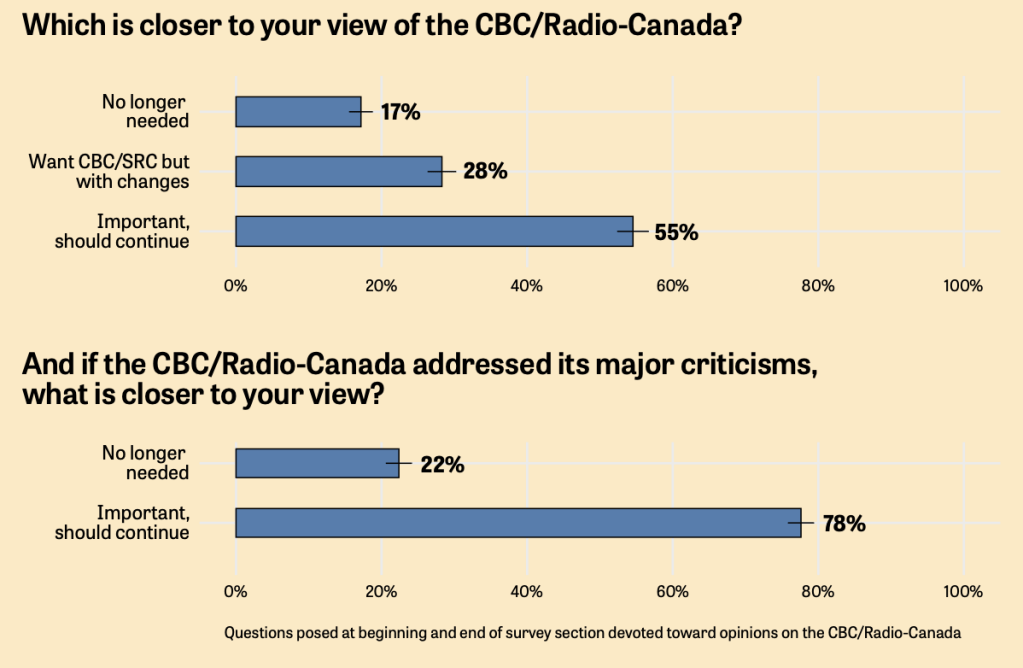
The McGill poll from October pegged 78% majority support for maintaining the CBC in the face of Poilievre’s threat to defund. Importantly, that 78% was tied to “changes” at the CBC (at some point we ought to poll what Canadians mean by changes).
But other results from the McGill poll are sometimes overlooked. Thirty-four per cent of the same pool of respondents said CBC needs more reliable funding, unchanged from previous polling in 2021. Perhaps surprisingly, the 34% is not skewed by regional differences but support for the CBC and better funding is higher among non-Conservative voters.
The political challenge for the Minister’s plan is that it’s front loaded with money, with the changes to come later. That’s why the pressure is on CBC/Radio-Canada CEO Marie-Philippe Bouchard to describe the changes.
The political challenge for defunder Poilievre is that Donald Trump has put the CBC top of mind for many Canadians. We’ll wait for some polling on that.
***
Two weeks ago I posted an update on the CRTC’s regulation of foreign music streamers and, as promised, the Commission has announced a June hearing on audio services, radio and online.
Parliament handed the Commission a laundry list of tasks in implementing the Online Streaming Act, the most pressing of which is what’s expected of Spotify and the American music streamers and whether the declining Canadian radio industry can catch a regulatory break.
The Commission’s Notice of Consultation sports the usual hints of what it’s already thinking before the hearings begin. Its code words are “our preliminary view,” “we consider,” and “we propose.”
Here’s a rundown:
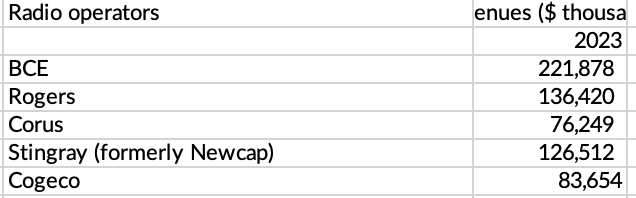
As the Commission ruled in June, the streamers are going to pay five per cent of Canadian revenues into funds for Canadian musicians and radio news. Perhaps to shore up its legal flank in the face of the streamers’ upcoming court challenge this June, the Commission plans to impose more significant cash contributions on Canadian radio networks that take in at least $25 million in annual revenue (the same earnings threshold as the Commission is applying to the foreign streamers).
CRTC Figures identify five radio broadcast groups exceeding $25 million in annual Canadian revenues
As for smaller radio broadcasters, the Commission seems ready to eliminate their half-per cent of revenue (0.05%) cash contributions to musician development funds. The current radio airplay quotas of 35% to 65%, however, are slated to remain.
The national pastime of debating the “MAPL” formula for a Canadian song that qualifies to fill airplay quotas will be revived but the Commission seems committed to the modest changes it proposed in 2022. Rules on Canadian co-writing of music and lyrics will be loosened. The Commission doesn’t seem convinced as yet that Canadian studio producers ought to join artists and songwriters in the talent club that satisfies the airplay quota.
The Commission is interested in strengthening on-air exposure for emerging Canadian artists and is open to a 5% airplay quota for artists in the first four years of their recording careers.
Similarly, the Commission is interested, in fact very determined, to introduce a 5% airplay quota for Indigenous music.
In a typically opaque discussion of news programming, the Commission declares that “news is a priority” (indeed the Online Streaming Act says so) but unlike other policy items it offers no blueprint for how to make the priority into a reality on air.
But the most difficult policy question is how to close the gap between radio broadcasters and online streamers with respect to the prominence and consumption of Canadian songs.
As noted by the Commission, CanCon consumption is a mere 10% on streaming platforms operating in Canada, a far cry from the 35% to 65% radio airplay quotas. The consumption of streamed French language music is 8.5% in Québec.
What’s unmissable in the Commission’s public notice is how little it makes of these consumption outcomes, so dismal that they are directly proportional to the Canadian share of the continental market.
It’s safe to say that if the Commission was planning anything bold to address the outcome gap, it would have said so. Instead it says “more information is required to fully understand how online services can facilitate [CanCon] discoverability.”
***
The Liberal-tormenting True North has rebranded itself as Juno News and its boss Candice Malcolm had Pierre Poilievre on her show for a 37-minute video interview last week.
The Malcolm interview is in the vein of the Conservative leader’s famous chat with Canadian expat Jordan Peterson: it falls short of being a softball news interview, it’s more of a tag team narrative (for example, Malcolm responding to Poilievre’s comments as “excellent”).
So naturally Malcolm introduced the topic of independent journalism.
What was interesting was that Poilievre passed on the opportunity to reiterate his plans for a scorched earth repeal of federal aid to journalism and said Canadians should wait to see his election platform.
Having said that, he expressed concern that some news organizations had been denied eligibility for federal aid for politically motivated reasons.
All of this is difficult to read, but there seems to be some kind of policy cogitation going on behind the scenes and we will, as the Opposition Leader suggests, have to wait to see his election platform.
***
If you would like regular notifications of future posts from MediaPolicy.ca you can follow this site by signing up under the Follow button in the bottom right corner of the home page;
or sign up for a free subscription to MediaPolicy.ca on Substack;
Before catching up on MediaPolicy, there are two posts I offer up to you.
The first is my speech to the Digital Media at the Crossroads conference from last weekend. It’s a well salted explainer of the CRTC’s implementation of the Online Streaming Act on music streaming, its first efforts having drawn court appeals, trade threats and the launch of the “Scrap the Streaming Tax” campaign.
The Commission is going to announce a further public consultation on audio (including radio) this week.
The US digital giants offshore revenue from their Canadian operations (and do the same in other OECD nations) in order to minimize corporate tax.
The DSTs enacted in Canada and Europe are a response to that tax avoidance.
Former US President Joe Biden recognized that when he negotiated a tax treaty to fix it but US Congress refused to ratify it.
The tech bros appear to have backed the right horse.
***
The Public Policy Forum just published a report on local news journalism, The Lost Estate. The report comes out of the Michener Foundation’s conference last October. Written by journalism A-listers Alison Uncles, Ed Greenspon and Andrew Phillips, the report covers familiar ground about the extent of Canadian news deserts and news poverty.
The Report’s public policy recommendations have evolved beyond those recommended in 2017 by Greenspon’s Shattered Mirror study and the roster of federal programs aiding news journalism enacted since then by the Trudeau Liberals.
Here they are:
Work harder at getting philanthropic foundations, community organizations and individuals to utilize current tax write-offs for donations to news journalism.
Make it easier for news organizations to go non-profit, unlocking those charitable donations.
Mirror these contributions to the operational costs of running newsrooms with a public-private-philanthropic capital investment fund for community rescues of failing news outlets.
Legislate a requirement that moribund media organizations must give a four-month public notice of closure so that local investors can save the outlet (this would require both provincial and federal action).
Redesign Ottawa’s Local Journalism Initiative that funds 400 reporting jobs by matching federal funding to charitable fundraising, something that the recipient news organizations would be responsible for undertaking.
Redesign the federal reporter subsidy by requiring staff retention and rewarding new hiring.
Introduce an advertiser tax credit for expenditures in local media.
Encourage more governments to increase their advertising expenditures in local media.
If there is a theme in these recommendations it is to juice the market-facing incentives in current programs while not abandoning government aid.
As an appendix to its Report, the Forum provided an Ipsos poll covering some familiar questions about public attitudes towards news journalism.
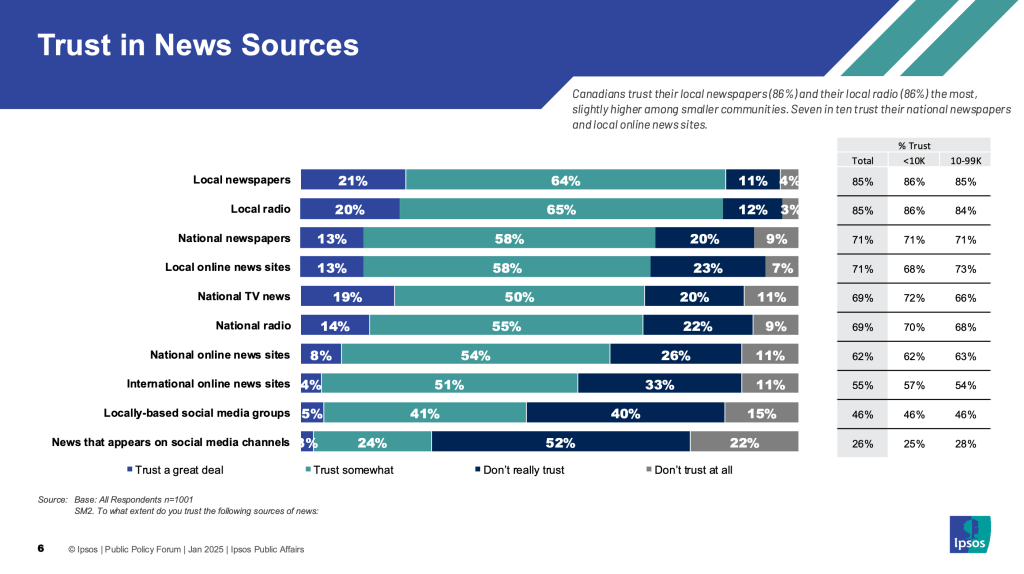
The results confirm a key trend in public opinion: mainstream media is highly trusted and information carried over social media is not.
On the other hand, two questions related to government subsidies to independent news journalism elicited concern that state sponsorship “might” stoke bias and a lack of independence from government.
The most trusted news sources are in fact the most subsidized by government, so give the public credit for agreeing with MediaPolicy: subsidies are a difficult to measure risk to public trust but so far not a harm.
***
I sometimes close this post by recommending content, but consider this more of a referral: the Hollywood-crafted and star-studded Super Bowl ads you didn’t get to see because the NFL sold the Canadian programming and advertising rights to Bell Media’s TSN.
Nobody quite does goofy the way that Hollywood can.
Are you not entertained? You decide.
***
Okay, changed my mind, I will recommend something serious.
I’m sure I wasn’t the only Canadian listening to Trump’s inauguration speech who noticed the President’s reference to “Manifest Destiny,” a long active but recently dormant part of America’s imperial DNA.
Here’s a good piece on that from the US National Public Radio news site.
***
From The Lost Estate Report:
FOR PHILANTHROPY
Expand issue definition: Philanthropy is growing rapidly in the United States around local news. In addition to the small handful of U.S. foundations that are interested in journalism and democracy, a second wave of foundations and donors that were funders of other issues — including domestic violence, hunger, homelessness and poverty — have come to realize they’re not going to make any progress if there’s no local news. Canadian philanthropists should follow suit.
Step up community foundation involvement: There are more than 200 community foundations across Canada, as well as thousands of private foundations. They are just now beginning to channel their impressive fundraising acumen towards local news initiatives: The Winnipeg Community Foundation, for instance, has funded reporting on religion by the Winnipeg Free Press, and the Toronto Foundation is one of several foundations that help to fund The Local. Community foundations should be encouraged to support local news coverage as part of their wider missions to encourage social vitality, community health and local democracy. More media organizations should be knocking on those doors, and more community foundations should be stepping up.
Help enable new local news models, including not-for-profits and charities: Major French-language news outlets such as La Presse and Le Devoir have become not-for-profits and then used that status to apply for Registered Journalism Organization status to take advantage of money from foundations and individual donors. Only four media organizations outside Quebec have done the same; that represents a major missed opportunity to develop a new source of revenue to support local news. RJO status would mean new startup ventures could accept philanthropic support or present an opportunity for community-based fundraising to claim back news outlets from the corporate chains that have abandoned local coverage.
Foundations can help with this step. Achieving charitable status can be complicated, but foundations can offer guidance on how to navigate the rules around registered philanthropic organizations, such as setting up “friends of” charities that can more easily raise money from supporters. If more outlets had charitable status, more foundation help could be unlocked for local journalism.
FOR GOVERNMENT
Reconceive the Local Journalism Initiative: Report for America in the United States provides a good model of a partnership with strategic intent that builds long-term capacity rather than plugging short-term holes. Its stated mission is to “strengthen our communities and our democracy through local journalism” and it funds reporters in local newsrooms for three-year terms, rather than the single year or less of the LJI. Among its other virtues: It provides training for journalists, unlike the LJI; its grants get smaller each year, shifting more onus each year on the news organization to finance its staff; and it helps news organizations learn how to fundraise within their communities. A homemade “Report for Canada” would roll in LJI funds to match those invested by philanthropy. This would provide the added governance benefit of distancing the program from the government of the day and placing authority in an independent board. Public contributions, as with academic granting agencies, would come in the form of multi-year funding.
Mandate a sales notice period: Communities should have an opportunity to rally support for news outlets that are threatened with closure by corporate owners. Specifically, there should be a notice period, perhaps 120 days, before a news operation can be shut down or sold to a non-local buyer. That would give communities time to gather support for local ownership. To help promote local buyers, governments can explore policy interventions that could include training and development, support with restructuring operations, access to expert resources, navigation support of federal and provincial programs, as well as low-cost or no-cost loans.
Tie the Labour Tax Credit to jobs: The LTC is the most important government program supporting news operations at the moment, worth an estimated $67 million in the 2024-25 fiscal year.[42] It should be continued, but with important changes. Organizations should not take money and cut content; the tax credit should carry an incentive to grow newsrooms and should be tied to the increase or preservation of editorial positions and other resources necessary to produce local content. The credit would be higher for those who increase their spending on journalism.
Drive local advertising with a tax cut: Along the same lines, local advertisers should receive a tax credit for spending their ad dollars with independent, locally owned media. As advertising dollars continue to flow to foreign-owned digital sites, depriving local media of funds they need, a tax credit would give advertisers a greater incentive to vote local while leaving the decision about which outlets get support to them, not government. Equitable tax credits for advertisers have the additional benefit of being more likely to withstand shifts in the political winds. That said, local advertising only helps if Main Street can withstand the competition from distant digital retailers, which presents a different set of challenges.
Direct government ad dollars to local news: Governments should earmark a portion of their substantial advertising budgets to local publishers and broadcasters. Ontario is showing the way by requiring that 25 percent of government ad budgets, including spending by four large provincial agencies, be directed to “Ontario-based publishers.” This program, which went into effect in September 2024, is explicitly aimed at “helping to support these publishers and their workers, who are creating local news content for people across the province.” Brought in by a Conservative government, it could be worth some $50 million a year to Ontario publishers. The federal government, other provinces and territories, and municipalities should follow suit. Governments are already spending substantial amounts on advertising and marketing. It makes no sense for them to talk about the need for vibrant local democracy and a healthy local news environment while they continue to funnel their own ad dollars to foreign-owned social media sites.
FOR PHILANTHROPY AND GOVERNMENT
Encourage capital formation: The best way to strengthen local news is to help it remain in local hands in whatever form entrepreneurs believe will work best in each community. In many cases, this will require capital. Programs to encourage capital formation for this purpose would go a long way to preserving the public good that is local news. A sustainable investment vehicle, co-funded by the federal government, provincial and territorial governments, the philanthropic sector, as well as NGOs, could draw lessons from government programs like the Social Finance Fund[43] and the Canada Rental Protection Fund,[44] where federal investment complements other public, private and philanthropic money. The government should explore any mechanism that makes crowding-in more effective, by utilizing a “first-in, last-out” methodology. For philanthropic organizations engaged in social impact investment, local journalism is a perfect match. The same is true for governments that have already put in place measures to encourage employee ownership or support.
***
If you would like regular notifications of future posts from MediaPolicy.ca you can follow this site by signing up under the Follow button in the bottom right corner of the home page;
or sign up for a free subscription to MediaPolicy.ca on Substack;
As a federal election gets closer, the fate of the CBC gets nearer.
The worst thing that can happen to the CBC (and the 78% of Canadians who support it) is that Pierre Poilievre gets elected to majority government. He will indeed defund the CBC, the only question is how quickly and completely.
The second worst thing that can happen is that the Conservatives don’t come to power and Ottawa hits the snooze button on re-engineering the public broadcaster. Recall, the McGill poll from November 2024 reaffirmed broad public support for the CBC but only if it addresses its major criticisms.
The public debate about those criticisms of the CBC, and what to do about them, finds commentators speaking from two different viewpoints. No, not for and against. But rather “news” versus “entertainment.”
Most of the high profile commentators are journalists who focus on the democratic imperative of saving CBC News in a shrinking journalism ecosystem. After all, about a third of Canada’s 10,000 professional journalists are employed by the public broadcaster. The journalist corps representing the other two-thirds, employed by privately owned media, is steadily shrinking despite the federal government financial aid that Poilievre also says he will defund.
There’s been a useful public debate on how CBC News could do the trifecta of improving programming, defending its audience share (at risk among young Canadians) and mollifying its critics in the political class.
Chris Waddell and Peter Menzies, both interviewed here on MediaPolicy, have offered useful ideas on how to do it. Their views were supplemented last week by the journalist and policy analyst Ed Greenspon and independent (and very much ex-CBC) news producer and writer Tara Henley.
If there’s at least one common theme to all these opinions, it’s to decentralize or re-regionalize CBC News. As it happens, this rhymes with the talking point that the new CBC President Marie-Philippe Bouchard is making by extolling “local” and “proximity” as the CBC’s greatest virtues.
Decentralizing CBC News would address at least two problems: first, give Canadians more of the local news they want. Second; mitigate the hinterland anger directed at a richly endowed public broadcaster that is dug deep into the Toronto streetscape where its main newsroom is steeped in a metropolitan bias, the natural outcome of where most of its employees live.
Another common theme among the news-first proponents is the lack of interest in preserving or improving CBC’s entertainment programming. Waddell and Henley want to toss it overboard entirely and cry uncle to the US streamers, while Greenspon just doesn’t mention it at all.
The CBC is the nation’s biggest platform for Canadian entertainment content, in particular television drama and documentaries (leave aside CBC sports television programming for now, that’s a different discussion).
The private Canadian broadcasters are spending less and less on “Programs of National Interest” (PNI)—-don’t be distracted by the awkward CRTC jargon—- for a variety of macroeconomic factors that can’t be bargained or reasoned with.
The ad market for television has deflated.
Canadian broadcaster revenues and profit margins have been falling steadily because of cord-cutting and the success of foreign television and music streamers.
Corus Entertainment (operator of StackTV and Global TV) is almost insolvent.
Bell Media runs its news division at a massive loss and is barely profitable only because of an entertainment portfolio anchored by its long-term deal to retail HBO programming in Canada.
Indeed, the trends are all going in the wrong direction.
Spending on Canadian TV dramas by the English language Canadian networks has shrunk 65% (in real dollars) over the last decade according to a recentstudy commissioned by the Director’s Guild.
Meanwhile the streamers have set a new, stratospheric bar in rising per hour production budgets. Canadian broadcasters can either respond with bigger budgets (they can’t or haven’t) or allow the gap in on-screen production values to widen. (The APTN/CBC/Netflix co-pro North of Northcould not have been made without the Netflix investment that made filming in Iqaluit possible).
Enter the CRTC’s white-flag-of-surrender idea of abolishing the regulatory category of “PNI” in hopes that when it orders Netflix, Amazon and Disney to make “Canadian content” the streamers will by default make dramas. Meanwhile, abolishing PNI for Canadian broadcasters would mean Bell, Global, Rogers and Québecor can opt to shift their spend from money-pit dramas to profitable unscripted television and lifestyle programming.
Quite apart from whether it’s a good idea to outsource Canadian television dramas to American studios looking to sell back into their own market, the question is whether Canadian broadcasters would ever make a drama series again if the CRTC doesn’t require it.
Those who were around to win the regulatory battle for Canadian television drama back in the 1980s will have an opinion on the matter.
If we have to take a defunded English language CBC out of the funding equation for Canadian television drama we subtract a programming budget north of $120 million annually, as the public broadcaster is the nation’s biggest buyer of Canadian dramas.
Bell spent $70 million on English-language Canadian drama in 2023-24 (its budget was $75 million ten years ago) and Corus spent $37 million (it was $96 million as Shaw and Corus combined in 2014).
Friends and foes of the Online News Act Bill C-18 will say the predictable things. What a spineless, election-motivated reversal.What a foreseeable debacle.
News Media Canada took the opportunity to hurry new survey results to press: a solid majority of Canadians want the federal government to spend more advertising in newspapers and less on social media.
According to its press release, “almost two thirds (63 per cent) of Canadians trust advertising in newspapers/news sites, while just 28 per cent trust ads they see on Facebook/Instagram.”
The publishers’ alliance applauded the Ontario government’s decision last July to boost ad spending on newspapers while pointing out that the federal advertising budget allocates only two per cent of its dollars to print.
***
I often recommend Ken Whyte‘s Substack column SHuSH and do so again.
Whyte is the owner and operator of the Canadian book publisher Sutherland House and as such automatically qualifies as an expert in the economics of Canadian media. He’s also the former editor of Maclean’s Magazine, ex-President of Rogers Publishing, and once Editor-in-Chief of the National Post. Additionally, he writes like a dream.
In his last column he contemplates what a Trump tariff on books would do to Canadian publishers who are mostly small independents that hold, collectively, a minority share of the Canadian market that is otherwise dominated by foreign giants.
Sound familiar?
***
If you would like regular notifications of future posts from MediaPolicy.ca you can follow this site by signing up under the Follow button in the bottom right corner of the home page;
or sign up for a free subscription to MediaPolicy.ca on Substack;
Batter up: Mark Zuckerberg (Meta), Lauren Sanchez, Jeff Bezos (Amazon), Sundar Pichai (Google) and Elon Musk (X).
January 25, 2025
The memorable line-up of US tech bros attending Donald Trump’s inauguration as special guests is an early candidate for Photo of the Year, although it’s possibly been eclipsed by Elon Musk’s nazi salute of the same day.
What the Trump victory means for Canadian regulation of Internet services seems ominous and Michael Geist is first out of the gate with “I told you so.”
In the months ahead you’ll find a different perspective here on MediaPolicy, I promise.
Thanks to Trump, we are headed into a nation-defining crucible, as Jean Charest just argued persuasively on CBC News. Of course media policy is just one thing on the table and you can’t eat cultural sovereignty.
Forty years ago, a majority of Canadians voted against a free trade deal with the United States as an over commitment of our economic fortunes to a single dominant trading partner.
But if we stick together and get decent political leadership, we can come out the other side as a greater country and more independent of the United States.
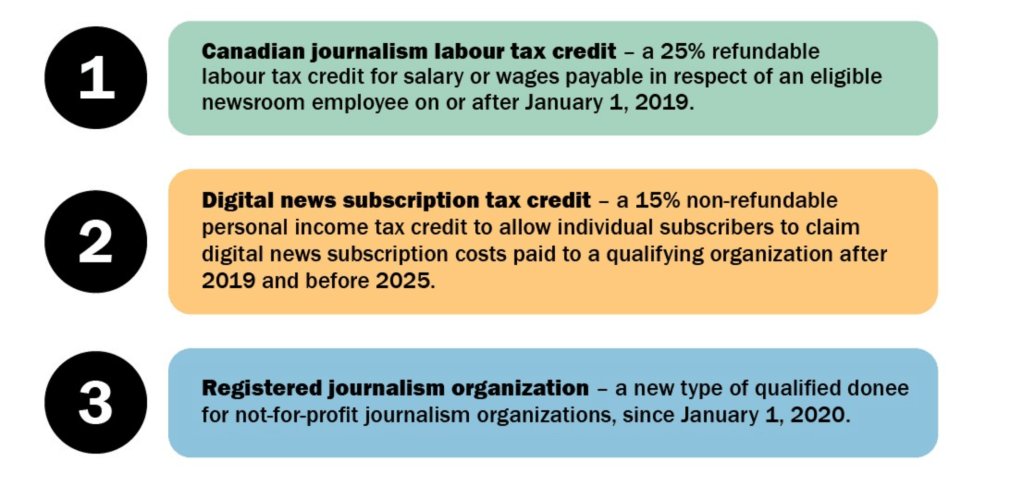
The Qualified Canadian Journalism Organization seal of approval unlocks reporter salary subsidies of 35% and reader tax credits of up to $75 per year in subscriptions paid.
The drift of Beeby’s article is that the news subsidies are bad —a debate for another day— and expensive to administer. Also, he says the costs of the entire program are not transparent because so little effort is made to publicize them.
The “$275 million” paid out in labour subsidies (spread out over six years, it’s worth mentioning) are reported in the government’s annual tax expenditure report.
The annual cost of the reporter subsidy was about $35 million until the government almost doubled its cost last year in response to the shortfall in anticipated news licensing payments from Google and Facebook. (The subsidy was boosted from 25% to 35% of a mid-range reporter salary of $85,000).
In addition to the $35 million labour subsidy, the reader tax credit has cost the public treasury about $15 million per year. With little fanfare, that subscription tax program expired on December 31, 2024.
The tax expenditure of a third QCJO program —-tax write-offs for private donations to non-profit journalism—- has never been released if it has even been tracked.
As for the Panel members’ compensation, Beeby notes that annual billings to the taxpayer have averaged $47,000. That’s divided among its five members. Most of their time is spent reviewing news articles submitted by QCJO applicants seeking to demonstrate “ongoing” (i.e. frequent) and “original” (i.e. not harvested from other sources) reporting of “news” (not opinion) that is of “general interest” (i.e. not niche or specialized).
I’m advised by panel Chair Colette Brin that its members bill the government on an hourly basis, with detailed timesheets, against the federal daily tariff of $275 to $450.
Since the program’s inception, the five panel members representing regions across the country have met online eighteen times rather than convene in Ottawa, except for a single in-person meeting costing $8000 in total travelling expenses.
Spitballing the three-part QCJO program cost at $90 million annually, the Panel’s administrative costs are 0.05% (half of a tenth of one per cent). The CRA did not provide Beeby with a costing of civil servants processing tax claims.
On the other hand, as Beeby points out, the lack of the government’s interest in pro-active transparency about the identity of the program recipients is baffling.
The Revenue Canada website does identify 191 news outlets whose readers are eligible for the now-expired QCJO reader tax credit (and therefore also the labour subsidy), but it does not reveal the unpaywalled news sites that only collect the labour subsidy. There may be as many as another 200 recipient news outlets basking in anonymity. As the reader tax credit has expired, it’s possible the list of 191 news outlets will disappear from public view.
The panel itself asked for more transparency as far back as 2019.
So have news organizations. Asked for comment, Paul Deegan of News Media Canada told MediaPolicy that “transparency is a necessary precondition for trust and accountability. We fully support making the list of QCJOs public, and we have asked the Government of Canada to do so.”
By comparison the $20 million per year Local Journalism Initiative, administered directly by Heritage Canada rather than Revenue Canada, requires recipient news organizations to identify the reporter subsidy on their mastheads.
In addition to identifying recipient news organizations so that readers can reach their own conclusions about accepting subsidies, there is the absence of employment and subscriber data that would permit public analysis of the programs’ effectiveness.
Did the $75 reader tax credit bring in new readers, or just subsidize the existing news junkies? Are labour-subsidized news organizations still laying off reporters or have numbers stabilized?
Transparency is the low hanging fruit in any public policy, especially a controversial one. It’s a harsh judgment on this federal government for not taking the simple steps here.
***
Here are two rabbit holes to dive down this weekend.
The first is an excellent backgrounder by Matt Stoller on the up-for-grabs US Congressional ban on TikTok, now delayed 90 days by President Trump. If you want a deeper (and Canadian) perspective, check out law professor Jon Penney’s guest column in the Globe and Mail.
The second is a Broadcast Dialogue podcast interview of Brodie Fenlon. The CBC Editor-in-Chief has many candid things to say, including some illuminating comments on the “niche casting” challenge for CBC News to meet younger audiences fragmented across the Internet, as well as TV viewers whose portal to content is the app menu embedded in foreign-made smart televisions.
***
If you would like regular notifications of future posts from MediaPolicy.ca you can follow this site by signing up under the Follow button in the bottom right corner of the home page;
or sign up for a free subscription to MediaPolicy.ca on Substack;
The Dais report probed how Canadians get our news, how misinformation is consumed, the prevalence of hate speech, and public attitudes about using government to fix it. (This is the fifth annual report from the Dais, a two-minute video on its 2023 report can be viewed here.)
The Dais analysis of online harms —it includes false information among the harms— is the juicy stuff. I’ll keep that warm for my next post.
Mainstream media dominates
As for news sources, The Dais report confirms what we already knew: “legacy” television news is far and away the most popular news source for Canadians:
In fact, the Dais report shows that “yesterday’s man” of Canadian media is creeping even higher over time (Figure 5). And look above in Figure 4 who’s standing next to television on the podium: news websites and radio. It’s a clean sweep for mainstream media and the news organization that make it up.
On the other hand, the 2024 Reuters Digital Report for Canada lumped together a collection of “social media” platforms to claim third place for news consumption (whereas the Dais Report above breaks out those platforms, individually).
The results are of course skewed by age cohort (Figure 6 in the Dais Report). Younger Canadians (16-29 years) are more likely to source their news from search engines and social media, also observed by Pollara earlier this year.
As for trust in the news that Canadians are consuming, again it’s mainstream media that rules. And the under-fire CBC is the king of credibility (Fig.10):
As an aside on the issue of trust in CBC News, the Dais notes that the public broadcaster’s 48% for “high” trust is elevated by a 64% score in Québec for Radio-Canada but weighted down by a 34% “high trust” in Alberta. Then again, those skeptical Albertans gave Global News and CTV the same score and even rated the Globe and Mail at 21%.
Perhaps the biggest token of skepticism is found in the Dais’ Figure 7. While noting television news’ dominant trust in comparison to other news sources, almost as many survey respondents replied that they didn’t trust any news sources, running the gamut from mainstream media to the entire Internet.
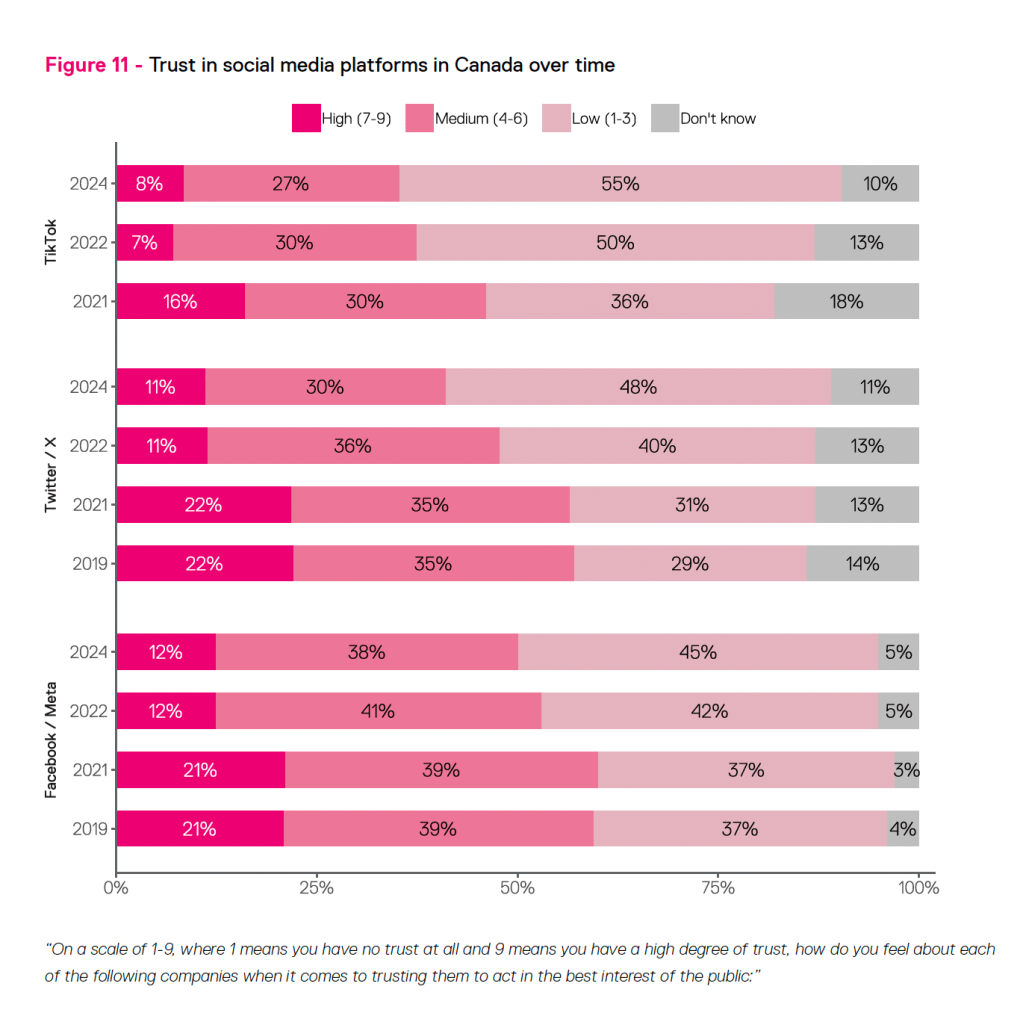
On the other side of the trust coin, popular trust of social media platforms is very low (and getting lower over time), even among the young Canadians who flock to them:
As MediaPolicy wrote this summer, the good news is that we are still a nation of news consumers. News avoidance and exhaustion is a real thing, but it’s not the main problem.
The main problem is the unravelling of news media’s business model, but the second biggest problem is Canadians’ declining trust in media and many other public institutions. That’s a world wide phenomenon, particularly acute in the United States. In Canada, the percentage of the public saying “yes” to the question “I think you can trust most of the news, most of the time” has declined from 55% in 2016 to 39% in 2024.
In the next post, we’ll look at The Dais report’s insights into misinformation, hate speech and public attitudes towards government regulation.
***
If you would like regular notifications of future posts from MediaPolicy.ca you can follow this site by signing up under the Follow button in the bottom right corner of the home page;
or e-mail howard.law@bell.net to be added to the weekly update;
It being the time of the year, retrospective lists abound.
The MediaPolicy 2024 wrapped list includes posts that are worth reading (again or for the first time) because they cover public policy that Pierre Poilievre has sworn to repeal or at least do something else that looks like he has wiped the Liberal policy slate clean.
***
Defunding or defending the CBC
The Poilievre banner campaign to defund the CBC is the right-wing answer to cancel culture. I don’t like you, I silence you.
A Sparks poll in January 2024 suggested overwhelming public support for the CBC, although a big slice of that is soft. Hence the importance of a public discussion of how to improve or re-engineer the public broadcaster.
MediaPolicy posted two interviews and a guest column from media commentators who know what they are talking about when it comes to the CBC: Chris Waddell, Richard Stursberg and Peter Menzies. I have a fourth instalment in this series on the way.
Online Harms
The Liberals’ Bill C-63 obliges social media platforms to come up with content moderation codes. It also empowers the government to order take-downs of revenge porn and content harmful to children. The Justice Minister has split off the more controversial portions of C-63 into a second bill: harsher criminal sanctions for Internet hate and access to human rights tribunals for victims.
The Conservatives are opposed to all of it (they have a more modest proposal) and none of it will pass before the next federal election.
In 2019 the Liberals passed the so-called “$600 million bailout” for Canadian news organizations (except for licensed broadcasters). The $600 million was the over-budgeted amount for five years: the actual spending was less than half of that.
MediaPolicy posted about the alleged relationship between that federal program and declining trust in news organizations. Also I looked at some policy prescriptions that might carry over into a Poilievre government despite his pledge to abolish the program.
News licensing payments
You say “link tax,” I say “compulsory news licensing payments.”
The Online News Act Bill C-18 blew up on the Liberals when Google and Meta decided to play hardball with enough gusto that US legislators would think twice about following Canada, Australia and Europe in making Big Tech platforms share their advertising revenue generated by news links.
I tried to get past the noise on this bill and pinpoint what I believe are the deeper truths about the legislation. The post is now a year old, but still helpful.
Poilievre says he will repeal this bill and, it would seem, refund Google its $100M in annual news licensing payments.
The Netflix Bill C-11
It took them forever, but the Liberals passed the bill that compels foreign streaming giants to share the responsibility with Canadian broadcasters to finance and distribute Canadian audio and video content.
Poilievre has been clear: he will “kill Bill C-11.”
Digital Services Tax
The DST is a stand-in for recouping $900 million in corporate tax avoidance by Big Tech in Canada. That doesn’t always come through clearly in news reports. Unfortunately, leading Canadian critics have displayed an obsequiousness (to Big Tech) or fear mongering (of US retaliation) that is unbecoming.
MediaPolicy posted what I will call a context piece on the DST that I hope is informative.
***
A note to readers, MediaPolicy posts will now be available on Substack. The MediaPolicy website on the WordPress platform will continue with its archive of previous postings and resource links.
If you are already an e-mail subscriber, you will continue to receive MediaPolicy posts and will not get a duplicate from Substack (unless you sign up for it).
Substack is a fascinating creature in the news ecosystem. Founded in 2017, it’s a platform for 17,000 writers, including journalists. You can find leading independent Canadian journalists: folks like Paul Wells (30,000 paid and unpaid subscribers); Jen Gerson of The Line (26k), Justin Ling (12k), Terry Glavin (12k), Ken Whyte (7k) and Patrick White (2k). On Subtstack, both writers and readers can pepper the blogosphere with rhetorical outbursts, à la Twitter/X. But for journalists and news junkies, the site’s real draw is full-length opinion and analysis.
A year ago, Substack had about 50 million unique visitors in the month of January. It boasts two million paying subscribers and over 20 million registered readers (after you have opened an account or surrendered your e-mail address to one of your favourite writers). The writer posts are usually partially paywalled, but not always (mine is not).
The most popular Substacker is Heather Cox Richardson (1.8 million), American historian and author of the non-paywalled Letters to an American. Popular Substackers, who usually charge a $5 monthly subscription fee, can make a decent living.
The question arises at to whether Substack is a candidate for stealing yet another big chunk of mainstream media’s franchise by peeling off well known staff journalists who are currently thankful for a regular paycheque.
Having lost classified ads, much of its display advertising, and a range of editorial products to the Internet leviathan, online newspapers have stayed in business by cutting news and news gatherers. To replace the lost news content, we have a great deal more opinion columns. Opinion is popular and, for the news proprietors, cheap. The key has been to concede more of the news hole to the best and well known opinionators.
What if Substack took those marquée writers and their audiences too?
If you mark off 45 minutes of your time, an engaging Canadaland podcast hosted by Jesse Brown and starring Paul Wells, Jen Gerson, and Chris Best (Substack’s Canadian co-founder) talks about the possibility of mainstream media losing its stars to Substack.
Gerson has a trenchant observation: the Canadian journalists enjoying success on Substack are generally those who made their bones and their reputations after years of service in mainstream media newsrooms. That career path, she suggests, doesn’t exist anymore.
Then there’s Substack’s Nazi problem. With that teaser, I recommend the podcast, here.
***
If you would like regular notifications of future posts from MediaPolicy.ca you can follow this site by signing up under the Follow button in the bottom right corner of the home page;
or e-mail howard.law@bell.net to be added to the weekly update;
The devil makes work for idle hands and lately MPs from the filibuster-becalmed House of Commons amuse themselves by summoning CBC Presidents before the Heritage Committee. Once in the dock, prosecutorial MPs flay the witness and then video clip for their social media posts.
Some MPs had trouble with their facts. Not without justification, MP Kevin Waugh cited the public broadcaster for raking in $400 million in advertising revenue that could otherwise be available to private media. The true dollar figure is $270 million; Google and Facebook have the rest.
MP Jamil Javani claimed that CBC English language television has a 2.1% share of viewing audience. The CBC’s percentage for prime time viewing in television, excluding its all-news and documentary channels, is more than twice that at 5.2 %. By comparison, Canadian private broadcasters collectively take 26%, a wide array of specialty channels are at 53% and US networks are at 13%.
Conservative MPs dwelled upon the bonus payout for senior CBC executives. Bouchard defused the situation by agreeing to review the payments, make her review transparent, and gently reminded MPs that the correct term is “variable pay” (the at-risk performance pay that is part of every senior manager’s compensation package in the modern world).
MP Niki Ashton from northern Manitoba assailed the CBC for its retreat from local television news. She’s not imagining that: in response to the deep Liberal budget cuts during the 1990s, the public broadcaster closed stations and reduced coverage across Canada. The coverage-killing budget cuts didn’t stop there: between 2013 and 2023, the CBC responded to Parliament’s austerity by reducing its spending on television programming in English Canada by 40% in real dollars as it shifted resources to online news.
Bouchard’s reply to MPs was noteworthy: local news will be a “big focus” as the incoming CEO. Last month the CBC announced it was spending its $7 million of “Google money” on hiring 25 journalists in underserved markets.
***
In a previous post I did the CRTC an injustice by accusing Commission staff of “twiddling around” in its investigation of whether Meta is offside by selectively waving some news items through its block of Canadian news content.
I said that because the Commission appeared to be too patient in allowing Meta lawyers to rag the puck in response to the CRTC’s demand for the details on the porous news block, details which the regulator intends to make public in the course of its inquiry.
Last Monday the Commission fired off another letter to Meta and, if you read for nuance, you will conclude that the CRTC has lost patience with Mr. Zuckerberg’s demands to keep his explanation a secret and is ready to post Meta’s unredacted explanation of its news block.
Meta has until tomorrow to play ball or else. Else what, we shall see. Once Meta’s statement of defence is public, the next step will be a decision from the CRTC on whether to investigate further.
***
There may never have been a busier week for Big Tech lawyers responding to legislation and lawsuits around the world.
Here’s a quick run down:
Australia passed a law banning kids under 16 years old from having their own social media accounts (WhatsApp and YouTube excepted). The ban takes effect a year from now —-an eternity in political time—- as the thorny issue of age verification gets sorted out. The debate over the legislation was the occasion for Elon Musk to tweet accusations of censorship, a rebuke from the CEO of the Australian public broadcaster Kim Williams and then Musk responding by unleashing a troll storm against Williams.
The Australian government dropped its version of our Bill C-63, the Online Safety Act. Its “misinformation bill” was destined to fail in the Australian upper chamber where the government does not enjoy a majority.
The Canadian Competition Bureau has filed suit against Google for allegedly abusing its market power in digital advertising. Having cleared Google of this very charge in 2013, it seems likely the Bureau has more evidence in hand as a result of the ongoing anti-trust trial against Google in the US.
Canadian news outlets have filed a copyright lawsuit against the Microsoft-backed OpenAI and its ChatGPT app —-in the wake of a similar lawsuit by the New York Times—- for ingesting millions of the outlets’ online news articles. There’s already an AI-ingestion lawsuit proceeding in Canada between two smaller players as recounted by the University of Calgary’s Hugh Stephens in a blog post.
***
The Globe and Mail’s Cathal Kelly is a born-with-the-muse columnist who just happens to write about sports.
If you would like regular notifications of future posts from MediaPolicy.ca you can follow this site by signing up under the Follow button in the bottom right corner of the home page;
or e-mail howard.law@bell.net to be added to the weekly update;
This week MediaPolicy published a report of the CRTC’s announcement on November 15th laying the groundwork for how Netflix and the other foreign video streamers will contribute to Canadian content under the Online Streaming Act.
Released on a Friday, the announcement flew quietly under the radar of the daily news cycle, possibly because there is no immediate price tag attached to Netflix’s future obligations to make or license Canadian shows.
Last June the CRTC imposed on the foreign streamers $140 million worth of annual contributions to Canadian television subsidy funds for news, drama and kid’s programming: last week’s much anticipated announcement might end up being worth five times as much in streamers’ programming budgets for Canadian content.
There are times when the impact of American public policy initiatives on Canadian media policy dwarves anything we might do north of the 49th.
As you may recall, the trial judge in an anti-trust suit begun by the Trump White House and several states against Google resulted in a legal ruling declaring Google an illegal monopoly in Search and search related advertising.
Following up, the collective of Attorneys Generals spearheaded by the federal DOJ have now tabled remedial requests to the trial judge.
Just for starters, they are requesting that Google divest its Chrome web browser and its Android mobile operating system. And there are important requests focussing directly on bootstrapping would-be competitors to Google in the Search market by giving them “catch-up” access to Google’s treasure trove of consumer data. Radical stuff for radical times.
There is a useful news summary from the New York Times. But if you can afford the time for a ten-minute read, I recommend Matt Stoller’s excellent explainer.
As I read Stoller’s piece, it easily came to mind how unlikely it is that Canadian news publishers would have successfully pursued the news licensing payments in the Online News Act if instead of Google’s monopoly on search referrals there was robust competition in the Search Engine market.
***
More than a few times MediaPolicy has raised the question of how Meta is getting away with its selective ban on Canadians news content, its response to our Online News Act.
The Heritage Minister raised the same question publicly but she is constrained by the fact that it’s the CRTC’s jurisdiction to investigate it.
It’s possible that federal cabinet considered but dismissed the idea of sending the CRTC a policy directive asking the Commission to look into why Meta permits the sharing of some news items, but not others, and why it has flat-out restored news posting privileges to outlets such as Narcity.
The Commission is twiddling around on this one. In early October it asked Meta to explain the rhyme and reason for allowing some news content on its Facebook and Instagram platforms while banning the vast majority of news organizations.
Meta filed a letter in response and, according to a Canadian Press story, it appears that Menlo Park submitted something, but it’s not clear what. And beyond whatever details of its selective ban it provided, Meta has claimed confidentiality and opposes the public release of its answers to the Commission.
This minor legal drama will play out in the fifth dimension of regulatory time.
Meanwhile the public is still in the dark as to whether the Commission thinks there is a basis for playing hardball with Meta by, for instance, officially designating its platforms under the Online News Act so that banned news organizations can file an “undue preference” complaint and get equal treatment to Meta’s favoured news outlets.
***
I’m pleased that so many followers of this blog liked Richard Stursberg’s guest column on the CBC, his advice for the incoming CBC President Marie-Philippe Bouchard. It’s now the most popular post in MediaPolicy’s short history.
Now there’s an interesting column from The Hub’s Managing Editor Harrison Lowman in which he identifies the “defund the CBC” problem as the public broadcaster’s news curation and journalism culture. His bottom line: fix it, don’t destroy an important Canadian institution and a vital provider of news journalism.
Lowman’s piece —-clearly not toeing the Conservative Party line—- was immediately disputed by The Hub’s Editor-At-Large and former Harper policy chief Sean Speer.
Speer’s says his support of defunding the CBC is not founded on an allegation of biased news reporting. Gosh no. It’s about the CBC’s declining audience share (him citing poor television viewership numbers, but ignoring strong digital and radio numbers). His colleague Lowman is just being “nostalgic” about the CBC.
***
If you would like regular notifications of future posts from MediaPolicy.ca you can follow this site by signing up under the Follow button in the bottom right corner of the home page;
or e-mail howard.law@bell.net to be added to the weekly update;