CBC: Welcome Mme.Bouchard, here’s some advice.

Guest Columnist Richard Stursberg

November 13, 2024

When you’re right, you’re right. And if you were right a long time ago, you’re vindicated.

It’s possible that former CBC executive Richard Stursberg is feeling just that, 13 years after leaving the public broadcaster where he served as the head of English language services from 2005 to 2011. 

At the CBC, Stursberg’s calling card was that “audiences matter.” His single minded mission was to capture for the public broadcaster, especially in English language television, an audience commensurate with its role as Canada’s leading cultural organization (and its billion dollar Parliamentary funding).

To outside observers, he seemed to be at odds with everyone and not really minding. First there was the lockout of CBC staff in 2005. Then he grabbed the rest of the organization by the scruff of the neck and piloted a revolution in the CBC’s entertainment programming, for example embracing audience-pleasing reality television (remember Battle of the Blades?).

With an all-Canadian line-up, in five years Stursberg moved the needle significantly in CBC’s share of the national television market, closing the gap with CTV and its prime time schedule of hit US shows. Then he fell out with his new boss, CBC President Hubert Lacroix. And so on: read all about it here in his memoir, The Tower of Babble, ranked by the Globe and Mail as one of the best books of 2012.

Along the way, he made some friends, allies and enemies. The enemies he cheekily dubbed “The Constituency,” an assortment of CBC traditionalists and media watchers who might also have been described as “those who rip Richard in public.”

After he left, the CBC lost NHL hockey rights to Rogers and with it a whole lot of eyeballs and connection with Canadian audiences. Netflix ate up market share for Canadian entertainment television. And then Google Search and Facebook devoured the digital ad market. Stursberg tells more of that story in another prize winner, his 2019 book, The Tangled Garden. The job of keeping CBC relevant today is twice as hard as it used to be.

These days Stursberg continues to have his fingers in different cultural pies. He is outspoken on his support for major reforms to the definition of Canadian content, favouring a “cultural theme” test of distinctive Canadian programming over the traditional headcount of Canadian talent.

As a past reinventor of the public broadcaster, it’s his 2024 views on the reinventing the CBC that are worth soliciting in its hour of crisis. As conservative commentator Harrison Lowman recently projected, “CBC, your days are numbered.”

MediaPolicy asked Stursberg, what is to be done? This guest column, his advice to incoming CBC President Marie-Philippe Bouchard, is his response.

***

Advice to the new President of the CBC, Marie-Philippe Bouchard

By Richard Stursberg

Welcome to the job.

Given your deep knowledge of public broadcasting you are ideally placed to do well, but you will have significant challenges. Here is some unsolicited advice on how you can succeed from one who also believes in the importance of the CBC/Radio-Canada. 

The Structure of the Corporation

First, your most important challenge will be English television. It is the central problem, not because Pierre Poilievre wants to shut it down, but because it has fallen to its lowest audience share ever. Put bluntly, with the exception of the recent Olympic Games, almost nobody is watching it. There are very few viewers for any of its shows, including news. Your presidency will succeed or fail depending on whether you can solve the problem of English television.

Second, it is important to understand the CBC is not a normal corporation and lacks a normal Board. It cannot decide its own fate. The overall strategy of the corporation has to be approved by the CRTC; and it cannot raise capital without the agreement of the Treasury Board. It lacks many of the powers of a normal corporation. This makes change very difficult. To succeed you will have to have the Minister of Heritage and the Prime Minister on-side for whatever you plan to do.

Should English TV be Fixed?

The Environment

The TV landscape in English Canada is in serious difficulty. The big conventional networks — CTV and Global — the major private sources of local and national news, have been shedding staff for over ten years and losing money. Their ability to commission Canadian drama and comedy is compromised. They are spending less and — for financial reasons — what they are doing is increasingly American in look and feel. 

The cable industry has been losing customers for many years and with them, the fees that they pay to specialty channels. As a result, they too are significantly cutting back their staff and ability to commission Canadian shows.

The groups that own the vast majority of the conventional and specialty broadcasters are in trouble. Corus, the parent of Global, is essentially insolvent. Bell Media, the parent of CTV recently wrote down its broadcast assets by just over $2 billion. It is not hard to imagine that in another five to ten years the English Canadian broadcasting industry will — with the possible exception of the sports channels — no longer exist.

Their loss will mean that CBC TV will be the only broadcaster still producing Canadian drama, news, comedy, public affairs and documentary shows. If we value hearing our own stories told in our own voices, there will likely be nowhere else to see them.

Social fragmentation

The emergence of algorithmically driven social media has encouraged polarization and social fragmentation. Canadians increasingly live inside filter bubbles that act as echo chambers. Disinformation, deep fakes and AI generated falsehoods have compounded the problem. The space of common ground and shared assumptions has grown ever narrower as distrust spreads like a stain across public discourse.

As divisions grow more fractious, it is increasingly important that there be places that can bind the country together and create shared understandings about who we are. They need to provide stories, ideas, news and art that allow Canadians to celebrate, explore, discuss and make sense of their country. And, they need to be true. Truth is an essential component of patriotism.

The CBC is the last great cultural institution in the country that is in a position to do this. It can only do so, however, if its programming is trusted and popular. Unless it reaches big audiences it cannot create the large scale shared space that will provide the counterweight to the endless fragmentation of social media. 

One initiative that the CBC might take is to address the challenge of disinformation by creating a news and public affairs portal that hosts not just its content but also that of all the other media in the country that are governed by traditional journalistic standards of truth and fairness. This could include other broadcasters, newspapers, magazines, on-line information sources and bloggers that are committed to ensuring the accuracy of their reporting. The portal’s promise — its brand — would be truth.

The other thing it must do is provide galvanizing programming that speaks directly to Canadians to foster debate and conversation about who we are and want to be. It must take on large projects that transcend the current divisions — whether regional, ideological or social —  and provide Canadians a place to laugh, argue and cry. This is very difficult to do.   

Can English TV be Fixed?

It will be very difficult. Your most important source of revenue aside from the Parliamentary appropriation is advertising, which has collapsed. At the same time, you are facing brutal competition from the vastly rich, foreign owned, unregulated streamers — Netflix, Apple, Amazon, etc.– who bear none of the costly cultural and social burdens that you do. 

Business as usual cannot succeed. To save English TV you will have to develop a radical new plan for its future. The plan needs to reinvent its news and entertainment properties and find significant new sources of revenue. The creation of such a plan will be challenging. Substantive change will be met with criticism from all sides.

How Should the Plan be Developed?

It is important to develop a set of principles to guide the creation of a plan. These might include the following. 

1. Focus on what the private broadcasters cannot do. They do not need competition from a publicly supported CBC. They are in tough enough shape as it is.

The space that the privates can no longer occupy is very large. Delivering what they cannot will make you more distinct and give Canadians more reason to view your programming.

2.  Focus on serving audiences. The measure of success must always be whether Canadians are watching your shows. They pay for the CBC and can reasonably expect to be offered programs that they will want to watch. There is no public broadcaster without a public.

3. Focus on developing new sources of revenue. Television advertising is dying. Google, Facebook and the other big digital companies have taken it all away. Make a virtue of necessity and get out of ads for your drama, comedy and documentary programming. This proved a very successful strategy for radio and would certainly make CBC TV much more distinctive and attractive to audiences.

You will need to develop a new revenue plan. It can be based on sponsorships, whether from corporations or foundations, charitable giving, levies on the streamers and/or internal reallocations.

4. Ensure that the money you are given by Parliament is allocated fairly and sensibly. The French service receives 44% of the government money. This means that French speakers get a per capita subsidy of $70 per person, while the rest of the country gets $23 per capita. Given your biggest challenge is on the English side, this is both unhelpful and unfair. Only a French President can change it.

5. Do not try to please everybody. You can’t. Instead, focus. Be bold. Take risks. Make big bets.

Some Facts About English Canada’s Media habits

Every week Canadians spend about 20 hours on the Internet and 30 hours watching TV, whether traditional TV or streaming services. These are their most important leisure activities.

CBC English radio continues to perform well. It takes a 16% share of all radio listening and is number one in most markets.

CBC English TV has collapsed over the last ten years. It now has a share of roughly 4% of all TV viewing. Its share is equivalent to that of a specialty channel.

Although CBC likes to brag about the reach of its digital service, it is very lightly consumed. Compared to radio and TV, it performs poorly. Canadians spend about 17 minutes per week on CBC.ca., which is a share of just over 1% of their time spent on the Internet.

What are the Key Elements of a Plan?

Local News

Much of local news has vanished; Canada has entered a local news desert. Most small town and community papers and supper hour newscasts have died. All market research indicates that local news is the most important form of news, since it is about the events that directly affect people’s lives. Where local news dies, electoral participation falls and local corruption increases.

Consistent with the principle of doing what the private sector cannot, CBC should expand its local news presence. Recently (November 12, 2024), it announced a significant expansion of its local news presence.

To strengthen its local news further, it would be wise to leverage its strength in radio and have radio promote to and complement the CBC’s local news sites. This has proven a successful strategy in some very small towns in western Canada and Ontario.

Strengthening local news would also help your national news. There is a powerful correlation between local shows on radio and Canadians’ propensity to listen to the national ones as well. 

National and International News

The National needs to be refocussed. Some evenings it draws less than 200,000 viewers at 10:00. CTV typically draws two to three times as many viewers for its late night news at 11:00, although in fairness The National gets many more viewers on Youtube and CBC Gem.

Aside from the Globe and Mail, almost nobody except the CBC has any foreign bureaus or investigative capacity. The National — and the News Network — could be dramatically strengthened by using these resources to shift the focus of their journalism. Instead of “telling” Canadians the news, they should give priority to making sense of it by providing background and context.

By way of example, the recent coverage of the US election focused on it as a horse race. There was much discussion of polls, performance at rallies, the Electoral College, more polls, swing states, etc., all accompanied by hand wringing and pearl clutching. Through it all, there was little or no discussion of what a Trump victory might mean for Canada. What will we do when he starts to deport “illegal” migrants when they appear at our border looking for sanctuary? How will we respond to his demand that we turn on the “tap” and divert our water to the parched southwestern states? How do we respond when he withdraws from NATO? The point of foreign bureaus is to make sense of what is happening in other countries for Canada.

In a similar vein, the coverage of the health care crisis focuses on Canadians’ lack of family doctors, overcrowded emergency rooms, and long waits for elective surgery. It does not explore how Canada might fix its broken system by looking at what other countries get right. Why are France, Sweden, Denmark and Norway doing better than we are?

A promise to answer these kinds of questions and embrace Solutions Journalism would go a long way to restoring the relevance of The National and The News Network.

Entertainment and Documentaries

Like the news, the entertainment and documentary shows are doing poorly, particularly the newest ones. The older shows are holding up better: Heartland (season 18), Murdoch Mysteries (season 18), This Hour Has 22 Minutes (season 45?). The newer shows like Crime Scene Kitchen and My Mum Your Dad (a dating show) draw hardly any viewers.

The problem with the new shows is that they are not unique; they do not fill any unmet need. Similar offerings can be found on lots of specialty channels. They are also not particularly Canadian.

A new strategy must be based on commissioning shows that Canadians cannot get anywhere else. They need to be big, daring, appointment pieces that speak to our unique history, dreams, fears and sense of humour. They need to be about us, our neighbours, fellow citizens and friends. To be relevant, they must be distinctly Canadian and squarely rooted in Canada. The private broadcasters will never do this.

By way of example, one of the CBC’s most successful series was Canada: A People’s History. It drew tremendous interest and precipitated great controversy. For years, it was used in schools and with immigrants to help explain who we are. Surely the time is right for an Indigenous People’s History of Canada. To achieve reconciliation, it is essential that people understand the truth of what happened from the point-of-view of Canada’s original inhabitants. Like its predecessor, it would be a multi-part series that starts with first contact and comes up to the present day. Inevitably, it would be expensive, controversial and — if done properly — galvanizing. Nobody else in Canada has the resources or the expertise to make it.

As for fiction, one can imagine a show about our relationship to the US. The premise is simple. The southwestern states have run out of water (which they have). Canada has more fresh water than any country in the world. The Americans face an existential challenge: they must save Texas, New Mexico, Arizona and southern California. They must have the “tap” turned on even if it means war. Again, no private broadcaster would make this; they could never sell it in the States.

Radio-Canada has been very good at producing extremely popular shows that reflect Quebec in all of its remarkable diversity and energy. Every Sunday night “Tout le monde en parle” (Everybody Is Talking About It) provides a funny, charming and thoughtful window into the cultural, social, political, athletic, musical, business and religious life of Quebec. It is the most successful talk show in Canadian history. It is must see viewing. Why is there no English equivalent?

To do these kinds of things, you may have to restore the financial balance within the English network. Over the last ten years roughly $200 million has been stripped from English TV and radio to finance digital, the worst performing service.

Conclusion

English TV can and should be saved, but it will require difficult and bold restructuring. It will need a plan that is based on making great shows that speak to English Canadians’ desire to see themselves and explore their country in ways that are exciting, beautiful and moving. Whether news, documentaries or entertainment shows, table stakes for programs are — in the current intensely competitive environment — quality, originality and relevance. Nothing less will do.

The plan must also ensure that the necessary resources are in place to make it happen. This is likely to involve very controversial decisions about the reallocation of money across the corporation and within English services. It will also require the development of new sources of funds (the major banks could easily sponsor an Indigenous People’s History of Canada).

Although you have a deep understanding of public broadcasting, I understand that your experience is principally on the French side of the corporation. The English and French markets are very different, both in terms of their levels of competitive intensity and the kinds of conventions that underpin successful TV.  It might be a good idea for you to move to English Canada for a few months. Watch all the shows and newscasts, both those that are working and those that are not. Talk to everybody: the employees of the CBC, the heads of the big English media companies, the audience measurement experts, the independent producers, everyone. 

Use all that you learn to make a real plan, one with teeth and targets, recognizing that it will take two to three years to bear results. Then, find yourself a media executive who agrees with you and has the skills, contacts, experience and daring to execute it.

Once the plan is ready, make it public. It is essential that Canadians understand and support what you are trying to achieve. Let them see that you understand what they need and want, and that you are daring enough to try and deliver it. Let them hold you accountable for the spending of their money. 

Building a public constituency for your plan will provide a powerful counterweight to the forces that will resist change. You will need all the friends you can find.

The plan may also be a good answer for Mr. Poilievre – if elected – and his Heritage minister. You will also need them.

Bon courage.

***

“Defunding the CBC would be extremely unwise.” Senate appearance by Richard Stursberg on December 3, 2024

***

If you would like regular notifications of future posts from MediaPolicy.ca you can follow this site by signing up under the Follow button in the bottom right corner of the home page; 

or e-mail howard.law@bell.net to be added to the weekly update; 

or follow @howardalaw on X or Howard Law on LinkedIn.

Catching up on MediaPolicy – The Spotify stonewall – Debating the CBC – Ottawa’s warning label on TikTok – more Corus misery

November 7, 2024

On the weekend MediaPolicy published a lengthy explainer about the new “Scrap the Streaming Tax” campaign launched by the global music streamers to fight CRTC regulation. 

The post’s opening hook —-how Canadian rocker Bryan Adams stepped forward to become the celebrity face of the campaign—- adds a little colour to the debate over the regulatory environment for “CanCon,” something Adams once said “only breeds mediocrity.” This week, Adams launched his own channel on Bell Media’s iHeart radio.

The main point of my post was that the music streamers appear to making no efforts to come to grips with the biggest of cultural challenges within Canadian music: the enormous and baffling underconsumption of French language music on their streaming platforms in Québec.

Right on cue, La Presse published a story on its journalist’s discovery that part of Spotify’s song algorithm is, not surprisingly, a popularity index that rates songs based on global listens and the time freshness of that audience. The result is not a shock: the popularity index of French language Canadian music is not in the same ball park as English Canadian songs, to say nothing of the indexing of the most successful global artists. 

La Presse’s attempt to get Spotify’s comments were met by stony silence, as were previous inquiries by MediaPolicy.

***

Former CBC executive Richard Stursberg wrote in his 2012 memoir of his tumultuous tenure at the helm of English language services that one of the things that the CBC excels at, and should focus on, is “smart talk,” his description of programming that curates debates about important public issues.

In the swirling discussion over the Conservative Party’s promise to defund the CBC, that smart talk is what CBC host Elamin Abdelmahmoud just put together on his Commotion podcast, first with a panel of three critics of the CBC and next with three defenders.

Separating the sparring teams was a good idea: you will be better informed and spared the tedious cross talk of face to face debate.

Harrison Lowman of The Hub warned the CBC “that your days are numbered,” something he does not relish personally, and that a dramatic re-engineering of the public broadcaster is required for survival. On the other hand, writer Rupa Subramanya is not for saving the CBC: she would defund CBC television, CBC2 music radio, and provide “tiny” funding for CBC Radio One (perhaps inadvertently, no comment on CBC.ca).

In the other room, National Observer columnist Max Fawcett regarded Subramanya’s claims that the free market will provide Canadians with their own media as “delusional.” 

What makes the two podcasts so engaging is how everyone addresses the elephant in the room with honesty. That elephant is a composite of belief, caricature, misrepresentation and reality that CBC’s institutional culture is dominated by its location in downtown Toronto and that this culture suffuses its programming throughout the rest of the country, creating resentments, hostility and worst of all indifference. 

We live in an age of cultural wars that animate political polarization, with tribes suspecting the worst of each other. Together the two podcasts are a tonic. Which is what the CBC mandate can be.

***

A news story that is going to hang around and get a whole lot bigger is the federal government’s decision after a lengthy national security review to ban TikTok from operating on Canadian soil but allow private citizens to use the app. In short, it’s a “use at own risk” advisory.

There’s an informative story on this in the Globe and Mail (which has followed the federal government in banning its employees from using the app out of surveillance concerns).

US Congress had ordered the Chinese-owned TikTok to sell its American operations or face an Internet ban in that country. But with President-Elect Trump making friendlier noises about TikTok, that’s in doubt.

***

Life at Corus Entertainment must be a misery these days.

The profitable but debt-laden company is the target of acquisition by Canadian media rival Québecor which hopes to buy Corus at a discount. The unsecured creditors see this coming and are manueuvring for a more modest haircut on their loans. 

Meanwhile, Rogers is showing no mercy to its vulnerable competitor. In addition to its scoop of Corus’ best American programming, it is now seeking to dump Corus’ kids channels from its cable service. 

***

If you would like regular notifications of future posts from MediaPolicy.ca you can follow this site by signing up under the Follow button in the bottom right corner of the home page; 

or e-mail howard.law@bell.net to be added to the weekly update; 

or follow @howardalaw on X or Howard Law on LinkedIn.
Making sense of Trump in ’24

November 6, 2024

The most common Canadian observation about US politics is confusion over what has happened to American democracy.

How could more than 70 million Americans re-elect Donald Trump: felon, racist, fascist and possibly a future dictator? 

For any Canadian older than Generation Zed, American reality no longer jibes with our learned experience of the American public, how they vote, or what they think.

This cognitive dissonance we experience might have something to do with with our inability to place Trumpism within a “political order,” even if we have a clear take on Trump the man.

On that note, a week ago the New York Times’ Ezra Klein, had American historian Gary Gerstle on his podcast show.

Gerstle’s gift of commentary is to organize our thoughts into a sensible narrative, in particular his sketch of American history as a sequence of paradigms of political consensus on political economy and the voting coalitions that support them.

His account begins with the bipartisan political order of the New Deal (Franklin Roosevelt to the administration of Jimmy Carter) eclipsed by three decades of neo-liberalism under Reagan, Clinton, the Bushes and Obama. 

The end and beginning of political orders, he says, are marked by great economic upheaval. The Great Depression of the 1930s. The oil price shocks and stagflation of the 1970s. He identifies the end of neo-liberalism, and the beginning of an as yet undefined new political order, as the financial crisis of 2010 followed by the 2016 election of Trump. 

Gerstle suggests that the class disparities in the economic impact of the financial crisis and recovery tipped the neo-liberal order into a credibility crisis: the exploding income inequality between rich and poor that was supposed to be tolerated so long as working and middle class Americans were incrementally better off was making Main Street America very angry. The Pandemic shock did the same thing.

And in fact the uncertainty over where we are in 2024, and what kind of political order exists, is what causes Gerstle to say towards the end of the engrossing 90 minute podcast that he doesn’t yet know how to define this new paradigm, because there isn’t one. In a nation divided, it’s still contested.

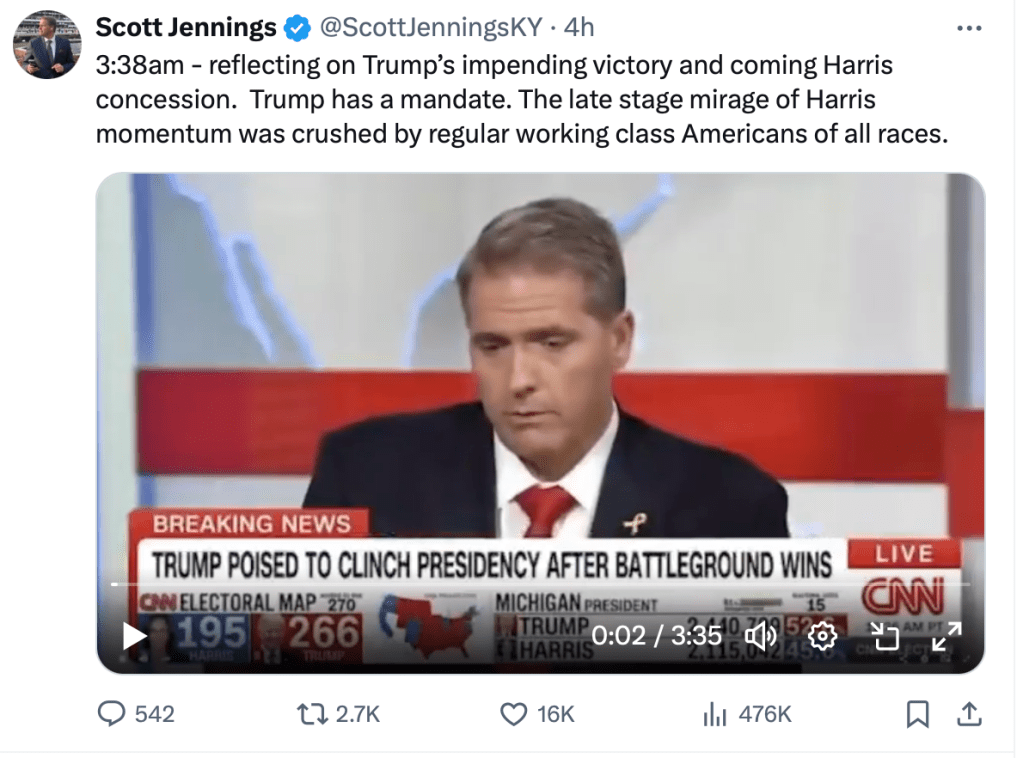
And here we are trying to make sense of it all. This morning my X feed sent me to two video commentaries among thousands. 

Have a listen and a look:

***

If you would like regular notifications of future posts from MediaPolicy.ca you can follow this site by signing up under the Follow button in the bottom right corner of the home page; 

or e-mail howard.law@bell.net to be added to the weekly update; 

or follow @howardalaw on X or Howard Law on LinkedIn.

Travels in America

A Louisiana racoon, searching the bayou for gators

October 29, 2024

Lucky me, I spent last weekend visiting family in the bone-soaking warmth of New Orleans. 

We kicked off a hot and sunny Saturday morning in the Treme neighbourhood by joining in a Second Line, otherwise known as tucking in behind a street parade of musicians. Turns out, it was a Kamala event. Someone gave my sister-in-law a Harris-Walz sign to carry. As a well mannered southern white lady and hard-core Democrat, she was glad to oblige. We spent the next hour being rewarded with verbal fist-bumps from Treme residents.

Afterwards, we walked the narrow sidewalks towards the Mississippi levee through the touristy French Quarter.  This time, verbal fist bumps from young white women, almost on every block. 

A young white fellow in a full sized pickup espied our election sign, pulled up, rolled down the window, and yelled “Donald Trump” in our faces for all his life was worth. My unfailingly polite sister-in-law replied “have a nice day.” The gentleman sped off to a safe distance of 50 yards away and flipped us the bird. Blaring Fleetwood Mac melodies on the truck radio. 

A few minutes later, same thing. A twenty-something white guy in a pretend pickup pulls up, leans out the window, and shouts “Donald Trump, baby.” My sister-in-law gives him the same agreeable reply . He takes off and too late I think to say “yes.”

Sunday morning. It’s time to get out of blue New Orleans and see red and rural Louisiana. The four of us take a swamp tour on the Pearl River, not far from the Mississippi state line. The weather-beaten homes along the bayou have a few Trump flags, but no Harris signs and we didn’t bring our’s. 

The Pearl has plenty of gators, boars, egrets, rattlesnakes, and pint-sized raccoons. The latter are right out of Disney. Apparently they like to eat juvenile alligators. “It’s no contest,” says the tour guide.

The guide René is great: a funny and swamp-wise young man raised on the Pearl and absolutely in the core Trump demographic. But no political ad hominems from him today. Except for some dry remarks about government wasting taxpayers’ dollars fighting invasive plants when hurricanes get the job done for free.

***

As expected, last week the Heritage Minister announced that veteran public broadcaster Marie-Philippe Bouchard is the next CEO of CBC-Radio Canada.

Bouchard’ ‘s appointment was marked by a yet another poll confirming that a strong majority of Canadians don’t want to defund the CBC, but many want to see it improved. 

What Canadians want will make no difference to Pierre Poilievre or his Heritage Minister in waiting, the steely Rachel Thomas. They will defund the CBC anyway. Or as Poilievre giggled recently, “I can’t wait.”

The Conservatives’ single-minded commitment to silencing the English-language side of the public broadcaster is on display whenever CPC MPs get together (along with the NDP’s Nicky Ashton) at Heritage Committee hearings to haze current CEO, Catherine Tait. 

Ms. Tait has had just about enough thank you and is biting back. Good for her, I say.

There’s two ways of looking at this dynamic. Here’s a contrarian column from the Globe and Mail’s Simon Houpt casting Tait as the “imperfect defender of public broadcasting.” And here’s another from Konrad Yakabuski, predicting Bouchard will be its last CEO.

***

I’m enjoying the launch of Village Media’s first digital start-up in the big smoke, Toronto Today. Some good stories and lots of demographic maps. I love maps.

The Today newsroom came up with an attention-grabbing idea of shooting video of their reporter at a local independent grocer —-my local grocer—- paying for people’s groceries on the condition they pay it forward by doing something kind for someone.

Now you have to know my downtown neighborhood, which the realtors call “Seaton Village.” With some mischief, I used to call it the Soviet Socialist Republic of Seaton Village. Despite the fact that our most famous resident is Jordan Peterson, it’s kinda pink. So just try to pay for someone’s groceries on condition they do something kind that they were already going to do. As you can see from the video, it’s harder than you think.

Another cool thing that Village Media pulled off this week was getting a podcast interview with the Prime Minister. It was a soft interview by Press Gallery standards, but still interesting to get the most thick-skinned PM in Canadian history to talk about his daily torments. 

Village Media CEO Jeff Elgie was miffed when CBC.ca used the interview content, credited his newsroom, but failed to link to the podcast. The Toronto Star had not failed to do so. Deprived of the considerable traffic referrals a CBC link would have sent his way, an irritated Elgie groused on LinkedIn that even Meta was never so discourteous. 

***

Back to the US election. 

At the last moment the “democracy-dies-in-darkness” Washington Post withheld its locked-in Presidential endorsement to Kamala Harris. Its owner, Amazon CEO Jeff Bezos, vetoed it. The same thing happened at the L.A. Times, but my god this is the Post. 

In a sentence that fits the crime, Bezos’ newsroom wrote several stories humiliating him for cravenly valuing his money over his integrity. Here’s his rebuttal.

Bezos joins a growing queue of Big Tech titans who are either pro-Trump (Elon Musk, Peter Thiel) or quickly cuddling up to him (Mark Zuckerberg, Sundar Pichai, and Bezos) in hopes that a second Trump presidency will disavow the Biden administration’s Big Tech trust-busting.

There’s an insightful piece on that here, from Matt Stoller.

***

If you would like regular notifications of future posts from MediaPolicy.ca you can follow this site by signing up under the Follow button in the bottom right corner of the home page; 

or e-mail howard.law@bell.net to be added to the weekly update; 

or follow @howardalaw on X or Howard Law on LinkedIn.

Catching up on MediaPolicy – local news poverty is dangerous – a new CEO for CBC? – Jeff Elgie’s big idea – the Bowie vibe

October 21, 2024

Last week I was in Charlottetown attending a conference on local news. 

I posted a brief summary of the keynote speech delivered by Steve Waldman here.

Waldman is the American journalist who heads the Local News Project and the Report for America intern program. If you want to place him in the Canadian constellation of public journalism, consider him an American counterpart to our Ed Greenspon or Margo Goodhand. The headline graphics above and below are from Waldman’s slide deck.

Waldman’s pitch, and the idea behind the conference, was that saving local news journalism is job one. 

The argument he makes is that there is a great deal of evidence in the US suggesting that towns and rural areas living in news poverty —with too few or no community news outlets — are ripe for misinformation circulating on social media and also political polarization when searching for news on more partisan sources at the national level. 

There is a connection, he says, between being underinformed or misinformed about local events, issues, and politics and on the other hand the rising national tide of political polarization where citizens sort themselves into tribes and stop listening to each other. 

One should be cautious about copy and pasting Waldman’s analysis from the US to Canada, but his view will strike many as true.

***

The National Post scored some of outgoing CBC President Catherine Tait’s e-mails, commenting on the Conservative “defund the CBC” campaign, through an access to information request. Alas, her comments weren’t very juicy. 

Tait’s replacement is due to be announced by the Heritage Minister any day now: LaPresse and Le Devoir had stories claiming it will be Marie-Philippe Bouchard. She is currently the CEO of the Canadian broadcasting consortium TV5 Unis that partners with global francophonie broadcaster TVMonde. She was at CBC-Radio Canada for 26 years before that.

Bouchard’s reputation precedes her, at least in Québec, where reaction to her possible appointment was roundly positive.

Appointing Bouchard to replace Tait would fall in line with the important tradition of alternating between Québec and English Canada.

Peter Menzies raised the obvious question: it’s the current state of English-language CBC that needs review in response to Pierre Poilievre’s promise to defund CBC but not Radio-Canada, so why not pick someone from another province?

The answer may be that she spent 12 of her 26 years at CBC working as legal and regulatory counsel for both sides of the corporation. You can expect the question to be raised again if Bouchard is appointed.

***

A notable absence from the Charlottetown local news conference was Jeff Elgie, CEO of the expanding Village Media chain of local digital media sites.

Elgie has seemingly defied gravity for the last ten years by growing from one local site in Sault Ste. Marie to more than thirty in Ontario. Along the way he’s built a popular proprietary publishing system and even added a legislature news bureau. 

I interviewed Elgie back in March and it is one of the most popular posts in MediaPolicy’s short history (he’s only got a 100 or so employees, so it’s not what you think).

Besides launching his first Toronto site in the next weeks, his next big idea is “Spaces,” a social media platform for chat groups moderated by community hosts. 

I just signed up, so wait for a report.

***

My recommended read is for media nerds only. Doug Shapiro has another crystal ball blog, this time about the impact of Generative AI on video creation. It has the feel of David Bowie’s famous 1999 “tip of the iceberg” prognostication about the Internet.

Here’s a teaser from Shapiro’s “GenAI as a New Form” about what might lie below the water line:

***

If you would like regular notifications of future posts from MediaPolicy.ca you can follow this site by signing up under the Follow button in the bottom right corner of the home page; 

or e-mail howard.law@bell.net to be added to the weekly update; 

or follow @howardalaw on X or Howard Law on LinkedIn.

Independent news publishers chart a path through the local news crisis

October 17, 2024

We are into year seven of Toronto Metropolitan University’s Local News Research project issuing regular reminders of the steady decline of local news outlets and the matching rise of “news poverty” (no news, or less news) in communities across the country.

The most recent report is here. Represented graphically above as a tally of closings and start-ups (not necessarily in the same communities) it presents a disturbing picture of Canadian news poverty.

The Michener Awards Foundation —the public service journalism organization that co-manages its well known annual awards with the Rideau Foundation—  just assembled a meeting of 40 or so independent news publishers and editors in Charlottetown, hoping to survive and chart a path to “innovation and sustainability.”

The first two hours of the conference were the most compelling as news outlets swapped strategies of audience engagement. The common denominator could be summarized as “independent local ownership equals brand trust and community engagement with readers, advertisers and community organizations,” the latter being particularly effective in generating popular local content. 

The keynote speaker was up next: Steve Waldman of the American Rebuild Local News project and the national intern program, Report for America. His elevator pitch was already known to anyone tracking the news poverty crisis. Measuring by polling metrics, citizens living in communities that have lost most or all of their local news outlets are prey for misinformation spread on social media, increased political polarization and alienation. It’s a democratic crisis, not a business crisis. Or as one publisher told the crowd, “this is not a business. This is a public service that I have to run as a business.”

Familiar to Canadians, Waldman’s prescription is a variety of public policy solutions, that is subsidies of one kind or another at the state or federal level. 

One intriguing idea, as yet not floated north of the 49th, is government assistance to local businesses that place ads in local media. An obvious policy companion to the existing federal reader subscription tax credits, this kind of assistance has the merit of being market-facing. Plus, I speculate, it could be catnip to politicians courting small business as a political constituency.


After speaking, Waldman sat down and tried to eat his sandwich while MediaPolicy and others peppered him with questions about the American experience with public policy solutions (he was just as interested in what Canada is doing).

His political reporter’s account of US legislation falling short by a whisker —in US Congress and at the state level— make it clear that bipartisan Republican and Democrat support is indispensable but within reach. 

That political reality offers a segue to our own Canadian politics of saving local news. The publishers at the conference were grimly aware of Pierre Poilievre’s invective against government assistance to media. 

If the likely winner of the next federal election cannot be persuaded to see the wisdom in the current federal program of subsidies tied directly to the employment of news gathering journalists in communities, it’s possible he might be enticed into a re-design that keeps some form of that program and expands the market-facing policy solutions. 

On the other hand it may be necessary to take Poilievre’s nihilism at face value. His hostility to the mainstream media in general and federal aid in particular is, when combined with his prowess in reaching voters directly through social media, a little too close to Donald Trump’s political strategy. 

It may or may not be fair at this point to make a one-to-one comparison of Poilievre to Trump for demonizing the media, but the Canadian populist’s provocative style is on voters’ minds.

***

Steve Waldman’s presentation deck includes this slide charting American public policy proposals for funding local news, compared to Canada. The chart would appear to be missing the Big Tech news licensing payments flowing from Canada’s Online News Act:

***

If you would like regular notifications of future posts from MediaPolicy.ca you can follow this site by signing up under the Follow button in the bottom right corner of the home page; 

or e-mail howard.law@bell.net to be added to the weekly update; 

or follow @howardalaw on X or Howard Law on LinkedIn.

Catching up on MediaPolicy – End of the CBC? – Bell settles Warner Bros lawsuit – CRTC investigates Meta’s news ban – the Rage of Google

October 12, 2024

This week MediaPolicy published an interview with Chris Waddell, author of the 2020 book “End of the CBC?” Waddell is not advocating defunding the CBC, but recommends sweeping change.

The post’s viewing numbers are off the charts (for this modest blog) which tells me there is a real thirst for this kind of discussion.

***

You will recall the reporting on the Warner Brothers Discovery studio and streamer allowing its content deals with Corus and Bell to lapse and making a new Canadian distribution deal with Rogers instead.

I think Rob Malcomson saw this coming. In 2021 the Bell regulatory executive told the CRTC that if it approved the Rogers-Shaw merger it would be giving Rogers the hammer in the Canadian market for content rights by granting Rogers 47% of the English Canadian market.

Three years later, Rogers shoved Bell and Corus aside and grabbed rights for a significant bundle of Warner Brothers Discovery (WBD) content that Bell and Corus had profited from over the years while investing in their own Canadian programming to build around that branded American content.

When BCE announced in response to the Rogers coup that it was suing its American business partner — Bell also buys WBD’s premium Home Box Office content for Canadian distribution on Bell Crave— all eyes were on the text of the non-compete agreement that Bell said restrained their Hollywood supplier from taking all that content to Rogers for two more years.

This week Bell announced the lawsuit was settled. The WBD deal with Rogers remains intact.

In exchange, Bell says it gets “expanded content” from WBD. The announcement then lists some big shows that, as far as I can tell, it already offers in its Crave/HBO package. Bell was unable to clarify whether it really meant to say “extended access,” in terms of pushing out further the undisclosed expiry date on HBO content. The press release says the new deal “ensures Crave subscribers have continued access to a vast library of premium content for the foreseeable future.”

The more enigmatic paragraph in the announcement was that Bell is “strengthening and deepening our relationship with Warner Bros. Discovery, marking a significant milestone as we move forward together. With our commitment to develop co-productions, and the extended pipeline of extremely valuable content for subscribers, we’ve ensured Crave is well-positioned for continued growth and success.” (Emphasis added).

Throughout the Parliamentary and regulatory journey of the Online Streaming Act, Bell has pushed for regulatory “incentives” that might induce the global streamers to partner with Bell in financing big budget Canadian productions and then distributing them with a bigger payoff for Bell. The partnership idea found favour in the federal government’s cabinet instructions to the CRTC on implementation of the new Act.

Perhaps Bell’s settlement with WBD is part of that strategy.

***

The CRTC must be feeling the heat from MediaPolicy or the federal Liberals —you can guess which— on Meta’s porous ban on Canadian news, designed to shield the social media company from liability for licensing payments to news outlets under the Online News Act, Bill C-18.

Last week the Commission told Meta to explain why some Canadian news content continues to appear on Facebook and Instagram without Meta self-identifying as a digital news intermediary, subject to the legislation. Meta’s response was due yesterday.

Michael Geist has an interesting blog post arguing a couple of points.

The first is that news posts on Meta platforms originating from entities that might not qualify as “news outlets” operated by “eligible news businesses” under C-18 would therefore not be “making news available” as defined by the Act. It would follow that Meta would not be carrying on any news hosting making it liable for licensing payments. 

This begs the question of what Canadian news organizations fall outside the definition of “news outlets” as defined in C-18, a deep but fascinating rabbit hole to dive down. Is that Rebel News? Narcity? The Conversation? MediaPolicy?

The other point Geist argues is that screen shots of Canadian news stories originating from bona fide news outlets, but uploaded by citizens to Meta platforms, may fall outside the definition of “news content” because —this is going to bake your noodle—-the ownership of the screen shot news has migrated from the news outlet to the citizen as a consequence of “user rights” under copyright law and therefore is no longer content from news outlets liable for licensing payments under the Act.

Go figure.

***

There are two recent news items about governments regulating social media platforms that seem to go together well. 

The New York Times has an explainer about the big wins rung up in the US by NetChoice, Big Tech’s lobby coalition, relying on expansive First Amendment free speech rights.

On the other hand, government regulation came out on top in Brazil: a court order shut down Elon Musk’s X platform for a month after he refused to moderate content advocating a military coup. Musk relented. The migration of Brazilians from X to rival platforms seemed to have done the trick.

***

The US Department of Justice’s trust-busting case against Google, ruled in August by the US Third Circuit federal court to be an illegal monopolist under the Sherman Act, is now at the remedy stage where consequences will be considered. The DOJ’s last great anti-trust victory was over AT&T and it resulted in the court breaking up the telecommunications giant in a court remedy known as “structural separation.”

Matt Stoller provides a good summary and predicts a no-holds-barred political fight in the near future, enticingly headlined “The Rage of Google.”

***

If you would like regular notifications of future posts from MediaPolicy.ca you can follow this site by signing up under the Follow button in the bottom right corner of the home page; 

or e-mail howard.law@bell.net to be added to the weekly update; 

or follow @howardalaw on X or Howard Law on LinkedIn.

Catching Up on MediaPolicy – The Hip rule – CTV impales itself – a new CBC? – again, the Meta news “ban” – Google threatens news ban in New Zealand

October 5, 2024

Let’s start this weekend with something inspirational.

I’m half-way through the four-episode documentary No Dress Rehearsal on the glorious music career of Kingston Ontario’s own The Tragically Hip.

It’s gold (say I, as a diehard Blue Rodeo fan).

The documentary was made by Mike Downie, older brother to late Hip frontman Gord Downie. It premiered at the Toronto International Film Festival last month. You can watch it now on Amazon Prime.

The Hip was the X/millennial generations’ iconic Canadian band in both its songwriting and success. Perhaps because of their international appeal, the documentary’s streaming rights were snapped up by Amazon Prime, instead of Bell Media’s Crave.

Filmmaker Downie is interviewed by The National’s Ian Hanomansing here.

If you want to dwell a little deeper on your connection to “Canada’s band” and the signposts in their music to Canadian experiences, have a listen to Elamin Abdelmahmoud’s CBC radio show here.

***

You may have noticed two weeks ago that CTV National News stepped into a big puddle of mess with its reporting on the Conservative Party’s efforts to bring down the Trudeau government through a Parliamentary motion of non-confidence.

CTV took up a story angle linking Pierre Poilievre’s motion —–which he branded as Canadians deserving an opportunity to vote in a carbon tax election— to the possibility that the Liberal-NDP dental program would be the collateral damage of a fallen government. CTV’s spliced video of Poilievre’s stand-up edited out his reference to the carbon tax which, of course, wasn’t the story angle.

The Conservatives were having none of CTV’s grovelling on-air apology for an “error” when the Tories saw premeditated journalistic malfeasance. CTV then fired the video editor and reporter involved in the story production.

I was waiting for the dust to clear for a clearer picture of what happened. The fired staff aren’t speaking publicly (the unionized editor has filed a grievance and the non-union reporter hasn’t done a Lisa Laflamme-style video giving her side of the story).

But Rewrite commentator Peter Menzies did some digging and has an informed take on it, here.

The controversy shed light, retrospectively, on yet another CTV National face plant, a story covering the capital gains tax increase in the Liberals’ spring budget.

Three weeks ago the industry self regulator, the Canadian Broadcasting Standards Committee (CBSC), found against CTV in a complaint filed by two Canadians who pointed out egregious factual errors in a newscast that misstated Canadian tax law and as a consequence wrongly identified tax liabilities for children inheriting the family cottage.

The CBSC ruled that CTV breached the expected standards of “accuracy” in news presentation.

When pressed by the complainants to make a further finding of CTV’s “bias” against the Liberal government, the CBSC ruled that “to make a finding of bias, the report would need to use incorrect facts for the purpose of pushing a specific agenda. This was not the case with the CTV report.” (Emphasis added).

As far as we know, no one got fired.

***

We are only weeks away, one hopes, from something very big on the CBC.

A story on the CBC website, quoting an anonymous Heritage Canada source in Minister Pascale St.-Onge’s department, says that within the month we can expect the Minister’s announcement of her government’s new vision of the CBC along with the appointment of a new CEO to carry it out.

With a federal election looming, St.-Onge appointed an expert panel in May to advise her on a CBC re-boot.

She’s been posting social media videos about a new CBC for the last two weeks, stating that questions about the CBC’s mission need answering. Soon we will get a peak at what her answers are.

***

Another big Canadian broadcaster —it’s Facebook I have in mind— still makes available original news journalism produced by a Canadian television broadcaster and uploaded by its news subject, Pierre Poilievre, on August 23rd in brazen defiance of its year-old ban on posting Canadian news.

MediaPolicy commented previously on the selectivity of Meta’s news blackout on its Facebook and Instagram platforms.

Meta’s Canadian news ban is easily evaded, and apparently not policed by the company, through uploads of news story screen shots and modified hyperlinks.

In the high profile case involving Narcity, the news outlet was reinstated to active posting of news articles because its content was rejected for journalism salary subsidies by Revenue Canada due to an insufficient volume of original news-gathering.

Now there’s yet another on ramp to Facebook and Instagram for those wishing to evade the ban: news outlets can pay Meta for a boosted post of their news journalism.

Lauren Watson has the story in the Columbia Journalism Review.

UPDATE: On October 4, 2024, the CRTC asked Meta to explain reports of a selective news blackout, Meta’s response to be filed by October 11th.

***

The new centre-right New Zealand government is on track to pass a bill similar to Canada’s Online News Act, Bill C-18. In response, Google is threatening to remove news links from Search.

The bill was tabled two years ago by the ruling Labour Party and opposed by the National Party. But the new government has had a change of heart.

Previous coverage of the issue appears to assume that Meta will also block news.

***

If you would like regular notifications of future posts from MediaPolicy.ca you can follow this site by signing up under the Follow button in the bottom right corner of the home page; 

or e-mail howard.law@bell.net to be added to the weekly update; 

or follow @howardalaw on X or Howard Law on LinkedIn.

Catching up on MediaPolicy – Libs not splitting the online harm and hate bill – Conservatives would regulate algorithms – Netflix and US music streamers jump into Canadian politics

September 28, 2024

The House of Commons is back in full swing and media policy issues are coming thick and fast. 

For at least the next few months, it might be a good idea to rename this blog MediaPolitics.ca.

I say that because the politicization of media policy issues —- the linking of minor events to allegations of catastrophic policy failure —  is spinning around the turntable at 78 rpm. 

***

I just attended a conference organized by Taylor Owen of the Max Bell School of Public Policy focussing on policy issues embedded into the Liberal government’s Bill C-63, the Online Harms Act

The Bill earned publicity when it was tabled in the House last February by folding in tougher criminal sanctions against hate communications and reinstating the right of individuals to file human rights complaints as a consequence of online hate.

But the core of the bill is legislating a generic “duty to act responsibly” for social media platforms such as InstagramSnapchat, and TikTok.

Platforms will be required to reduce online harms through safety plans that re-engineer data-driven algorithms responsible for driving harmful content and Internet predators to unsuspecting users. User tools and settings are other ways for platforms to make their services safer. Take-down orders are limited to revenge porn and sexual exploitation of children.

Justice Minister Arif Virani is the bill’s sponsor in the House but, he informed the crowd, he has no intention of giving ground to suggestions that he split off the hate crime provisions of the Bill to enable the safety plan core of the legislation to pass the House with less resistance from Pierre Poilievre’s Conservatives.

Online hate, said Virani, is what silences Canadians belonging to vulnerable, maligned communities and discourages their participation in online speech. 

Online racist hate, he continued, radicalized the murderers who targeted those same Canadians. The rest of us of should find more empathy for those Canadians, he suggested, choosing his words more diplomatically than I have paraphrased. 

Those who advocate for splitting the hate provisions off into another Bill (I’m one such advocate)  see only another Conservative filibuster in House committee proceedings, previously the fate of the Netflix Bill C-11 (twice in the House and arguably a third time in the Senate).

On the other hand, Virani may be looking the Leger and Nanos opinion polls that demonstrated a high level of support for getting tough on hate crimes and haters. If the Conservatives try to block the government bill, they are going to wear it at election time.

The Conservatives may have figured out that their habitual opposition to regulating the Internet won’t cut it when it comes to online harassment, bullying, and sexual exploitation of minors. 

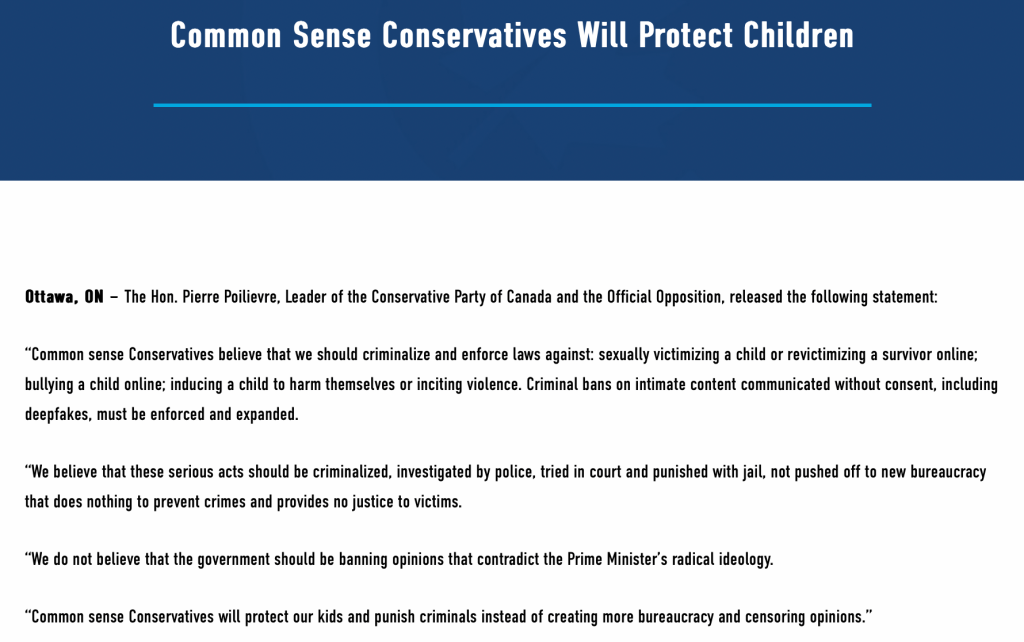
That’s why they just tabled a private member’s bill, C-412, An Act to enact the Protection of Minors in the Digital Age.

Here’s the Leader of the Opposition’s branding:

Beyond the bombast, the CPC bill is a serious piece of legislation, but of a different (and smaller) footprint than the government’s C-63. 

The Conservative bill requires social media and gaming platforms to design their tools, settings and recommendations of content and contacts to protect children, and only children, from harm. 

Unlike the government bill, there are no safety plans in the CPC bill for adults, not even for revenge porn or hate (although both are currently subject to criminal sanctions: the Conservative Bill would increase prisons sentences for revenge porn).

Leaving little work for a future regulator, the CPC bill gives explicit instructions to Internet platforms on what they must or must not do to protect children through safety settings that children and their parents can control or disable:

5 (1) Every operator must provide any parent of a user whom the operator knows or should reasonably know is a child, as well as that user, with clear and readily accessible safety settings on its platform, including settings to

(a) control the ability of other individuals to communicate with the child

(b) prevent other individuals from consulting personal data of the child that is collected by, used or disclosed on the platform, in particular by restricting public access to personal data;

(c) reduce features that increase, encourage or extend the use of the platform by the child, including automatic displaying of content, rewards for time spent on the platform, notifications and other features that could result in addictive use of the platform by the child; 

(d) control personalized recommendation systems, including the right to

(i) opt out of such systems, while still allowing content to be displayed in chronological order, with the latest published content displayed first, or

(ii) limit types or categories of recommendations from such systems; and 

(e) restrict the sharing of the child’s geolocation and notify the child and their parent when their geolocation is being tracked.

Default settings

(2) The operator must ensure that the default setting for the safeguards described in subsection (1) is the option that provides the highest level of protection.

It’s shrewd retail politics and allows the Conservatives to say “limiting screen time,” “protect children,” and “parents’ rights” all in the same sound bite.

What seems to have slipped under the radar is that their bill authorizes interference with algorithmic recommendations, previously the centrepiece of the Conservatives’ opposition to the Online Streaming Act.

What’s next for these bills is subject to the whirlpool of Parliamentary politics. It’s not clear when (or if) the Conservative bill might be cleared for mandatory debate by MPs sitting in the House Justice Committee. The same committee has yet to schedule the government’s bill. 

***

The battle over the Netflix Bill C-11 continues to flare. With an election in the air, the foreign streamers are engaged.

This week Netflix announced it was pulling training and development funding — vaguely described as $25 million spent over the last few years— from Canadian creator projects such as the Pacific Screenwriting Project and the imagineNATIVE film festival. Netflix gave the Globe and Mail a statement blaming its cancellations on the CRTC’s cash levy on foreign streamers to support financing subsidies to Canadian news and entertainment programming. 

Netflix is already appealing the CRTC’s  $52 million annual cash levy to the Federal Court (my estimate based on 3.5% of $1.5 billion in annual Canadian revenue). 

Netflix had previously told the CRTC it would support a 2% charge, but strenuously objected to any of its cash going to the Independent Local News Fund. 

Netflix had also pitched to the CRTC that its training and development deals with various Canadian creative organizations ought to be deducted from the cash levy (training funds are also not deductible from the 5% levy paid by Canadian cable companies). 

The CRTC has enveloped Netflix’s 3.5% levy like this:

  • 0.5 % ($7.5M) to the Canada Media Fund for CanCon television series
  • 0.5% to the Indigenous Screen Office to support television productions 
  • 0.5% shared by the Black Screen Office, the screen fund for BPOC creators and the Broadcasting Accessibility Fund
  • 0.5% shared by funds supporting producers in official language minority communities in Québec and English Canada, as well as diverse communities; and
  • 1.5% ($22.5M) to support newscasts at independent local stations.

[The list above has been revised and corrected from the original blog post]

Netflix’s grievance is that it ought to be given special regulatory treatment to deduct training and development funding of Canadian recipients of its choosing. (There is no public information available on whether there are strings attached to their funding).

The door is not closed on Netflix making its argument to the CRTC, however. When the Commission completes its regulatory assessment on Netflix and the other video streamers by setting expectations of direct spending on Canadian shows for their services, the streamers can make the same pitch to deduct training and development commitments.

In the same fighting spirit, the US-based music streaming lobby group Digital Media Association is launching a Canadian online petition campaign (see photo above), accompanied by messaging on its services guiding Canadians to the petition. The “Scrap the Streaming Tax” site threatens consumer price increases expressed in a vocabulary similar to the Conservative Party’s “scrap the Carbon Tax.”

Google did a similar campaign two years ago to mobilize opposition to Bill C-11. Canadian cable companies also launched a “Stop the TV tax” campaign in 2009.

***

Here are two new information releases that you can nerd out on.

The CRTC released its “what we heard” report that summarizes public comments on whether and how to revise Canadian content rules for video entertainment. This is a first step towards a public proceeding on possible revisions to CRTC rules that accredit video programming for regulatory compliance.

The Commission also posted for comment an application from APEM, the French-language song publishers’ organization, asking the CRTC “to collect data from the main online music streaming services and to make them public in order to provide the entire sector with a status report on the listening, showcase and recommendation of musical selections in Canada.”

***

If you would like regular notifications of future posts from MediaPolicy.ca you can follow this site by signing up under the Follow button in the bottom right corner of the home page; 

or e-mail howard.law@bell.net to be added to the weekly update; 

or follow @howardalaw on X or Howard Law on LinkedIn.