Catching up on MediaPolicy – Netflix is Rex – Miller is minister – CRTC vets Meta’s news ban

AI image

December 7, 2025

This week’s blockbuster news is that Netflix edged out Paramount to buy Warner Brothers for $82 USD billion. The deal immediately depleted the supply of adjectives at the disposal of media analysts. 

If the deal closes as scheduled in late 2026, Netflix buys up the world’s biggest movie archive and keeps it out of the hands of a major rival with the second biggest (Netflix is number three).

Netflix is paying a heavy price tag and arguably overpaid (you know who pays for inflated merger valuations, it’s subscribers and workers). Netflix goes from its status as the streaming industry’s 900-pound gorilla to, I dunno, T-Rex stature?

The public commentary on the deal is mostly doomsaying. 

It speeds up the chiselling of the tombstone for the theatrical release industry.

In a press release, Netflix CEO Ted Sarandos said shareholder value would flow from adding HBO and the full Warner Brothers archive to the Netflix “best in class streaming service:” his pro forma commitment to theatre release was relegated to a subordinate sentence clause.

But if the merciless dispatch of theatrical-release seems inevitable, and just the law of the marketplace jungle, what is of long term concern is the anti-competitive effect on the pipeline of big-budget premium video entertainment. The Globe & Mail’s Barry Hertz has a good analysis here.

The Netflix deal is a prime candidate for anti-trust review by the Trump administration (especially as Netflix outbid Friend-of-Trump Paramount). 

That review could go in any direction but things to watch for include (a) Trump reviving his threat to levy tariffs on foreign movies and the offshore shooting of Hollywood blockbusters, and/or (b) using the anti-trust hammer to get something that he personally wants, which could be commitments to US-based production or some vanity trophy we can’t imagine right now.

It’s not that Sarandos can’t see that coming. In his press release he said the acquisition would allow Netflix to expand its US based production, a gimme that doesn’t commit him to a rate of new releases equal to “Netflix plus Warner Brothers” but only “Netflix plus a dollar.”

Any Trump-driven re-shoring of studio production could hurt the two offshore leaders of Hollywood production, the UK and Canada (and hurt Hollywood too, but that’s a longer discussion).

Beyond that, the effect on Canadian-owned broadcasting could be massive. Netflix is buying Warner Brothers’ Home Box Office streaming service and catalogue which may or may not be integrated into the Netflix platform, once subscription pricing is figured out. The press release suggests HBO content will be on the Netflix platform, at least in the US. 

Here in Canada, there is no HBO streaming service and Bell Media holds the exclusive license to distribute HBO on the only Canadian streaming service of consequence, Crave TV.

You would have to question whether Netflix has any interest in continuing that Canadian licensing arrangement when it expires and, in fact, Netflix has an excellent opportunity to severely wound its only Canadian-owned competitor.

Without that profitable HBO content, Bell’s ability to keep funding Canadian content takes a big hit. 

***

Canada has a new Heritage minister, Marc Miller.

That’s the fallout from Steven Guilbeault’s cabinet resignation over Prime Minister Mark Carney scrapping the Trudeau/Guilbeault policies on oil production, emissions, pipelines, oil tankers and clean energy regulations.

Miller continues a long tradition of the Liberals appointing an MP from the island of Montréal to the Heritage portfolio.

But of course Miller is the first anglophone the Libs have picked for that job since Hamilton’s Shiela Copps —-who was born ready to butt heads with the US on cultural sovereignty. She did the job from 1996 to 2003 under Prime Minister Jean Chrétien. 

The feisty Miller is prone to speaking with candour, as a rule. That’s already got him into a spat with CAQ premier François Legault who didn’t like Miller insisting on making a distinction between “the decline” and “fragility” of the French language in Canada and Québec. The Bloc dutifully piled on.

Guilbeault was the federal champion of Canadian and French language content in Québec and as the new Heritage minister no less will be expected of Miller. His life will get very interesting in about six months when CUSMA negotiations begin.

Will Miller become the political reincarnation of Shiela Copps? It’s up to Mark Carney, just as it was up to Jean Chrétien.

***

It looks like the CRTC’s investigation into whether Meta is selectively enforcing its made-in-Canada ban on news content has come an end. The CRTC’s brief discharge letter to Meta was published last week.

You can still find news items on Facebook and Instagram in Canada, despite Meta’s avowal that it banned news to take itself outside of the scope of the compulsory licensing of “news content” in the Online News Act.

Meta must have satisfied the Commission staff that it is sticking to its ban by taking down news items posted by Canadian users and by deleting user screenshots of articles. If you want to know how the Commission reached its conclusion, you won’t find it in the letter. 

What remains unresolved, or perhaps resolved only to the Commission’s private satisfaction, is Meta permitting posts from news outlets like Narcity and The Peak who successfully applied to Meta for what they describe as “exemptions” from the news content ban.

Without more transparency, one can only guess if Meta’s exemption of hand picked news outlets violates the statutory prohibition against digital platforms discriminating for or against selected news outlets. 

In the case of Narcity, its publisher claimed that Meta granted an exemption because Narcity was refused certification for federal journalism labour tax credits on the grounds that it doesn’t publish enough original news on current affairs. 

But certification for federal subsidies program doesn’t mean that a news outlet isn’t producing some news content, or pieces of news content, as defined by the Online News Act, which Meta says its banning to avoid paying for it. 

The Peak also recently announced that Meta gave it “an exemption” and I invite you to have a look at the news articles it’s allowed to post on Facebook and Instagram.

If you go looking, keep in mind that the “news content” that Meta is supposed to be banning in order to escape the gravitational pull of the Act includes “any portion” of news content. 

The Commission’s original inquiry into the news ban appears to have been its own idea, so the fact that it hasn’t published its reasons at any length is not a total surprise. No Canadian news organization has filed a complaint. 

***

If you would like regular notifications of future posts from MediaPolicy.ca you can follow this site by signing up under the Follow button in the bottom right corner of the home page; 

or sign up for a free subscription to MediaPolicy.ca on Substack;

or follow @howardalaw on X or Howard Law on LinkedIn.

COMMENTS ARE WELCOME. But be advised they are public once I hit the “approve” button, so mark them private if you don’t want them approved. 

I can be reached by e-mail at howard.law@bell.net.

This blog post is copyrighted by Howard Law, all rights reserved. 2025.
Catching up on Media Policy: Canada dips in the World Press Freedom index after journalist arrests – Trump’s 100% tariffs on Hollywood

May 6, 2025

The annual World Press Freedom index is not something all national governments dread.

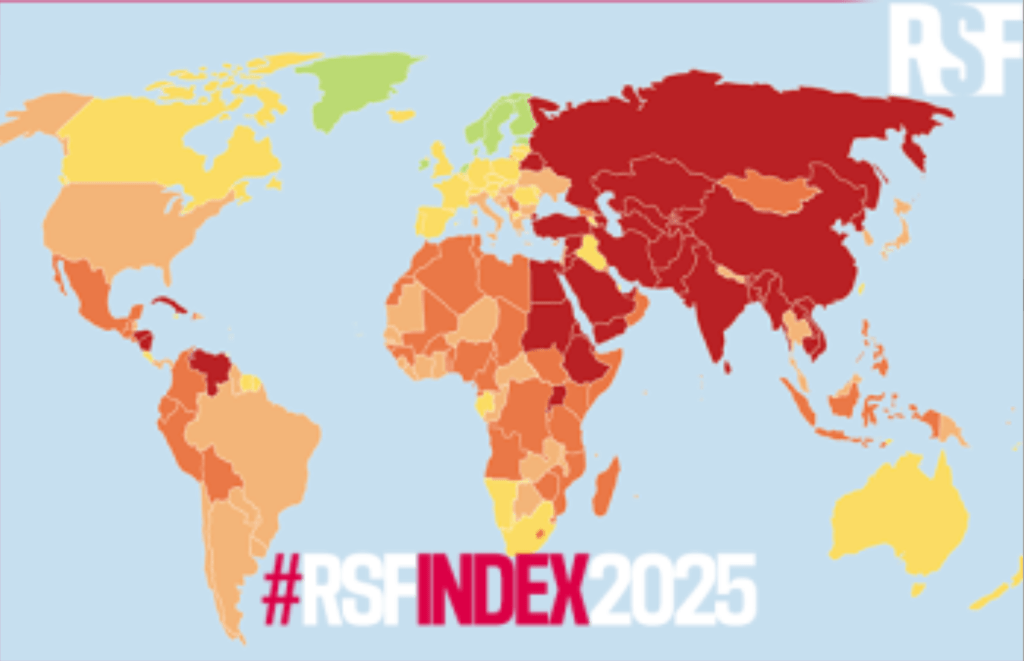
If you’re Norway (1st of 180 surveyed nations) or China (178th) you aren’t going to sweat what Reporters Without Borders, a Paris-based NGO best known for public campaigns against the murder or imprisonment of journalists, has to say.

But in between, maybe liberal democracies that think highly of themselves are in for a humbling moment.

This year, Canada’s global ranking is 21st, down from 14th because its index score, spread across five categories of political, legal, economic, social and safety considerations, fell from 81.7 to 78.75 out of 100 points. The US is 57th, France is 25th and the United Kingdom is 20th.

In who’s opinion, you might ask: in each of 180 nations, Reporters Without Borders asks local news journalism experts and practitioners to respond to a series of standardized “press freedom” questions that plumb the depths of journalists’ ability to report on the news without interference.

According to the RWB website:

Press freedom is defined as the ability of journalists as individuals and collectives to select, produce, and disseminate news in the public interest independent of political, economic, legal, and social interference and in the absence of threats to their physical and mental safety.

The Canadian report does not moot the debate over Canadian media subsidies and regulation, to the contrary across 180 nations strong public service broadcasting tends to drive higher scores.

The Index is as much a monitor of a healthy Press as freedom from state power. Broader social, political and economic factors that support or attack a free press play an important role in the scoring.

The editorial notes that accompany Canada’s score suggest that the police arrests of Canadian journalists covering volatile news sites —blockades, demonstrations and encampment clearings— drove down our ranking.

That concern also appears in Reporters Without Borders election-related statement that called for better training of Canadian police in their treatment of journalists as the top public policy priority.

RWB’s other recommendations included protecting the CBC from defunding, a ban on police spyware aimed at journalists, and a rebuilding of Canada’s “broken” access to government information mechanisms (the new Prime Minister having shown some interest in the latter).

RWB also noted the existence of “a patchwork of [media subsidies] policies” that beg for “a comprehensive and consistent strategy that helps enable the media to innovate and find news models of sustainability.”  

The latter point was included in my own list of things for the next Culture & Identity Minister to do, posted last week: Miles to Go: the Media Policy work of the 45th Parliament.

In next year’s report, we’ll likely see an impact on ratings from CTV’s firing of Rachel Gilmore as a guest election fact checker because of trolling by right-wing actors.

***

This is my last post for a month thanks to our first real vacation since pre-pandemic times. It’s a bit of a science experiment: can four adults manage a two-year old while travelling? Should be possible.

I couldn’t leave without commenting on Donald Trump’s latest announcement of a 100% tariff on Hollywood’s movie production outside the U.S.

It will be a popular move in the US. Hollywood is making less audio visual content globally and in the United States owing to a number of factors, most noticeably budget cutbacks in response to the saturation of the subscription streaming business.

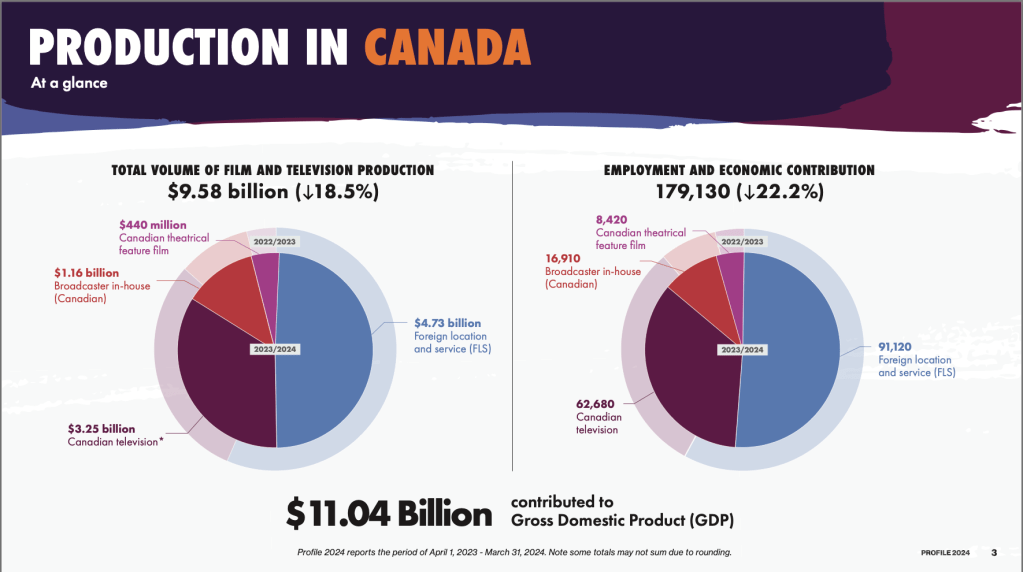
Canada is Hollywood’s biggest non-American supplier of movies and television shows: half of Canada’s $9.58 billion in annual production is for American shows and much of our Canadian content is widely exported to the American market for second runs. The employment hit could be substantial, as this screen capture from the CMPA’s Profile report reveals:

The obvious Canadian counter-tariff is a 100% surcharge on American-made shows exported to Canada. Those would hit Canadian broadcasters filling their schedules with American programming (Corus, TVA, CTV, Bell Crave, etc) but also Netflix and the other American streamers who sell to Canadian subscribers.

It’s not likely that Hollywood asked for the Trump tariff: the studios rely upon the high-quality, competitively priced production centres across Canada, but mostly Toronto and Vancouver.

The tariff disrupts their supply chains and their budgeting, not unlike the Trump tariffs hitting the auto industry.

A White House spokesperson walked back the President’s announcements within hours —-“no final decisions“— suggesting a WTF phone call from the Motion Picture Association.

Shortly afterwards, Trump’s “Hollywood ambassador” Jon Voight made a public statement suggesting that his recommendations to the President had been to boost tax incentives and subsidies for domestic production, negotiate international co-production treaties, and apply tariffs in some situations.

At the CRTC, the Motion Picture Association and the US streamers have put almost all of their strategic capital on securing a minimal commitment to offering Canadian content because the studios spend so much money making American movies in Canada.

That strategy is now in shreds.

A recommended article on the tariff is by Barry Hertz in the Globe & Mail.

***

If you would like regular notifications of future posts from MediaPolicy.ca you can follow this site by signing up under the Follow button in the bottom right corner of the home page; 

or sign up for a free subscription to MediaPolicy.ca on Substack;

or follow @howardalaw on X or Howard Law on LinkedIn.

I can be reached by e-mail at howard.law@bell.net.

This blog post is copyrighted by Howard Law, all rights reserved. 2025.

Catching up on MediaPolicy – Canadian culture first – Spotify the Colossus – the CRTC’s better late than never – The Shapiro Oracle speaks to Will Page

February 1, 2025

The illegal Trump tariffs begin today, heralding trade war.

Last week MediaPolicy posted an editorial of sorts, calling for elected politicians to greet America First with Canada First in trade negotiations over culture. 

A flimsy “cultural exemption” in our free trade deal with the US dates back to 1987. As intended, it offers no more than a speed bump to powerful US media and tech companies determined to dominate Canadian cultural consumption. It needs to be locked down.

How and when that happens in the permanent state of Trump chaos that we’ll endure for the next 1500 days isn’t clear.

Tariffs now, tariffs later,

tariffs done or undone.

How’s the weather in Newfoundland?

***

Spotify is feeling it. 

In this week’s corporate blog post, the Netflix-of-music-streaming stands triumphant.

As the colossus of the audio industry, Spotify is more than twice the size of any of its nearest competitors TenCent, YouTubeMusic, Apple and Amazon, with over 220 million paid subscribers. 

As the proud vanquisher of Napster and the torrent pirates, Spotify reports that every industry metric is looking up. Altogether, audio steamers have a half-billion paid subscribers signed up around the world. Spotify music VP David Kaefer says a billion is the next goal. 

Kaefer also says musician earnings are way up over the last ten years, with the top 10,000 musicians on Spotify —out of 10 million— earn at least $100,000 USD annually. That money is shared with band members and songwriters.

Spotify earnings are 25% of a typical “musician’s” total income, he estimates, adding to income from other streaming services, downloads and live performances. 

The “long tail” of music creators uploading to streaming platforms, to quote music economist Will Page, “is very long and very skinny.”

***

The CRTC is expected to announce in March a public consultation on a policy framework for audio streaming and radio.

On the streaming side, the cash contribution of 5% of Canadian revenues was established by the CRTC last June, so this new consultation will likely focus on other things; the discoverability and prominence of Canadian songs being the logical focus.

The Commission just now put out a request for proposals for a third party research study of the prominence and discoverability of Canadian audio and video content. 

Well, better late than never, no? The results won’t be reported until November and will be unavailable for the policy framework.

In response to a MediaPolicy inquiry, commission staff said the report findings would be available when the commission moves into its third phase of setting tailored regulatory terms and conditions for streamers in 2026.  

***

The recommended podcast for the week is an episode of Bubble Trouble, music economist Will Page’s platform. 

He’s invited media oracle Doug Shapiro onto his show. MediaPolicy often recommends Shapiro’s Substack page, The Mediator. 

If you follow either tech or media news in the most cursory way, you’re going to find this interview about the past, present and future of media as riveting as I did.

If podcasts aren’t your thing, I found a LinkedIn post from Midia Research’s Mark Mulligan who has some out of the box thoughts about how music streaming algorithms that chase listening time above all else will drive away some artists, hardcore fans, and discerning listeners, into the emerging ecosystem of Do-It-Yourself distribution.

***

Here’s an update on my January 1st post about polling conducted by TMU’s The Dais School of Public Policy. 

No thin skins for them, the folks at The Dais acknowledged the point I raised about how its annual survey questions failed to solicit the experiences of Jews and women with online hate. 

The Dais also saw some merit in my observations that their poll questions testing Canadians’ susceptibility to misinformation on the basis of political ideology were torqued towards right-wing conspiracies and misinformation. 

To its credit, The Dais is going to review these issues in preparation for its 2025 survey.

***

If you would like regular notifications of future posts from MediaPolicy.ca you can follow this site by signing up under the Follow button in the bottom right corner of the home page; 

or sign up for a free subscription to MediaPolicy.ca on Substack;

or follow @howardalaw on X or Howard Law on LinkedIn.

I can be reached by e-mail at howard.law@bell.net.