
July 1, 2026
In my last post, I spent time teasing out the nuances of how the Reuters Oxford 2026 report on digital news analyzes “trust in news.” The gist of the post was: look at the right “trust” numbers before rushing to judgment against Canadian news media in general and CBC/Radio Canada in particular.
The Reuters Oxford report coincided with the release of the Senate of Canada’s report on the CBC (which I will get to, below).
One of the items in the Senate report was that the CBC is perceived to have a bias problem that requires action. That single recommendation instantly grabbed the headline of reporting on the Senate’s work by competing news organizations.
Also released last month was the annual Pollara analysis of trust in Canadian media.
What is immediately striking about the Pollara results is that they quantify public trust in Canadian media at a much higher number than Reuters Oxford (51% versus 37% trust in all Canadian media), rebounding from a low point in 2022 and with even higher trust ratings than in 1992.
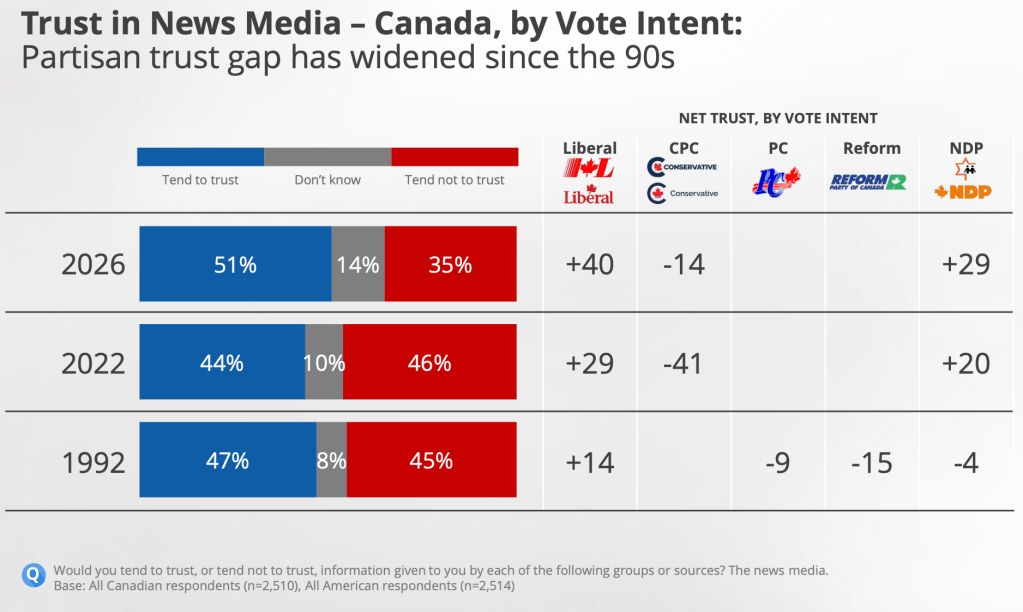
Mostly, Pollara asked the question differently than Reuters, a softer and yet binary question: do you “tend to” trust or distrust “the news media”?
By contrast, Reuters asks Canadians if you think you can “trust most news, most of the time.” Then on a scale of 1 (distrust) to 10 (trust), Reuters slots you into trust (6 through 10), distrust (1 through 4) or neither (5). That spits out the 37% figure for Reuters, suggesting there are a lot of grudging sixes in that cohort of trusting respondents.
The grain of salt here is that whether the trust number is 51% or 37%, Canadians are being invited to pass judgment on the entire news ecosystem, including the news outlets you don’t trust and the clickbait you see on social media.
But as I mentioned in the last post, beyond looking at the entire news ecosystem, you need also to take note of the trust numbers for individual news outlets.
For each news source, Pollara has three simple categories: trustworthy, not trustworthy and “not familiar.”
On the other hand, Reuters polls Canadians on each news source using its 1 to 10 scale and then slotting all of the 6/7/8/9/10s as trust, the 1/2/3/4s as don’t trust, and the fives as “neither.”
Under either poll (for English language news), the positive trust figures track almost the same: in order of trust, CBC or CTV on top, then Global News, followed by the Globe & Mail, and then the National Post or the Toronto Star.
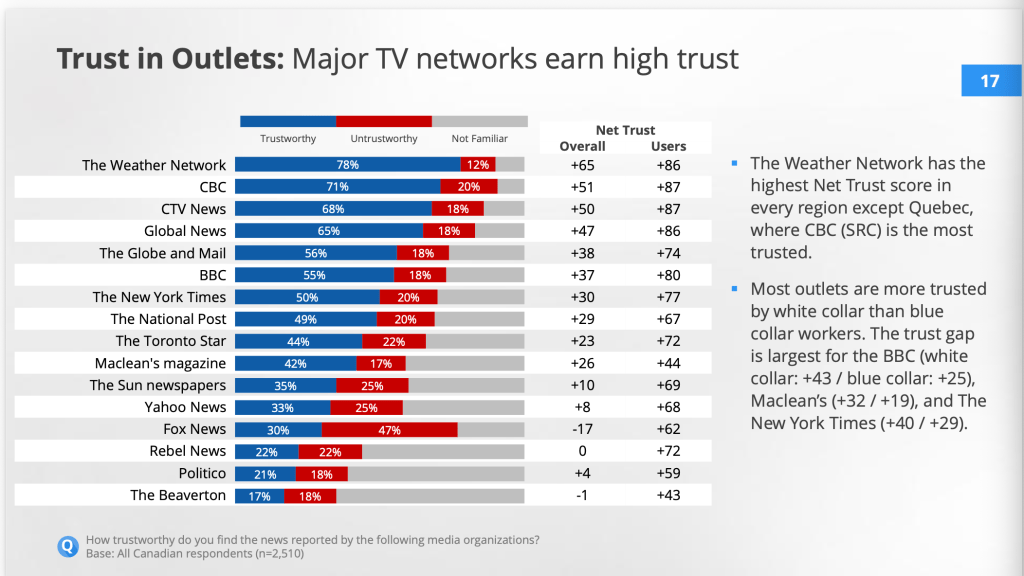
Pollara
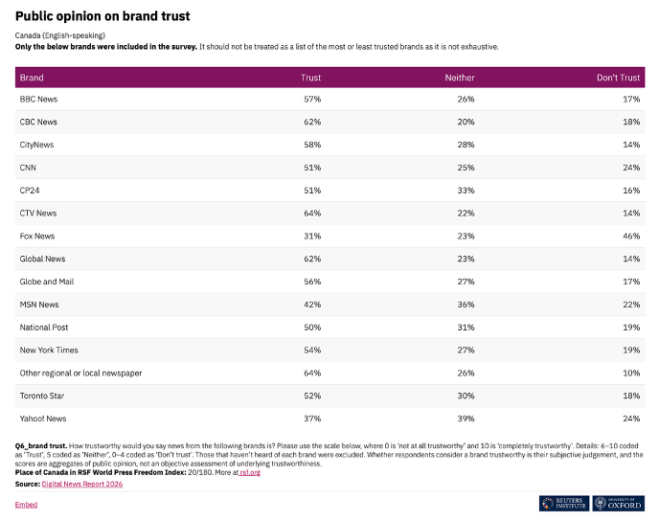
Reuters Oxford
Notice the pattern?
Like in a cycling road race, the major Canadian television broadcasters are the leader pack (ranging from 62% to 64% in the Reuters poll) while the national newspapers are further back, clustered in the 50% to 56% range (local or regional newspapers are more trusted however). Explain that if you can, but it occurs to me that newspapers regularly publish opinion columnists, opinion editorials, and election endorsements.
Television newscasts limit their overt opinionating to (somewhat) diverse political panelists.
Feel free to disagree.
But don’t feel free to disagree about this fact. CBC News is killing it. It’s as trustworthy as its major competitors and significantly more so than the Brahmin of text journalism, the Globe & Mail (and far more than the conservative National Post and the centre-left Toronto Star).
Yet all we hear is the drumbeat of criticism that CBC News is biased, or alternatively that all that counts is the perception that it is biased (to be fair, its negative trust rating is slightly worse than most of its competitors’ except for the Post and the Star).
If I sound dismissive of the bias accusations, I’m not. The fact that polls reveal the CBC’s negative trust ratings accumulating in the West and among Conservative voters tells you there is something about the editorial curation that isn’t working (here’s my two cents worth). Defunding or not, if the West or Conservative voters “want in” to a national institution like the CBC, open the door.
This bias hot potato got batted about in the Senate Report on the CBC, the outcome of a Senate Committee investigation initiated by Senator Andrew Cardozo in late 2024, an especially precarious political moment when the countdown to a Pierre Poilievre cancellation of English language CBC seemed only to be a matter of time (and arguably, still is).
Cardozo kicked off the inquiry with his own multi-point analysis of the CBC, (reviewed by MediaPolicy here, but see the disclaimer at the bottom of this post).
The mandate handed by Senators to its Transportation & Communications committee was focussed on local media: “to examine and report on the local services provided by the CBC/Radio-Canada .”
After 60 witnesses and 18 months, the Committee came up with a series of recommendations that could be distilled to this:
- The CBC should put more resources into local reporting and programming, especially in news-scarce localities and official minority language communities and regions.
- Long term Parliamentary funding should be established to pay for that coverage, making the CBC less vulnerable to budget cuts by the government of the day.
- To make it national policy, the Broadcasting Act should be amended to explicitly include “local” coverage to its priority coverage (in addition to “regional and national”).
- Just in case, the CRTC should reinforce this emphasis on local through its licensing conditions for the CBC.
- Keeping in mind the force of gravity that the CBC poses to private local media, the CBC should find more ways to collaborate with local outlets.
- The CBC should disclose more data about its resourcing of local news so we can measure how it’s discharging its mandate.
Meanwhile to confront the perception or accusation of journalistic bias, the committee recommended that the CBC should commission an annual third party study of bias in its news reporting.
The auditing recommendation was a gimme. The fact that the Senate committee felt it was necessary to recommend it was taken in some quarters as a guilty verdict for its many journalistic crimes, but candidly it was a bone to throw to CBC critics and haters, the latter category being inconsolable. An audit is a good idea for any public broadcaster, especially with the aid of AI analysis, because the CBC shouldn’t just have industry leading trust ratings for its news product, it should have great ratings.
One of the ways to improve the CBC’s trust ratings, aside from a consciously diverse editorial curation that addresses Western and conservative alienation from the public broadcaster, is to put more money into local coverage across the country with a particular emphasis on the long under-resourced Western provinces.
The CBC seems to be doing that in the last year by announcing more local reporting bureaus and journalists in the Prairie provinces.
But it all comes back to funding. Reporters are expensive and it’s a big country.
On this point, we can argue until we are blue in the face about the adequacy of the $1.3 million annual Parliamentary grant to the public broadcaster.
But I will say the quiet part out loud: whether that grant is more, less or the same, satisfying every Canadian’s idea of what the CBC’s programming priorities ought to be is not possible. As one witness told the Senate committee, the CBC “is drowning in mandates.”
The CBC is formally independent so we’ve been letting CBC management decide on its own what matters most. Lately it seems to have alit on local news as the priority. But if that’s going to be done with gusto, something else in the mandate has to give. The shell-shocked executives at the public broadcaster will be inclined to be risk averse, so the Senate committee might be disappointed in its recommendations.
The ball is in the court of culture and identity minister Marc Miller, which is to say it’s aimlessly bouncing about in the Prime Minister’s Office. The passive neglect of the CBC policy file, and the false election promises of significantly increased funding for the public broadcaster, are both on Mark Carney.
***
(Disclaimer: Senator Cardozo and I co-authored a research paper for the Senate, Making News Media Sustainable. The study focusses on funding for private news media).
***
If you would like regular notifications of future posts from MediaPolicy.ca you can follow this site by signing up under the Follow button in the bottom right corner of the home page;
or sign up for a free subscription to MediaPolicy.ca on Substack;
or follow @howardalaw on X or Howard Law on LinkedIn.
COMMENTS ARE WELCOME. But be advised they are public once I hit the “approve” button, so mark them private if you don’t want them approved.
I can be reached by e-mail at howard.law@bell.net.
This post is copyrighted by Howard Law, all rights reserved. 2026.

