June 20, 2026
After getting challenged by CTV’s Vassy Kapelos for his government’s June 3rd “capitulation” on the Online Streaming Act, culture and identity minister Marc Miller travelled to the Banff World Media Festival this week where the Globe and Mail’s Barry Hertz put the same proposition to him.
“Look, well, it’s wrong,” said Miller rejecting the “capitulation” label. The minister is preparing to issue new instructions to the CRTC on foreign streamer contributions to Canadian content.
“There isn’t a chance that we won’t stand up and make sure that Canadian culture gets supported. I certainly do understand the frustration, because there’s been a lot of blood shed and battles fought on these grounds. … But you can have all the aspirations in the world to make sure that people are doing what they’re supposed to be doing, but if that doesn’t work, we have to act. And this reflects my impatience, and the Prime Minister’s impatience, to make sure that we are creating some stability in the system.”
Hertz also asked Miller if Netflix and the other US streamers would ever pay anything into Canadian media funds that subsidize Canadian content, given that Netflix had volunteered to the CRTC in 2023 that a two per cent levy was acceptable.
Miller responded that “we have to have that conversation with streamers, which has yet to occur in any developed form. My colleagues in the Bloc Québécois assume that it will go down to zero. That isn’t the case. We want people to pay what they would on a fair basis, and you can compare it to some other jurisdictions. It may be a staggered process of policy directions. I want to get it set out quickly, so we can get the ball rolling.”
Miller’s answer appears to contradict a government source in an earlier Globe and Mail story who said the government would direct the CRTC to levy no cash contributions on streamers at all.
Next, Miller was asked if the government is confident in its assumption that streamers can successfully pass along the CRTC’s 6.55% cash levy to Canadian subscribers given the aggressive price increases of the past years in an industry notorious for subscriber churn. Research from the EU suggests regulatory charges don’t necessarily get passed along.
“Not to minimize the counterpoint that you’re making,” he responded, “but we have seen in some of those jurisdictions an increase in production costs, which is an affordability issue from another angle.”
In other words, the government’s assumption of a subscriber paid “Netflix tax” is based not only on the CRTC’s order of 6.55% streamer cash contributions to media funds but also an assumed increase in streamer production costs arising from the CRTC order for streamers to spend 8.5% of Canadian revenues on making Canadian shows for their own platforms. (The EU study did however take that into account).
Finally, Hertz got to the salacious stuff and asked Miller what he knew about the private meeting that the Prime Minister had with Netflix CEO Ted Sarandos a week before his June 3rd announcement of the government bailout.
The minister said he didn’t know.
“I don’t know what was discussed, to be honest I know they met, and he meets with a lot of people in the industry. I don’t think that anyone meeting would shape policy in any way that’s material.”
Meanwhile according to Hertz’s further reporting, the Canadian producers attending the Banff festival were generally in a state of disorientation following the government striking down the Netflix levies and promising to replace the CanCon production money from a $600 million increase in federal cultural spending.
Like any entrepreneurs investing in multi-year projects, Canadian film producers need to know where their financing is coming from before they start taking out loans and passing on other projects. More than half of their production budgets come from government tax credits, media funds, and direct investments by broadcasters and, until June 3rd, foreign streamers too.
The government promised to replace the streamer money with taxpayer cash but for now no one knows when, how much, or what the program rules might be.
Yet despite all appearances to be making it up as they go along, there are signs that the federal Liberals know what they are doing but are keeping their cards close to their vest.
One clue is the special industry committee that Miller created in April to advise on the future of Canadian video production. In a press release, the government offered no details on the committee’s mandate. Neither did officials for the Canada Media Fund, the public-private subsidy fund central to any changes in the bundle of financing sources that consists of investments from independent Canadian producers, Canadian broadcasters, foreign streamers, and federal and provincial governments.
Now we have a second clue: a document obtained by veteran journalist Dean Beeby (who was kind enough to share it with me) written in October 2025 by former deputy heritage minister Isabelle Mondou for then-minister Steven Guilbeault. Commissioned immediately after the Carney government was elected in April 2025, the lightly redacted report appears to have three major recommendations:
- Identify efficiencies by combining the program administration of Canada Media Fund, the National Film Board and Telefilm Canada.
- Formulate an “integrated vision of audio-visual production.”
- Align the funding mandates of federal subsidies (i.e. the Canada Media Fund and the CPTC tax subsidies) with that vision.
One of the salient points made by the deputy minister is that government CanCon subsidy is overwhelmingly dedicated to production financing and is underwhelming in its support of pre-production development and post-production distribution and export strategies. Although the final recommendations are redacted in the document, the deputy minister’s observation correlates with advice from some Canadian commentators that a policy shift is overdue (and see the item on the Fox-Roku merger, below).
The Mondou memo was signed off eight months ago by Guilbeault, so it may be that since then civil servants in the Department of Heritage have fleshed out a plan they want to run past the industry volunteers on the minister’s new committee.
It’s unknown if the new vision that emerges will dovetail with the minister’s other big files: rewriting instructions to the CRTC on streamer contributions, figuring out what that means for “equitable” contributions from Canadian broadcasters, and then replacing any shortfall from the $600 million bank account for federal cultural subsidies, also announced on June 3rd.
On another front, there is the policy storm moving in from a different direction: what to do about federal funding of news journalism.
Miller announced in May that the Carney government plans to extend federal QCJO journalism salary subsidies to broadcasting companies. The public consultation was also announced on June 3rd, the same day as the CRTC’s streamer levies were struck down. Those QCJO subsidies are scheduled to drop from 35% to 25% of journalist salary rates in 2027.
As well, the Netflix bailout scotched the annual $45 million in expected streamer contributions to the Independent Local Television News Fund earmarked as relief for the financially distressed Global News network and 19 other independent television stations.
The quashed streamer cash levies were also expected to put $40 million in annual radio news funding.
On yet another funding front, the federal government is cutting $10 million of the funding for weekly newspapers in the $85M Canada Periodical Fund .
With all of those funding cuts in the wind comes the news that Heritage is continuing its five-year review of the Periodical Fund but now also the $20M Local Journalism Initiative which was only recently reviewed.
Something’s up.
***
Another potential outcome of the Netflix bailout is whether the Liberals pay the price for their decision in Québec where electors rank cultural issues —-deeply intertwined with language issues—- near the top of their list. The Carney government’s shredding of the Trudeau-Guilbeault environmental policies is also on the list.
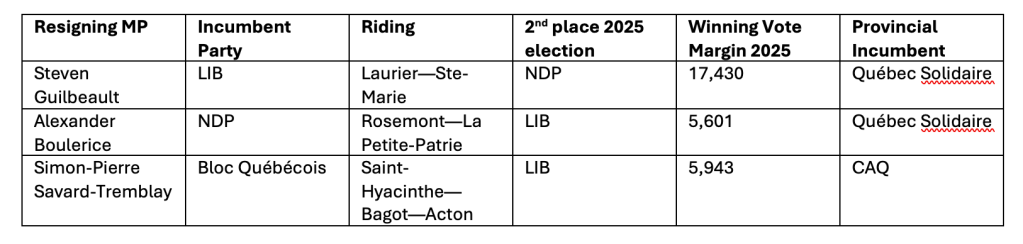
Not only is there a provincial election in October that could produce a separatist government spoiling for a fight with Ottawa, but the Bloc Québécois is gearing up for three federal by-elections in the greater Montréal area triggered by pending resignations from the House of Commons by Liberal Steven Guilbeault, the Bloc’s Simon-Pierre Savard-Tremblay, and NDP MP Alexander Boulerice. Two of the three ridings are sufficiently progressive to have elected Québec Solidaire provincially.
The Carney Liberals currently hold majority government by a three-seat margin.
***
The Senate Transportation & Communications Committee has released its report on the CBC.
The report made only seven recommendations, three of which can be summed up as arguing for a major pivot of the public broadcaster into local news.
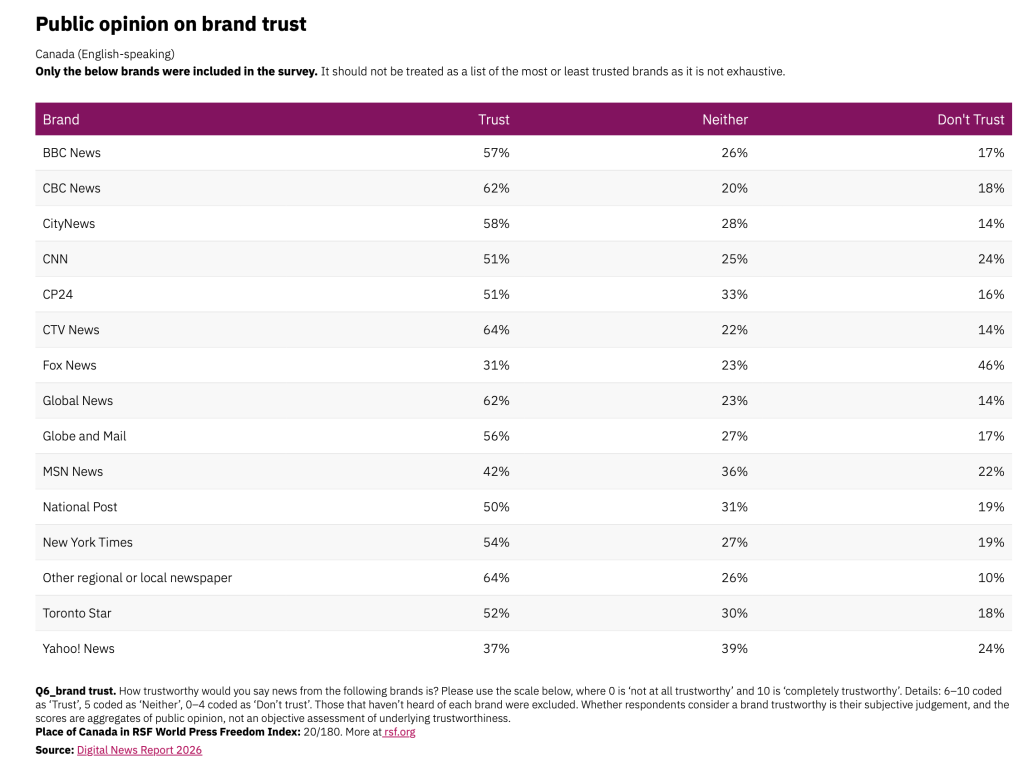
What grabbed headlines of course was the recommendation of a regular audit of CBC News content by an external consultant to assess for bias in news reporting.
Source: Reuters Oxford Digital News Report, 2026
***
Media merger activity in the US is getting frothy.
After the US Department of Justice announced it had no anti-trust concerns about the Paramount $110 USD billion takeover of Warner Brothers Discovery, the Wall Street Journal published a story with sources from “people familiar with the matter.”
The story was that DOJ staff lawyers were “leaning towards recommending” a DOJ anti-trust lawsuit blocking the merger when senior DOJ officials unexpectedly announced the green light for a “pro-competitive” merger. The focus of the staff investigation had been whether Paramount CEO David Ellison can deliver on a promise to increase, not decrease, the number of feature film productions given the extraordinary debt load incurred to buy Warner Brothers.
In an unrelated announcement, the Murdoch-owned and content-rich Fox Corporation is paying $22 USD billion to buy streaming distribution giant Roku.
Fox already runs its own free advertising streaming television (FAST) platform Tubi that engages 100 million active users each month. Fox will consolidate Tubi with the Roku’s industry-leading 80 million accounts that are integrated into its streaming hardware and content launch screens.
***
If you would like regular notifications of future posts from MediaPolicy.ca you can follow this site by signing up under the Follow button in the bottom right corner of the home page;
or sign up for a free subscription to MediaPolicy.ca on Substack;
or follow @howardalaw on X or Howard Law on LinkedIn.
COMMENTS ARE WELCOME. But be advised they are public once I hit the “approve” button, so mark them private if you don’t want them approved.
I can be reached by e-mail at howard.law@bell.net.
This post is copyrighted by Howard Law, all rights reserved. 2026


Howard
Where does the figure of 6.55 percent come from?
You talk about the “Netflix bailout” removing obligations for contributions, but the 5 percent levy is still before rhe Federal Court. What if the court upholds the CRTC? Any intel on timing for that decision?
Does the impending redirection to the CRTC necessarily affect the initial 5 percent “down payment” that is being challenged by the streamers?
Thanks
Hugh
Hugh Stephens
http://www.hughstephensblog.net http://www.hughstephensblog.net
LikeLike
The 6.55% is the 5% levy (with the 1.5% CMF opt-out now removed) plus the 1.55% SEI cash levy added in the May 21st ruling.
The court ruling will be moot regardless of whether it’s thumbs up or down for the streamers or the CRTC.
I doubt the court would interfere with the CRTC’s ruling that a non-news broadcaster can be asked to support news: after all, Telus, Cogeco etc already do that.
It’s possible the Court could accept Amazon’s argument that any CRTC levies had to be Gazetted before they could be implemented. It was an incredibly intricate legal argument. But all that means is an extra step.
Since the government has struck down the 2024 five per cent levies anyway, it’s moot right?
The only thing that remains is for the CRTC to direct the return of the escrowed streamer funds. I think they should make Carney sign the cheque.
LikeLike