July 5, 2026
Of the gamut of emotions that supporters of the Online Streaming Act ran through when Prime Minister Mark Carney overruled the CRTC’s 15% contribution scheme for Netflix and the foreign streamers, the most gut wrenching was betrayal.
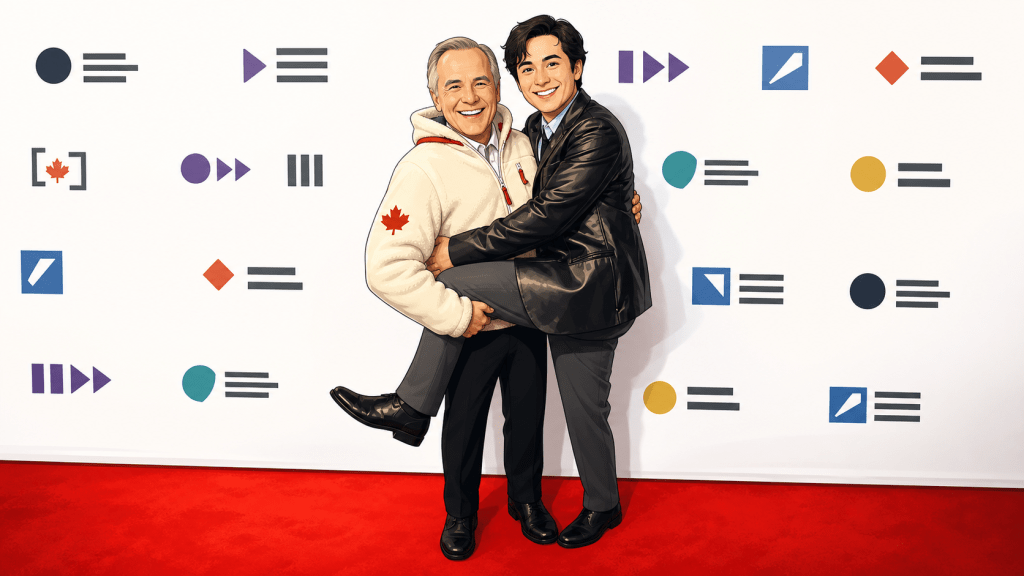
Who could forget only 125 days earlier Carney horsing around with Hudson Williams at the CMPA Prime Time conference, donning the iconic Team Canada fleece jacket from the TV series Heated Rivalry? The smash cultural hit was a demonstration of Canada’s “soft power,” said the PM, as he snuggled deeper into the jacket.
In my high school days, wearing the football team jacket was the prerogative accorded to the girlfriends of the young men on the championship team, showing up to class on a daily basis sporting the team colours.
Well, Carney’s bromance with film producers is over. Or at least they are very seriously taking some time apart. So there’s the problem of the jacket, you see.
Marie Woolf has a delightful story in the Globe & Mail reporting that the executive producer of Heated Rivalry, Brendan Brady, is taking back the fleece (or more precisely, putting on hold his promise to send it to Carney).
Said Brady, “We actually have one of those fleeces on hold for him that we want to send to him. But obviously I think we’re waiting to see how this goes and making sure that everything gets cleared up for the Online Streaming Act to be enacted for real for us, so we might just be holding off on that.
“If we’re on pause with the government, then the fleece is on pause until we know.”
Alternatively, Brady could raffle it off.
***
The Investigative Journalism Foundation published a story last week on the tax troubles of Honest Reporting Canada (HRC).
HRC is a media watchdog that appears to have two main functions: the first to stridently criticize by-lined journalists whose news stories it considers treat Israel unfairly.
The other is to offer journalist-facing content to educate reporters about controversial assumptions often made about the Israeli-Arab conflict without sufficient historical depth or geographic breadth.
The tax trouble is that as of a year ago the Canada Revenue Agency has been seeking to revoke the charitable status (“as a qualified donee”) of a related organization, Honest Reporting Canada Charitable Organization (HRCCO) on the grounds that it does not engage in any of the tax code’s short list of charitable activities.
Examples of the CRA’s approved spending on charitable objects include the relief of poverty or the advancement of education.
Also, the CRA told HRCCO that from the audit it performed HRCCO appears to be diverting charitable donations to pay the expenses of the media website, Honest Reporting Canada, which is not a registered charity.
The tax dispute is headed to the Federal Court of Appeal and in the meantime HRCCO has stopped accepting donations and the CRA has paused deregistration.
Honest Reporting Canada’s publishing generally does not include original news, which explains why it could not obtain “qualified donee” status directly under the federal government’s QCJO program of news subsidies. Probably for a similar reason, HRC is not eligible for Google journalism funds under the Online News Act.
The QCJO program allows non profit journalism organizations to become “qualified donees” of public donations, as an expansion beyond traditional tax parameters limited to education or the relief of poverty.
In general, US charity tax laws are more hospitable to public interest journalism than the Canadian tax code.
Meanwhile charities are free under Canadian law to engage in public policy dialogue and development activities connected to the legal purpose of the charity as long as they are not directly or indirectly partisan. Previously no more than 10% of donations were permitted to support political advocacy.

***
It’s not every day you ask yourself, “what would Konrad von Finckenstein do?”
In February 2011 the one-term CRTC chair (2007-2012) made a ruling he thought was good public policy —-allowing ISP providers to charge more to heavy consumers of data —only to be publicly slapped down by the Harper government that had appointed him.
Von Finckenstein was outspokenly defiant in response to the government’s public rebuke although in the end his Commission came up with a compromise. He was not reappointed when his term expired a year later.
In a recent appearance on Michael Geist’s half-hour podcast, Mark Musselman is unsparingly candid about the current CRTC chair Vicky Eatrides meekly submitting to her now diminished independence on implementing the Online Streaming Act.
Musselman has the gift of the explanatory gab and calls it as he sees it (and his narrative just happens to line up with the MediaPolicy’s posts on this topic). We part company at about the 27th minute when he describes the current federal policy on supporting film and television as outdated and in need of something new.
Still, the podcast is well worth your time.
***
If this was a blog site devoted to American media policy, not Canadian, we could spend a lot of time tracking the never ending mergers and corporate somersaults that feature south of the border.
Here are a few in the recent past:
- TikTok spun off its American operations with Oracle founder and billionaire Larry Ellison taking control.
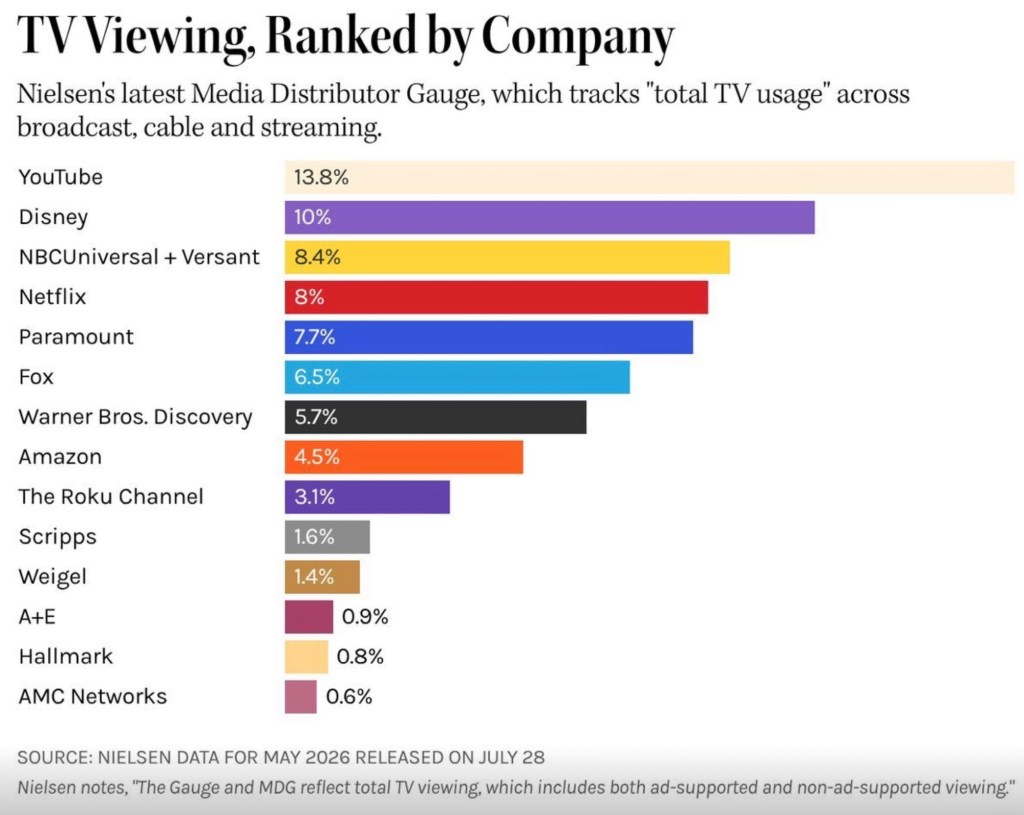
- Ellison is the money behind Paramount’s take-over of Warner Brothers Discovery, leaving Netflix as the jilted suitor flush with an unspent dowry.
- The Murdoch family’s Fox Entertainment has bought Roku, combining Fox’s content empire with Roku’s extensive home distribution network.
The latest is that Comcast is spinning off its content division, NBC Universal, into a separate company.
This is seen as an acknowledgement of the fading benefits of combining NBC Universal content with Comcast cable distribution, despite Comcast going out of its way to buy NBC in 2011.
Comcast shares bounced up following the announcement that it was cutting NBC Universal loose. More long term, the plan is for Comcast to focus its efforts and its capital on competing with other cable and fixed wireless distribution networks and to free itself of the less predictable media business.
The new NBC Universal would arguably be in a better position to make deals with other distributors not named Comcast. But the sleeper in this new arrangement may be that it becomes a takeover target for Netflix.
Meanwhile, the 900 pound gorilla YouTube has asked that its sleep not be disturbed.
***
I cannot sign off this week without stating my admiration of the Canadian men’s national soccer team.
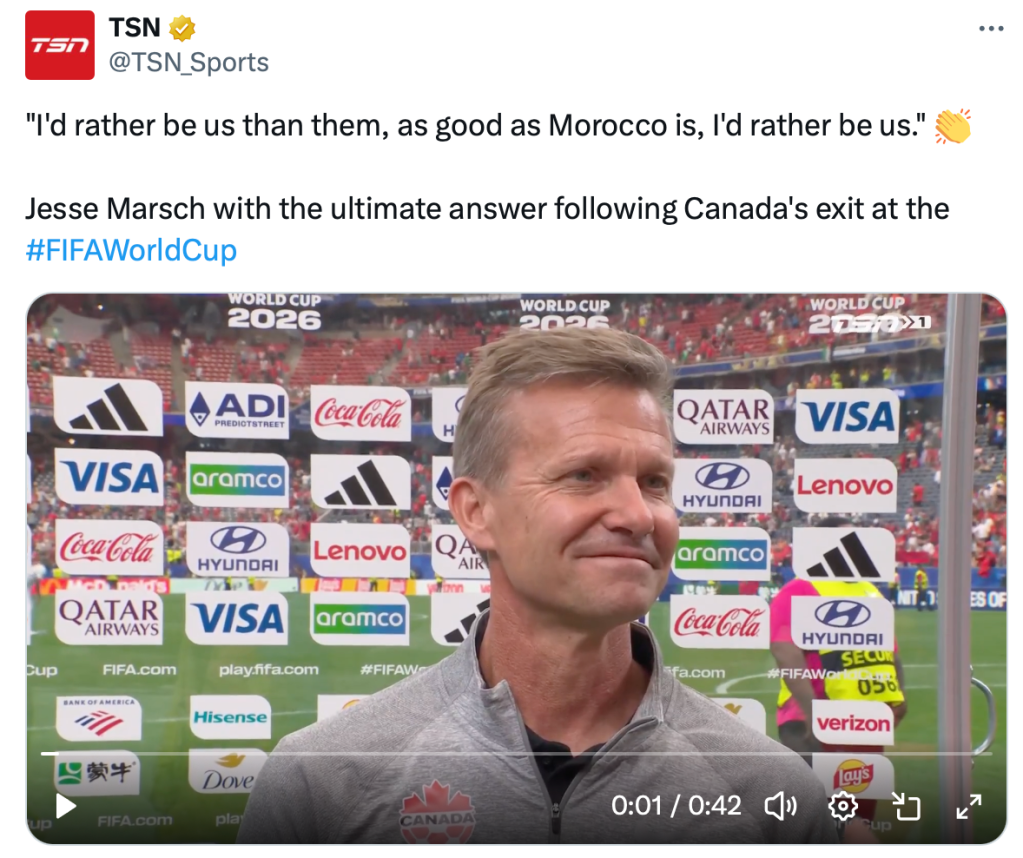
If you watched their 3-0 exit —not reflective of the balance of play—-from the World Cup against a superior team from Morocco, you would have witnessed a special cultural moment of Canadian self belief, ambition, and a brotherhood of young men utterly unafraid of the odds.
Instead of doing the classic underdog routine of turtling in a defensive shell and playing 120 minutes for a penalty shoot out, the Canadians went for the jugular from the opening whistle. They were the better team for most of the game.
Other than the injured Alphonso Davies, there are no world class stars on this team. Yet they played as if it was the ghost of Admiral Horatio Nelson whispering in their ears, “ne’er mind the maneuvers lads, always go straight at ‘em.”
Huzzah.
***
If you would like regular notifications of future posts from MediaPolicy.ca you can follow this site by signing up under the Follow button in the bottom right corner of the home page;
or sign up for a free subscription to MediaPolicy.ca on Substack;
or follow @howardalaw on X or Howard Law on LinkedIn.
COMMENTS ARE WELCOME. But be advised they are public once I hit the “approve” button, so mark them private if you don’t want them approved.
I can be reached by e-mail at howard.law@bell.net.
This post is copyrighted by Howard Law, all rights reserved. 2026.


Delightful blog. So Canadian in content and style, I must say ( Ed Grimley reference). Loved the Carney pun. Good treatment of the commentary issue, and I thought the Oxfam clip was a clever way to get the whole argument on the table. And I also loved “ where we part company” as an example of civility in public discourse.
>
LikeLike