
July 12, 2026
Canadians are familiar with the story of the Online News Act. True policy nerds know that it’s part of a bigger story in which Google and Meta grappled with mandatory news licensing in the European Union, Australia, Canada and the United States.
Something similar might be playing out again between digital news publishers and global AI companies. But it is in its early stages, as large news publishers with lots of content to offer, and a modicum of leverage, choose between launching copyright lawsuits against AI companies or settling for licensing agreements. Here’s a list.
The latest news —- relevant to Canada because it occurred in our parallel policy universe, Australia—- is that Microsoft Co-Pilot has a content deal with Nine News (roughly, the equivalent of Canada’s Bell Media) to license its digital news content. Neither party is saying if cheques are being written, but certainly audience traffic will flow.
Co-Pilot has licensed Nine’s paywalled content as feedstock for its AI summaries but will embed Nine’s hyperlinks and enough paywalled content to push Co-Pilot consumers back to Nine’s full stories.
As Ulrike Langer wrote last week, publishers of premium news content such as Time, The Economist, and Dow Jones are making different kinds of AI deals that license content scraping in different ways: full archive access, data-only access, or journalism-only access.
The beginnings of a commercial market in AI-digested news content is an obvious way that AI companies can deflect or minimize any government efforts to come to the rescue of domestic news companies getting illegally scraped by the AI giants. Google and Meta did something similar a decade ago. They made voluntary agreements with a cherry-picked assortment of big media companies until sovereign governments decided to back the claims of news companies that Google and Meta bargained unfairly or not at all because they were monopolists in Search and social media.
The prevalence of ongoing copyright lawsuits against the AI companies suggests that news companies again believe they are getting ripped off but don’t have the leverage to get adequate settlements without the intervention of their domestic judiciaries. Yet litigation is a long and uncertain path and it’s probably a non-starter strategy for local publishers anyway.
At some point, sovereign nations are going to think about legislating mandatory licensing of news content by AI companies with a dispute resolution mechanism that drives a fair market price. You might have heard of the idea.
***
Editorial strategy in news journalism hasn’t changed much over time: most publishers curate their news feed with “biased” or standpoint content stemming from a politically partisan, ideologically driven or simply a “watchdog” philosophy of keeping an eye on powerful political and corporate actors.
It’s hardly a secret that publishers are keenly aware of who their audience is, particularly their paying audience.
As the advertising revenue stream for professional news journalism continues to collapse, two public policy imperatives meet: providing the people with fair and balanced news content and getting them to pay for it. Only 12% of Canadians pay for or share a digital news subscription, a stubborn statistic that hardly moves from year to year.
The policy sweet spot is to foster a commercial market in broad spectrum news reporting on current affairs that gets citizens out of their self-imposed filter bubbles, whether on social media or from conventional news sources.
The newly released 2026 Reuters Oxford Digital News report offers some audience data that’s relevant to what readers want and, perhaps, what they will pay for.
The report includes an inquiry by Denmark’s highly esteemed Rasmus Nielsen where polling respondents were asked to declare the strength of their allegiances to news sources they considered neutral, ideologically comfortable, or offering an editorial standpoint that challenged their own.
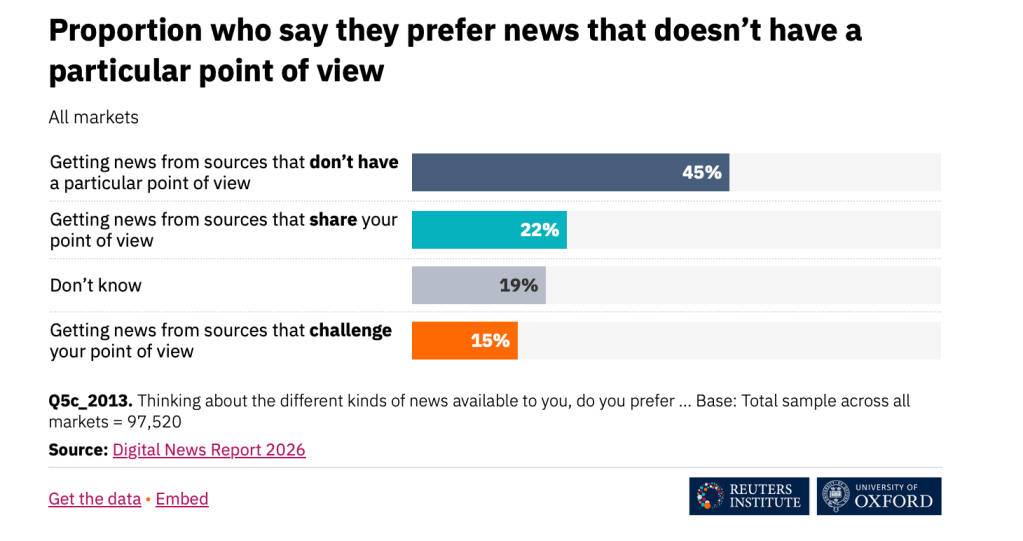
As you can see from this graph above a strong plurality of respondents fancied their favoured news source were neutral. But significant minorities openly declared their allegiances to either intellectually comforting or challenging news sources.
Here’s Nielsen’s take away from his research:
But the outsize role played by the minority who seek partisanship is easier to understand when we take into account that those who say they prefer news from sources that share their point of view are, in our survey data, also more likely to:
- Share and comment on news online and on social media
- Be very or extremely interested in news and in politics
- Place themselves on the left or the right of the political spectrum
- Access news many times daily and pay for online news
The people who prefer news that aligns with their own views are a minority. But they tend to be more vocal, more highly engaged, more partisan, and more commercially important for many news publishers than the public at large.
I’ll translate that passage as “an audience that is very tuned in to politics with very clear political views of their own will pay for news.”
This is not surprising, is it.
For Canadians, this troubling disconnect between the willingness to pay for news and non-partisan content leads us back to another conclusion: the important role of CBC Radio-Canada as a news content provider for citizens who stubbornly won’t pay for news.
To change tack here, Nielsen also makes some other conclusions from the data with the benefit of polling from around the world.
The first is that there is a correlation between audience preferences for ideologically friendly news sources and the prevalence of social media as a news platform. Not a surprise either.
Another is that perhaps we in the global north and citizens that enjoy the privilege of living in liberal democracies ought not to be too judgmental about that lack of journalistic detachment in autocracies and conflict zones.
“When core democratic institutions or the fundamental rights of whole swaths of the public are under concerted political attack,” says Nielsen, “what does it mean to report the news in a way that doesn’t have a particular point of view?”
Discuss.
***
Open to being pleasantly amused? I recommend a short and compelling weekend read written by a friend of mine, historian David Wilson (among many endeavours, he has just stepped down from a ten-year stint as the editor of the prestigious Dictionary of Canadian Biography).
Published last week on the American July 4th holiday, Wilson asks whether the birth of the republic was a better choice than Canada’s own (but more patient) path to independence and responsible government. A cheeky but serious piece, worth your five minutes.
***
If you would like regular notifications of future posts from MediaPolicy.ca you can follow this site by signing up under the Follow button in the bottom right corner of the home page;
or sign up for a free subscription to MediaPolicy.ca on Substack;
or follow @howardalaw on X or Howard Law on LinkedIn.
COMMENTS ARE WELCOME. But be advised they are public once I hit the “approve” button, so mark them private if you don’t want them approved.
I can be reached by e-mail at howard.law@bell.net.
This post is copyrighted by Howard Law, all rights reserved. 2026.

 MediaPolicy.ca
One thought on “Catching up on MediaPolicy – AI news scraping deal in Australia – who will pay for non-partisan journalism? – two paths to liberal democracy”