August 29, 2026
The how and why of last Friday’s breakdown in US-Canadian trade talks preoccupied us for most of last week.
The Canadians weighed in on why things went sideways after Trump announced a “deal” several days before the deadline. The Americans spun their narrative in the other direction. Commerce secretary Howard Lutnick’s performance is not to be missed.
It would help to know what was in those negotiating documents that will never become public. Or to start demanding polygraphs that will never be taken.
Without those here is my take, based on what negotiators said and what might have happened.
Carney and Trump talked on the Tuesday night. Clearly they agreed on something. Probably it was some high level numbers on key tariffs. Looking for a public win, Trump couldn’t restrain himself and rushed to announce a deal the next morning. The key thing is that Trump thought he had hooked Carney by giving him enough and that the US would then steamroller the Canadians on the fine print and all of the remaining issues. Saying there was already a deal was part of his strategy.
That is the bargaining dynamic that often occurs when one negotiating party has, or believes it has, the hammer. Trump expected to run the table. If there was any truth to the rumours of the impending demise of the Online News Act, the Canadian team was half expecting the same.
But Trump miscalculated and overreached. On trucks and pickups. On culture. On Canada’s options to make other trade deals without Trump’s permission. This provided an opportunity for Ontario premier Doug Ford to signal Carney that he was about to go offside. Manitoba premier Wab Kinew already was. The Bloc Québécois was making noise about cultural concessions.
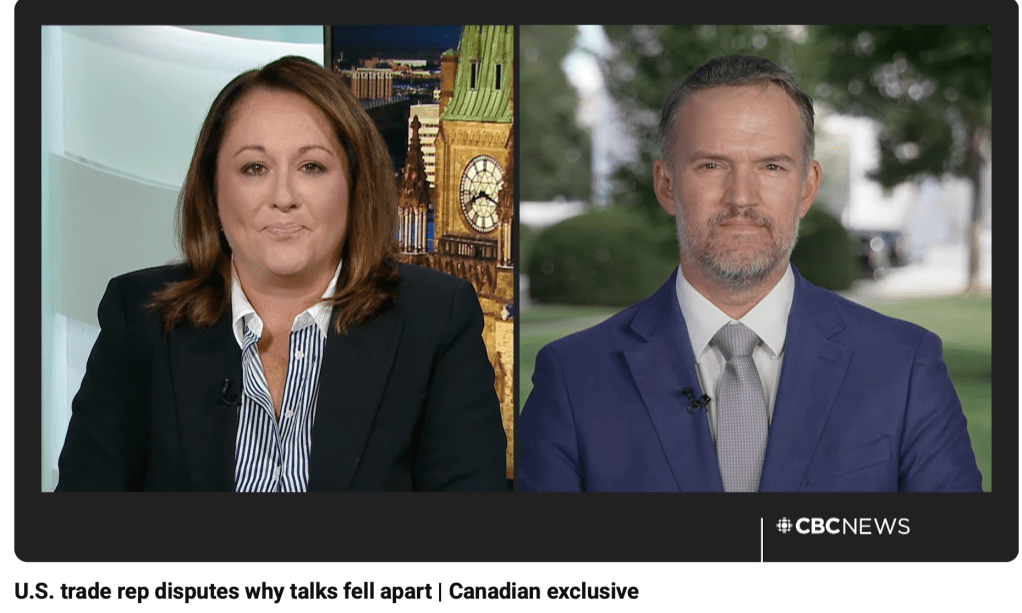
When CBC interviewed Trump’s trade envoy Jamieson Greer on Thursday he claimed that the cultural issue embedded in the federal Online Streaming Act —-repeatedly and narrowly confined to “the discoverability of French language content”—- was, shucks, never a big deal for the US.
“It’s the furthest thing from a red line,” Greer told CBC host Rosemary Barton. “We highlighted [it at the end] yes, but our view is you should let capitalism do its thing and let people pick. We know it’s important to people in Quebec….We would not have let it get in the way of a good deal.” (Roll the video from the nine minute mark).
Slick and slippery, yes. But more likely a sign that Trump thought the Canadians were already hooked and would swallow anything to get a deal across the line.
Greer still found time to have another moan to CBC’s Barton about streamer cash payments to Canadian media funds: “What we don’t like is a situation where Canada forces American tech companies to take their earnings to give a percentage to their competitors.”
Putting aside that mischaracterization of how cash payments to media funds get recycled to all contributors, Carney had already taken them off the table three months ago by overruling the CRTC.
Yet here Greer was still fixated on them, raising them on both Canadian and US television networks, even after the breakdown of talks and in the same breath in which he claimed that “the French language” issue raised by the federal Online Streaming Act and Québec’s counterpart Bill 109 was no big deal.
Canada’s trade envoy Dominic Leblanc responded to Greer’s claims tactically. He publicly thanked the Americans for taking the streamer issue off the table.
While Leblanc was thanking Greer, the Canadian cultural community was effusively and publicly thanking Carney for fending off the Americans.
Every iota of that effusiveness was proportional to a residual mistrust that the Online Streaming Act and the Online News Act are off the table for good, or that a Prime Minister who would give away the digital services tax for nothing, humiliate the CRTC by overruling their implementation of cash payments, and for Pete’s sake would even submit to a shameless Trump shakedown on a bridge we paid for, might yet fold again on culture.
Reynolds Mastin of the Canadian producers’ union CMPA, which has emerged as the de facto spokesperson for the English-language cultural community, described the near-death of the Online Streaming Act as “an inflection point” for Canadian culture and trade talks.
Mastin also politely chided the Carney government if it had indeed assumed that its climb down on the streamer payments in June had sated the US streamers’ hunger to get rid of the OSA altogether. “Knowing those players as we do, they were not going to say, ‘Thank you very much. We’re done.’ They were only going to regard that as the appetizer.”
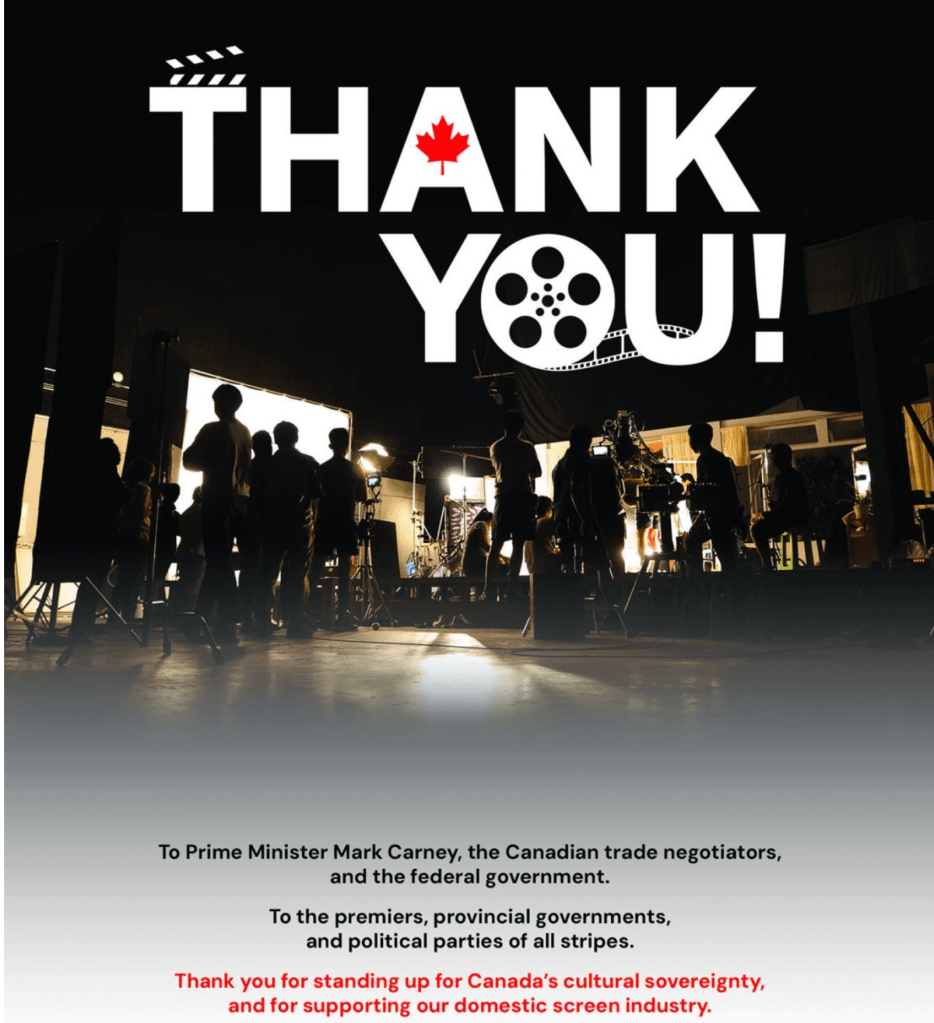
This weekend Mastin’s CMPA and another 40 cultural organizations took the time and expense to express their gratitude to Carney “for standing up for Canada’s cultural sovereignty” in full-page newspaper ads. Newsmedia Canada’s Paul Deegan did much the same on the Online News Act.
In Québec, the Coalition for the Diversity of Cultural Expression went a step further, calling for Carney to throw it into reverse gear and reinstate the $200 million in audio-visual and audio streamer payments.
Carney is now in a pickle of his own making.
The Americans may or may not have let go of the cultural concessions. All it would take to revive them is an American reporter asking Trump the question.
Canadians have increasingly seen cultural issues as a defining issue of our dignity and resistance to Trump humiliation, at high levels of support that were already elevated according to year-old public polling.
Meanwhile Carney has his $600 million pot of cultural spending that, contrary to MediaPolicy’s initial skepticism, might actually be doing something more than taking the sting out of his climb down on cultural issues.
A leaked page grab from an internal Canadian Heritage document suggests that the $600 million will cover the $134 million in foregone streamer payments to Canadian audiovisual media funds for broadcast news and Canadian content. But the document also suggests that the remaining “unallocated” $467M is earmarked for “additional audiovisual stabilization funding” and the “audio sector.”
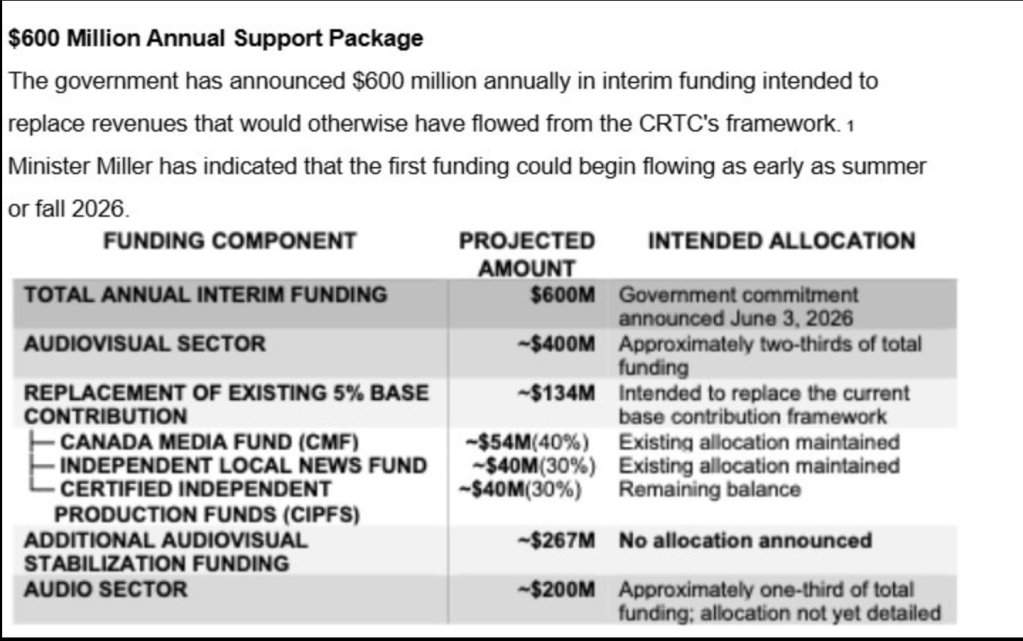
The vagueness of this $467 million commitment may sustain skeptics like myself. But other internal documents from Heritage suggest an earnest and far reaching rethink of how to spend not only the $467M but all of the $850 million in various federal programs for audio visual production on a growth and export strategy for Canadian content.
I’ve buried the lede here. More to come on that.
***
If you would like regular notifications of future posts from MediaPolicy.ca you can follow this site by signing up under the Follow button in the bottom right corner of the home page;
or sign up for a free subscription to MediaPolicy.ca on Substack;
or follow @howardalaw on X or Howard Law on LinkedIn.
COMMENTS ARE WELCOME. But be advised they are public once I hit the “approve” button, so mark them private if you don’t want them approved.
I can be reached by e-mail at howard.law@bell.net.
This post is copyrighted by Howard Law, all rights reserved. 2026.


2 thoughts on ““Knowing those [streamer] players as we do, they were not going to say, ‘Thank you very much. We’re done.’ They were only going to regard that as the appetizer.””