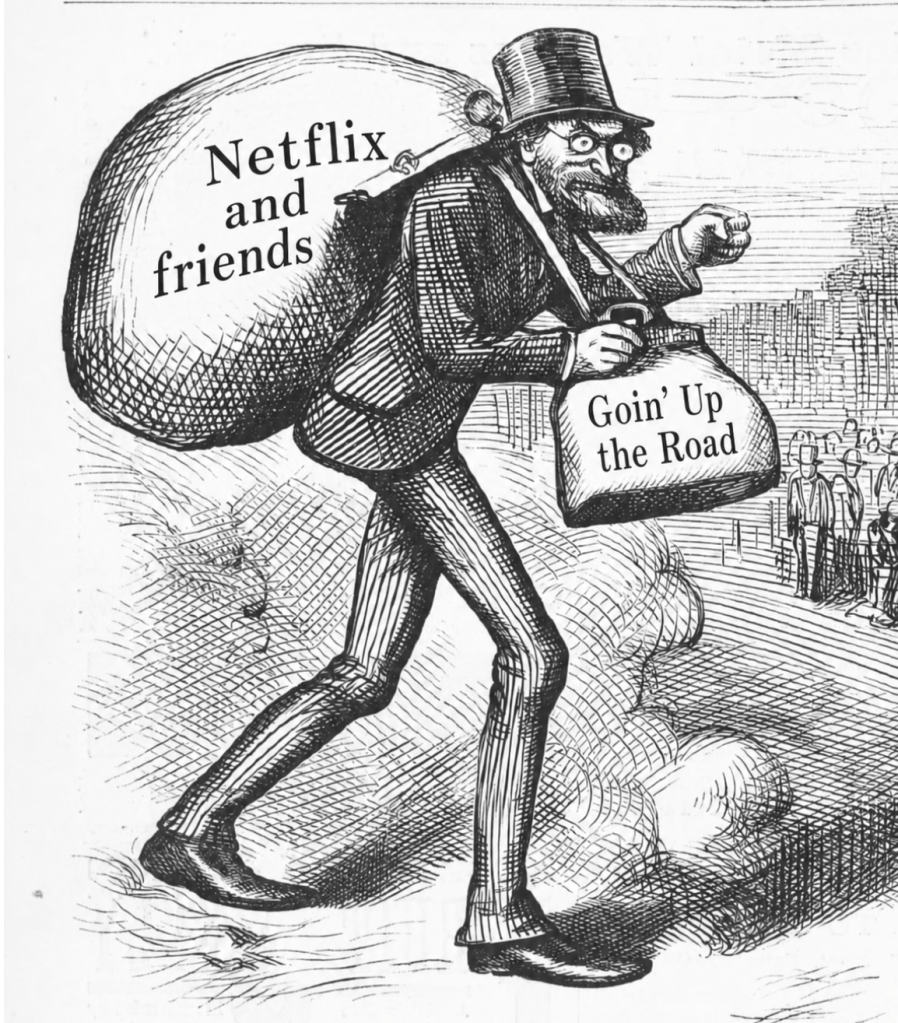
Satiric AI illustration based on Thomas Nast’s Harpers Weekly illustration, 1872
September 2, 2026
The epithet “Carpetbaggers” has an evocative history in the United States.
It was how post-Civil War white southerners described opportunistic northern merchants who descended upon the war-devastated former slave states.
The same vitriolic insult was conferred upon the corps of northern abolitionists and office-seekers who arrived to mobilize the Black vote for newly created state legislatures, the entire chapter in American history known since as the Reconstruction era.
After Reconstruction ended in the 1876 sell-out of Black civil rights and the wage re-enslavement of African Americans, the term Carpetbaggers became more generic. Wikipedia describes it as “denot[ing] people who move into a new area for purely economic or political reasons despite having no ties to that place.”
Lately the California-headquartered streamers operating in Canada have earned the Carpetbagger sobriquet.
The streamers don’t own our broadcasting market, not yet. Canadian owned television and radio broadcasting is slowly diminishing but it remains significant. Our cable and satellite-borne audio visual signals reach 9 million out of 15 million Canadian households.
But Netflix reportedly reaches about 9.8 million Canadian subscribers. With the grey market in password sharing, that is probably well over 10 million households. The other US streamers Amazon Prime (7.5m), Disney (6m) and Paramount (5.3m) are all ahead of the HBO-boosted Bell Crave (5m). According to the CRTC, three out of four Canadians reported subscribing to an audio-visual streaming service, compared to a little over half of Canadian households (58%) subscribing to a traditional television service.
That dominant American share of our streaming market means that Canadian subscriber dollars, advertising revenues, and reinvestment capacity generated by Canadian profits all flow south.
As a caveat to that generalization, there is a debate (impoverished by the lack of data) over how much money Netflix and the streamers voluntarily invest in English language Canadian content as equity partners. Canadians are also familiar with the occasional appearance of Canadian themed Netflix originals such as the upcoming Below or Amazon’s The Sticky.
But the yawning gap between how much Canadian broadcasters are required by the CRTC to invest in Canadian content —-30% of their revenue—- and the goose egg obligations for streamers can only be described as Carpetbagging.
The federal government has taken a couple of stabs at remedying that extraction of value.
One attempt was the ill-fated $1 billion per year Digital Services Tax on the streamers (but also other digital businesses like Uber).
When this kind of tax was developed a decade ago in Europe, it was a counterweight to American Big Tech’s avoidance of local corporate taxes by parking their profits in tax havens. By the time Canada got around to legislating our own DST, the federal Liberals never clarified whether it was plugging the corporate tax hole or simply reshoring a share of the streamers’ revenue extraction from Canada.
As you know, Prime Minister Carney gave the DST away in June 2025 when President Trump demanded it. I am sure Carney now regrets that as a bad bet on the President’s intentions.
The second attempt to remedy the California streamers’ value extraction was the Online Streaming Act.
You know the story here. The latest chapter is that in 2024 the CRTC imposed a five per cent cash levy on the US streamers, the same that Canadian cable companies pay. Those levies feed the Canada Media Fund and a number of similar production funds that finance Canadian content shows. Those shows are made by independent Canadian producers who license them back to Canadian broadcasters and (once the three-year old Online Streaming Act is actually applied) to US streamers. The key point is that the shows are licensed at a lower price because of the media fund money that gets invested up front.
Not good enough for the Carpetbaggers. Even after Mark Carney overruled the CRTC and rid them of the levies, they weren’t satisfied. That was confirmed when the streamers were able to get the White House to push for the evisceration of another Online Streaming Act tool, the surfacing of Canadian content on US streaming platforms, on the very last day of trade talks.
The reason that the streamers deserve the unsavoury Carpetbagger label is because they have worked so hard to earn it.
Before Donald Trump began his second term in 2025, a more compliant Netflix told the CRTC they could live with a two per cent cash levy (provided none of it went to news). Canadian cable companies pay double that, at 4 per cent.
Ah, but that was then and this is now. At the moment, the Netflix position in Canada is no regulation, no obligations. Full value extraction from Canadian subscribers and advertisers.
And to make this happen, the streamers have been able to insinuate their influence into the ground zero of trade talks.
Writing about this back in 2024 in Cartt.ca, I noted the Netflix “strategy appears to be oppose, appeal, and get the attention of the next U.S. president, U.S. Congress and U.S. trade representative.”
And here we are.
***
One of the trade files that went quiet for the last few months was Donald Trump’s threats beginning in 2025 to put a tariff on US movies shot in Canada, destined for the American, Canadian and global markets.
That’s not what the streamers and big studios wanted from him. They like shooting some of their shows abroad in the UK, Canada, and Europe, all of which have world-class production clusters and a Rolidex of trusted production partners. The analogy of the integrated US-Canada automotive market applies here.
The industry backdrop to this is that, post-pandemic, Los Angeles has endured a substantial drop off in its market share of American film and TV production, losing work to other US states and other countries. The end of the “streaming wars” and its profligate spending is also a factor. Some states, like California, have aggressively stepped into the subsidy space in order to reclaim work. But US Congress has not.
It looks like months of federal lobbying has paid off for the streamers because this week President Trump came out in favour of a federal film production tax credit. While California and other US states have increased their own subsidies, the US does not have a federal counterpart. In Canada, we combine federal and provincial production subsidies made available to both Canadian and foreign studios making shows here.
Canada has been smart about building a world class audio-visual production industry. It is in fact our domestic industry’s financial ballast.
To the extent that a US federal subsidy succeeds in American studios reshoring production, that will impact us.
***
MediaPolicy has been following the big Meta settlement with 48 US states (Florida is not settling) on the product liability lawsuit against Instagram and Facebook.
There is a good post-game analysis in the New York Times.
Meta’s lawyer is C.J. Mahoney. He was the US Deputy Trade Representative during the 2018 CUSMA talks (isn’t that an interesting connection between Big Tech and the Trump White House!).
The Times story reports that Mahoney stick handled his client’s settlement with the states after individual plaintiffs won the precedent setting jury trials in California and New Mexico resulting in hundreds of millions of dollars of damages awarded against Meta.
Those trials and related litigation proved that Meta can not successfully hide behind the “free speech” shield in the famous section 230 of the Clinton-era Communications Decency Act.
From there, it was all downhill sledding for the state Attorneys General.
And importantly for Canada, despite binding ourselves to Big Tech’s section 230 defence in the 2018 CUSMA digital chapter (clause 19.17.2), the reversal of Meta’s fortunes means that the federal Safe Social Media Act Bill C-34 is in principle not a violation of that agreement, vindicated by rulings in the American courts.
Another backbone moment in this story was demonstrated by the state Attorneys General who rebuffed Mahoney’s offer to settle for damages only. They held out for the product safety changes to protect children logging on to Facebook and Instagram. Credit the parent groups and children’s advocates who fought for that and made the states accountable to them.
According to the Times, the settlement’s die was cast before last month’s big trial even began but it took some time to line up agreement from the various states. The key was coming up with a fair allocation of the $18B USD in damages that will go to children’s mental health programs.
In the end, all 49 states fell into line except Texas (which settled separately shortly afterwards) and Florida.
The Florida suit will proceed as will many others, but one would expect that judges will engage in some extraordinary arm twisting in chambers with the plaintiffs’ lawyers to get them to fall in line with the Big Settlement.
Two remaining Big Questions are whether the Meta settlement gets adopted by competitors YouTube, TikTok and Snap and whether the safety upgrades helps Congress get to a deal on federal legislation.
***
Oops.
In my last post I wrote that “a leaked page grab from an internal Canadian Heritage document suggests that the $600 million will cover the $134 million in foregone streamer payments to Canadian audiovisual media funds for broadcast news and Canadian content.”
I made a mistaken assumption about the document’s authorship based on Globe & Mail journalist Barry Hertz’s tweet about the allocation numbers and Heritage Canada failing to confirm or deny to me when I asked if it was a Heritage document.
I have now discovered that the document in question is in fact an industry stakeholder’s summary of what the stakeholder was told verbally by a Heritage Canada source. The stakeholder contacted me this morning to clarify.
Hertz’s tweet indicates that according to Heritage the numbers cited in the stakeholder document were “not final.” I will leave it there.
***
If you would like regular notifications of future posts from MediaPolicy.ca you can follow this site by signing up under the Follow button in the bottom right corner of the home page;
or sign up for a free subscription to MediaPolicy.ca on Substack;
or follow @howardalaw on X or Howard Law on LinkedIn.
COMMENTS ARE WELCOME. But be advised they are public once I hit the “approve” button, so mark them private if you don’t want them approved.
I can be reached by e-mail at howard.law@bell.net.
This post is copyrighted by Howard Law, all rights reserved. 2026.


Hi Howard Anne Lagacé Dowson here
LikeLike
Hi Anne… did your comment get cut off ?
LikeLike