Eight months is a long time in politics and we have come a long way since former Heritage minister Steven Guilbeault proclaimed that “culture is not on the table” in CUSMA trade talks.
Despite Prime Minister Mark Carney vetoing the core ruling of the CRTC’s application of the Online Streaming Act to Netflix and the Hollywood streamers last Wednesday, a wag might suggest Guilbeault has been vindicated. Culture never even got to the table.
If you have any lingering doubts about my view on all of this, you can go back and read my opinion column published last Friday in Cartt.ca. If on the other hand you would rather just soak your head in some sardonic humour, there’s always Mark Musselman’s satiric piece.
Carney may have made his political calculations shrewdly. His cave on streamer contributions to Canadian content and his embrace of the Conservative Party’s “no Netflix tax” anthem wasn’t much more than a one day story in English Canadian media. The Globe & Mail’s television critic Kelly Nestruck stood out as a dissenter.
In Québec media commentators were critical, but not in the hair-on-fire manner you might have expected. Perhaps everyone is waiting to see where the big fat $600 million in public subsidies, tabbed to replace streamer dollars, is going to land. Brilliant stuff sir, keeping your critics hungry like that.
Nobody in the national media, save one journalist, thought to ask the Prime Minister what transpired in his private meeting with Netflix CEO Ted Sarandos a week before handing him a multi million dollar windfall. If the Prime Minister was ever to attend Question Period, an MP might ask him.
Now perhaps there is reason for optimism, or at least less pessimism.
We know nothing about the $600 million. It could be good news.
Also, we haven’t seen the minister’s new Policy Direction to the CRTC that is supposed to guide the regulator’s reconsideration of its government-vetoed ruling.
The PMO’s lawyers will be hard at it, drafting the new Policy Direction so that it stays on the legal side of the line that separates “advice” from “command.” A PMO dictat to ban streamer cash contributions to Canadian media funds will be tricky. As will any bottom line demands on direct streamer investments in Canadian programming.
As well, we have to wait to see if the new Policy Direction quietly delves into other parts of the CRTC’s ruling that the government may or may not like.
Rethinks of copyright partnerships, priority treatment for English language dramas, and funding for “services of exceptional importance” are possible.
And of course, the biggest conundrum that seems to escape all notice is what to tell the CRTC to do with respect to the yawning gap between foreign streamer contributions to Canadian content and those made by Canadian broadcasters.
After all, the law that Parliament passed requires the regulatory load be spread “equitably” and the first CRTC ruling did that (with fingers crossed behind back) by fixing a 15% (of revenues) CanCon spending quota for streamers and 25% for broadcasters.
You can expect Canadian broadcasters to tell the CRTC that they want the deal that Netflix got.
Here’s one: the British Competition and Markets Authority just ruled that Google must reveal to news publishers whether it’s ingesting their content into its AI models and give them a window into who is engaging with their content. According to Press Gazette, the CMA will require Google to:
“– provide publishers with effective controls over the use of their search content in generative AI
“– publish clear, comprehensible and user-friendly information explaining how publishers’ search content is used by Google in its generative AI
“– provide publishers with clear and detailed metrics on user engagement with their search content in search generative AI features
“– take reasonable steps to ensure that search content is attributed clearly and accurately in general search, and that end users have a clear means to access that search content.”
The CMA also says that it plans to force Google to let news publishers opt-out of AI ingestion of their content and —this is a big one— stop Google from forcing news publishers to de-index their linked snippets from appearing in Search as the condition of withholding their content from the maw of Google’s AI models.
Said the regulator, “Publishers will now have effective tools to prevent their content being used to power AI features in search, such as AI Overviews. This will put publishers, like news organisations, in a stronger position to negotiate content deals with Google.”
Keep in mind, the CMA’s move is a competition remedy to an anti-competitive practice by a single monopoly tech player. On another continent. By a public regulator that could be overruled by elected officials. Although as we know, that so rarely happens.
***
If you would like regular notifications of future posts from MediaPolicy.ca you can follow this site by signing up under the Follow button in the bottom right corner of the home page;
or sign up for a free subscription to MediaPolicy.ca on Substack;
This week’s announcement by Culture and Identity minister Marc Miller that the federal government is striking down the CRTC’s ruling on streamer contributions to Canadian content is perhaps more shocking in its timing than its substance.
After all, Prime Minister Mark Carney’s government has an appetite for jettisoning government policy that he considers unwanted baggage. Recall the climb down from the Digital Services Tax, the carbon tax, and the suite of Trudeau-era environmental policies…
If you would like regular notifications of future posts from MediaPolicy.ca you can follow this site by signing up under the Follow button in the bottom right corner of the home page;
or sign up for a free subscription to MediaPolicy.ca on Substack;
Brad Danks is the CEO of OUTtv Media Global, based in Vancouver. Most Canadians know OUTtv as the Canadian LGBTQ television channel. I interviewed Danks back in 2022 when the parliamentary debate over the Online Streaming Act was cooking on high heat.
He’s a bit of a unicorn: a broadcaster who is perfectly comfortable talking policy. With his eye cast on the future of Canadian broadcasting, Danks just wrote a 60,000 word, seven-part series Beyond the Walled Garden published in Cartt.ca last month. It’s time we caught up.
MediaPolicy: Brad, instead of a very long introductory paragraph to set up this Q&A, I’m just going to give you my undergrad-level synopsis of your Cartt.ca series. I promise I didn’t use AI. So here goes, this is me channelling you:
We’ve been trying to renovate the current CRTC regulatory model using the tools granted by the Online Streaming Act Bill C-11, but that is just “optimizing for managed decline.” It’s triage. A policy model that is singularly devoted to production financing for a domestic market runs counter to competing in the global supply of content. The regulatory framework must be to make it possible for Canadian content producers to monetize content on a global scale.
And increasingly, it is Canada’s small and medium-sized content producers, not the big three broadcasting companies, Bell, Rogers, and Québecor, that represent Canada’s best hope. That’s because OUTtv and our fellow SME Canadian services can succeed in creating specialized, authentic content that is both relatable and popular with foreign audiences who find affinity with it. It’s effectively the YouTuber creator strategy, scaled up. This distribution strategy is what the CRTC and our funding institutions need to spend more time and resources on supporting. And that means incentivizing and rewarding broadcasters that make and distribute their own proprietary content, don’t partner away their IP for a quick buck, don’t blow the budget on American shows, and grow their businesses by finding audiences around the world.
A crucial part of doing that is AI. The integration of AI tools is the key to success for SMEs seeking loyal audiences scattered across the in-between spaces in foreign markets. But our funding institutions that are CRTC-adjacent, like the Canada Media Fund, take no notice of AI development as worthy of subsidy or support. We need to encourage and reward the sharing of digital and AI infrastructure for Canadian SMEs through regulatory incentives and support. The data-collector Numeris is a salutary example.
At the same time, we can’t neglect SMEs succeeding in the Canadian domestic market. Unfortunately, the CMF’s and CRTC’s performances on this have been awful. The cable companies get away with clogging proper access for SMEs to reach cable audiences and monetize their content.
How did I do?
Danks – Good. The key point is that the system was designed for a different era. In that era, Canada had a technologically walled garden. Foreign content arrived through Canadian services, and in exchange for the licensed right to broadcast that content — at significant profit — the broadcasters were obligated to subsidize Canadian production. It was a cross-subsidy, and it worked. The problem is that the wall is coming down. Gradually at first because of streaming, and now faster because of AI. We have been propping up a structural problem without a long-term plan to replace it. The deeper problem is that we kept funding production without funding the infrastructure that connects that content to audiences. It’s like building cars without roads. The cars get made, but they have nowhere to go.
MediaPolicy – You’ve been writing for years that Canadian broadcasting regulation has been overinvested in the so-called national champions — the big and vertically integrated broadcasters Bell, Rogers and Québecor and at one time Shaw as well— who are supposed to save Canadian content. Do you still think that?
Danks – Yes, the Big 3 were supposed to be exactly that — the CRTC said as much in the Let’s Talk TV decision in 2015. Here’s the quote:
“The Commission expects that vertically integrated companies … will continue to have the opportunity to leverage their resources and audience reach … Their critical mass provides these companies with the financial capital required to succeed both domestically and internationally.”
And later in paragraphs 42 and following: “Canadian programming must seek out and develop international audiences.” That is the Commission acknowledging that domestic demand alone is no longer sufficient and that Canadian programming must increasingly compete in global markets. On paper, the Commission was telling the Big 3 they already had the scale to compete internationally. The bargain was giving them flexibility on where to spend their CanCon dollars.
MP: I think you’re about to tell me the Big 3 have not lived up to that bargain over the last ten years.
Danks – I’ve joked for years about a “MapleBox,” a Canadian BritBox we never built. The Big 3 didn’t step up. But a different group of companies has, Canadian-controlled programming services. I’m calling them the CSPs. They are the small and medium-sized operators that own libraries and reach audiences through their own SVOD, FAST, broadcast, and platform partnerships — OUTtv, Blue Ant, Gusto, Stingray, Anthem, and others. They are not production companies, nor are they cable or online distributors. They are building the MapleBox, one deal at a time. My view is simple. They should be supported by the system, and they are not.
MP: Not supported, in what ways?
Danks – The failure runs in four directions.
The first is the structural disadvantage of independent services in the cable televisionsystem. Since the 2011 vertical integration policy and the packaging changes from Let’s Talk TV in 2015, independent specialty services have been progressively marginalized on cableplatforms. The large vertically integrated companies control both the pipes and many of the channels that travel through them. They have every commercial incentive to promote their own services and every available tactic to constrain competitors. The upcomingMarket Dynamics decision is specifically about whether the Commission will finally address that imbalance.
The second is regulatory speed, and I’ll say more about that in a moment. We have active files before the Commission, so I’ll keep this brief. We have been materially harmed by delays. We have filed urgent applications, with the financial consequences documented and fully understood by Commission staff, and been told decisions may take not just months but years. The delay itself is the injury.
The third is the Canada Media Fund which provides very crucial programming subsidies. The CMF’s primary financing mechanism, the Broadcaster Envelope, allocates funding based on a broadcaster’s track record of supporting Canadian programming, measured primarily against domestic cable viewership.
For a service like OUTtv, which has been deliberately building international distribution while domestic cablesubscribers decline, because that is the right long-term strategy, the CMF treats the right strategic choice as underperformance. Our envelope allocation shrinks as our international reach grows, because the system measures what we are moving away from, not what we are building toward.
The fourth is the complete absence of export support. The CMF measures Canadian audience and domestic production output. It does not measure export revenue, international subscriber growth, or the audience relationships being built in foreign markets. A service that invests resources in building global distribution, which the Broadcasting Act itself identifies as a policy objective, is invisible to the performance metrics that determine how much public support it receives. The system rewards businesses focused entirely on the domestic market, which is the market contracting fastest.
The common thread is thatthe system measures what it was designed to measure in 1985, and those measurements no longer align with the outcomes Canadian content policy is supposed to produce.
MP: You mentioned regulatory speed, or lack thereof. Give me an example.
Danks – The clearest one is the OneSoccer channel. Its owner Timeless complained to the CRTC in 2022 that Rogers was refusing to carry it. The Commission found in OneSoccer’s favour in 2023. Rogers challenged their Canadian ownership. The CRTC rejected that. Rogers appealed to the Federal Court of Appeal, and in May 2026 the court dismissed the appeal. It ruled that Rogers had raised a “forest of issues,” every one of them “without merit.” Four years, wins at every level, and the channel still isn’t on Rogers cable. They’re only now headed into arbitration over terms, just before Canada co-hosts the World Cup. The delay itself was the outcome, regardless of the merits. In a market that moves quarterly, a regulatory cycle measured in years isn’t just inconvenient. It works exactly like a tax. It raises the cost of capital, reduces what companies can reinvest, and pushes them toward lower-risk options. A system that rewards the use of delay is not one that works for independents.
MP: So what does Bill C-11 do, at least hypothetically, for Canadian SMEs like you?
Danks – So far, very little. C-11 gave the CRTC the tools. It didn’t determine how they’d be used. The open question is whether those tools get used to build the CSP layer, the Canadian-controlled services that retain IP and reach audiences directly. Or are the tools used just slow the decline of the existing model with new money from foreign streamers? The second part of the Market Dynamics decision is rumoured to be released in July. It will be the first real test of which way it goes.
MP: What are you hoping to see in that Market Dynamics decision?
Danks – Three things. The first is CSP access to distribution platforms. Canadians should be able to access Canadian services through the online distributors they actually use — Amazon, Apple TV, Roku, smart TV platforms — just as carriage rules ensured access on cable.
Second, prominence. It’s not enough to be available if no one can find you. A separate Canadian shelf that nobody visits is not the answer.
Third, the protections that already exist for independents on the cable side, like the standstill rule, the wholesale framework, a dispute process that resolves things, they all need to be improved and extended into the online world, not dismantled. This is the decision that determines whether there is a domestic foundation left to build on. WildBrain shut down four Canadian children’s channels after disputes with the large distributors. If this decision doesn’t fix access and the dispute process, we’ll keep losing the very companies the system should be building.
MP: You’ve introduced the term “Canadian-controlled programming services” (CSPs). What are they, and why aren’t they just producers?
Danks – A producer makes content. A CSP owns it, distributes it, and builds the audience relationship that compounds in value over time. OUTtv, Blue Ant, Gusto, Stingray, Anthem — these are the companies that actually built what the national champions were supposed to build. They are not production companies, nor are they cable or onlinedistributors. They hold a different position in the value chain. The part that captures the long-term value. Right now, the system doesn’t recognize them as a category at all. That is the gap the Cartt.ca series pointed at.
MP: The independent producers might hear this as an attack on them and their copyright. Is this a zero-sum fight over CanCon IP?
Danks – It shouldn’t be heard that way, and it isn’t zero-sum. Producers are the creative engine. CSPs are the systems that deliver their work to a global audience and return value to them. They are different functions in the same value chain, and both have to be strong.
But there is a deeper reason why Canadian producers are better off working with Canadian CSPs than with foreign platforms, and it has nothing to do with nationalism. The system can regulate us. The CRTC can attach conditions to our licences, require us to work with Canadian producers in ways that benefit both parties, mandate joint exploitation of IP across international windows, and enforce those conditions if we don’t meet them. It cannot do the same things to a major foreign platform, not in the same way, not with the same reach. When a foreign platform commissions a Canadian production, the producer gets paid and the platform gets the rights. What happens to those rights afterward is largely outside the regulatory system’s reach. When a Canadian CSP is the partner, we are inside the same regulatory structure as the producer. We have structural reasons to maintain relationships that work for both parties. Our licence depends on it. Our CMF access depends on it. Our standing in future proceedings depends on it. That accountability is not a constraint on us. It is exactly what makes us a better long-term partner.
The major platforms face no equivalent structural incentive to make those relationships work. That is the difference.
MP: Can you elaborate on why retaining IP by Canadian services matters?
Danks – Two reasons. First, all rights and all monetization flow from IP.
Second, in an AI world, creating derivative versions in different languages, formats, and genres becomes far cheaper, which raises the value of owning the underlying IP. But the real issue is not creation, it’s retention. The current system requires Canadian ownership at the production stage and then lets that ownership leak downstream through financing structures that assign international rights to whoever puts up the money. You can satisfy every ownership rule on paper and still hand the long-term value to a foreign platform. Owning IP on paper is not the same as keeping it, and keeping it is what the system doesn’t protect.
MP: Should the federal government be realigning its support — through the CMF, Telefilm, or the production tax credit — to better support CSPs?
Danks – Yes, and urgently. The CMF was built in 1985 to measure what mattered which was domestic linear audience and production hours. That is not what matters now. A CSP investing in global distribution, building audience relationships in fourteen countries, retaining IP across multiple revenue windows — that is exactly the outcome the system should be rewarding. Instead, that service is penalized because the metrics don’t capture what it’s doing. Comparable support for export capability needs to become a priority. The instruments for these policies already exist. They just need to be redirected.
MP: Do you worry the Commission will never get a chance to address these issues? There’s been anxiety about how much of C-11 will survive CUSMA and trade retaliation.
Danks – Yes, I think we should all be worried about the scope of US retaliation and the trade-offs required. On the contribution obligation itself, the anxiety is mostly misplaced. European jurisdictions impose comparable or higher obligations, and the streamers continue to operate there. The precedent is clear. But here is what I want more people to hear. There is a whole set of policies that carry zero trade risk because they sit entirely outside CUSMA. Building Canadian-controlled services that own IP and reach audiences directly — we can do that regardless of where the trade talks land. The trade conversation has been crowding out the one policy direction that needs no permission from Washington.
MP: Okay, so what’s your elevator speech to the heritage minister?
Danks – Turn the policy lens toward what builds the Canadian system. Start at home. Canadian services, whether they ever export or not, need a fair foundation to operate from. That foundation is real access to audiences through the platforms Canadians use, prominence so they can be found, and a dispute process that resolves things in months rather than years. The Market Dynamics decision is the test of whether that foundation gets built. Without it, there is nothing to export.
For those services ready to grow beyond Canada, the Broadcasting Act already calls for an environment that encourages the development and export of Canadian programs globally. Export is not a by-product. It is a core objective and increasingly the only realistic path to replacing the distribution capacity we have lost to streaming over the past 15 years. The companies already doing this have built it without support. That must change.
The job now is to align the CRTC, the CMF, tax policy, and export development behind the same goal. That goal is to support Canadian services that serve Canadians well and can own and distribute what the system produces. No single decision does it alone. But every decision that fails to ask ‘does this build something durable?’ is a decision for managed decline, whether it calls itself that or not.
***
If you would like regular notifications of future posts from MediaPolicy.ca you can follow this site by signing up under the Follow button in the bottom right corner of the home page;
or sign up for a free subscription to MediaPolicy.ca on Substack;
The Leader of the Opposition gets his sunglasses stuck in his teeth
May 30, 2026
Last week I published my take on the CRTC’s latest ruling on how much Netflix and the Hollywood streamers will have to invest in Canadian programming and how they will make that content highly visible on their platforms.
As for what the Commission did for Canadian broadcasters, I was harshly critical of the decision to relieve them of minimum investments in English-language dramas and documentaries based on the sanguine hunch that US streamers might do it for them. I wish I could be harsher.
I highly recommend a Substack column by Derrek Lennox who casts cultural sovereignty as a project of building an infrastructure of empathy among Canadian communities. Worth the short read.
As yet, Poilievre isn’t recycling his old accusation that the Online Streaming Act’s promotion of Canadian content is “government censorship….pro-government, liberal-leaning, boring, statist content that is approved of by the establishment crowd in general and the liberal glitterati in particular.” Ouch!
Indeed according to Poilievre, the legislation is a Liberal tool intended to “favour certain kinds of pro-government content online while discouraging content that the government does not want us to see, in some cases taking that content off the Internet together.”
Sticking to the better messaging point, he says the new CRTC ruling is a consumer tax because the streamers will pass along regulatory charges to the public.
Poilievre isn’t wrong about that being possible, but here’s some context.
Netflix upped the price on its standard plan from $14 monthly to $15 in 2020. Then to $16.50 in 2022. Then to $19 in 2025. That was twice the rate of inflation.
As for the CRTC ruling, the cash cost to Netflix and the Hollywood streamers is not the 15% of Canadian revenues set as an overall investment in Canadian content, mostly in their own shows on their own platforms.
The out of pocket cash cost is not the 15% but an included 6.55% of revenues, paid to Canadian media funds supporting news, entertainment, and a short list of public service programming such as APTN, Omni multilingual, Ugavut TV or CPAC.
The streaming market —the highly concentrated streaming market— will determine how much of this 6.55% cash levy that Netflix can pass along to subscribers.
Still, you would expect at least some of that 6.55% levy to drive the 2028 price increase higher. As much as, I dunno, twice the rate of inflation?
***
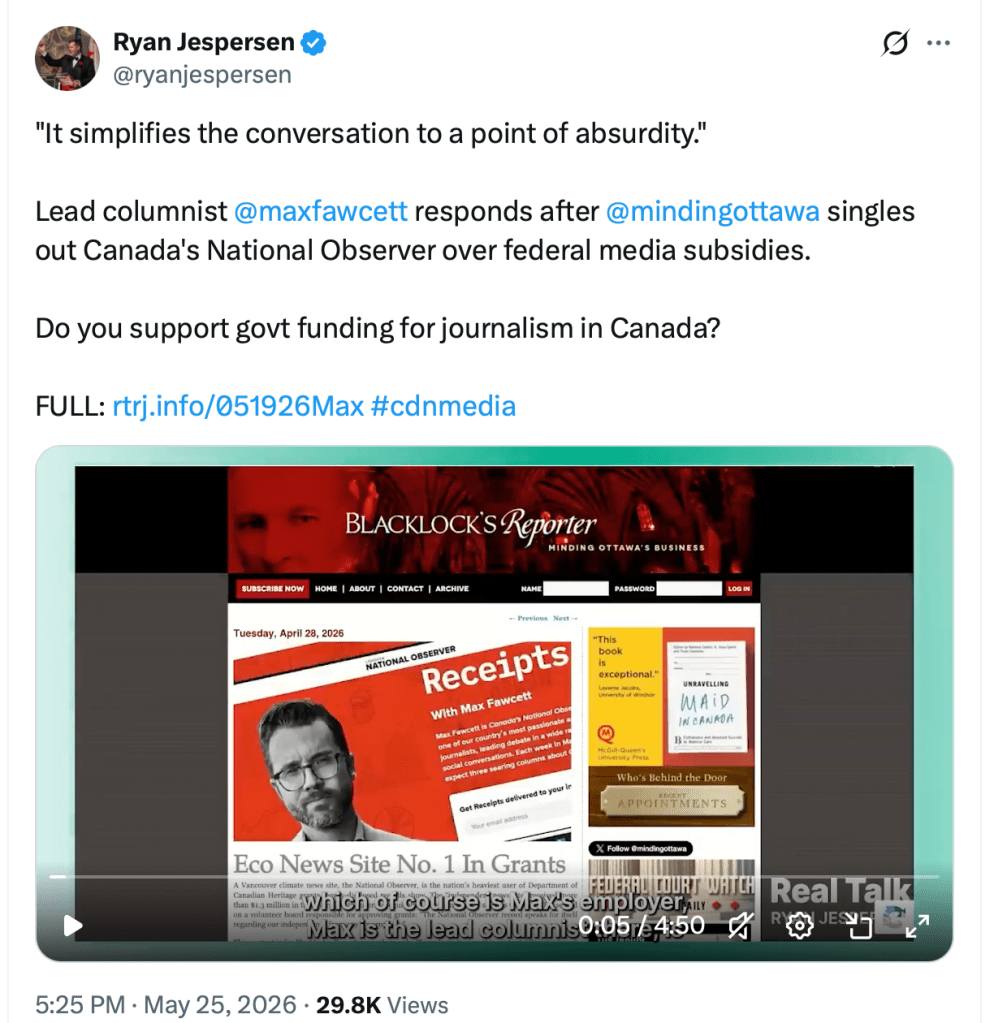
Kudos to Max Fawcett, the National Observer columnist who stepped up to take one for his team.
It began with a Blacklock’s Reporter story reporting on the journalism subsidies collected over the last ten years by the Observer from the threemajorfederal programs. That wouldn’t be especially newsworthy except for the fact that Observer publisher Linda Solomon Wood is one of five news publishers sitting on a panel that decides which news outlets get a piece of the Local Journalism Initiative.
A past recipient of the National Newspaper Award for best columnist, Fawcett went on Ryan Jespersen’s Edmonton talk radio show and gave a scorching elevator speech defending the Observer and the federal programs.
He didn’t address the point raised by Blacklock’s reporting that maybe his boss should not be sitting on the panel that carves up limited funds in the federal Local Journalism Initiative.
Wood and the other members of the judging panel did recuse themselves when their own publications were reviewed. The Observer was awarded two out of the 700 one-year job subsidies this year and three last year.
Still, Canadian Heritage would do well to consider putting academics and retired journalists in charge of the LJI disbursements, as it does for the QCJO program.
On the general topic of journalism subsidies, I came across a parliamentary brief that Torstar just submitted to the Heritage committee’s investigation into the state of news journalism. I confess to a love-hate relationship with Torstar (I was the Unifor union rep at the Toronto Star for many years) but I found this submission has a lot of policy gravitas.
The Online News Act, directing Google payments for news links, is under threat. But not just from looming CUSMA trade negotiations, rather from AI technology.
This has been known for some time. Google’s Search’s AI Overviews and AI Mode offer comprehensive answers to questions, before you get to the page after page of ten blue links.
Google’s referral traffic to news sites has already plummeted and it will get worse as late adapters get comfortable with AI tools. If the Online News Act was intended to compensate news publishers for populating Google’s blue links, that intention is being steadily eclipsed.
The next AI wave is now hitting Google Search which enjoys a 90% world market share. You can read the long versions at TechCrunch or in Press Gazette, but two of the new features of an overhauled Google AI mode stood out to me.
The first is what you already get on most AI chatbots: Google Search will engage in a conversation with you, deducing your research mission and offering help. Its response will be gussied up by creating multimedia answers to your question. Clicking through hyperlinks to original news sources, even if these are still offered, will be for suckers. I will remain one of those suckers, but I expect most will not look the gift horse in the mouth and let AI mode take over their brains, although maybe not for the more discerning news consumers who still want to check the underlying reporting.
But the truly revolutionary AI feature will be creating autonomous research agents that become your auto piloted research apps for the next days, weeks or years and periodically bring to your attention breaking news and developments relevant to your search query.
At some point, I may break down and create an AI agent for “what is happening in Canadian media policy.” Just as a science experiment, mind you. Right now, I read e-newsletters offering links to media news.
The point is, the new Google may well kill Search referrals to original news sites. Kill them dead.
That appears to be the goal, anyway. And with that death goes any Google argument that its intermediation of hyperlinks, as they currently argue, makes them a benefactor to the news industry whose content they ingest.
On the other hand, the alternative (and unofficial) government intention behind legislating the Online News Actwas not just compensating news outlets for their journalism, but effectively levying an anti-competition fine against Google Search for its oligopoly power over advertising in the absence of any action by the federal Competition Bureau. Google isn’t able to exercise that kind of monopoly power in the AI market, at least not yet.
As for the impact on the Online News Act, any retreat from offering news hyperlinks means Google will certainly buck against renewing its $100M/yr deal to fund news journalism that expires in 2030.
That’s how much time the federal government has to wake up and acknowledge that Google and the other AI bots are ingesting Canadian news by scraping their websites without a license. What is needed are amendments to an Online News Act v.2.0, starting with a new definition of a “digital news intermediary.”
***
If you would like regular notifications of future posts from MediaPolicy.ca you can follow this site by signing up under the Follow button in the bottom right corner of the home page;
or sign up for a free subscription to MediaPolicy.ca on Substack;
The other shoe dropped this week when the CRTC delivered two rulings that nearly complete its new regulatory framework for Netflix and the rest of the Hollywood streamers, as well as Canadian television broadcasters.
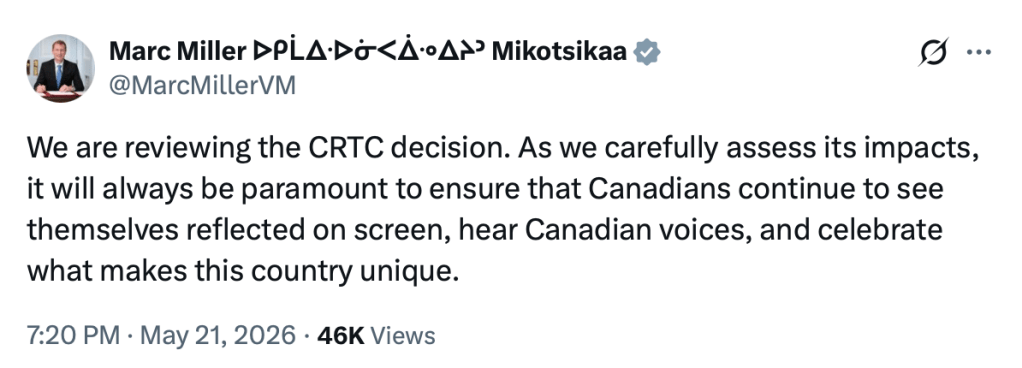
The reaction to the rulings from the Hollywood streamers and their Canadian enablers offered more heat than light. Media reports played them as a trade story and some breathlessly speculated on Culture & Identity minister Marc Miller’s inscrutable comments on X.
Across the border, a steady stream of ominous threats and faux outrage from American trade officials is expected soon.
In the interest of a more cool-blooded debate, let me offer some analysis of the CRTC’s new rulings on direct streamer investments in Canadian content (“Canadian Programming Expenditures,” or CPE) and the distribution and prominence of that content on streaming platforms, made “discoverable” so that shows made by Canadians don’t end up as wine corks bobbing on an ocean of global content.
The bottom line is that the CRTC’s expected ruling on those direct CPE investments came in at 15% of the revenues that streamers earn in the Canadian market.
That 15% includes a 5% subset of the (still unpaid) cash levy in favour of Canadian media financing funds imposed by the Commission in June 2024 as an “initial” CPE contribution, thus the feverish cries of “tripled contributions.”
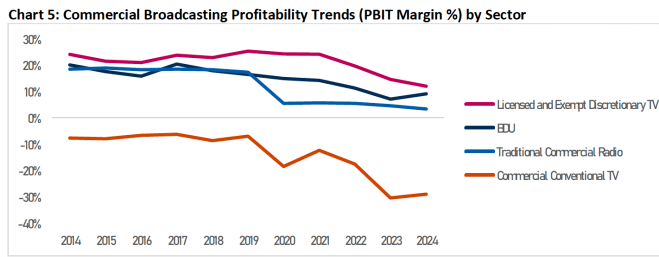
While the bar for streamers was set at 15%, the Commission lowered the parallel CPE contributions of Canadian broadcasters from 30% (or more) of their Canadian revenues down to 25%. The broadcasters have been fuming about their CPE obligations for years since cable subscriptions and Canadian television revenues began their downward descent around 2017 while the Hollywood streamers surged in growth and remained unregulated until the Online Streaming Act was finally legislated in 2023.
The gap separating Hollywood streamer and Canadian broadcaster CPE is now reduced but still a substantial 10% of revenues (although it’s probably less than 10% when you take into account that more than a third of the streamer CPE consists of their cash dollars going out the door to media funds).
Whatever number you ascribe to the remaining gap between streamer and broadcaster CPE contributions to CanCon, the Commission excuses this remaining favouritism shown to the streamers as being “equitable” as opposed to “equal” contributions. You be the judge if it’s equitable. The streamers insist its “discriminatory.”
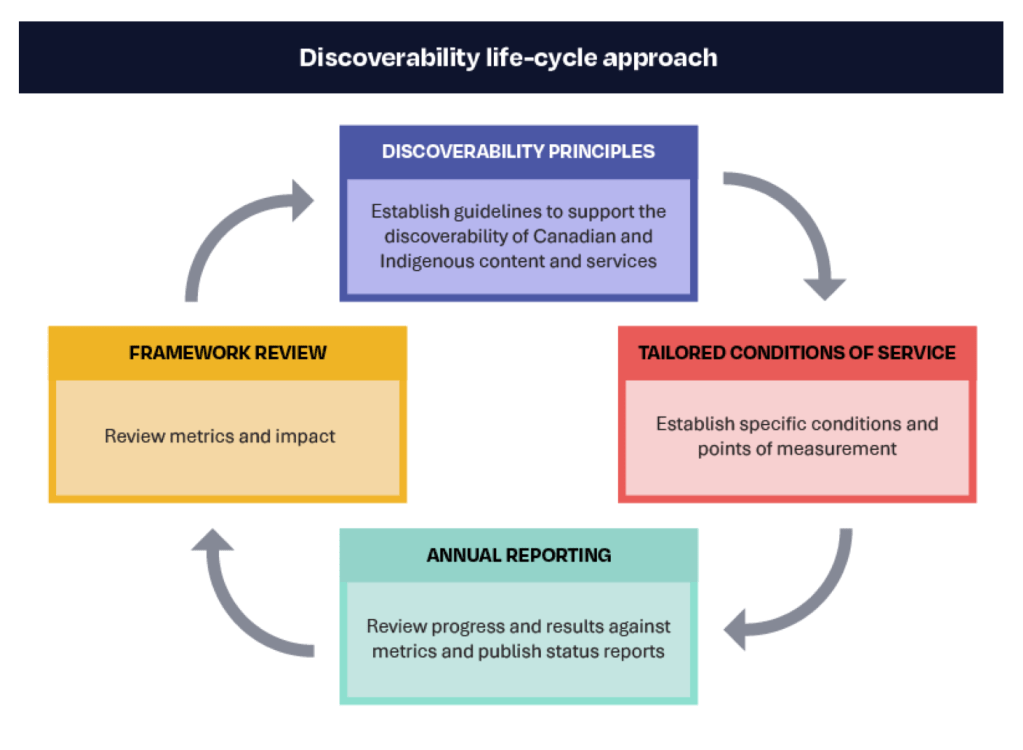
The CRTC’s companion ruling on discoverability is poised to be a genuine victory for Canadian content and a vindication of the federal Liberals’ crawl-over-broken-glass efforts to legislate the Online Streaming Act. How big a victory depends on how soon and firmly the CRTC follows up on the key regulatory principles in the ruling:
The Commission states an expansive definition of “discoverability”: “Canadian content and services are discoverable if they are made available and visible to audiences, including when an audience is not actively seeking such content and services.”The emphasis is on the streamers making their Canadian content highly visible on their platforms, irrespective of whether Canadians are patriotically seeking it out through keyword searches or on the streamers’ ghettoized “Canada” tabs.
To make this happen, the CRTC tasks each streamer to offer the Commission “measurable outcomes” in making Canadian shows prominent with transparent and annual measurements using standardized data. The Commission has told streamers that Canadian content should be “presented consistently when audiences browse landing pages, recommendations, categories, carousels and playlists” and not just “dedicated spotlight categories” for Canadian content. And just in case the streamers don’t get the message, the Commission says it expects “equitable” platform exposure of Canadian content in Canada, a deliciously vague objective that should keep entertainment lawyers well employed.
And the Commission expects streamers “to facilitate the installation, integration and/or promotion of [Canadian broadcasting services of exceptional importance] and local streaming apps and stations on Smart TVs, set top boxes or other devices so that they are easily visible to consumers.” This is bold stuff. It’s not clear how the Commission is going to implement this in cases where screen interfaces are installed by television manufacturers: the Québec provincial government says it’s going to legislate it.
Taking these Commission pronouncements on discoverability at face value, this is good news for Canadian content. As television broadcaster Brad Danks wrote in his recent series of articles in Cartt.ca, we are overdue to pivot from our singular focus on regulatory support for production financing in favour of supporting distribution, prominence and the cultivation of loyal audiences at home and abroad.
From here, the streamers’ self-designed discoverability strategies will have to pass muster before the Commission in the final phase of the legislation’s implementation, the application of “tailored conditions of service.” That will likely take another year to complete, assuming a light-speed effort by the Commission. Beyond that, the Commission is allowing the streamers three years to meet these higher expectations of CanCon discoverability. That will put us seven years from Royal Assent to full implementation of the Online Streaming Act.
Of course, the streamers want no part of any of this, neither CPE nor discoverability, judging from their cede-no-quarter opposition to any regulatory obligations, court appeals and weaponization of American trade power over the last three years.
The streamer fury is highly performative. But let me speculate on at least four things about the Commission’s latest rulings that might genuinely stick in their collective craw.
The first is copyright. The streamers notched a big win last November when the Commission announced its new rule about whether non-Canadian services could hold copyright ownership in the Canadian shows eligible for its CPE quota for direct CanCon investments (as opposed to paying copyright-owning Canadian producers to license their shows for Canadian release or global distribution).
It’s a complex issue that I wrote about here. In brief, in any production partnership the owner of majority copyright in a show holds an advantage in negotiations over return on investment, revenue sharing and the long-term commercial exploitation of the intellectual property flowing from a successful production.
During parliamentary hearings in October 2022, Netflix identified copyright ownership as its number one priority. But despite the clear language in the Online Streaming Act favouring copyright remaining vested in independent Canadian producers, the Commission sided with Netflix and the other Hollywood streamers. Incensed by that ruling, I wrote about ithere.
Alas I incensed too soon. The Commission evidently had more to say about copyright. In this most recent ruling, the Commission claws back some of that apparent streamer victory. Under the heading “enhanced partnerships,” the CRTC directs the streamers to earmark about a third of their 15% CPE for co-ventures with independent Canadian producers in which the Canadians retain majority copyright.
By my figuring, the streamers will have to cede majority copyright to independent Canadian producers in Canadian shows in its programming budget amounting to a 4.5% envelope of Canadian revenues within its 15% overall CPE. That leaves the streamers contributing 6.55% of revenues in media fund cash payments (see below) and 4% for direct content investments in shows where they can retain majority copyright.
Another unwelcome surprise for the streamers was the CRTC rethinking the mulligan it gave the streamers back in June 2024 when it extended an option for streamers to shave off 1.5% of their initial 5% cash levy to media funds to 3.5%. The deal wasthat the streamers could withhold that 1.5% (of a total 2%) contribution to the Canada Media Fund provided they invested the money directly in Canadian shows. It was essentially a downpayment on their yet-to-be-determined CPE. In setting a final CPE number of 15% the Commission eliminated the 1.5% opt-out. That leaves the streamers paying out of pocket to media funds at the full “initial” 5%.
The Commission then tacked on to that 5% an additional cash levy of 1.55% of revenues to feed a new Services of Exceptional Importance Fund —more or less demanded by federal cabinet and Parliament— to replace the per subscriber “wholesale rates” that Canadian cable operators pay to vital services such as CPAC, the Weather Network, APTN, Uvagut TV, Omni, TV5, and CBC/Radio-Canada news in official minority language regions. The major Canadian broadcasters will pay the 1.55% levy too.
The last of the craw-stickers is probably the Commission’s rejection of the streamer proposal to count their marketing expenses towards their fulfillment of CPE spends. The Commission reaffirmed its existing policy that only small and medium sized Canadian broadcasters get that break. The streamers and the big Canadian broadcasters will not get it, in the name of maximizing contributions to production financing. On the other hand, the Commission told the streamers it remains open to them pitching a detailed plan on whether their financial sponsorship of creator training and development ought to count in CPE calculations.
That’s the impact of the rulings on the streamers. There were some controversial results for Canadian media companies too, not limited to the “equitable” 10% CPE gap with streamers.
The Commission followed through with its preliminary view expressed in the notice of consultation by abolishing the mandatory spending category of “programs of national interest,” (PNI) a subset of CPE spending quotas to support feature films, drama series, comedy shows and documentaries. The notice of consultation didn’t elaborate much on the Commission’s thinking except to wonder aloud if the US streamers were going to flood the market with so many Canadian movies and serials that the Commission could relieve Canadian broadcasters of their PNI spending obligation.
Citing no evidence for its 180-degree reversal from the Yale Report, the Commission nevertheless decided that while news, children’s programming, and French language content is unprofitable and “at risk,” English-language drama and documentaries are not.
I do not exaggerate when I say this is a repudiation of a half century of Canadian media policy built on a comprehensive regime of CRTC regulation and government subsidies that puts dramas at the heart of “at risk” content. The Policy Direction that the federal cabinet issued to the CRTC in June 2023 gave the Commissioners a lot of instructions and priorities on a great many issues, but not one of them deprioritized the historic funding for English language feature films and dramas.
There were other issues close to the hearts of Canadian broadcasters that remain unresolved in these new Commission rulings.
News is one. The CRTC elected to maintain its existing policy which is that about 35 independent television stations (including the Global News network) can draw subsidies from the Independent Local News Fund but that Bell CTV, Rogers City-TV and Québecor TVA cannot. In fact, the big three will have to continue underwriting their cash-hemorrhaging network stations at current levels or 15% of their 25% CPE (about $380 million), whichever is more. By doing this the CRTC is confirming its 2016 ruling which was, if you will excuse the vulgarity, that the telcos can suck it up.
The consolation prize for news broadcasters is that the Commission will schedule new hearings on the sustainability of news programming sometime in the future. When we get there, that future may look much different than today, depending on what happens with funding from the Online News Act and the federal government’s new proposal to extend federal journalism tax credits to broadcasters.
As for the much-anticipated production financing for content made by Indigenous producers, and by producers from equity-deserving groups, that has been kicked down the road, but hopefully not too far. The major broadcasters and streamers will be expected to table a plan to improve production financing in those communities in the third and final regulatory phase of “tailored conditions of service.”
***
If you would like regular notifications of future posts from MediaPolicy.ca you can follow this site by signing up under the Follow button in the bottom right corner of the home page;
or sign up for a free subscription to MediaPolicy.ca on Substack;
There’s an election upcoming in Québec this fall and the politics of media and culture can be expected to get a lot of attention.
This past week media titan Pierre-Karl Péladeau delivered hisremarks about Québécor’s most recent quarterly report by celebrating the strong growth in his expanding national telco business. He then tacked on a threat to cut more jobs and programming in his money-losing television business unless he gets what he wants.
Péladeau has cut 800 television jobs in the last four years and 20% of original programming. Citing a 14% drop in ad revenues over the last year, he told reporters that he has done his part by cutting jobs and programming, bringing his media division back to break-even after years of losses (owing to his cuts and stronger broadcasting revenues from Montréal Canadians hockey).
Now Péladeau wants to squeeze his suppliers. By that he means price reductions from independent producers who make his TV content and wage concessions from the crews that shoot them.
From the provincial government, Péladeau wants more television production tax credits and the removal of tax deductions for Canadian advertisers patronizing foreign tech platforms. His explicit “or else” is more job cuts and replacing original television content shot in Québec with foreign acquisitions.
The new CAQ Premier Christine Fréchette didn’t take the bait from Péladeau, the former leader of her rival Parti Québécois, preferring to reflect that her government “is closely monitoring developments in the cultural sector and in relation to digital media.”
But her culture minister Mathieu Lacombe, not so much. He was annoyed by Péladeau’s ultimatums, reminding the him that the province —which just increased its $50M annual budget to supplement federal contributions to French language television production—won’t overcommit to television programming on a “dying” cable television network. Salting it some more, Lacombe suggested that following Péladeau’s logic the province was being invited to go down the path of “nationalizing” Québécor’s TVA network.
Also, Lacombe might not appreciate Péladeau’s public demands just two months after his government’s March 2026 budget that delivered on extending Québec’s journalism labour tax credit to licensed television and radio stations at a cost of $40M annually. At the time, Péladeau commented that “while we have been calling for this for many years, the Québec government’s decision represents a major step forward.”
Under the radar, the Québec budget began its three-year phase out of an eight-year-old $8M/yr spending program for digital transformation of legacy media.
Québec has always been more aggressive than the federal government about supporting digital innovation through subsidies, both as one-of tech projects and the inclusion of IT staff in its labour tax credit.
As Senator Andrew Cardozo and I wrote in our recent report, La Presse credits Québec’s support for digital innovation as making a big contribution to its successful digital transformation as well as its ability to retain software developers who might otherwise abandon their employer for better paying jobs in the tech ecosystem.
But in the March budget, the province eliminated the IT salary subsidy and began the wind down of the digital transformation grants.
***
“Innovation” holds a magical place in media policy.
Some see innovation and government subsidies as binary: one cancels out the other. The assumption is that the opportunity for innovation to grease the skids of transition from legacy media to a successful new business model will be stymied so long as news outlets can fall back on subsidies.
In our report “Making News Media Sustainable,” Senator Cardozo and I see innovation and subsidies as complimentary. We wrote a longish part of the report on innovation and observed that the nation’s best adapters to digital —the Globe & Mail, La Presse, Village Media— draw journalism subsidies.
On either view, realizing the potential of innovation probably comes down to corporate leadership, something I think Ariel Freiman described well in this recent piece in J-Source.
It’s possible that if innovation and subsidies can elbow each other out, it will probably depend in part upon the particular market in which news outlets operate. Is that market national, regional, local or hyperlocal? What is the audience demographic? How saturated is the competitive landscape? What are the opportunities for scale? And so on.
We also tend to think about innovation as “tech.” There’s been plenty of that, with the above noted news outlets all hitting it out of the park by developing proprietary publishing software.
Another innovation theme that keeps emerging in media commentary is “the bundle.” That refers to the digital reimagination of the old newspaper formula of packaging news content together with an array of local information, buy-sell classifieds, pastimes, and invitations to community participation.
Village Media is a constant innovator on this score, as the Senator and I discuss in our report. Last week I stumbled upon a good e-newsletter on news innovation written by a German journalist Ulrike Langer, located in the US. Her latest is an interview with Richard Gingras, the former Google VP who now serves as chair of CEO Jeff Elgie’s board of directors at Village.
After describing the ways in which Village is putting together its content bundle, Gingras is at pains to describe Village as a “community impact platform” (or alternatively a “community operating system”) that includes news publishing in that bigger bundle.
Gingras also thinks that as AI tools automate writing and publishing, the “human element” (journalists?) will increasingly be directed at gathering information and forming the community bonds and sources to provide it.
In the course of the interview, Gingras let the cat out of the bag by revealing that the 27-location Village network is about to expand to 15 locations in the US with an American partner.
When I asked Elgie where and when, he replied in an e-mail that he isn’t ready to announce the move yet.
***
I will plead guilty to the charge of indulging, from time to time, in bitter sarcasm. Most often in response to the hubris of the Big Tech elite. You may have noticed.
Netflix is the object of my disaffections this week.
The studio-streaming colossus has some claim to my better angels and maybe your’s as well. After all, Netflix isn’t a social media platform that floods the digital airwaves with poisonous content.
Just ask Netflix CEO Ted Sarandos. According to him, Netflix is a benevolent force for good in the world. In a riff on the adage “what’s good for General Motors is good for America,” Sarandos dropped this pearl last week, modestly dubbed “the Netflix Effect”:
Over the last decade, Netflix shows and movies have consistently shaped what people read, buy, listen to, eat, wear and play. We’ve pushed old songs back up the musical charts, helped niche sports go mainstream, and boosted sales…Now we have a responsibility to keep that flywheel going. That’s why, while other entertainment companies pull back, we’re leaning in — spending tens of billions of dollars on content every year, investing in production facilities from Spain to New Jersey, and growing the entertainment industry through training programs that have reached over 90,000 people across more than 75 countries.
***
If you would like regular notifications of future posts from MediaPolicy.ca you can follow this site by signing up under the Follow button in the bottom right corner of the home page;
or sign up for a free subscription to MediaPolicy.ca on Substack;
There’s no other way to say it. It was a goofy week for Canadian media policy.
On Tuesday, cabinet minister Marc Miller popped up at the Commons Heritage Committee. MPs wanted to hear from him before voting on the government’s main budget estimates for 2026-2027.
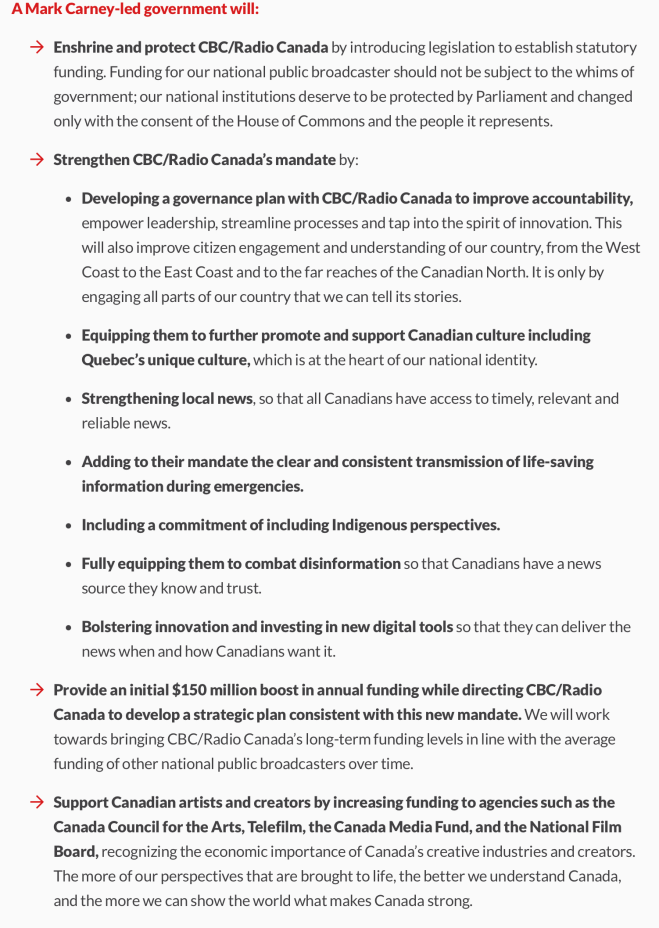
At last someone put him on the spot about the Liberals cutting nearly $200 million from the CBCjust a few months after delivering on Prime Minister Carney’s signature election promise of adding $150 million to the $1.4 billion parliamentary grant.
In response to Conservative MP Bernard Généroux’s sardonic admiration of the government’s sleight of hand, Miller replied (in this Google translation):
“With all due respect, Mr. Généreux, I think one needs to better understand how budget estimates are made. We see an immediate picture of CBC/Radio-Canada’s funding profile, but that doesn’t factor into the subsequent bailout estimates. It’s a flawed equation to say we’re giving 150 to take away 200. This is part of the budget cycle.”
Silly Opposition MPs. Don’t they know about the double-tap of Supplementary budget estimates that often follow the Main Estimates?
By the way, the French word Miller used was “renflouement,” translated as “bailout” or “refloating.” Or perhaps it means “later, when we can make a favourably timed announcement of more money for the CBC in a Supplementary Estimate .”
One salacious policy hint he dropped: the government expects a discussion of a subsidy ceiling on the largest broadcasters in favour of smaller ones.
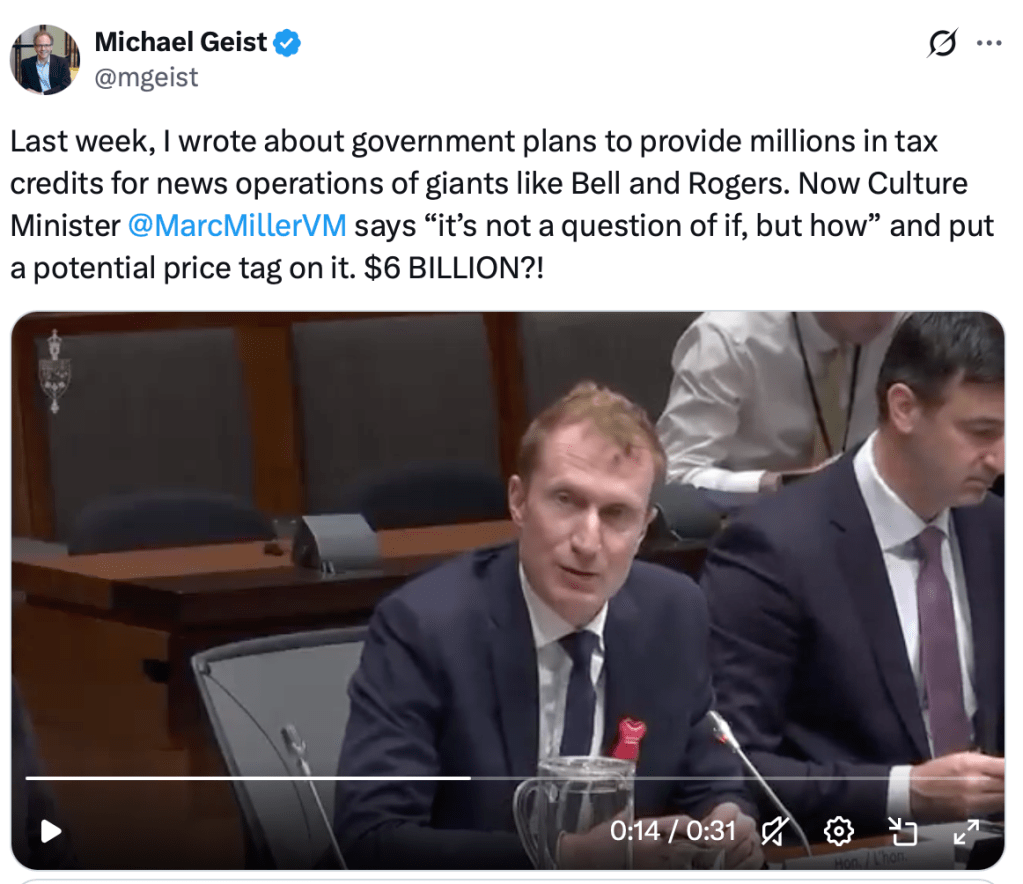
Then Miller said an odd thing (twice, so not by accident): the additional cost of the expanded program would be $6 billion dollars. That’s 100 times the cost of the existing QCJO program for print media.
By the time his interlocutor, Bloc MP Martin Champoux, followed up on that eye-popping number, Miller had left the committee room.
As you might expect, the Twittersphere went off like a Roman candle. Six. Billion. Dollars. Try to imagine Mike Myers’ Dr. Evil delivering that line.
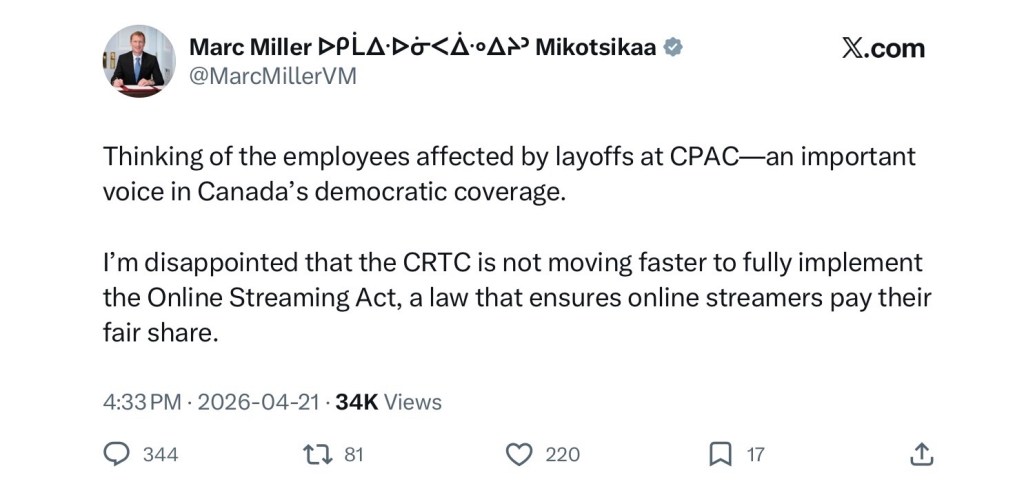
Two days later, Miller ‘fessed up in an X post saying he misspoke. He had mixed up the $75M per year journalism labour tax credit for print media with the $1 billion per year budget for federal film andtelevision productions tax credits (over the next six years, ergo the $6 billion figure).
Okay. Happens all the time.
So what might be the cost of a program for supporting broadcast news? Grabbing the nearest napkin and pen, I came up with a number somewhere between $82 million and $115 million. Let me show you my math:
To begin, the program cost of the federal labour tax credit is driven by journalist headcount based on 35% of journalist wages on the first $85,000 of salary.
Going to the best available source for headcounts, the news producer head count for the Google funds distributed under the Online News Act by the Canadian Journalism Collective, expressed as full-time equivalents working a 40-hour week, is 3,549 for broadcasting companies and 4,179 for publishers. Bottom line: the broadcasting headcount is 85% of print journalists, a figure I need for this arithmetic.
As for a hypothetical broadcasting program cost fixed as an 85% percentage of the known costs of federal print media subsidies, you need to first establish the combined cost of labour tax credit for print journalists at daily newspapers ($75M), Aid to Publishers for community weeklies and magazines ($71M), another program for free distribution weeklies ($13M) and the Local Journalism Initiative (LJI) for 700 additional reporters in local media ($20M, although not all in print media). It adds up to $179M for print media journalists.
But there’s a caveat to that $179M figure: the payout in the Aid to Publishers and LJI subsidies are much higher than the 35% wage subsidy in the labour tax credit, although how much higher is difficult to pin down.
Rough guess of a final print media subsidy? Calculating the total print journalism program costs at an across-the-board 35% wage subsidy spits out a final number of $135M for print media journalists.
Next step: the broadcasting headcount is 85% of that $135M, leading to an estimated program cost of $115M for TV and radio news outlets.
But there’s one final adjustment to the numbers: the existing labour tax credit is scheduled to fall back from 35% to its original 25% next year, a 29% reduction. If that goes through, the $115 million for broadcasting support drops to as low as $82M. And if a ceiling is put on subsidies to large broadcasters, even further.
So, not $6 billion, no.
***
The next goofy thing is ironic, not funny.
I subscribe to The Hub, a commentary and news reporting website that is cerebral in its writing and conservative in its point of view. I listen religiously to its biweekly Full Press podcast.
On Thursday, publisher Rudyard Griffiths informed subscribers that he was abandoning The Hub’s years long refusal to accept QCJO labour tax credits or distributions of Google money under the Online News Act. I estimate the value of the two income streams to his publication at $60,000 annually. Griffiths cited softening advertising revenues and promised to park the cash in a reserve fund.
As he put it, “We are using that latitude to park any payroll subsidies in a segregated “rainy day” fund—available if we ever truly need it, but walled off from day-to-day operations so our journalism doesn’t become dependent on government money. If we ever draw on these subsidy dollars, we will tell you.”
There’s no need for “I told you so’s” here, although Griffiths has been vocal for years in his opposition to journalism wage subsidies, as well as passing judgement on those news organizations that accept them (“the soft, silent takeover of the nation’s press.”)
The Hub’s walk-back dittos the Western Standard which did it in September 2025, also stating it was doing so reluctantly.
As far as I know, this leaves just two news organizations who could qualify for the labour tax credits (which require ongoing publication of original news content) but make a point of refusing subsidies.
One is the hyper partisan Juno News. The other is the watchdog news outlet Blacklock’s Reporter which specializes in access-to-documents news reporting on the federal government and, it’s fair to say, offers no quarter to government and expects none.
***
Moving on, I was distressed reading journalist Shauna Rae’s winning essay for the Dalton Camp Award, juried by Friends of Canadian Media. I’m a long time member of Friends and a volunteer on its policy committee, but I don’t have any connection to the annual writing award that honours Camp, the veteran political strategist who died in 2002.
You can read Rae’s short piece and evaluate the message in her own words. To summarize, she is of the view that journalists should feel free to report the news as their truth, rather than the truth.
This is hardly a newly minted journalist creed even though I believe it is very much in the minority.
It’s a call for “openly activist and participatory” (Rae’s words) journalism in the fight against privilege and power, in a binary world of oppressor and oppressed. It feeds directly into identity politics of racial and gender inequality and the dispossession and gross mistreatment of Indigenous peoples; identity politics in the sense that individuals are ascribed membership status as either oppressor or oppressed. Taken to the global stage, it underpins an anti-Israel news narrative.
Rae’s justification for activist journalists throwing off the shackles of objectivity is that no such thing as objectivity exists.
Objectivity may be the world’s biggest straw man. Outside of university seminars dwelling upon political theory I don’t think I’ve ever met anyone, let alone a journalist, who posits the existence of objective truth. The overwhelming majority of journalists (that I’ve ever met) adhere to the journalist creed of “pursuing the truth” while practicing professional norms of fairness and accuracy in fact gathering.
But, fill your boots with openly activist and participatory journalism if you wish. It’s a free and independent press that allows Rae and any other journalists to wear the activist mantle if they choose. Their work will be judged on its merits.
What disturbs me so deeply—and I know this will sound harsh— is the intellectual nihilism behind the activist creed. It’s the idea that in the absence of indisputable objectivity that anything goes. It’s the idea that you can defend any news reporting narrative as fair and deserving of credibility no matter how closely it operationalizes the writer’s agenda for making change in the world.
Mostly it disappoints me because that’s not how change happens. And do we ever need change.
***
At the risk of making this weekly update too long, there is another item that I didn’t want to go stale.
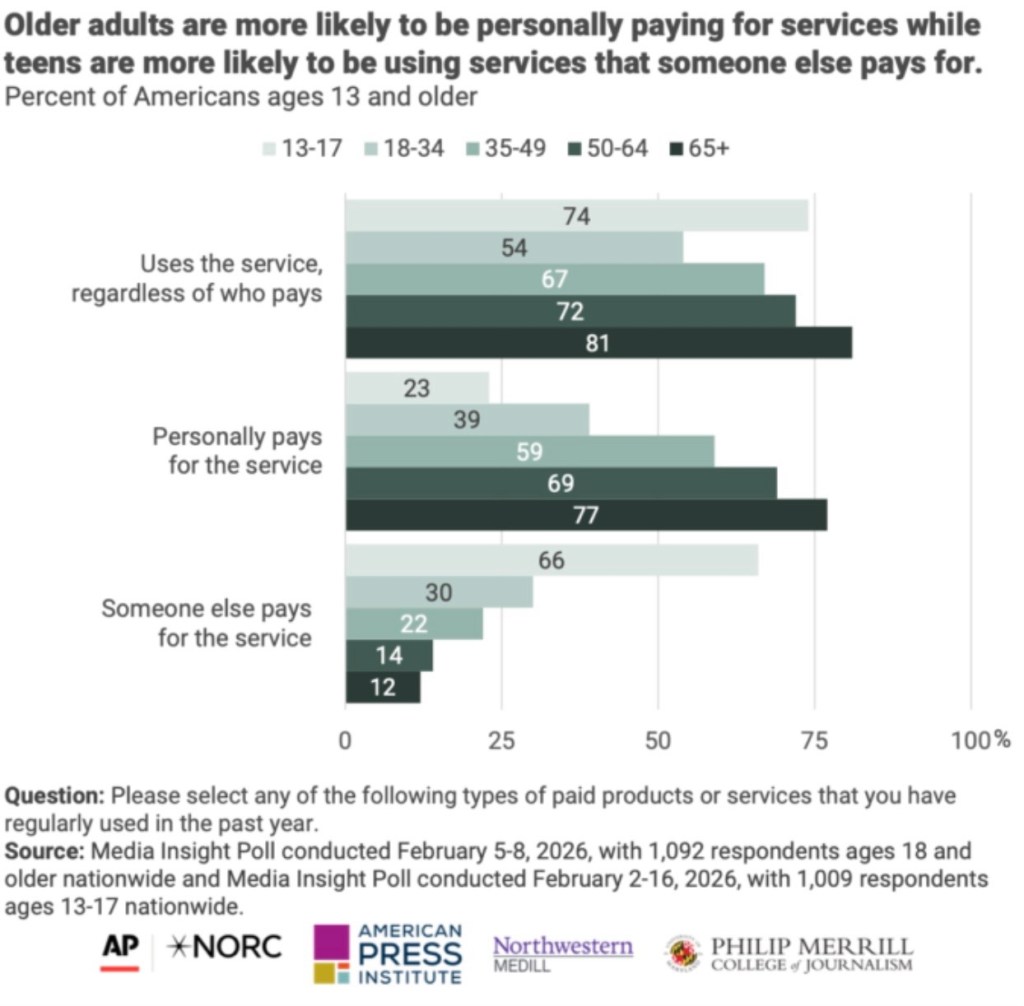
It’s a survey conducted by the Media Insights Project on where Americans get their news and whether they pay for it. That has implications for how much emphasis we Canadians might put on public policy subsidizing paid news subscriptions as a reliable delivery vehicle for reporting on current events to a broad based democratic polity. It’s an issue that Senator Andrew Cardozo and I raised in our recent report, “Making News Media Sustainable.”
A key conclusion in the survey was “the majority of Americans — 7 in 10 — access a paid media service of some kind, even if they don’t pay for it themselves.”
We already knew that Americans pay for digital news subscriptions at a slightly higher rate than Canadians, which tends to fluctuate between 15% and 20%.
The public policy consequence is that such a low uptake on paid news subscriptions makes it hard to rely on the subscription business model as a comprehensive way of delivering news when so many Canadians are stuck on getting free news (there is data suggesting lower prices of digital news subscriptions don’t tempt people much).
The low uptake on digital news is mitigated by the fact that half of Canadians live in a household with access to a cable TV package that includes news channels (alas, news is a serious money loser for television networks).
The Media Insights survey’s conclusion that “7 in 10” Americans have access to “a paid media service” even if they don’t pay for it suggests that young people are watching cable TV or else making liberal use of a streaming password shared by someone else who paid for it. Thanks Mom and Dad.
The asterisk to that “7 in 10” statistic, and the limitation of the survey question’s relevance to news policy, is that it was about paid media services, not paid news media services. There’s this thing called Netflix, you know.
Still, it’s an encouraging set of public policy data on news consumption. Which reminds me to refer you again to the Cardozo-Law study where we recommend the federal government experiment with a generous news voucher program for news subscriptions.
***
If you would like regular notifications of future posts from MediaPolicy.ca you can follow this site by signing up under the Follow button in the bottom right corner of the home page;
or sign up for a free subscription to MediaPolicy.ca on Substack;
One of the not so surprising options we propose is to extend the federal QCJO journalism labour tax credits to news websites operated by broadcasting companies. The Québec provincial government did it in March with their labour tax credit that parallels the federal QCJO. (A correction: the Québec labour credit directly supports news broadcasting on television and radio).
Entirely by an accident of timing (promise!), on Tuesday the Carney government announced a public consultation proposing to extend QCJO labour tax credits to “audio and audio visual news production,” which is not quite the same thing as digital news websites operated by broadcasting companies, but close enough.
Law professor Michael Geist was out of the gate fast opposing public journalism subsidies being paid to major broadcasters, in particular the three owned by telco pantomime villains Bell, Rogers and Québecor. It’s fair to say, Geist won’t be alone on this.
I have a long winded rebuttal which I will save for later.
***
AI Image
The Australian government has taken the next step in responding to Meta’s refusal in March 2024 to reboot news licensing agreements under the News Media Bargaining Code (NMBC). The 2021 NMBC legislation was the prototype for Canada’s Online News Act.
To counter Meta’s exit from news licensing agreements, the Australian government announced in December 2024 that it would replace the NMBC with a News Bargaining Incentive (NBI). The key provision in the proposed NBI is a default cash levy on Meta, even if it tries to elude payments by banning local news. The NBI news levy would be reduced by any licensing deals struck between tech platforms and news outlets. It also would extend the levy net to catch TikTok, in addition to Meta and Google.
The calendar months have flipped by and it was not until this week that the Australian government at last announced the next step for the NBI, a public consultation.
The most newsworthy item in the announcement was the proposed price point for the cash levy: 2.25% of a company’s Australian revenues.
At first glance, that number suggests a climb down from an old levy rate of 4% of revenues that in 2021 generated $190 million in annual licensing payments by Google and Meta. The defacto 4% figure was identified by reverse calculation back in September 2023 by Canadian officials commenting on the monetary value of the 2021 Australian deals with Google and Meta.
Canadian officials said at the time that applying the Australian 4% target under our Online News Act would mean Canadian outcomes of $172 million from Google and $62 million from Meta. When Ottawa finally settled in December 2023 with Google for $100 million instead of $172 million, that converted the Canadian 4% into 2.32%.
Which is awfully close to the 2.25% proposed now by the Australian government.
But the lower Australian levy rate is still intended to produce the same $190 million contribution outcomes from 2021 because the legislation adds TikTok revenues and reflects the growth of Google and Meta revenues in the last five years.
Back in Canada, it’s unclear what Ottawa is going to do about the Meta ban on mainstream news (going forward I am calling it “Meta’s mainstream media ban” as it’s now clear that Meta permits certain Canadian news outlets to post on Facebook and Instagram provided these outlets sign off that they are not, or would not be eligible for federal QCJO labour tax credits or a share of the $100 million in Google money under the Online News Act. Effectively, this means the Meta news ban on Facebook and Instagram targets mainstream Canadian news organizations who produce original news).
This selective news ban gives the peripheral news organizations —whether they behave as honest news outlets or political activists — a leg up on mainstream media in the quest for audience.
The policy boomerang that smacks mainstream media in the mug, whether you blame Meta or the legislators of the Online News Act for the ban, results in the loss of audience exposure and click-through referrals to news websites.
But there are self-help strategies.
On this, Torstar President Angus Frame appeared before the parliamentary Heritage committee on April 23rd and offered some interesting information.
In the course of testimony about Big Tech in Canada, Frame said that since Meta imposed the news ban in August 2023 the Torstar chain of dailies and community weeklies has neutralized the loss of referral traffic.
I asked how and his answer, about leaning into web traffic generated by Google Discover and e-mail distribution strategies, is succinct enough to quote in its entirety:
There are always a bunch of variables in the mix, but the simple story looks like this:
In July 2023 (the month before Meta pulled out of news in Canada) our community sites generated 1.6M page views from Facebook referrals. This was typical for the first half of 2023 though the number had been declining since about 2018.
In July 2023 we generated 550K page views from newsletter click-throughs (people visiting from our own newsletters). We had 5.2M page views from Google.
Last month we had 1.55M page views from our newsletters, which almost completely replaces the views lost to Facebook. Google referrals were at 5.1M.
So the way that all came together is this:
-With the Meta ban, we shifted focus to optimizing for Google and in particular Google Discover. This gave us a good recovery heading into 2024 but it has since declined a bit with some reductions in Google traffic.
-Once Google was in better shape, we started to emphasize newsletter growth and newsletter effectiveness. This involved a number of tactics to get more people to sign up for our newsletters, to make sure our newsletters were landing in people’s inboxes properly and to optimize the newsletters (both design and story selection) for the best possible click-through rate. And that gets us to where we are today with newsletter traffic almost completely replacing the lost Facebook traffic.
And the newsletter traffic is better for us — we have a direct relationship with that audience, they come back to us more frequently and we can continue to grow that audience channel without worrying about algorithm changes or other things that can disrupt the strategy.
***
The Senate Bill S-209 that would introduce age verification to block underage access to porn sites and porn on social media apps has now made its way into the House of Commons.
Now that the Liberals have a majority in the House, don’t expect the bill to get far, even if they find themselves on the wrong side of public opinion on this one.
The door isn’t completely shut. Heritage minister Marc Miller was quoted in the Globe and Mailas saying S-209 “has merit,” the opposite of what the Trudeau PMO used to say.
But Miller appeared to pour cold water on the bill anyway, simultaneously saying that age verification would not be in a Liberal online harms bill while referring the issue, along with the idea of a blanket age ban on social media, to his expert advisory committee.
As part of the debate over child safety and social media, expect the troubling privacy and compliance issues to keep bubbling up to the surface.
There are anecdotal reports of Australian teenagers circumventing the new social media ban in that country.
As well, the technical issues of privacy breaches keep arising, as they just did in Europe. The hacking of adult viewers’ age verification data is a problem that gets bigger depending on where the digital gatekeeping of age verification happens, from the narrow access to online porn sites to universally accessed social media or device operating system sign-ins.
***
Here’s a few things to read that follow up on issues followed in MediaPolicy:
The Paramount sneeze and the Canadian cold: The possibility that a soon-to-be- sanctioned merger between Paramount and Warner Brothers Discovery will sideswipe Bell Media, by cancelling HBO’s exclusive Canadian distribution through Crave, is further off in the future than previously thought. The Globe & Mail‘s Barry Hertz got Bell to talk.
Canadian book publishing: Hugh Stephens has reviewed Richard Stursberg’s Lament for a Literature. Stephens offers his skepticism of Stursberg’s “draconian” proposal for state intervention into the Canadian book publishing market. Knowing Stursberg, he wouldn’t flinch at “draconian” but would argue that drastic measures are required after 40 years of federal neglect.
CanCon: Cartt.ca is publishing Brad Danks’ seven-part series on the future of Canadian content in a small domestic market and a global streaming audience. So far there are two instalments and if you find the first one a little abstract, the second (“why Canadian media keeps missing the upside”) makes his arguments with brevity and persuasion. I won’t give away more than that.
Journalism standards: Are you a Canadian journalist? Colette Brin of Laval University is shaking your tree to get involved a survey supporting a study on whether there are consensus standards for news coverage that we should be articulating for the industry. If you don’t help, consider your dissenting privileges revoked!
***
Lastly, a magnetic documentary to watch.
CBC is streaming Canadian filmmaker Ric Esther Bienstock’s two-part “Speechless,” profiling the pitched ideological battles staged on American university campuses and inside faculty lounges.
The film got a meh from Globe reviewer Kelly Nestruck, but I found it both riveting and kind of terrifying (after having tuned it all out for years for just that reason).
***
If you would like regular notifications of future posts from MediaPolicy.ca you can follow this site by signing up under the Follow button in the bottom right corner of the home page;
or sign up for a free subscription to MediaPolicy.ca on Substack;
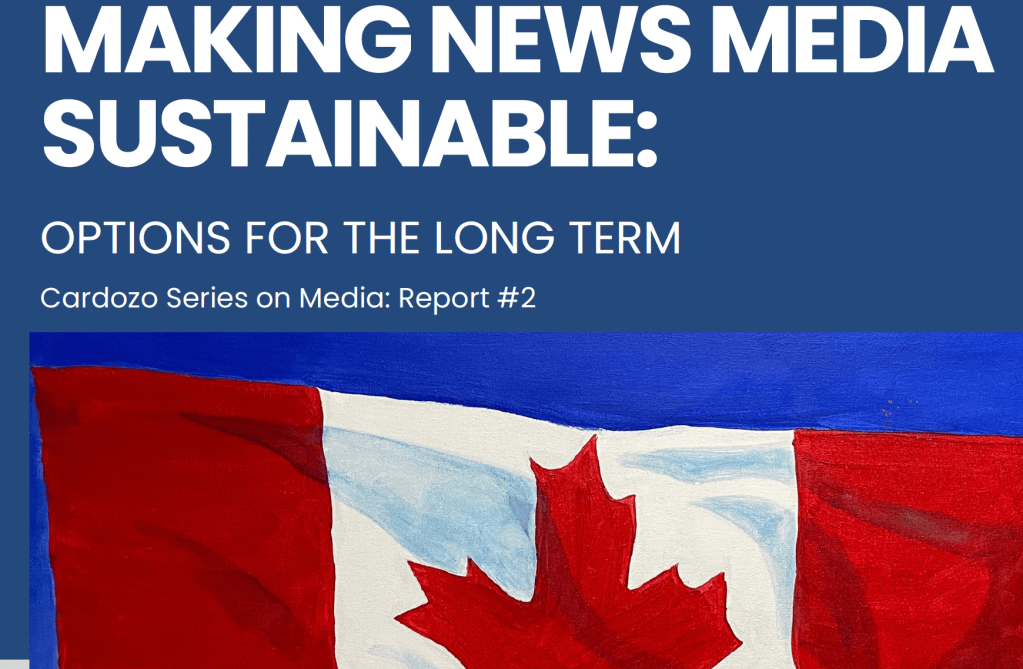
Today, Senator Andrew Cardozo released his new report “Making News Media Sustainable,” co-authored with yours truly, on future policy options for supporting Canadian news journalism. It’s about subsidies.
Our project is to put forward new ideas. For discussion. The working assumption is that public support of private journalism is here to stay in one form or another, so what can we offer in terms of continuous improvement? The Senator already put forward his ideas about public support for the CBC in a 2024 report here, so this new report focusses on public support to privately owned news journalism.
Some of our ideas will roil the waters. Just to choose one, we suggest that federal news subsidies should be reduced or eliminated to heavily indebted news organizations (i.e. Postmedia) that are using public money, in whole or in part, to pay off their controlling owners and creditors.
There are other ideas that you might call technocratic, invoking the subtle art of policy design, such as offering news organizations an opportunity to go paywalled, or to stay paywalled, and forego journalist salary subsidies in favour or more enticing subscription tax credits offered to citizens. To work properly, the federal government would have to launch a seriously generous news voucher program for citizens, whether or not they pay taxes.
Another idea, that we lean on pretty hard, is that the federal government end its arbitrary exclusion of broadcasting companies from accessing subsidies for their news websites that are indistinguishable from the digital operations of print publishers. By coincidence, yesterday the Carney government announced in its Economic Update that the Finance Department will launch a public consultation “to seek the views of Canadians and stakeholders on extending the Canadian Journalism Labour Tax Credit to audio and audiovisual news production.”
We give a lot of attention in the report to the under appreciated history of innovation success in Canadian news journalism, both with respect to digital technology and content strategies. There have been many successes to admire or replicate, both from start-ups and legacy news organizations. One policy idea that emerges from that experience is public funding of innovation-related expenses, such as IT staff salaries.
We also applaud the gaining traction of non-profit news journalism. It is no silver-bullet to cure all that ails the beleaguered industry. But it clearly can be tapped for greater potential.
One of the challenges to change-management in our sprawling news industry is that we lack a cohesive public policy for supporting news journalism. Policy initiatives have been ad hoc, reactive, and initiated under overlapping jurisdictions of federal government, provincial governments, and the federal regulator, the CRTC. Unsurprisingly, there is no central institute equipped to collect and analyze a broad and deep well of industry data that might guide the best decisions for supporting journalism.
And our closing advice in the 100-page report: the policy solutions for news journalism may not be one-size fits all. We have an array of Canadian news markets where consumers seek or passively consume the news of the day: national, regional, local, by language, by content silo, by platform preference, etc.
The biggest conundrum, the one that reveals our deepest policy conviction in writing the report, is the enormous gap between the number of Canadians who will pay for news (about 20%) and those who won’t. That 20% number is stubborn: even hypothetically lower paywall prices don’t seem to budge it very far.
All Canadians vote (well, 68% of those eligible in the last federal election), whether they consume news or not. As the loss of advertising revenue to Big Tech platforms has destabilized news organizations that distribute trustworthy news for free and without a subscription, the threat of a news consumption deficit becoming a democratic deficit is something that only the naive would avoid looking straight in the eye.
Finally, we have a lot to say about the connection between public trust and public subsidies to news journalism.
We don’t subscribe to the idea that a penny of subsidies means a pound of distrust: the healthy and unhealthy skepticism expressed around the world about news media is powerfully influenced by many things other than subsidies and, for example, is far more profound in the United States where there is precious little subsidy of news journalism. Regardless, care must be taken regardless by making greater efforts to make the gatekeeping of Canadian news subsidies arm’s length from the government.
The report begins with a brief executive summary. It’s followed by a landscape review of subsidy programs, a comparison to policy initiatives in non-Canadian jurisdictions, and then an extended series of policy issues inviting you to engage in the debate over what is to be done.
***
If you would like regular notifications of future posts from MediaPolicy.ca you can follow this site by signing up under the Follow button in the bottom right corner of the home page;
or sign up for a free subscription to MediaPolicy.ca on Substack;
On Thursday, CBC president Marie-Phillipe Bouchard told Heritage committee MPs the $150 million increase in the public broadcaster’s parliamentary grant for 2025 was “temporary.”
In fact, she said in response to a question from Bloc MP Martin Champoux, “we knew it was temporary.”
Bouchard’s answer is a revelation because, until the Carney government published its Main Estimates for the 2026-27 federal budget, neither the Prime Minister nor the author of the 2025 federal budget that included the $150 million, Finance minister François-Phillipe Champagne, told the public that the new CBC money was temporary.
Announced this February, the 2026-27 budget projection cuts$192 million from the public broadcaster.
The Prime Minister, who promised the $150 million in his April 2025 election platform as a downpayment on a larger funding increase, also told voters on the campaign trail that that in addition to the $150 million “we expect that in the coming years, we will continue to increase that funding until it can be compared to that provided by other public broadcasters.” (On budget day November 4, 2025 a carefully worded press release avoided the characterization of either a temporary or permanent increase).
And while Canadians might have taken the Prime Minister and the Finance minister at their word, it seems the CBC president knew otherwise. “We knew it was temporary.”
A follow up question from the Bloc’s Champoux, a former journalist, might have been “when did you know it was temporary?” And who told you?
But the question never came. Conservative MP Bernard Généreux followed up, but only to rib Bouchard over the Liberal budget cut and how perhaps the CBC had more to fear from the government than would-be CBC defunder Pierre Poilievre.
Liberal backbencher Bienvenu-Olivier Ntumba then asked Bouchard about the impact of parliamentary cuts on Radio-Canada. The CBC president replied that some staffing resources shared equally between French and English language services would be affected if cuts were “significant.”
The government’s main budget estimates have scheduled a $192 million cut to the CBC budget, representing the repeal of the $150 million increase from the 2025 budget. An earlier $42 million boost under the Trudeau government in 2024, renewed in the 2025 parliamentary grant, was also repealed for 2026-27.
Heritage minister Marc Miller appears before the committee on May 5th (update: now rescheduled to May 7th).
***
In our last MediaPolicy post, we reported on the stale news — I was on vacation, okay? — that the CRTC had reversed itself and agreed to provide a three cents per subscriber increase to the parliamentary news service CPAC.
Minutes before or after I hit the publish button on that post, CPAC CEO Christa Dickenson announced the termination of CPAC’s evening news show. The $2.8 million boost to her $13 million budget from the CRTC rate increase wasn’t enough to stabilize finances, according to Dickenson. The cancellation of the show meant 12 staff layoffs, including show host Michael Serapio.
An online hue and cry followed in response to the CPAC announcement and Heritage minister Marc Miller joined in with a tweet suggesting that the CRTC’s delay in implementing the Online Streaming Act was to blame:
As I retweeted at the time, oh my.
By linking the CPAC layoffs to a live CRTC file dealing with requests to deliver financial relief to “services of exceptional importance,” the minister seemed to be saying that the independent regulator ought to giddy up and deliver it to CPAC.
That special funding was requested by CPAC on July 2, 2025, citing its services of exceptional importance including the now eliminated evening shows, and is still under consideration by the Commission.
Miller’s impatience with the languid pace of CRTC decision making on implementation of the Online Streaming Act is shared widely, for good reason. But now the Commission’s eventual decision on funding services of exceptional importance will either be a yes (submitting to its minister) or no (defying its minister).
A footnote to this story: on the same day that Miller was tweeting about CPAC, the CRTC followed up its increase to CPAC’s subscriber rate with a two cent increase for TV5, the French language news service.
CPAC’s Dickenson appears before the Heritage committee this coming Tuesday, April 28th.
One of the better kept secrets in minister Miller’s thoughts is what he has in mind by appointing a special advisory committee on the future of Canada’s audio visual industry.
The ministerial appointments are mostly not the usual suspects and stakeholders, bending instead towards active industry executives, producers and investors.
The Government of Canada is reviewing how it supports the audiovisual sector. The current framework for federal audiovisual support was built for a different era and needs to evolve so Canadian stories can thrive, both at home and globally. The goal is to make sure that federal support remains effective, efficient and transparent, and that it can support the full spectrum of Canadian voices and stories. The work includes reviewing audiovisual policy and institutions.
Parsing that brief statement, change is certainly in the wind, but what? Presumably, committee members asked the Minister for something more detailed when they were recruited. It’s a good bet they aren’t signing on for a mere reorganization of government departments Telefilm, CAVCO, the National Film Board or the Canada Media Fund.
The CanCon-funding Canada Media Fund immediately expressed support for the minister’s “modernization” agenda. This suggested that the CMF, jointly governed and funded by the federal government and Canadian cable companies, knows what that agenda is. Asked for comment on its understanding of what in Miller’s agenda it is endorsing, the CMF replied “the CMF shares the Minister’s view that the current framework was built for a different era and needs to evolve.”
The rest of us, we’re on a need to know basis.
In the absence of more information, it is reasonable to speculate that the Liberals are going to re-launch something like the dead-ended 2016-17 federal policy review conducted by Heritage minister Melanie Joly that dismissed pleas for what became the Online Streaming Act in 2023 and instead called for more government support of exported Canadian content and a Canadian spending commitment from Netflix.
If you want to get a flavour of what an export strategy might look like, I recommend Ken Whyte’s latest Substack post which admires how Korea has remodelled its cultural production policies since the 1990s. (Coincidentally, Whyte served on Melanie Joly’s advisory committee in 2017).
***
If you would like regular notifications of future posts from MediaPolicy.ca you can follow this site by signing up under the Follow button in the bottom right corner of the home page;
or sign up for a free subscription to MediaPolicy.ca on Substack;