The Dais report probed how Canadians get our news, how misinformation is consumed, the prevalence of hate speech, and public attitudes about using government to fix it. (This is the fifth annual report from the Dais, a two-minute video on its 2023 report can be viewed here.)
The Dais analysis of online harms —it includes false information among the harms— is the juicy stuff. I’ll keep that warm for my next post.
Mainstream media dominates
As for news sources, The Dais report confirms what we already knew: “legacy” television news is far and away the most popular news source for Canadians:
In fact, the Dais report shows that “yesterday’s man” of Canadian media is creeping even higher over time (Figure 5). And look above in Figure 4 who’s standing next to television on the podium: news websites and radio. It’s a clean sweep for mainstream media and the news organization that make it up.
On the other hand, the 2024 Reuters Digital Report for Canada lumped together a collection of “social media” platforms to claim third place for news consumption (whereas the Dais Report above breaks out those platforms, individually).
The results are of course skewed by age cohort (Figure 6 in the Dais Report). Younger Canadians (16-29 years) are more likely to source their news from search engines and social media, also observed by Pollara earlier this year.
As for trust in the news that Canadians are consuming, again it’s mainstream media that rules. And the under-fire CBC is the king of credibility (Fig.10):
As an aside on the issue of trust in CBC News, the Dais notes that the public broadcaster’s 48% for “high” trust is elevated by a 64% score in Québec for Radio-Canada but weighted down by a 34% “high trust” in Alberta. Then again, those skeptical Albertans gave Global News and CTV the same score and even rated the Globe and Mail at 21%.
Perhaps the biggest token of skepticism is found in the Dais’ Figure 7. While noting television news’ dominant trust in comparison to other news sources, almost as many survey respondents replied that they didn’t trust any news sources, running the gamut from mainstream media to the entire Internet.
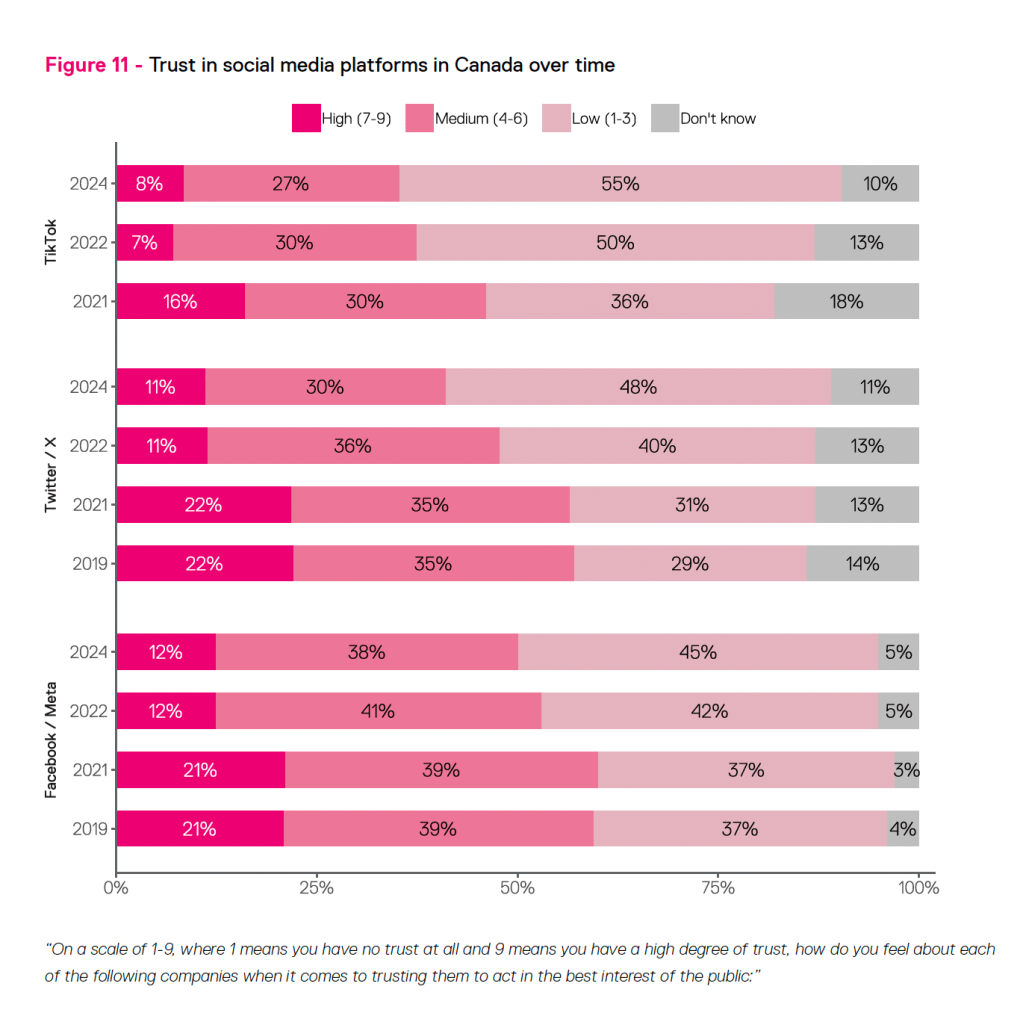
On the other side of the trust coin, popular trust of social media platforms is very low (and getting lower over time), even among the young Canadians who flock to them:
As MediaPolicy wrote this summer, the good news is that we are still a nation of news consumers. News avoidance and exhaustion is a real thing, but it’s not the main problem.
The main problem is the unravelling of news media’s business model, but the second biggest problem is Canadians’ declining trust in media and many other public institutions. That’s a world wide phenomenon, particularly acute in the United States. In Canada, the percentage of the public saying “yes” to the question “I think you can trust most of the news, most of the time” has declined from 55% in 2016 to 39% in 2024.
In the next post, we’ll look at The Dais report’s insights into misinformation, hate speech and public attitudes towards government regulation.
***
If you would like regular notifications of future posts from MediaPolicy.ca you can follow this site by signing up under the Follow button in the bottom right corner of the home page;
or e-mail howard.law@bell.net to be added to the weekly update;
It being the time of the year, retrospective lists abound.
The MediaPolicy 2024 wrapped list includes posts that are worth reading (again or for the first time) because they cover public policy that Pierre Poilievre has sworn to repeal or at least do something else that looks like he has wiped the Liberal policy slate clean.
***
Defunding or defending the CBC
The Poilievre banner campaign to defund the CBC is the right-wing answer to cancel culture. I don’t like you, I silence you.
A Sparks poll in January 2024 suggested overwhelming public support for the CBC, although a big slice of that is soft. Hence the importance of a public discussion of how to improve or re-engineer the public broadcaster.
MediaPolicy posted two interviews and a guest column from media commentators who know what they are talking about when it comes to the CBC: Chris Waddell, Richard Stursberg and Peter Menzies. I have a fourth instalment in this series on the way.
Online Harms
The Liberals’ Bill C-63 obliges social media platforms to come up with content moderation codes. It also empowers the government to order take-downs of revenge porn and content harmful to children. The Justice Minister has split off the more controversial portions of C-63 into a second bill: harsher criminal sanctions for Internet hate and access to human rights tribunals for victims.
The Conservatives are opposed to all of it (they have a more modest proposal) and none of it will pass before the next federal election.
In 2019 the Liberals passed the so-called “$600 million bailout” for Canadian news organizations (except for licensed broadcasters). The $600 million was the over-budgeted amount for five years: the actual spending was less than half of that.
MediaPolicy posted about the alleged relationship between that federal program and declining trust in news organizations. Also I looked at some policy prescriptions that might carry over into a Poilievre government despite his pledge to abolish the program.
News licensing payments
You say “link tax,” I say “compulsory news licensing payments.”
The Online News Act Bill C-18 blew up on the Liberals when Google and Meta decided to play hardball with enough gusto that US legislators would think twice about following Canada, Australia and Europe in making Big Tech platforms share their advertising revenue generated by news links.
I tried to get past the noise on this bill and pinpoint what I believe are the deeper truths about the legislation. The post is now a year old, but still helpful.
Poilievre says he will repeal this bill and, it would seem, refund Google its $100M in annual news licensing payments.
The Netflix Bill C-11
It took them forever, but the Liberals passed the bill that compels foreign streaming giants to share the responsibility with Canadian broadcasters to finance and distribute Canadian audio and video content.
Poilievre has been clear: he will “kill Bill C-11.”
Digital Services Tax
The DST is a stand-in for recouping $900 million in corporate tax avoidance by Big Tech in Canada. That doesn’t always come through clearly in news reports. Unfortunately, leading Canadian critics have displayed an obsequiousness (to Big Tech) or fear mongering (of US retaliation) that is unbecoming.
MediaPolicy posted what I will call a context piece on the DST that I hope is informative.
***
A note to readers, MediaPolicy posts will now be available on Substack. The MediaPolicy website on the WordPress platform will continue with its archive of previous postings and resource links.
If you are already an e-mail subscriber, you will continue to receive MediaPolicy posts and will not get a duplicate from Substack (unless you sign up for it).
Substack is a fascinating creature in the news ecosystem. Founded in 2017, it’s a platform for 17,000 writers, including journalists. You can find leading independent Canadian journalists: folks like Paul Wells (30,000 paid and unpaid subscribers); Jen Gerson of The Line (26k), Justin Ling (12k), Terry Glavin (12k), Ken Whyte (7k) and Patrick White (2k). On Subtstack, both writers and readers can pepper the blogosphere with rhetorical outbursts, à la Twitter/X. But for journalists and news junkies, the site’s real draw is full-length opinion and analysis.
A year ago, Substack had about 50 million unique visitors in the month of January. It boasts two million paying subscribers and over 20 million registered readers (after you have opened an account or surrendered your e-mail address to one of your favourite writers). The writer posts are usually partially paywalled, but not always (mine is not).
The most popular Substacker is Heather Cox Richardson (1.8 million), American historian and author of the non-paywalled Letters to an American. Popular Substackers, who usually charge a $5 monthly subscription fee, can make a decent living.
The question arises at to whether Substack is a candidate for stealing yet another big chunk of mainstream media’s franchise by peeling off well known staff journalists who are currently thankful for a regular paycheque.
Having lost classified ads, much of its display advertising, and a range of editorial products to the Internet leviathan, online newspapers have stayed in business by cutting news and news gatherers. To replace the lost news content, we have a great deal more opinion columns. Opinion is popular and, for the news proprietors, cheap. The key has been to concede more of the news hole to the best and well known opinionators.
What if Substack took those marquée writers and their audiences too?
If you mark off 45 minutes of your time, an engaging Canadaland podcast hosted by Jesse Brown and starring Paul Wells, Jen Gerson, and Chris Best (Substack’s Canadian co-founder) talks about the possibility of mainstream media losing its stars to Substack.
Gerson has a trenchant observation: the Canadian journalists enjoying success on Substack are generally those who made their bones and their reputations after years of service in mainstream media newsrooms. That career path, she suggests, doesn’t exist anymore.
Then there’s Substack’s Nazi problem. With that teaser, I recommend the podcast, here.
***
If you would like regular notifications of future posts from MediaPolicy.ca you can follow this site by signing up under the Follow button in the bottom right corner of the home page;
or e-mail howard.law@bell.net to be added to the weekly update;
The devil makes work for idle hands and lately MPs from the filibuster-becalmed House of Commons amuse themselves by summoning CBC Presidents before the Heritage Committee. Once in the dock, prosecutorial MPs flay the witness and then video clip for their social media posts.
Some MPs had trouble with their facts. Not without justification, MP Kevin Waugh cited the public broadcaster for raking in $400 million in advertising revenue that could otherwise be available to private media. The true dollar figure is $270 million; Google and Facebook have the rest.
MP Jamil Javani claimed that CBC English language television has a 2.1% share of viewing audience. The CBC’s percentage for prime time viewing in television, excluding its all-news and documentary channels, is more than twice that at 5.2 %. By comparison, Canadian private broadcasters collectively take 26%, a wide array of specialty channels are at 53% and US networks are at 13%.
Conservative MPs dwelled upon the bonus payout for senior CBC executives. Bouchard defused the situation by agreeing to review the payments, make her review transparent, and gently reminded MPs that the correct term is “variable pay” (the at-risk performance pay that is part of every senior manager’s compensation package in the modern world).
MP Niki Ashton from northern Manitoba assailed the CBC for its retreat from local television news. She’s not imagining that: in response to the deep Liberal budget cuts during the 1990s, the public broadcaster closed stations and reduced coverage across Canada. The coverage-killing budget cuts didn’t stop there: between 2013 and 2023, the CBC responded to Parliament’s austerity by reducing its spending on television programming in English Canada by 40% in real dollars as it shifted resources to online news.
Bouchard’s reply to MPs was noteworthy: local news will be a “big focus” as the incoming CEO. Last month the CBC announced it was spending its $7 million of “Google money” on hiring 25 journalists in underserved markets.
***
In a previous post I did the CRTC an injustice by accusing Commission staff of “twiddling around” in its investigation of whether Meta is offside by selectively waving some news items through its block of Canadian news content.
I said that because the Commission appeared to be too patient in allowing Meta lawyers to rag the puck in response to the CRTC’s demand for the details on the porous news block, details which the regulator intends to make public in the course of its inquiry.
Last Monday the Commission fired off another letter to Meta and, if you read for nuance, you will conclude that the CRTC has lost patience with Mr. Zuckerberg’s demands to keep his explanation a secret and is ready to post Meta’s unredacted explanation of its news block.
Meta has until tomorrow to play ball or else. Else what, we shall see. Once Meta’s statement of defence is public, the next step will be a decision from the CRTC on whether to investigate further.
***
There may never have been a busier week for Big Tech lawyers responding to legislation and lawsuits around the world.
Here’s a quick run down:
Australia passed a law banning kids under 16 years old from having their own social media accounts (WhatsApp and YouTube excepted). The ban takes effect a year from now —-an eternity in political time—- as the thorny issue of age verification gets sorted out. The debate over the legislation was the occasion for Elon Musk to tweet accusations of censorship, a rebuke from the CEO of the Australian public broadcaster Kim Williams and then Musk responding by unleashing a troll storm against Williams.
The Australian government dropped its version of our Bill C-63, the Online Safety Act. Its “misinformation bill” was destined to fail in the Australian upper chamber where the government does not enjoy a majority.
The Canadian Competition Bureau has filed suit against Google for allegedly abusing its market power in digital advertising. Having cleared Google of this very charge in 2013, it seems likely the Bureau has more evidence in hand as a result of the ongoing anti-trust trial against Google in the US.
Canadian news outlets have filed a copyright lawsuit against the Microsoft-backed OpenAI and its ChatGPT app —-in the wake of a similar lawsuit by the New York Times—- for ingesting millions of the outlets’ online news articles. There’s already an AI-ingestion lawsuit proceeding in Canada between two smaller players as recounted by the University of Calgary’s Hugh Stephens in a blog post.
***
The Globe and Mail’s Cathal Kelly is a born-with-the-muse columnist who just happens to write about sports.
If you would like regular notifications of future posts from MediaPolicy.ca you can follow this site by signing up under the Follow button in the bottom right corner of the home page;
or e-mail howard.law@bell.net to be added to the weekly update;
This week MediaPolicy published a report of the CRTC’s announcement on November 15th laying the groundwork for how Netflix and the other foreign video streamers will contribute to Canadian content under the Online Streaming Act.
Released on a Friday, the announcement flew quietly under the radar of the daily news cycle, possibly because there is no immediate price tag attached to Netflix’s future obligations to make or license Canadian shows.
Last June the CRTC imposed on the foreign streamers $140 million worth of annual contributions to Canadian television subsidy funds for news, drama and kid’s programming: last week’s much anticipated announcement might end up being worth five times as much in streamers’ programming budgets for Canadian content.
There are times when the impact of American public policy initiatives on Canadian media policy dwarves anything we might do north of the 49th.
As you may recall, the trial judge in an anti-trust suit begun by the Trump White House and several states against Google resulted in a legal ruling declaring Google an illegal monopoly in Search and search related advertising.
Following up, the collective of Attorneys Generals spearheaded by the federal DOJ have now tabled remedial requests to the trial judge.
Just for starters, they are requesting that Google divest its Chrome web browser and its Android mobile operating system. And there are important requests focussing directly on bootstrapping would-be competitors to Google in the Search market by giving them “catch-up” access to Google’s treasure trove of consumer data. Radical stuff for radical times.
There is a useful news summary from the New York Times. But if you can afford the time for a ten-minute read, I recommend Matt Stoller’s excellent explainer.
As I read Stoller’s piece, it easily came to mind how unlikely it is that Canadian news publishers would have successfully pursued the news licensing payments in the Online News Act if instead of Google’s monopoly on search referrals there was robust competition in the Search Engine market.
***
More than a few times MediaPolicy has raised the question of how Meta is getting away with its selective ban on Canadians news content, its response to our Online News Act.
The Heritage Minister raised the same question publicly but she is constrained by the fact that it’s the CRTC’s jurisdiction to investigate it.
It’s possible that federal cabinet considered but dismissed the idea of sending the CRTC a policy directive asking the Commission to look into why Meta permits the sharing of some news items, but not others, and why it has flat-out restored news posting privileges to outlets such as Narcity.
The Commission is twiddling around on this one. In early October it asked Meta to explain the rhyme and reason for allowing some news content on its Facebook and Instagram platforms while banning the vast majority of news organizations.
Meta filed a letter in response and, according to a Canadian Press story, it appears that Menlo Park submitted something, but it’s not clear what. And beyond whatever details of its selective ban it provided, Meta has claimed confidentiality and opposes the public release of its answers to the Commission.
This minor legal drama will play out in the fifth dimension of regulatory time.
Meanwhile the public is still in the dark as to whether the Commission thinks there is a basis for playing hardball with Meta by, for instance, officially designating its platforms under the Online News Act so that banned news organizations can file an “undue preference” complaint and get equal treatment to Meta’s favoured news outlets.
***
I’m pleased that so many followers of this blog liked Richard Stursberg’s guest column on the CBC, his advice for the incoming CBC President Marie-Philippe Bouchard. It’s now the most popular post in MediaPolicy’s short history.
Now there’s an interesting column from The Hub’s Managing Editor Harrison Lowman in which he identifies the “defund the CBC” problem as the public broadcaster’s news curation and journalism culture. His bottom line: fix it, don’t destroy an important Canadian institution and a vital provider of news journalism.
Lowman’s piece —-clearly not toeing the Conservative Party line—- was immediately disputed by The Hub’s Editor-At-Large and former Harper policy chief Sean Speer.
Speer’s says his support of defunding the CBC is not founded on an allegation of biased news reporting. Gosh no. It’s about the CBC’s declining audience share (him citing poor television viewership numbers, but ignoring strong digital and radio numbers). His colleague Lowman is just being “nostalgic” about the CBC.
***
If you would like regular notifications of future posts from MediaPolicy.ca you can follow this site by signing up under the Follow button in the bottom right corner of the home page;
or e-mail howard.law@bell.net to be added to the weekly update;
When you’re right, you’re right. And if you were right a long time ago, you’re vindicated.
It’s possible that former CBC executive Richard Stursberg is feeling just that, 13 years after leaving the public broadcaster where he served as the head of English language services from 2005 to 2011.
At the CBC, Stursberg’s calling card was that “audiences matter.” His single minded mission was to capture for the public broadcaster, especially in English language television, an audience commensurate with its role as Canada’s leading cultural organization (and its billion dollar Parliamentary funding).
To outside observers, he seemed to be at odds with everyone and not really minding. First there was the lockout of CBC staff in 2005. Then he grabbed the rest of the organization by the scruff of the neck and piloted a revolution in the CBC’s entertainment programming, for example embracing audience-pleasing reality television (remember Battle of the Blades?).
With an all-Canadian line-up, in five years Stursberg moved the needle significantly in CBC’s share of the national television market, closing the gap with CTV and its prime time schedule of hit US shows. Then he fell out with his new boss, CBC President Hubert Lacroix. And so on: read all about it here in his memoir, The Tower of Babble, ranked by the Globe and Mail as one of the best books of 2012.
Along the way, he made some friends, allies and enemies. The enemies he cheekily dubbed “The Constituency,” an assortment of CBC traditionalists and media watchers who might also have been described as “those who rip Richard in public.”
After he left, the CBC lost NHL hockey rights to Rogers and with it a whole lot of eyeballs and connection with Canadian audiences. Netflix ate up market share for Canadian entertainment television. And then Google Search and Facebook devoured the digital ad market. Stursberg tells more of that story in another prize winner, his 2019 book, The Tangled Garden. The job of keeping CBC relevant today is twice as hard as it used to be.
These days Stursberg continues to have his fingers in different cultural pies. He is outspoken on his support for major reforms to the definition of Canadian content, favouring a “cultural theme” test of distinctive Canadian programming over the traditional headcount of Canadian talent.
As a past reinventor of the public broadcaster, it’s his 2024 views on the reinventing the CBC that are worth soliciting in its hour of crisis. As conservative commentator Harrison Lowman recently projected, “CBC, your days are numbered.”
MediaPolicy asked Stursberg, what is to be done? This guest column, his advice to incoming CBC President Marie-Philippe Bouchard, is his response.
***
Advice to the new President of the CBC, Marie-Philippe Bouchard
By Richard Stursberg
Welcome to the job.
Given your deep knowledge of public broadcasting you are ideally placed to do well, but you will have significant challenges. Here is some unsolicited advice on how you can succeed from one who also believes in the importance of the CBC/Radio-Canada.
The Structure of the Corporation
First, your most important challenge will be English television. It is the central problem, not because Pierre Poilievre wants to shut it down, but because it has fallen to its lowest audience share ever. Put bluntly, with the exception of the recent Olympic Games, almost nobody is watching it. There are very few viewers for any of its shows, including news. Your presidency will succeed or fail depending on whether you can solve the problem of English television.
Second, it is important to understand the CBC is not a normal corporation and lacks a normal Board. It cannot decide its own fate. The overall strategy of the corporation has to be approved by the CRTC; and it cannot raise capital without the agreement of the Treasury Board. It lacks many of the powers of a normal corporation. This makes change very difficult. To succeed you will have to have the Minister of Heritage and the Prime Minister on-side for whatever you plan to do.
Should English TV be Fixed?
The Environment
The TV landscape in English Canada is in serious difficulty. The big conventional networks — CTV and Global — the major private sources of local and national news, have been shedding staff for over ten years and losing money. Their ability to commission Canadian drama and comedy is compromised. They are spending less and — for financial reasons — what they are doing is increasingly American in look and feel.
The cable industry has been losing customers for many years and with them, the fees that they pay to specialty channels. As a result, they too are significantly cutting back their staff and ability to commission Canadian shows.
The groups that own the vast majority of the conventional and specialty broadcasters are in trouble. Corus, the parent of Global, is essentially insolvent. Bell Media, the parent of CTV recently wrote down its broadcast assets by just over $2 billion. It is not hard to imagine that in another five to ten years the English Canadian broadcasting industry will — with the possible exception of the sports channels — no longer exist.
Their loss will mean that CBC TV will be the only broadcaster still producing Canadian drama, news, comedy, public affairs and documentary shows. If we value hearing our own stories told in our own voices, there will likely be nowhere else to see them.
Social fragmentation
The emergence of algorithmically driven social media has encouraged polarization and social fragmentation. Canadians increasingly live inside filter bubbles that act as echo chambers. Disinformation, deep fakes and AI generated falsehoods have compounded the problem. The space of common ground and shared assumptions has grown ever narrower as distrust spreads like a stain across public discourse.
As divisions grow more fractious, it is increasingly important that there be places that can bind the country together and create shared understandings about who we are. They need to provide stories, ideas, news and art that allow Canadians to celebrate, explore, discuss and make sense of their country. And, they need to be true. Truth is an essential component of patriotism.
The CBC is the last great cultural institution in the country that is in a position to do this. It can only do so, however, if its programming is trusted and popular. Unless it reaches big audiences it cannot create the large scale shared space that will provide the counterweight to the endless fragmentation of social media.
One initiative that the CBC might take is to address the challenge of disinformation by creating a news and public affairs portal that hosts not just its content but also that of all the other media in the country that are governed by traditional journalistic standards of truth and fairness. This could include other broadcasters, newspapers, magazines, on-line information sources and bloggers that are committed to ensuring the accuracy of their reporting. The portal’s promise — its brand — would be truth.
The other thing it must do is provide galvanizing programming that speaks directly to Canadians to foster debate and conversation about who we are and want to be. It must take on large projects that transcend the current divisions — whether regional, ideological or social — and provide Canadians a place to laugh, argue and cry. This is very difficult to do.
Can English TV be Fixed?
It will be very difficult. Your most important source of revenue aside from the Parliamentary appropriation is advertising, which has collapsed. At the same time, you are facing brutal competition from the vastly rich, foreign owned, unregulated streamers — Netflix, Apple, Amazon, etc.– who bear none of the costly cultural and social burdens that you do.
Business as usual cannot succeed. To save English TV you will have to develop a radical new plan for its future. The plan needs to reinvent its news and entertainment properties and find significant new sources of revenue. The creation of such a plan will be challenging. Substantive change will be met with criticism from all sides.
How Should the Plan be Developed?
It is important to develop a set of principles to guide the creation of a plan. These might include the following.
1. Focus on what the private broadcasters cannot do. They do not need competition from a publicly supported CBC. They are in tough enough shape as it is.
The space that the privates can no longer occupy is very large. Delivering what they cannot will make you more distinct and give Canadians more reason to view your programming.
2. Focus on serving audiences. The measure of success must always be whether Canadians are watching your shows. They pay for the CBC and can reasonably expect to be offered programs that they will want to watch. There is no public broadcaster without a public.
3. Focus on developing new sources of revenue. Television advertising is dying. Google, Facebook and the other big digital companies have taken it all away. Make a virtue of necessity and get out of ads for your drama, comedy and documentary programming. This proved a very successful strategy for radio and would certainly make CBC TV much more distinctive and attractive to audiences.
You will need to develop a new revenue plan. It can be based on sponsorships, whether from corporations or foundations, charitable giving, levies on the streamers and/or internal reallocations.
4. Ensure that the money you are given by Parliament is allocated fairly and sensibly. The French service receives 44% of the government money. This means that French speakers get a per capita subsidy of $70 per person, while the rest of the country gets $23 per capita. Given your biggest challenge is on the English side, this is both unhelpful and unfair. Only a French President can change it.
5. Do not try to please everybody. You can’t. Instead, focus. Be bold. Take risks. Make big bets.
Some Facts About English Canada’s Media habits
Every week Canadians spend about 20 hours on the Internet and 30 hours watching TV, whether traditional TV or streaming services. These are their most important leisure activities.
CBC English radio continues to perform well. It takes a 16% share of all radio listening and is number one in most markets.
CBC English TV has collapsed over the last ten years. It now has a share of roughly 4% of all TV viewing. Its share is equivalent to that of a specialty channel.
Although CBC likes to brag about the reach of its digital service, it is very lightly consumed. Compared to radio and TV, it performs poorly. Canadians spend about 17 minutes per week on CBC.ca., which is a share of just over 1% of their time spent on the Internet.
What are the Key Elements of a Plan?
Local News
Much of local news has vanished; Canada has entered a local news desert. Most small town and community papers and supper hour newscasts have died. All market research indicates that local news is the most important form of news, since it is about the events that directly affect people’s lives. Where local news dies, electoral participation falls and local corruption increases.
Consistent with the principle of doing what the private sector cannot, CBC should expand its local news presence. Recently (November 12, 2024), it announced a significant expansion of its local news presence.
To strengthen its local news further, it would be wise to leverage its strength in radio and have radio promote to and complement the CBC’s local news sites. This has proven a successful strategy in some very small towns in western Canada and Ontario.
Strengthening local news would also help your national news. There is a powerful correlation between local shows on radio and Canadians’ propensity to listen to the national ones as well.
National and International News
The National needs to be refocussed. Some evenings it draws less than 200,000 viewers at 10:00. CTV typically draws two to three times as many viewers for its late night news at 11:00, although in fairness The National gets many more viewers on Youtube and CBC Gem.
Aside from the Globe and Mail, almost nobody except the CBC has any foreign bureaus or investigative capacity. The National — and the News Network — could be dramatically strengthened by using these resources to shift the focus of their journalism. Instead of “telling” Canadians the news, they should give priority to making sense of it by providing background and context.
By way of example, the recent coverage of the US election focused on it as a horse race. There was much discussion of polls, performance at rallies, the Electoral College, more polls, swing states, etc., all accompanied by hand wringing and pearl clutching. Through it all, there was little or no discussion of what a Trump victory might mean for Canada. What will we do when he starts to deport “illegal” migrants when they appear at our border looking for sanctuary? How will we respond to his demand that we turn on the “tap” and divert our water to the parched southwestern states? How do we respond when he withdraws from NATO? The point of foreign bureaus is to make sense of what is happening in other countries for Canada.
In a similar vein, the coverage of the health care crisis focuses on Canadians’ lack of family doctors, overcrowded emergency rooms, and long waits for elective surgery. It does not explore how Canada might fix its broken system by looking at what other countries get right. Why are France, Sweden, Denmark and Norway doing better than we are?
A promise to answer these kinds of questions and embrace Solutions Journalism would go a long way to restoring the relevance of The National and The News Network.
Entertainment and Documentaries
Like the news, the entertainment and documentary shows are doing poorly, particularly the newest ones. The older shows are holding up better: Heartland (season 18), Murdoch Mysteries (season 18), This Hour Has 22 Minutes (season 45?). The newer shows like Crime Scene Kitchen and My Mum Your Dad (a dating show) draw hardly any viewers.
The problem with the new shows is that they are not unique; they do not fill any unmet need. Similar offerings can be found on lots of specialty channels. They are also not particularly Canadian.
A new strategy must be based on commissioning shows that Canadians cannot get anywhere else. They need to be big, daring, appointment pieces that speak to our unique history, dreams, fears and sense of humour. They need to be about us, our neighbours, fellow citizens and friends. To be relevant, they must be distinctly Canadian and squarely rooted in Canada. The private broadcasters will never do this.
By way of example, one of the CBC’s most successful series was Canada: A People’s History. It drew tremendous interest and precipitated great controversy. For years, it was used in schools and with immigrants to help explain who we are. Surely the time is right for an Indigenous People’s History of Canada. To achieve reconciliation, it is essential that people understand the truth of what happened from the point-of-view of Canada’s original inhabitants. Like its predecessor, it would be a multi-part series that starts with first contact and comes up to the present day. Inevitably, it would be expensive, controversial and — if done properly — galvanizing. Nobody else in Canada has the resources or the expertise to make it.
As for fiction, one can imagine a show about our relationship to the US. The premise is simple. The southwestern states have run out of water (which they have). Canada has more fresh water than any country in the world. The Americans face an existential challenge: they must save Texas, New Mexico, Arizona and southern California. They must have the “tap” turned on even if it means war. Again, no private broadcaster would make this; they could never sell it in the States.
Radio-Canada has been very good at producing extremely popular shows that reflect Quebec in all of its remarkable diversity and energy. Every Sunday night “Tout le monde en parle” (Everybody Is Talking About It) provides a funny, charming and thoughtful window into the cultural, social, political, athletic, musical, business and religious life of Quebec. It is the most successful talk show in Canadian history. It is must see viewing. Why is there no English equivalent?
To do these kinds of things, you may have to restore the financial balance within the English network. Over the last ten years roughly $200 million has been stripped from English TV and radio to finance digital, the worst performing service.
Conclusion
English TV can and should be saved, but it will require difficult and bold restructuring. It will need a plan that is based on making great shows that speak to English Canadians’ desire to see themselves and explore their country in ways that are exciting, beautiful and moving. Whether news, documentaries or entertainment shows, table stakes for programs are — in the current intensely competitive environment — quality, originality and relevance. Nothing less will do.
The plan must also ensure that the necessary resources are in place to make it happen. This is likely to involve very controversial decisions about the reallocation of money across the corporation and within English services. It will also require the development of new sources of funds (the major banks could easily sponsor an Indigenous People’s History of Canada).
Although you have a deep understanding of public broadcasting, I understand that your experience is principally on the French side of the corporation. The English and French markets are very different, both in terms of their levels of competitive intensity and the kinds of conventions that underpin successful TV. It might be a good idea for you to move to English Canada for a few months. Watch all the shows and newscasts, both those that are working and those that are not. Talk to everybody: the employees of the CBC, the heads of the big English media companies, the audience measurement experts, the independent producers, everyone.
Use all that you learn to make a real plan, one with teeth and targets, recognizing that it will take two to three years to bear results. Then, find yourself a media executive who agrees with you and has the skills, contacts, experience and daring to execute it.
Once the plan is ready, make it public. It is essential that Canadians understand and support what you are trying to achieve. Let them see that you understand what they need and want, and that you are daring enough to try and deliver it. Let them hold you accountable for the spending of their money.
Building a public constituency for your plan will provide a powerful counterweight to the forces that will resist change. You will need all the friends you can find.
The plan may also be a good answer for Mr. Poilievre – if elected – and his Heritage minister. You will also need them.
If you would like regular notifications of future posts from MediaPolicy.ca you can follow this site by signing up under the Follow button in the bottom right corner of the home page;
or e-mail howard.law@bell.net to be added to the weekly update;
On the weekend MediaPolicy published a lengthy explainer about the new “Scrap the Streaming Tax” campaign launched by the global music streamers to fight CRTC regulation.
The post’s opening hook —-how Canadian rocker Bryan Adams stepped forward to become the celebrity face of the campaign—- adds a little colour to the debate over the regulatory environment for “CanCon,” something Adams once said “only breeds mediocrity.” This week, Adams launched his own channel on Bell Media’s iHeart radio.
The main point of my post was that the music streamers appear to making no efforts to come to grips with the biggest of cultural challenges within Canadian music: the enormous and baffling underconsumption of French language music on their streaming platforms in Québec.
Right on cue, La Presse published a story on its journalist’s discovery that part of Spotify’s song algorithm is, not surprisingly, a popularity index that rates songs based on global listens and the time freshness of that audience. The result is not a shock: the popularity index of French language Canadian music is not in the same ball park as English Canadian songs, to say nothing of the indexing of the most successful global artists.
La Presse’s attempt to get Spotify’s comments were met by stony silence, as were previous inquiries by MediaPolicy.
***
Former CBC executive Richard Stursberg wrote in his 2012 memoir of his tumultuous tenure at the helm of English language services that one of the things that the CBC excels at, and should focus on, is “smart talk,” his description of programming that curates debates about important public issues.
In the swirling discussion over the Conservative Party’s promise to defund the CBC, that smart talk is what CBC host Elamin Abdelmahmoud just put together on his Commotion podcast, first with a panel of three critics of the CBC and next with three defenders.
Separating the sparring teams was a good idea: you will be better informed and spared the tedious cross talk of face to face debate.
Harrison Lowman of The Hub warned the CBC “that your days are numbered,” something he does not relish personally, and that a dramatic re-engineering of the public broadcaster is required for survival. On the other hand, writer Rupa Subramanya is not for saving the CBC: she would defund CBC television, CBC2 music radio, and provide “tiny” funding for CBC Radio One (perhaps inadvertently, no comment on CBC.ca).
In the other room, National Observer columnist Max Fawcett regarded Subramanya’s claims that the free market will provide Canadians with their own media as “delusional.”
What makes the two podcasts so engaging is how everyone addresses the elephant in the room with honesty. That elephant is a composite of belief, caricature, misrepresentation and reality that CBC’s institutional culture is dominated by its location in downtown Toronto andthat this culture suffuses its programming throughout the rest of the country, creating resentments, hostility and worst of all indifference.
We live in an age of cultural wars that animate political polarization, with tribes suspecting the worst of each other. Together the two podcasts are a tonic. Which is what the CBC mandate can be.
***
A news story that is going to hang around and get a whole lot bigger is the federal government’s decision after a lengthy national security review to ban TikTok from operating on Canadian soil but allow private citizens to use the app. In short, it’s a “use at own risk” advisory.
There’s an informative story on this in the Globe and Mail (which has followed the federal government in banning its employees from using the app out of surveillance concerns).
US Congress had ordered the Chinese-owned TikTok to sell its American operations or face an Internet ban in that country. But with President-Elect Trump making friendlier noises about TikTok, that’s in doubt.
***
Life at Corus Entertainment must be a misery these days.
The profitable but debt-laden company is the target of acquisition by Canadian media rival Québecor which hopes to buy Corus at a discount. The unsecured creditors see this coming and are manueuvring for a more modest haircut on their loans.
Meanwhile, Rogers is showing no mercy to its vulnerable competitor. In addition to its scoop of Corus’ best American programming, it is now seeking to dump Corus’ kids channels from its cable service.
***
If you would like regular notifications of future posts from MediaPolicy.ca you can follow this site by signing up under the Follow button in the bottom right corner of the home page;
or e-mail howard.law@bell.net to be added to the weekly update;
Last week I was in Charlottetown attending a conference on local news.
I posted a brief summary of the keynote speech delivered by Steve Waldmanhere.
Waldman is the American journalist who heads the Local News Project and the Report for America intern program. If you want to place him in the Canadian constellation of public journalism, consider him an American counterpart to our Ed Greenspon or Margo Goodhand. The headline graphics above and below are from Waldman’s slide deck.
Waldman’s pitch, and the idea behind the conference, was that saving local news journalism is job one.
The argument he makes is that there is a great deal of evidence in the US suggesting that towns and rural areas living in news poverty —with too few or no community news outlets — are ripe for misinformation circulating on social media and also political polarization when searching for news on more partisan sources at the national level.
There is a connection, he says, between being underinformed or misinformed about local events, issues, and politics and on the other hand the rising national tide of political polarization where citizens sort themselves into tribes and stop listening to each other.
One should be cautious about copy and pasting Waldman’s analysis from the US to Canada, but his view will strike many as true.
***
The National Post scored some of outgoing CBC President Catherine Tait’s e-mails, commenting on the Conservative “defund the CBC” campaign, through an access to information request. Alas, her comments weren’t very juicy.
Tait’s replacement is due to be announced by the Heritage Minister any day now: LaPresse and Le Devoir had stories claiming it will be Marie-Philippe Bouchard. She is currently the CEO of the Canadian broadcasting consortium TV5 Unis that partners with global francophonie broadcaster TVMonde. She was at CBC-Radio Canada for 26 years before that.
Bouchard’s reputation precedes her, at least in Québec, where reaction to her possible appointment was roundly positive.
Appointing Bouchard to replace Tait would fall in line with the important tradition of alternating between Québec and English Canada.
Peter Menzies raised the obvious question: it’s the current state of English-language CBC that needs review in response to Pierre Poilievre’s promise to defund CBC but not Radio-Canada, so why not pick someone from another province?
The answer may be that she spent 12 of her 26 years at CBC working as legal and regulatory counsel for both sides of the corporation. You can expect the question to be raised again if Bouchard is appointed.
***
A notable absence from the Charlottetown local news conference was Jeff Elgie, CEO of the expanding Village Media chain of local digital media sites.
Elgie has seemingly defied gravity for the last ten years by growing from one local site in Sault Ste. Marie to more than thirty in Ontario. Along the way he’s built a popular proprietary publishing system and even added a legislature news bureau.
I interviewed Elgie back in March and it is one of the most popular posts in MediaPolicy’s short history (he’s only got a 100 or so employees, so it’s not what you think).
Besides launching his first Toronto site in the next weeks, his next big idea is “Spaces,” a social media platform for chat groups moderated by community hosts.
I just signed up, so wait for a report.
***
My recommended read is for media nerds only. Doug Shapiro has another crystal ball blog, this time about the impact of Generative AI on video creation. It has the feel of David Bowie’s famous 1999 “tip of the iceberg” prognostication about the Internet.
Here’s a teaser from Shapiro’s “GenAI as a New Form” about what might lie below the water line:
***
If you would like regular notifications of future posts from MediaPolicy.ca you can follow this site by signing up under the Follow button in the bottom right corner of the home page;
or e-mail howard.law@bell.net to be added to the weekly update;
We are into year seven of Toronto Metropolitan University’s Local News Research project issuing regular reminders of the steady decline of local news outlets and the matching rise of “news poverty” (no news, or less news) in communities across the country.
The most recent report is here. Represented graphically above as a tally of closings and start-ups (not necessarily in the same communities) it presents a disturbing picture of Canadian news poverty.
The Michener Awards Foundation —the public service journalism organization that co-manages its well known annual awards with the Rideau Foundation— just assembled a meeting of 40 or so independent news publishers and editors in Charlottetown, hoping to survive and chart a path to “innovation and sustainability.”
The first two hours of the conference were the most compelling as news outlets swapped strategies of audience engagement. The common denominator could be summarized as “independent local ownership equals brand trust and community engagement with readers, advertisers and community organizations,” the latter being particularly effective in generating popular local content.
The keynote speaker was up next: Steve Waldman of the American Rebuild Local News project and the national intern program, Report forAmerica. His elevator pitch was already known to anyone tracking the news poverty crisis. Measuring by polling metrics, citizens living in communities that have lost most or all of their local news outlets are prey for misinformation spread on social media, increased political polarization and alienation. It’s a democratic crisis, not a business crisis. Or as one publisher told the crowd, “this is not a business. This is a public service that I have to run as a business.”
Familiar to Canadians, Waldman’s prescription is a variety of public policy solutions, that is subsidies of one kind or another at the state or federal level.
After speaking, Waldman sat down and tried to eat his sandwich while MediaPolicy and others peppered him with questions about the American experience with public policy solutions (he was just as interested in what Canada is doing).
His political reporter’s account of US legislation falling short by a whisker —in US Congress and at the statelevel— make it clear that bipartisan Republican and Democrat support is indispensable but within reach.
That political reality offers a segue to our own Canadian politics of saving local news. The publishers at the conference were grimly aware of Pierre Poilievre’s invective against government assistance to media.
If the likely winner of the next federal election cannot be persuaded to see the wisdom in the current federal program of subsidies tied directly to the employment of news gathering journalists in communities, it’s possible he might be enticed into a re-design that keeps some form of that program and expands the market-facing policy solutions.
On the other hand it may be necessary to take Poilievre’s nihilism at face value. His hostility to the mainstream media in general and federal aid in particular is, when combined with his prowess in reaching voters directly through social media, a little too close to Donald Trump’s political strategy.
Steve Waldman’s presentation deck includes this slide charting American public policy proposals for funding local news, compared to Canada. The chart would appear to be missing the Big Tech news licensing payments flowing from Canada’s Online News Act:
***
If you would like regular notifications of future posts from MediaPolicy.ca you can follow this site by signing up under the Follow button in the bottom right corner of the home page;
or e-mail howard.law@bell.net to be added to the weekly update;
This week MediaPolicy published an interview with Chris Waddell, author of the 2020 book “End of the CBC?” Waddell is not advocating defunding the CBC, but recommends sweeping change.
The post’s viewing numbers are off the charts (for this modest blog) which tells me there is a real thirst for this kind of discussion.
***
You will recall the reporting on the Warner Brothers Discovery studio and streamer allowing its content deals with Corus and Bell to lapse and making a new Canadian distribution deal with Rogers instead.
I think Rob Malcomson saw this coming. In 2021 the Bell regulatory executive told the CRTC that if it approved the Rogers-Shaw merger it would be giving Rogers the hammer in the Canadian market for content rights by granting Rogers 47% of the English Canadian market.
Three years later, Rogers shoved Bell and Corus aside and grabbed rights for a significant bundle of Warner Brothers Discovery (WBD) content that Bell and Corus had profited from over the years while investing in their own Canadian programming to build around that branded American content.
When BCE announced in response to the Rogers coup that it was suing its American business partner — Bell also buys WBD’s premium Home Box Office content for Canadian distribution on Bell Crave— all eyes were on the text of the non-compete agreement that Bell said restrained their Hollywood supplier from taking all that content to Rogers for two more years.
This week Bell announced the lawsuit was settled. The WBD deal with Rogers remains intact.
In exchange, Bell says it gets “expanded content” from WBD. The announcement then lists some big shows that, as far as I can tell, it already offers in its Crave/HBO package. Bell was unable to clarify whether it really meant to say “extended access,” in terms of pushing out further the undisclosed expiry date on HBO content. The press release says the new deal “ensures Crave subscribers have continued access to a vast library of premium content for the foreseeable future.”
The more enigmatic paragraph in the announcement was that Bell is “strengthening and deepening our relationship with Warner Bros. Discovery, marking a significant milestone as we move forward together. With our commitment to develop co-productions, and the extended pipeline of extremely valuable content for subscribers, we’ve ensured Crave is well-positioned for continued growth and success.” (Emphasis added).
Throughout the Parliamentary and regulatory journey of the Online Streaming Act, Bell has pushed for regulatory “incentives” that might induce the global streamers to partner with Bell in financing big budget Canadian productions and then distributing them with a bigger payoff for Bell. The partnership idea found favour in the federal government’s cabinet instructions to the CRTC on implementation of the new Act.
Perhaps Bell’s settlement with WBD is part of that strategy.
***
The CRTC must be feeling the heat from MediaPolicy or the federal Liberals —you can guess which— on Meta’s porous ban on Canadian news, designed to shield the social media company from liability for licensing payments to news outlets under the Online News Act, Bill C-18.
Last week the Commission told Meta to explain why some Canadian news content continues to appear on Facebook and Instagram without Meta self-identifying as a digital news intermediary, subject to the legislation. Meta’s response was due yesterday.
The first is that news posts on Meta platforms originating from entities that might not qualify as “news outlets” operated by “eligible news businesses” under C-18 would therefore not be “making news available” as defined by the Act. It would follow that Meta would not be carrying on any news hosting making it liable for licensing payments.
This begs the question of what Canadian news organizations fall outside the definition of “news outlets” as defined in C-18, a deep but fascinating rabbit hole to dive down. Is that Rebel News? Narcity? The Conversation? MediaPolicy?
The other point Geist argues is that screen shots of Canadian news stories originating from bona fide news outlets, but uploaded by citizens to Meta platforms, may fall outside the definition of “news content” because —this is going to bake your noodle—-the ownership of the screen shot news has migrated from the news outlet to the citizen as a consequence of “user rights” under copyright law and therefore is no longer content from news outlets liable for licensing payments under the Act.
Go figure.
***
There are two recent news items about governments regulating social media platforms that seem to go together well.
The New York Times has an explainer about the big wins rung up in the US by NetChoice, Big Tech’s lobby coalition, relying on expansive First Amendment free speech rights.
On the other hand, government regulation came out on top in Brazil: a court order shut down Elon Musk’s X platform for a month after he refused to moderate content advocating a military coup. Musk relented. The migration of Brazilians from X to rival platforms seemed to have done the trick.
***
The US Department of Justice’s trust-busting case against Google, ruled in August by the US Third Circuit federal court to be an illegal monopolist under the Sherman Act, is now at the remedy stage where consequences will be considered. The DOJ’s last great anti-trust victory was over AT&T and it resulted in the court breaking up the telecommunications giant in a court remedy known as “structural separation.”
Matt Stoller provides a good summary and predicts a no-holds-barred political fight in the near future, enticingly headlined “The Rage of Google.”
***
If you would like regular notifications of future posts from MediaPolicy.ca you can follow this site by signing up under the Follow button in the bottom right corner of the home page;
or e-mail howard.law@bell.net to be added to the weekly update;
The “End of the CBC?” didn’t catch the attention it deserved when it was published in early 2020, two weeks before the Covid pandemic buried its promotional campaign. Nevertheless, it was extensively reviewed here, here, here,here and here.
The apocalyptic title of the policy piece written by Chris Waddell and the late David Taras was geared towards the public broadcaster’s drift and decline, not Pierre Poilievre’s subsequent campaign promise to “defund the CBC.”
Although the manuscript was finalized before the 2019 federal election —well before the Online Streaming Act, the Online News Act and Meta’s blackout of Canadian news— the authors’ analysis of the Canadian media environment in general, and English-language CBC’s struggles in particular, could have been written yesterday.
The “too long don’t read” version of their book is this: the CBC should get out of English-language television entertainment programming and focus on news, current affairs and information. It’s not just the $180 million savings of programming dollars that could be otherwise spent; it’s a matter of mission.
Sadly, author and Mount Royal University scholar Taras passed away in 2022. A professor emeritus at Carleton now, Waddell is also well known to Canadians because of this many years as a bylined journalist, including a lengthy stint at CBC News.
As Heritage Minister Pascale St.-Onge is poised to unveil a new policy direction for the CBC, MediaPolicy belatedly interviewed Waddell about End of the CBC?
Author Chris Waddell
Your book “End of the CBC?” was published very quietly just before the pandemic lockdown in 2020 so I don’t think many people heard about it, given the importance of the topic. Do you think the book is dated by the events of the last four years?
The book came out just two weeks before the pandemic lockdown in March 2020, but the trends David Taras and I highlighted have become more prominent during the past four years. Our analysis and recommendations are just as or even more relevant today than when the book was published.
Audience enthusiasm for streaming services, the collapse of the private broadcasting system in Canada and the competition for audience remain grave threats to the future of the CBC. That means we need a radical rethink about the role of public broadcasting in today’s media environment. Sadly that’s something the federal government has consistently avoided.
Meanwhile we continue to have this ridiculous situation of the federal government subsidizing the salaries of journalists in what was print media to offset some of their loss of advertising revenue to Google and Facebook. At the same time, parliament allocates $1.4 billion annually overall to CBC/RadioCanada radio, TV and online even as it competing for advertising against the same media outlets that the government is subsidizing. That makes no sense as either public or economic policy.
The book is about the future of English-language television. Radio still has an important although chronically underfunded role to play in Canada’s media world but we don’t address radio in any detail. Some of the global trends forcing change at CBC television also affect Radio-Canada, but the book isn’t about Radio-Canada. It plays a distinct role in the cultural life of French-Canadians and has traditionally been seen as a defender of their language as well, neither of which applies to CBC English television.
Heritage Minister Pascale St Onge is set to announce a new vision for the CBC and a new President. What do you think should be the strategic direction?
The changes we have seen in media in the past decade and a half means media outlets can no longer afford to be everything for everyone. They need to make choices and tough decisions about stopping doing things where they are no longer competitive. They must concentrate on what they think they can do better than anyone else.
The CBC has never decided to stop doing anything. Management just keeps piling on additional activities likely because it is afraid if they stop doing something, it will lose more audience which means less advertising revenue. But trying to do everything means spending is spread too thinly, continuing to fund activities where it is no longer relevant and has no hope of returning to former glory, while starving the activities where it has a competitive advantage.
In your book, you describe what I would call the anvil of reality for the old media world, eclipsed by the “attention economy” of the Internet. What are the consequences for Canadian media in general, and the CBC in specific?
The explosion in the ways people can watch, listen to, read, create and share their own media thanks to technology means Canadian media are now competing with global media for the eyes and ears of the Canadian audience. They are losing their domestic audience to video and audio streaming services, social media and global media available online. Even the growth in population we have seen from immigration in the last few years doesn’t help Canadian media as immigrants can watch, read and listen to media online in their own language from their home countries as well as non-English or French language media produced in Canada.
Audience size has fractured taking advantage of unlimited choices which reduces advertising revenue even without the success of Google and Facebook in building more effective models for advertisers than traditional media can provide. With less revenue, media outlets cut back on the breadth of what they are offering to audiences and cut employee numbers as well which hurts programming. Audiences notice that and go somewhere else for entertainment or news or whatever. That means media have to charge less for ads as fewer people are watching, reading or listening which means less revenue, which means more cuts and less programming. The cycle keeps repeating itself in what becomes a death spiral.
You talk about the CBC making hard choices about programming and platforms. What are the hardest choices and what would you say is untouchable?
The core function of the CBC must be news, current affairs and information. It needs to be strengthened and more focused that it is today as it is drifting and rudderless in editorial philosophy, trying to be everything for everyone.
News and information remain vitally important today as we watch the decline of private media in Canada. At the same time, misinformation, disinformation and lies are promoted by individuals and groups including foreign states trying to undermine our democratic institutions.
News, current affairs and information are the only parts of CBC’s current range of activities where it maintains a competitive advantage. That’s true in everything from local radio markets across the country to the number of Canadian journalists it supports abroad to show and tell Canadians about the world through Canadian eyes. Except for the Globe and Mail, Canadian media have abandoned foreign reporting to cut costs. That means Canadians learn about the world through foreign media and wire services, which have their own interests that reflect the interests of the audience in their home country, not Canada.
What about advertising? The federal Liberals promised in their last election platform to do away with that.
If the new vision to be announced for the CBC continues to include advertising it has no hope of success. That’s not just because streaming services have proven so popular because they don’t have advertising. Chasing advertising revenue distorts programming decisions and content. It creates a mentality within the CBC of competing against private media at a time when the CBC is needed to help rebuild private media.
The federal government’s new vision should focus on how the CBC can use its relative financial stability to work with private media – both the mainstream and the growing number of online media organizations – to help them survive and grow. Continuing to compete with private media means Canadians will be worse off.
The book outlines some ways cooperation can replace competition. Getting out of advertising completely is the essential first step down that road. CBC radio did it long ago and it remains a strong presence in both urban and rural Canada with distinctive programming and no ads (other than ones that promotes CBC radio and television programs). That has happened despite management’s continuing cuts to radio budgets at the expense of television or online activities.
If the CBC needs to pick a lane and focus on news and information what does the new CEO focus on?
First, the new president should have greater knowledge and understanding of the role that news, information and current affairs can and should play than recent presidents have demonstrated.
But not only should CBC television concentrate on news, information and current affairs, it should significantly narrow the focus of what it covers within those areas. Clearly stating what the CBC will and will not cover can help provide the editorial philosophy and approach it currently lacks.
Much of its online news for example is click-bait designed to boost audience numbers to sell to advertisers. Does the public broadcaster really exist to do stories about, for example, individual travelers who lost their luggage on airlines or who have complaints against banks? A clear editorial philosophy would help CBC programmers determine what stories they can leave to others as much as it would give direction to news judgments.
It also would make clear where private media can concentrate their attention without fear of being outnumbered by the CBC.
A new CBC should concentrate on six themes in news, current affairs and information. That starts by expanding its ability to tell Canadians about the world by increasing the number foreign correspondents it has based in more countries that are important to Canada and Canadians, including putting more reporters across the United States.
In Canada, CBC news, current affairs and information programming would focus on five themes: urban life in Canada; business and the economy; public policy at the federal, provincial and municipal levels; health and science and Canadians who are making a difference. We list in the book some of the sub-themes that are important under each of these broad categories.
These themes should guide both CBC local television news and national news and information programming. CBC television should do what radio already with regular programming about many of the issues under these themes.
That leaves room for local private media to cover police, crime and the courts, traffic, fires, sports, weather, entertainment without competition from CBC. They can also choose what to cover of the themes they know the CBC will focus on.
CBC should also make its foreign and domestic reporting available free to any Canadian news organization that wants to use it. That means current broadcast competitors and all Canadian online news sites. Perhaps the Canadian Press can be the distribution network though which that happens.
Finally, CBC online should also feature stories from small news startups helping give those organization the visibility for their work among a broader audience they lost when Facebook stopped posting Canadian news on its site. That could help encourage audiences to subscribe to those small media outlets, helping them grow.
This dramatic transformation would take place without cutting CBC budgets. All funds currently allocated to English language television would go to news, current affairs and information. That could allow a new CBC television to produce regular programming on the five themes we outline as well as on sub-themes within each theme
It’s a very different vision for public broadcasting that means a change in CBC mindset from competing with private media to helping save and rebuild Canadian media for the future.
In your book, you say that the CBC has to make the hard choice and stop competing in the CanCon entertainment space. Given that the CBC is the biggest Canadian broadcaster for that kind of programming, what would be the fate of Canadian entertainment programming?
If the federal government believes telling Canadian stories is an important public policy goal, it should fund that process directly to concentrate on getting Canadian content onto the global streaming services. Why should that be confined to a network that now has a very small domestic audience?
Sports provides an example of how to do it. When Vancouver was awarded the 2010 Winter Olympics, government decided that Canada must not repeat the embarrassments of 1976 in Montreal and 1988 in Calgary when Canadian athletes did not win a single gold medal. So the federal government created Own the Podium and began funding sports directly, supplemented by the private sector, with a clear goal of more athletic success. That paid off dramatically in Vancouver and continues to do so today.
Do the same for entertainment, drama and comedy programming. Replace the various levies applied by the CRTC with direct government funding for programming. Then use perhaps the National Film Board to market that programming to the streaming services. More Canadians would then watch Canadian stories than currently view them on CBC.
Do you think that the CBC has an image problem as much as a programming problem? A lot of Canadians might say they don’t see themselves or their regions reflected back to them.
Yes, very much so. Too many Canadians don’t see themselves or their communities on CBC particularly in news, information and current affairs. CBC radio has expanded – in Ontario for example in London, Kitchener-Waterloo and Hamilton. That hasn’t happened in television.
Television news pays little attention to subjects that are critically important in regions of the country. For instance, agriculture is major industry and a major exporter but there are rarely if any stories about agriculture on national CBC news. Education and health care are covered primarily through stories about individuals who have complaints about specific issues or events. There are hardly ever stories that compare how the education or health care systems work in different provinces or solutions to problems that one province has implemented that could be applied more broadly.
Yes, the broadcaster is too Toronto or central Canada-centric. But a more focused editorial philosophy could address that by providing a guide to what issues and stories should have national exposure if done by a regional newsroom.
Part of the problem is the decades of changes and tinkering with CBC television regional newscasts and newsrooms. That has been combined with steady cutbacks in employee numbers across the country, denying those newsrooms the resources to show the rest of the country what is happening in their own region.
What do you make of the fact that it took the Trudeau Liberals nine years of governing and Pierre Poilievre’s promise to defund the CBC to finally take this policy issue seriously?
Public broadcasting remains important in the contemporary media environment in many countries around the world.
But in Canada, politicians of all parties have always viewed the CBC through the narrow and self-interested lens of how its news and current affairs coverage hurts them politically. They never consider what public broadcasting could do to explore and explain the country and issues faced in different communities to other Canadians. A review of the 1991 Broadcasting Act in 2020 largely ignored the CBC and the federal government has done that as well.
For the last 30 years or more there has been no champion of public broadcasting among politicians in power. But that being said, it is also true that no politician has ever lost an election in Canada for failing to be an advocate for public broadcasting.
Poilievre says that when (he doesn’t say if) he is Prime Minister, he is going to defund English-language CBC. What do you think that would look like?
It’s a slogan, and slogans are almost always more difficult to turn into policies than a slogan’s simplistic solution implies.
I would be surprised if there is an effort to shut down CBC radio as I suspect there is more support for it in the Conservative caucus than some may think, particularly at a time when many smaller communities are losing all their other media.
Defunding the CBC is a bit like unscrambling an egg. Facilities, technical operations and some personnel are integrated, all under one roof among radio, television and online in French and English and the eight Indigenous languages in which the CBC broadcasts. Trying to take one service — English television — out of that mix may undercut the CBC services a Conservative government may want to maintain and the result would save less money than they think, if saving money is actually the issue.
Liberal and Conservative politicians have tried over the years to control the CBC by appointing party fundraisers or operatives without media or broadcasting experience to the CBC board. The board can then constrain spending or try to direct it in certain ways to implement whatever political agenda those who appointed them want the CBC to follow. Alternately the government can simply cut CBC funding to the point where it withers away. As audiences continue to decline steadily, it would then be easier for a government to it shut down without much pubic complaint – hence the title of our book.
***
If you would like regular notifications of future posts from MediaPolicy.ca you can follow this site by signing up under the Follow button in the bottom right corner of the home page;
or e-mail howard.law@bell.net to be added to the weekly update;








 MediaPolicy.ca