
Career musician and Liberal MP David Myles defends the Carney government’s actions (Photo from Myles’ Instagram account)
October 24, 2026
On Thursday, Canadian parliamentarians spent much of the day debating a Bloc Quebécois motion to do two things: expedite the Liberals’ promise of $600 million for the cultural sector but also restore the CRTC’s rulings that required a 6.5% of revenue cash levy on Netflix and other Hollywood streamers as well as an 8.5% investment quota for Canadian content.
MediaPolicy has previously covered those issues here and here.
The Liberal MPs’ rebuttal was blunt.
First on her feet, ex-Google staffer Leslie Church suggested the Bloc didn’t sincerely support culture because it voted against the Liberals’ 2025 budget.
More on point, the Liberal Parliamentary Secretary for Heritage, David Myles, said it was expedient for the Carney government to overrule the CRTC because the Californian streamers had so effectively tied up the payment of the cash levies in Federal court. He repeatedly said the $600 million was coming “very soon,” presumably a reference to the November 5th federal budget day.
Whatever cultural funding gets announced by the Finance Minister in two weeks’ time, it should clear up the confusion created by the Liberals touting their 2025 cultural spending (including a $150 million boost for the CBC) while at the same time tabling their February 2026 rollback of that increase in their “main parliamentary estimates.”
The Bloc motion was submitted by cultural critic Martin Champoux who put the case for restoring mandatory CanCon contributions by US streamers:
The only way … is to have a funding system that is not subject to the government’s whims.
The government cannot say that, this year, when it scrapped the [CRTC] levies, it replaced that with $600 million, as promised.
The government might say that this is great news because, next year, it intends to do the same thing and even index the amount.
Next year, the amount would be $800 million. The government believes this should please the cultural sector. However, the year after that, the amount might drop to $200 million, which might put everyone into a bit of a pickle.
Then, the year after that one, another government might be in power that is not interested in culture and might decide to get rid of it. We would be back at square one. It is unacceptable for the government to take this approach. It is important to create a system that reassures all cultural sector stakeholders. This means fair funding for culture and a significant contribution from big tech.
In response, Myles was enigmatic about the CRTC levies: “It is not that the tax has been abolished (ce n’est pas que la taxe a été abolie), but we are going to take some time to find a new policy direction, because the tax was not working.”
And as reported by The Wire Report, Liberal backbencher Juanita Nathan added to the veiled messaging that “all broadcasters, whether traditional or online, should make a meaningful contribution to Canada’s broadcasting ecosystem.” That was probably a reference to the CRTC’s 8.5% investment quota that was suspended by the government in June.
On a related point, Myles also cited the work going on with the government’s advisory committee on video production, reviewed by MediaPolicy here.
The policy picture should come into better focus after budget day, but what is shaping up is this:
- The federal budget clarifies when and how the $600 million in cultural spending is to be allocated.
- That includes the fate of the apparent spending cuts for the CBC, the Canada Media Fund, the Canada Book Fund, Canada Music Fund, Canadian Periodical Fund, and the French language TV5.
- The government is then cleared to publish its policy direction to the CRTC on what it wants to see in terms of streamer contributions to Canadian content. The CRTC will have to decide whether to hold another round of lengthy public hearings and written submissions or to cut to the chase and simply rewrite the rulings that the Carney government appears to have vacated.
- The government will also have the opportunity to publish its revised policy governing the structure and mandate of federal video production tax credits, the Canada Media Fund, Telefilm, and the National Film Board.
A vote on the opposition motion is due Monday.
***
It’s possible that the Carney government’s policy direction to the CRTC will also reconsider the Canadian content contributions from Canadian broadcasters. Those domestic commitments are set at 25% of revenues, a full 10% higher than the CRTC fixed for foreign streamers.
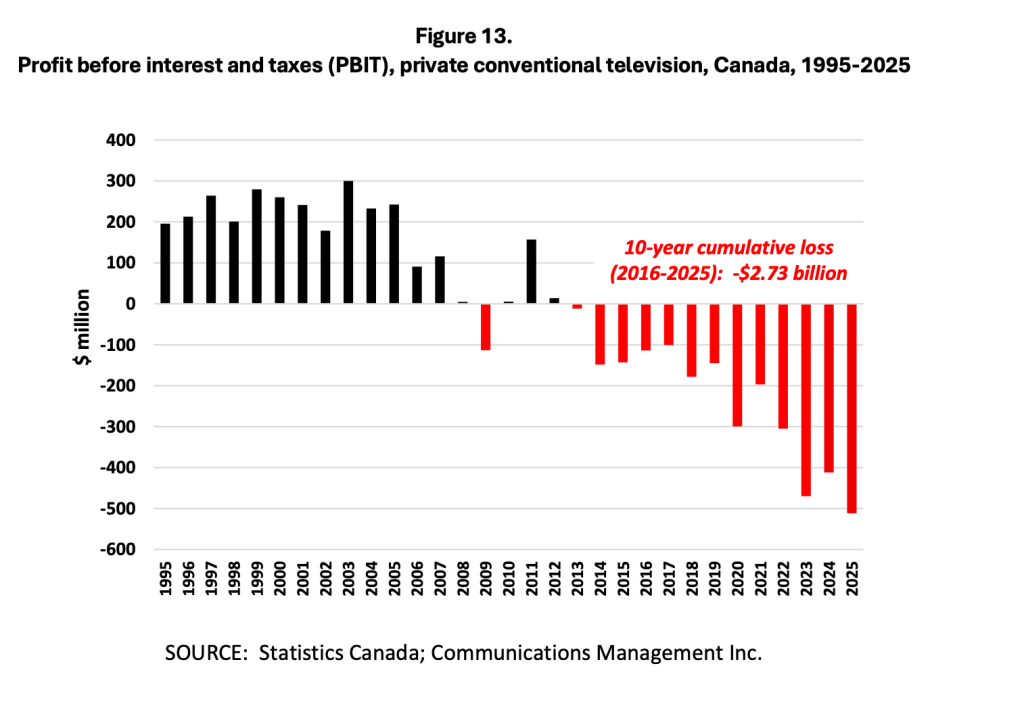
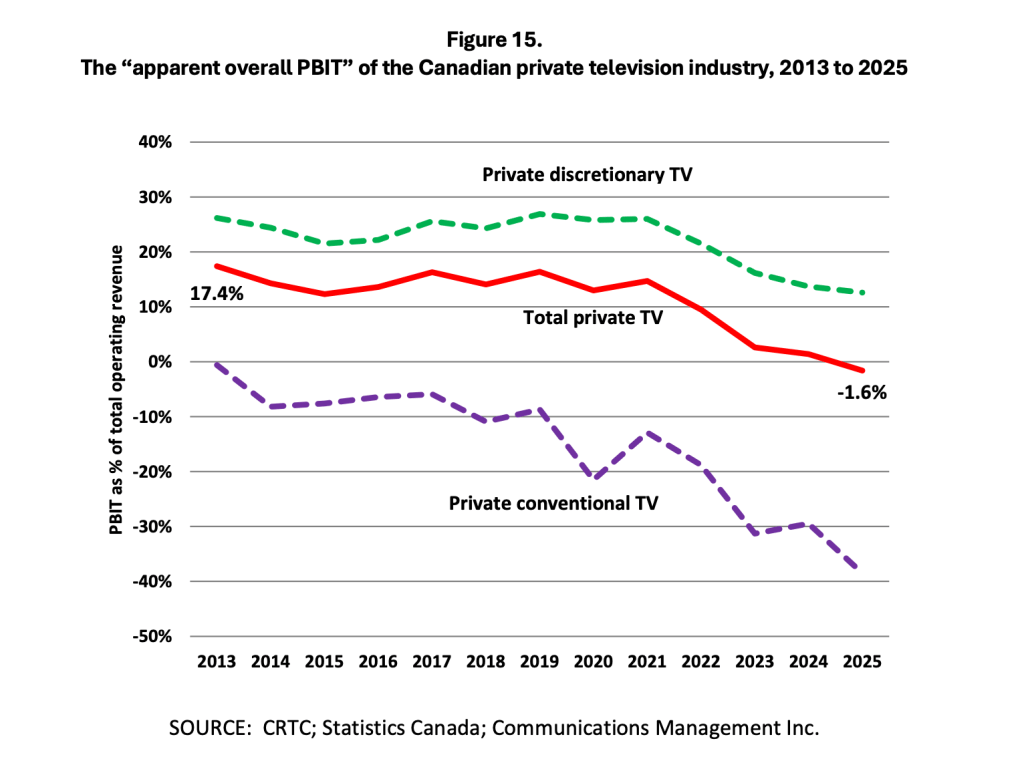
The argument advanced by the Canadian Association of Broadcasters isn’t just that the contribution gap between domestic and foreign competitors in the Canadian video market is too big, but that the 25% figure (which was lowered from 30% in the CRTC’s vacated ruling) is no longer aligned with the industry’s profit and loss.
In its 2026 update on the metrics of that profit and loss, the CAB reported that the industry’s anticipated crossing of the financial Rubicon took place in 2025. The total television profitability that combines network local television and specialty channels (e.g. Bell Crave or Rogers Sportsnet) is finally negative.
***
I recently attended the International Institute of Communications’ annual Canadian conference and listened attentively to the panel on Bill C-34, the Liberals’ Safe Social Media Act. That legislation currently awaits second reading in the House of Commons followed by the detailed debate and tabling of amendments in the Heritage parliamentary committee.
One of the IIC panelists, Dr. Charlotte Moore Hepburn from Toronto’s Hospital for Sick Children, provided a reality-check of how social media products precipitate child suicide and enable the sexual predation of minors. As the doctor put it so clinically, our timidity in regulating Big Tech’s toxic side effects contrasts unfavourably to our rigorous regulation of other unsafe products, such as phamaceuticals.
Another panelist, Josh Tabish of the Tech-friendly Chamber of Progress suggested the Liberal government should reconsider the regulatory sequence implicit in the bill. That sequence provides for age-gated social media accounts by default until the platforms submit an acceptable child safety plan to the digital regulator to be set up once the legislation is approved.
As Tabish suggested, this regulatory sequence pretty much guarantees a lengthy period of age gating with the risk, however manageable, of bad actors hacking the private information of children and adults.
Age gating of social media platforms will capture an estimated 80% of all Canadians, (although that number will be diminished by age verification based on publicly available data). The way to avoid that higher level of privacy risk, says Tabish, is for the government to establish its own interim rules for child safety features instead of age-gating while the social media companies’ safety codes are developed and approved.
If the government followed Tabish’s advice, it would still have to permanently age-gate adult viewers of pornography —an unknown percentage of the population— in order to block underage access to those websites. However that would entail age-gating porn viewers, not all Canadians.
The government’s current regulatory sequence has the merit of delegating the detailed and controversial policy task of safety codes to expert regulators instead of front-loading those codes through members of Parliament.
The bill as drafted makes a head start on these specifics with clear measures expected of the social media apps:
- There must be blocking tools for users to shut out noxious harassers and child predators.
- There must be user tools for flagging harmful content to bring to the attention of platform.
- The social media companies must label “synthetic” content (deep fakes).
- Bot-driven content must be labelled once it is discovered.
- And there must be a public facing “resource person” to deal with user concerns.
That still leaves the social media companies and the regulator with a lot to do. It’s a tricky policy task, no matter how you look at it.
***
If you would like regular notifications of future posts from MediaPolicy.ca you can follow this site by signing up under the Follow button in the bottom right corner of the home page;
or sign up for a free subscription to MediaPolicy.ca on Substack;
or follow @howardalaw on X or Howard Law on LinkedIn.
I can be reached by e-mail at howard.law@bell.net.
This post is copyrighted by Howard Law, all rights reserved. 2026.


