
(AI illustration)
November 26, 2026
Over the many years following the proceedings of the Commons Heritage Committee, the Bloc Québécois’s sole committee MP, Martin Champoux has impressed with patience and all-business approach.
His patience is now overtaxed, if his addendum to the heritage committee’s latest report on the state of journalism is any indication. That report contains a lengthy list of recommendations for the federal government to strengthen Canadian news media (which line up favourably with the pros, cons, arguments and recommendations that Senator Cardozo and I wrote up last April).
What’s bugging Champoux is the committee’s even-handed account of witness testimony taking at face value some argumentative claims of bias against CBC and mainstream media. In non-partisan style, the Report also uncritically advances a narrative lionizing the news publishers who set themselves up as antagonists to mainstream media.
That has ticked off Champoux. “Freedom of expression does not mean all expertise is equal,” he writes.
“When a committee studies a profession, it is responsible for clearly characterizing the stakeholders it quotes for the reader. A professional organization representing journalists, a researcher specializing in journalism, a publisher subject to recognized ethics and accountability mechanisms, a partisan media outlet and an advocacy group do not testify from the same institutional position. Their remarks may all be relevant, but they are not subject to the same standards and do not necessarily have the same evidentiary value.”
Ouch.
To name names, the objects of Champoux’s ire are Rebel News and Honest Reporting Canada.
Alas, Champoux might not be thrilled by the breaking news of Rebel News boss Ezra Levant’s cable deal with legendary broadcaster Moses Znaimer.
Znaimer just announced his plan to launch a weeknight Rebel News show for viewers who subscribe to his CRTC-regulated cable television channels JoyTV and FaithTV, in the 8 PM prime time spot.
The proprietor of Zoomer Media and the founder of CityTV claims he has been trying to land Levant as a show host for years. He says he redoubled his efforts in response to the Carney Liberals’ 2025 election promise to increase CBC/Radio Canada funding by $150M. Znaimer characterizes that promise as a Liberal bribe for more favourable election coverage by the CBC.
Znaimer also portrays Levant as reluctantly overcoming his mistrust of appearing on that greatest of socialist evils, government-regulated cable TV. In a Rebel News post on the Zoomer deal, Levant reiterates that inhibition.
However Levant as reluctant and regulation-shy doesn’t quite match up with the facts.
From 2011 to 2015, Levant hosted a prime time news show on the now defunct Sun News Network. That CRTC-regulated channel went dark after the CRTC turned down Sun News owner P.-K. Pélédeau’s request for a “must carry” designation, a privilege that comes with a CRTC-enforced minimum payment from cable carriers.
Saved from socialism you might say.
Levant’s show on Znaimer’s cable stations is set to air January 4, 2027. Don’t bet against its success.
However you can start the clock ticking on a citizen abusive comment complaint being filed at the CRTC.
***
The Liberals’ Safe Social Media Act Bill C-34 is half-way through eight days of parliamentary study by Heritage MPs. Minister Marc Miller shows up to defend and explain the bill next week and then we’ll see if the final three days of MPs tabling amendments gets scheduled before the Christmas recess.
The Conservative Opposition is less oppositional than it has been on the Liberals’ previous Internet legislation, the Online Streaming Act and the Online News Act, crediting the government this time around with “good intentions.”
MP Rachel Thomas video clipped her best and most flamboyant Conservative talking point when she asked “why are we giving Big Tech unfettered access to our children after they tick a few boxes?”
Thomas described her five big points in the following terms:
- The government has good intentions, says Thomas, but is leaving its bottom line on digital safety design to be drawn by a newly minted Digital Safety Commission after legislation is passed. Other critics have recommended that Parliamentarians fill in some of the blanks before handing off the bill to a regulator.
- In the same vein, C-34 downloads to federal cabinet and the independent regulator the authority to make “fifty” important decisions later (although this delegation is standard in regulatory bills).
- The bill gives the regulator too much discretion to draw the line between hate and harm and, on the other hand, free speech when devising and applying digital safety plans.
- In the same vein, the bill sets up liability-averse social media platforms as the government’s proxy in drawing that line.
- The bill lacks clarity on the method of age verification that will distinguish adult from under-age social media accounts.
I could write a longer piece about why the first four points are not compelling. But the age verification issue is sticky, as I keep writing in this space.
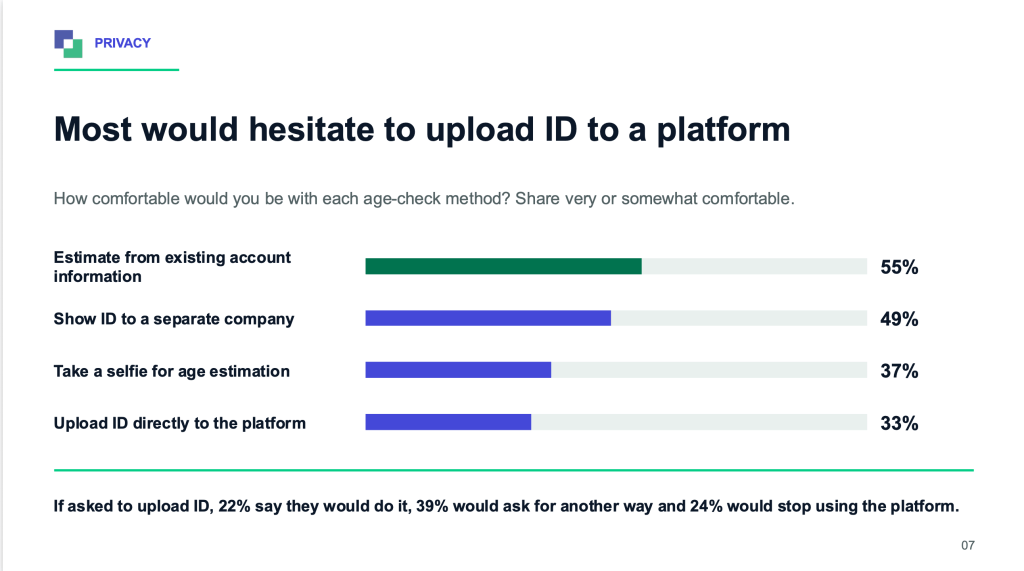
Popular support for the government intervening to clean up social media is overwhelming. But when public opinion polls ask Canadians to weigh the social good against age verification systems that trigger fears about the hacking of personal data, the public policy trade-off clearly makes Canadians nervous.
That’s the conclusion of a poll published by Liaison Strategies.
The new poll finds strong support for outright banning under-16 social media accounts, even though the legislation only contemplates a temporary ban until platforms prove their safety compliance to the satisfaction of an independent regulator. Of interest, there was no real divide in opinion between parents and non-parents.
However the enthusiastic support for legislating online safety diminishes into a bare majority territory once the fear of age verification is introduce. That fear can be mitigated by the availability of third party verification or whatever method might rule out uploading of Photo ID. But as MP Thomas points out, it will be very difficult to verify age majority of 16 year olds without face scans or Photo ID.
One last point.
I had been speculating that the static about age verification was driven by pornography viewers, i.e. men. What I dug out of Liaison’s unpublished polling cross tabs surprised me: resistance to age verification is not skewed by gender.
***
Oh joy, the federal government has struck another cultural committee. This time it’s AI and Canadian culture.
The committee doesn’t seem to have a solid mandate other than giving a voice to cultural organizations and advice to government that it is free to ignore.
Here’s the official vanilla:
The council will help the government and the cultural sector navigate the rapid changes driven by AI. It will provide ongoing advice and insight to guide implementation of Canada’s National AI Strategy, with a focus on the unique challenges facing the sector as well as the opportunities for adoption and innovation that responsible AI development can create for Canada’s creative industries.
There were a couple of names on the appointee list that I recognized as serious people, so perhaps skepticism is misplaced. But the public policy options on AI’s impact on copyright are well known. Up until now, this government has barely acknowledged them.
***
If you would like regular notifications of future posts from MediaPolicy.ca you can follow this site by signing up under the Follow button in the bottom right corner of the home page;
or sign up for a free subscription to MediaPolicy.ca on Substack;
or follow @howardalaw on X or Howard Law on LinkedIn.
I can be reached by e-mail at howard.law@bell.net.
This post is copyrighted by Howard Law, all rights reserved. 2026.


