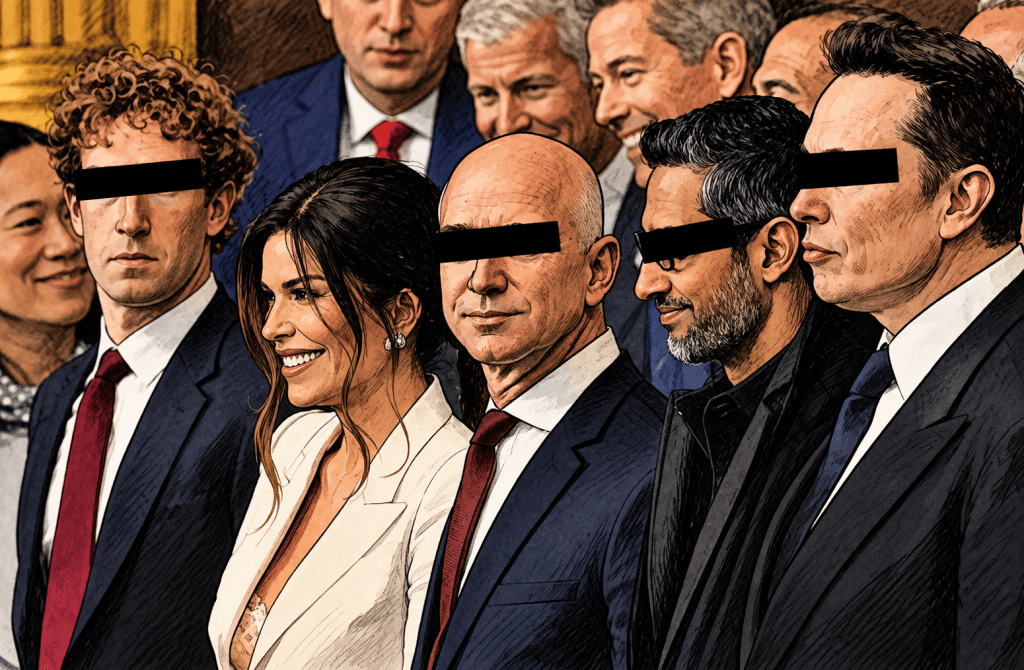
(AI illustration)
November 21, 2026
According to Meta’s Rachel Curran, the federal government is eager to accept Rachel Curran’s deal to bring back news on Facebook and Instagram.
And according to Politico‘s anonymous “official” source, this might actually be true.
Not irrelevant to the reliability of the Politico story was culture and identity minister Marc Miller’s conspicuous non-endorsement of the Online News Act two weeks ago while under fire from CTV’s Vassy Kapelos on the Online Streaming Act. The two bills “haven’t worked in the time frame we hoped they would,” says the minister.
Curran is tying the consummation of her deal to trade talks with the Trump administration.
She began flogging her deal to the Canadian public in early 2026 during an interview on CBC’s Power & Politics. The rumoured agreement is that Meta would re-platform news published by mainstream Canadian news agencies, obtain an exemption under the Online News Act Bill C-18 from the Carney government, and still not pay a cent of compensation to Canadian news organizations under C-18. Google bargained a similar exemption from the legislation at a tariff of $100M annually in a five year deal expiring in 2029.
Meta’s deliverable is that it would take its finger off of the pause button and begin seeking content licensing deals with preferred Canadian news organizations for ingestion of their news content into its AI products instead of paying for hyperlinked news articles posted to social media feeds within the scope of C-18.
Meta already has AI licensing deals with Reuters, News Corp, Fox News, Newsmax, and Le Monde. But no Canadian deals.
A minor but salacious item in the rumoured deal (or at least Meta’s proposal) is two salaries for administrators working for the Canadian Journalism Collective. That’s the independent agency that distributes Google’s $100M annual payments to Canadian news organizations, pursuant to the Online News Act.
So here’s my quick and dirty take on what I must reiterate is an unconsummated deal based solely on an anonymous source.
In July 2023 Meta sabotaged the newly legislated C-18 by banning news published by reputable Canadian news organizations. Meanwhile Meta permits peripheral Canadian media outlets to post Canadian Press stories on a daily basis. The CRTC has been sitting on a legal challenge to this malfeasance for 290 days.
As its price of ending its middle-fingered ban, the Meta deal would look like this:
Meta gets to draw Canadian news seekers to its platforms again for nothing, and;
Meta can resume pitching the AI content deals it was going to make anyway in Canada and handpick which particular Canadian news outlets are worthy of one. Like it did with hyperlinked news articles prior to C-18 getting legislated in 2023, Meta will mostly dictate the price it is willing to pay.
In return, Canadian news organizations who prefer the free distribution on Facebook and Instagram instead of compensation would get back on those platforms, although many have since adjusted to the alternative offered by YouTube and TikTok.
But in case I’m not being clear, the deal would turn the clock back almost ten years to when Meta cherrypicked the news organizations it thought worthy of paying for hyperlinked news while deeming all other news outlets as lucky to distribute their content without charge, like 25 million other Insta and Facebook users.
Fast forward to 2026, only the technology will have changed, from hyperlinked news stories posted on dominant distribution platforms to news content ingested by AI large language models to answer questions.
From the news publisher point of view, they would be back to where they started in 2017 by lobbying the Trudeau government for C-18, getting it legislated six years later in 2023, and pushing Google payments out the door in 2025. Meanwhile the European Union got the job done in 2019 and Australia in 2021.
Thanks to this policy inertia and delay, the Online News Act was born middle-aged. Today, there is one place where the aging lifespan of legislation tied to hyperlinked news is obvious. Look at what Google is doing with Search.
Google’s monopoly of the search engine market provided the best policy case for legislating C-18 as the way to compensate news organizations for getting stiffed by a distribution platform that was (and remains) a must-have distribution channel.
But Search 1.0 is quickly being eclipsed by Search 2.0, the AI version. Google has enthusiastically remade Search into AI Overviews. It’s costing Google Search significant advertising revenue. But Google sees this self disruption as essential, acknowledging that AI LLMs will outlive hyperlink Search.
No doubt Google will point this out to the Prime Minister when its $100M deal with Canada expires in 2029.
In short, the C-18 paradigm is beginning to crumble and a remarkably familiar paradigm in AI LLMs is re-forming.
Don’t take my word for it. Members of Parliament sitting on the Heritage committee came to the same conclusion in its recent report:
Recommendation 8
That the Government of Canada uphold the Online News Act and the Online Streaming Act in the context of international trade negotiations.
Recommendation 11
That, in light of developments in generative artificial intelligence, the Government of Canada uphold the principles of copyright protection and consider updating the Online News Act and related frameworks to address the impact of artificial intelligence on Canadian news media
To riff on Joseph Stalin’s aphorism about Pope Pius XII’s lack of military to enforce his moral nostrums (“how many divisions does he have?”) you might wonder how many heritage MPs sit in Mark Carney’s cabinet. Oh, none.
But Newsmedia Canada’s Paul Deegan says he’s confident the rumoured deal is just that.
“The one thing I know about the trade talks is that no one in the know on the Canadian side — and there are only about a half dozen people in that group — is talking. It’s very disciplined, ” Deegan told MediaPolicy in an e-mail.
Another thing that’s unclear in the Politico story is that it does not identify the anonymous “officials” as Canadian or American.
***
I mean no disrespect to land acknowledgments or knee-taking but the case could be made to preface every discussion of Artificial Intelligence, no matter the topic, with the statement “it may kill us all soon.”
Only two months ago Nvidia’s disgraced and spy-adjacent CEO Jensen Huang told the world as loud as he could that he rated existential threats from rogue AI agents at “zero.”
What’s scary is that he assigned a similar risk rating to getting caught cheating on his wife and endangering national security.
***
In addition to Huang, the tech bros may be departing an old world of hubris and entering a new world of humility. It’s all thanks to the blue wave of Democrats elected in the US mid-terms.
Elon Musk is off to a head start. Stand-up comedians take note: the big boy is claiming he was never MAGA.
“I mean, I’m not MAGA. I’m not sure what MAGA means.”
Musk also publicly regrets pouring $500 million into the campaigns of various MAGA all-stars like Senate-candidate Greg Paxton who lost in Texas, where Musk moved his companies Tesla and SpaceX.
Then there is Palantir’s Alex Karp: “I’ve been a Democrat my whole life. I grew up in a far-left environment. I know more about being a progressive than almost anybody on the planet, and I absolutely believe Palantir — all of our products are essentially progressive.”
That’s a slight revision of earlier comments that he admired the President and his “world historic” accomplishments “a lot” and that Palantir’s AI products were “anti-woke.”
***
If you would like regular notifications of future posts from MediaPolicy.ca you can follow this site by signing up under the Follow button in the bottom right corner of the home page;
or sign up for a free subscription to MediaPolicy.ca on Substack;
or follow @howardalaw on X or Howard Law on LinkedIn.
I can be reached by e-mail at howard.law@bell.net.
This post is copyrighted by Howard Law, all rights reserved. 2026.


