Catching up on MediaPolicy – Québec’s Netflix-Spotify bill is in play – social media ban for teens – hostile bid for Warner Bros and CNN – OpenAI’s Disney video app

AI generated image from OpenAI

December 13, 2025


This week the Québec National Assembly unanimously passed Bill 109, its version of the federal Bill C-11, the Online Streaming Act.

MediaPolicy has been following this file since the CAQ government commissioned a blue-ribbon committee to recommend how to reverse the low availability and consumption of French language content on global streaming platforms. In reverse chronological order, you can update yourself on this story here, here, here and here.

The CAQ bill is a policy response to the federal cabinet’s and the CRTC’s hesitancy to implement the “content discoverability” provisions of the federal bill as written by Parliament.

The political consensus in Québec on regulating audio-visual and audio content to protect culture and language meant that Bill 109 didn’t spark the controversy that the federal Bill C-11 did two years ago.

But the tinder is dry and the sparks will fly. 

The US Trade Representative will add Bill 109 to its list of American grievances over Canada regulating Hollywood streamers and Big Tech, to be tabled in CUSMA negotiations this spring. (When coincidentally the 2026 Québec election might be called).

So too there must inevitably be an impasse between the Mark Carney government and Québec over legislative jurisdiction. Though brief by comparison, Bill 109 is almost a carbon copy of Bill C-11. Until the Supreme Court says otherwise, Ottawa has exclusive jurisdiction over online broadcasting. 

Québec’s culture minister Mathieu Lacombe has been pretending there’s nothing jurisdictional to talk about with Ottawa. According to the minister, there’s no conflict, only concurrent federal and provincial powers to do the same thing. Good luck with that. A caveat: he might have a provincial claim to the regulation of home screens on Smart TVs and streaming devices. 

The Québec law is founded on a provincially claimed right to cultural discoveryprops to that boldness. Importantly, all of the bill’s cultural measures are focussed on French language content, not Canadian French language content, so the political framing is more linguistic than cultural.

Mess with this if you dare, Ottawa.

From here, things will move slowly at first.

Québec will establish the minister’s Discoverability Office and begin drafting streamer requirements for French language content.

The CAQ’s Lacombe will find out if the streamers are willing to take up his offer to negotiate bespoke agreements in order to avoid cookie cutter regulations set by the province.

On video streaming, he will no doubt benchmark his regulations or voluntary agreements with streamers against the outcomes reached in France since 2021.

Despite a framework EU law that proposes a 30% catalogue minimum (numbers of shows), the French implementation of that policy focusses instead on production investments in French language content, based on a range of 20% to 25% of a streamer’s national operating revenues. So far, the result has been bigger budgets rather than a proliferation of mid-budget shows.

On other hand Lacombe could just stick with catalogue quotas, as the CRTC is expected to announce its own federal expenditure quotas soon.

As the Québec legislation doesn’t require the cash contributions to Canadian media funds that the streamers hate so much in the federal scheme, a deal with Netflix focussing on French language video catalogues doesn’t seem out of the question.

A deal with Spotify to do something dramatic to increase rock bottom consumption of French language music would be tougher. 

Unless Lacombe’s process moves at lightning speed, CUSMA talks and the Québec election will intervene.

***

If you don’t have school age kids, you might have missed the seismic Big Tech event that just shook Australia: its government has banned social media accounts for children under age 16.

Social media companies are expected to rely on age estimation technology but also photo ID.

The Australian communications minister Anika Wells is the first politician in a liberal democracy to tell social media companies, “time’s up.” Apparently so, even Elon Musk says he will obey the law.

There’s a brief explainer in the New York Times on how harmful social media can be for teens and how we got to the point that Big Tech’s safety half-measures have worn out the patience of legislators. 

Still, a ban. Wow. As our federal justice minister Sean Fraser eyes a revised online harms bill, what would be interesting is an opinion poll on a ban, taken from Canadian parents of tweeners and teenagers, parsed out separately for age and gender of the children. 

***

In last weekend’s post, I speculated that Donald Trump would have some fun with the $87 billion USD Netflix-Warner Brothers merger deal, given his donor ties to the losing bidder, Paramount. 

The next business day after Netflix officially announced its winning bid, and media analysts had their say on the prospects for Netflix obtaining the Trump administration’s anti-trust vetting, Paramount unveiled its Plan B: a $108 billion hostile takeover bid for all of Warner Brothers Discovery properties.

Warner Brothers has a week to respond but Paramount CEO David Ellison has already signalled an improved second bid is ready to go.

Among Paramount’s financial backers are the CEO’s dad and second richest man in the world, Larry Ellison, and various gulf state sovereign wealth funds. Oh, and President Trump’s son-in-law Jared Kushner.

The Ellison-Gulf-Kushner bid includes Warner Brothers’ television entertainment channels and the cable news network CNN. 

Ellison-the-younger’s Paramount recently bought the CBS news network and appointed the Free Press’ Bari Weiss as CEO. Pa Ellison is also the key investor in the bid to buy TikTok’s US operations. 

***

A significant AI content licensing deal has been struck between the IP-rich Disney and OpenAI, the developers of Chat GPT and the video-creation app Sora. 

The deal will allow Sora subscribers to create videos with Disney’s classic animated film characters. Imagine making a birthday video card for your kids featuring them with their preferred cuddly creature or action hero.

As reported by The New York Times: “Sora users will be able to make videos with more than 200 characters from Disney’s library, including from “Encanto,” “Frozen,” “Moana,” “Toy Story,” “Zootopia,” “Inside Out” and other animated movies. Animated or illustrated versions of Marvel characters like Deadpool, Iron Man and Black Panther will also be available, along with “Star Wars” characters like Darth Vader and Princess Leia.”

Given all of the chatter about AI companies scraping copyrighted content, the Disney-OpenAI deal will set expectations that licensing deals are the way for Big Tech to make peace with content producers, especially the biggest ones. (Oddly the reporting on the deal noted Disney’s $1B USD investment in OpenAI but was mum on the value of licensing payments that Disney can expect).

The Hollywood Reporter has a good analysis of the deal, the gist of which is Disney isn’t going to rest on its IP laurels while other content companies get rich on AI monetization.

More broadly, the slow drip of licensing deals between AI and content companies might, in the news journalism space, begins to look like the years leading up to Australia’s NewsMedia bargaining code and the Canadian Online News Act: AI companies cherry pick the biggest and most popular news outlets for licensing deals while those left behind look to governments for action on content scraping and monetization. 

***

If you would like regular notifications of future posts from MediaPolicy.ca you can follow this site by signing up under the Follow button in the bottom right corner of the home page; 

or sign up for a free subscription to MediaPolicy.ca on Substack;

or follow 
@howardalaw on X or Howard Law on LinkedIn.

COMMENTS ARE WELCOME. But be advised they are public once I hit the “approve” button, so mark them private if you don’t want them approved. 

I can be reached by e-mail at howard.law@bell.net.

This blog post is copyrighted by Howard Law, all rights reserved. 2025.


Catching up on MediaPolicy – Netflix is Rex – Miller is minister – CRTC vets Meta’s news ban

AI image

December 7, 2025

This week’s blockbuster news is that Netflix edged out Paramount to buy Warner Brothers for $82 USD billion. The deal immediately depleted the supply of adjectives at the disposal of media analysts. 

If the deal closes as scheduled in late 2026, Netflix buys up the world’s biggest movie archive and keeps it out of the hands of a major rival with the second biggest (Netflix is number three).

Netflix is paying a heavy price tag and arguably overpaid (you know who pays for inflated merger valuations, it’s subscribers and workers). Netflix goes from its status as the streaming industry’s 900-pound gorilla to, I dunno, T-Rex stature?

The public commentary on the deal is mostly doomsaying. 

It speeds up the chiselling of the tombstone for the theatrical release industry.

In a press release, Netflix CEO Ted Sarandos said shareholder value would flow from adding HBO and the full Warner Brothers archive to the Netflix “best in class streaming service:” his pro forma commitment to theatre release was relegated to a subordinate sentence clause.

But if the merciless dispatch of theatrical-release seems inevitable, and just the law of the marketplace jungle, what is of long term concern is the anti-competitive effect on the pipeline of big-budget premium video entertainment. The Globe & Mail’s Barry Hertz has a good analysis here.

The Netflix deal is a prime candidate for anti-trust review by the Trump administration (especially as Netflix outbid Friend-of-Trump Paramount). 

That review could go in any direction but things to watch for include (a) Trump reviving his threat to levy tariffs on foreign movies and the offshore shooting of Hollywood blockbusters, and/or (b) using the anti-trust hammer to get something that he personally wants, which could be commitments to US-based production or some vanity trophy we can’t imagine right now.

It’s not that Sarandos can’t see that coming. In his press release he said the acquisition would allow Netflix to expand its US based production, a gimme that doesn’t commit him to a rate of new releases equal to “Netflix plus Warner Brothers” but only “Netflix plus a dollar.”

Any Trump-driven re-shoring of studio production could hurt the two offshore leaders of Hollywood production, the UK and Canada (and hurt Hollywood too, but that’s a longer discussion).

Beyond that, the effect on Canadian-owned broadcasting could be massive. Netflix is buying Warner Brothers’ Home Box Office streaming service and catalogue which may or may not be integrated into the Netflix platform, once subscription pricing is figured out. The press release suggests HBO content will be on the Netflix platform, at least in the US. 

Here in Canada, there is no HBO streaming service and Bell Media holds the exclusive license to distribute HBO on the only Canadian streaming service of consequence, Crave TV.

You would have to question whether Netflix has any interest in continuing that Canadian licensing arrangement when it expires and, in fact, Netflix has an excellent opportunity to severely wound its only Canadian-owned competitor.

Without that profitable HBO content, Bell’s ability to keep funding Canadian content takes a big hit. 

***

Canada has a new Heritage minister, Marc Miller.

That’s the fallout from Steven Guilbeault’s cabinet resignation over Prime Minister Mark Carney scrapping the Trudeau/Guilbeault policies on oil production, emissions, pipelines, oil tankers and clean energy regulations.

Miller continues a long tradition of the Liberals appointing an MP from the island of Montréal to the Heritage portfolio.

But of course Miller is the first anglophone the Libs have picked for that job since Hamilton’s Shiela Copps —-who was born ready to butt heads with the US on cultural sovereignty. She did the job from 1996 to 2003 under Prime Minister Jean Chrétien. 

The feisty Miller is prone to speaking with candour, as a rule. That’s already got him into a spat with CAQ premier François Legault who didn’t like Miller insisting on making a distinction between “the decline” and “fragility” of the French language in Canada and Québec. The Bloc dutifully piled on.

Guilbeault was the federal champion of Canadian and French language content in Québec and as the new Heritage minister no less will be expected of Miller. His life will get very interesting in about six months when CUSMA negotiations begin.

Will Miller become the political reincarnation of Shiela Copps? It’s up to Mark Carney, just as it was up to Jean Chrétien.

***

It looks like the CRTC’s investigation into whether Meta is selectively enforcing its made-in-Canada ban on news content has come an end. The CRTC’s brief discharge letter to Meta was published last week.

You can still find news items on Facebook and Instagram in Canada, despite Meta’s avowal that it banned news to take itself outside of the scope of the compulsory licensing of “news content” in the Online News Act.

Meta must have satisfied the Commission staff that it is sticking to its ban by taking down news items posted by Canadian users and by deleting user screenshots of articles. If you want to know how the Commission reached its conclusion, you won’t find it in the letter. 

What remains unresolved, or perhaps resolved only to the Commission’s private satisfaction, is Meta permitting posts from news outlets like Narcity and The Peak who successfully applied to Meta for what they describe as “exemptions” from the news content ban.

Without more transparency, one can only guess if Meta’s exemption of hand picked news outlets violates the statutory prohibition against digital platforms discriminating for or against selected news outlets. 

In the case of Narcity, its publisher claimed that Meta granted an exemption because Narcity was refused certification for federal journalism labour tax credits on the grounds that it doesn’t publish enough original news on current affairs. 

But certification for federal subsidies program doesn’t mean that a news outlet isn’t producing some news content, or pieces of news content, as defined by the Online News Act, which Meta says its banning to avoid paying for it. 

The Peak also recently announced that Meta gave it “an exemption” and I invite you to have a look at the news articles it’s allowed to post on Facebook and Instagram.

If you go looking, keep in mind that the “news content” that Meta is supposed to be banning in order to escape the gravitational pull of the Act includes “any portion” of news content. 

The Commission’s original inquiry into the news ban appears to have been its own idea, so the fact that it hasn’t published its reasons at any length is not a total surprise. No Canadian news organization has filed a complaint. 

***

If you would like regular notifications of future posts from MediaPolicy.ca you can follow this site by signing up under the Follow button in the bottom right corner of the home page; 

or sign up for a free subscription to MediaPolicy.ca on Substack;

or follow @howardalaw on X or Howard Law on LinkedIn.

COMMENTS ARE WELCOME. But be advised they are public once I hit the “approve” button, so mark them private if you don’t want them approved. 

I can be reached by e-mail at howard.law@bell.net.

This blog post is copyrighted by Howard Law, all rights reserved. 2025.

Catching Up on MediaPolicy – Spotify’s coy ignorance – Guilbeault’s agenda – Paramount, HBO and Crave

October 11, 2025

I am guessing the five commissioners running the CRTC’s public hearing on radio broadcasting and audio streaming read Simon Gionet’s column in Le Devoir, published on the last day of hearings, September 29th.

The story conveyed the Québec’s music industry’s message: we’re getting slaughtered and the CRTC better do something about it.

The online streaming consumption of Francophone music in Québec is 4.6% per cent of the top 10,000 songs, according to the latest projections by l’Observatoire de la culture et des communications de l’Institut de la statistique du Québec.

Approximately five per cent. In a province that is 80% Francophone.

This is happening in an environment in which streaming is gradually displacing the sale of digital and physical music formats in Québec; 55% of those sales are French language music. It’s skewed by age: the Observatoire notes that consumption of French language music remains high in legacy media such as physical music sales and radio, but rock bottom on streaming services, the medium of choice for the younger generation.

At the CRTC, the response of foreign music labels and global streamers went like this:

Patrick Rogers of Music Canada (the big three labels Universal, Warner and Sony) told the CRTCwhat we don’t support is [a CRTC requirement for] the inclusion of any music, Canadian or otherwise, that wouldn’t normally make‑up that listening experience.”

Xenia Manning, Spotify’s Director of Global Music Policy, offered her coy ignorance of the French language problem. When asked by a commissioner if the Observatoire’s “five per cent” number was accurate for the world’s biggest music streamer, Manning said “we could look into it.”

The best known spokesperson for Québec’s music industry is APEM’s Jérôme Payette. “The future of the music industry as we know it is truly at stake,” he told Le Devoir. “Our Francophone and Canadian musical culture risks virtually extinction or becoming completely invisible and marginalized if nothing is done.”

His ask of the Commission was:

  • Make the streamers include 50% Canadian music in their song recommendations made to Canadian subscribers, including a French language quota;
  • Next, collect quarterly data on the consumption of music;
  • Take further action if the new numbers aren’t good enough, and 
  • Look for an improvement from 2% to 8% consumption of French language music across Canada by 2029 (he didn’t specify a Québec-only number).

Payette’s parting shot to the Commission was “the CRTC has the opportunity… to show that we are capable of standing up to preserve our cultural sovereignty and our culture.”

***

Ah, the federal Heritage committee is back. How I have missed its performative politics. 

All roads to Canadian cultural policy run through the ten MPs who sit on this Parliamentary committee, five Liberals, four Conservatives and the lone member from the Bloc Québécois. 

It’s useful to parse the committee transcripts for clues on the government’s legislative intentions, as well as what mayhem to expect from Opposition MPs.

First, a report on the mayhem. The Conservatives began their dependable tormenting of the CBC. They also pushed successfully (over Liberal objections) to send three of the committee’s Reports from the last session of Parliament to the House of Commons. Those reports (on Big Tech meddling in Canadian politics, toxic content on social media, and the state of Canadian news media) are now filed in the Commons, with Conservative dissents, so the government owes a written response. More grist for the mill.

Going one Report further, the Conservatives won a new committee investigation into the state of news media, with subject matter, witnesses and committee dates to be determined. 

As for the government agenda, Minister Steve Guilbeault appeared at the committee and promised something newsworthy about CBC’s plans for local news would emerge soon. 

He was grilled by the Conservatives and the Bloc about where the rumoured Liberal budget cuts to his department’s programs might fall. He deferred to the Finance Minister’s budget on November 4th, but hinted about consolidating the administration of the Canada Media Fund for television, Telefilm, and another program (my guess, the National Film Board). It seems unlikely he can cut 15% of spending over three years without paring back program spending. 

The Minister also gave an unparsable answer to a question about retabling Bill C-63, the complex online harms bill that included mandatory safety codes for social media platforms, a revived individual right of complaint against hate speech, and stronger criminal penalties for online hate. While the latter subject matter is arguably covered by Justice Minister Sean Fraser’s Bill C-9, Guilbeault left us guessing about bringing back the safety code proposal. 

One last point, I was surprised that the Minister was willing to take the Conservative bait to pass judgment on ex-CBC host Travis Dhanraj, who claims he was mistreated and prevented from inviting conservative guests onto his show by CBC management.

Travis Dhanraj with co-host Karman Wong and guest Kevin O’Leary

The Minister’s comments in French —“d’abord, je tiens à déplorer ce qui est arrivé à cet employé”—- were officially translated as “I condemn,” but were closer to “I lament.” He says he wasn’t briefed on the controversy by CBC President Marie-Philippe Bouchard, so his willingness to express regret stands out. Later in the transcript he qualifies his concern by saying “it’s possible that it went very badly for this individual, I’m sorry about that.”

The Committee is currently engaged in a review of AI impact on media and cultural industries to which MediaPolicy will return.

***

The Hollywood news outlet Deadline is speculating about the rumoured Paramount purchase of Warner Brothers Discovery. Warner assets include studio production, the premier streaming platform HBO Max, and cable properties CNN, TNT Sports, and various nature and lifestyle channels.

Netflix might submit a competing bid, but Deadline immediately dashed that speculation by observing that Netflix wouldn’t want the cable assets (indeed, ask yourself why they would want anything other than the library of titles). 

What’s not speculated upon is the knock-on effect on Canada, specifically Bell Media which is hanging on to exclusive Canadian distribution rights to HBO content as the ballast for Crave. Bell’s current deal for HBO still runs for an unknown number of years, probably until 2027 or 2028, and keeping access to premium US television dramas will always be job one.

The unanswered question is whether a Paramount-owned HBO would be more or less willing to renew Bell’s deal for Crave or instead go direct to Canadian consumers like Netflix and Disney Plus.

***

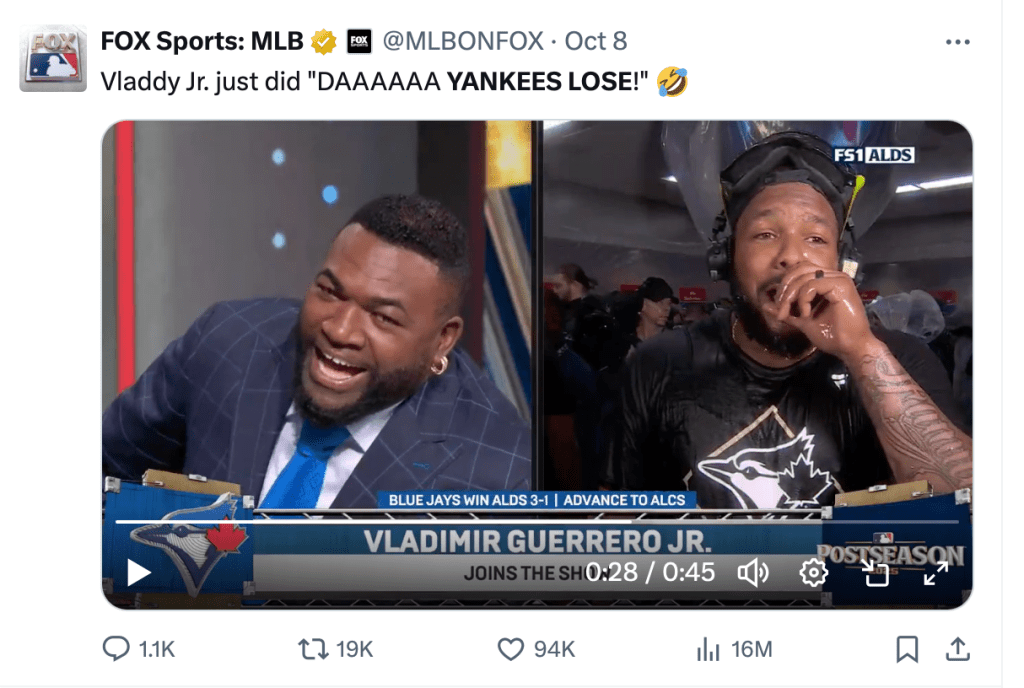
Go Jays.

I thought I was too old for birthday presents, but thanks to @27vladdyjr and @davidortiz for this:

***

If you would like regular notifications of future posts from MediaPolicy.ca you can follow this site by signing up under the Follow button in the bottom right corner of the home page; 

or sign up for a free subscription to MediaPolicy.ca on Substack;

or follow 
@howardalaw on X or Howard Law on LinkedIn.

I can be reached by e-mail at howard.law@bell.net.

This blog post is copyrighted by Howard Law, all rights reserved. 2025.



Catching Up on MediaPolicy – News subscriptions stall – Guilbeault parries Québec cultural demands – Bell’s proposal for local TV news

June 22, 2025

The 2025 Reuters Oxford Digital News Report was published this week, offering both global and Canadian break-out numbers. 

It’s a trite observation that digital technology has turned media on its head, disrupting the advertising revenue that once paid our bar tabs for the consumption of media. The disruption has hit hardest in news journalism and stoked alarm about its knock on effect upon liberal democracy.

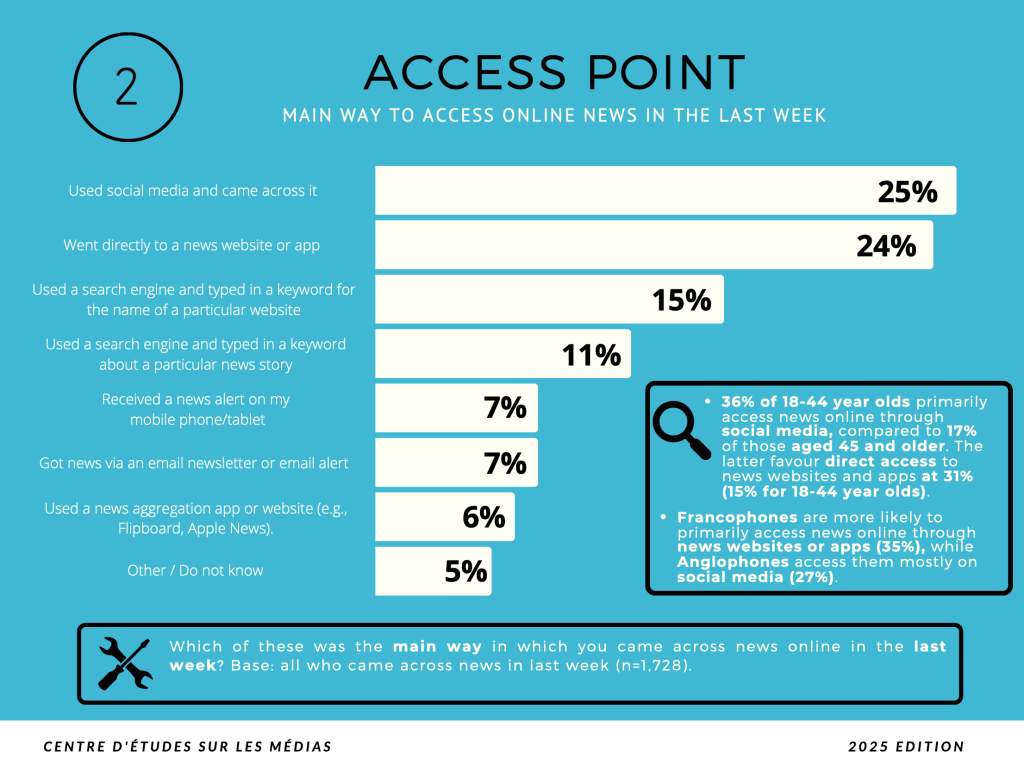
That’s probably why recurring polls and surveys tracking the arc of that disruption seize our attention, even if the trends are slow moving. For example, this year’s Rubicon crossed was that social media surpassed news websites as the leading access point for online news.

Cue the Reuters report, for my money the leading annual global survey. It tracks metrics on news consumption, platform preferences, news avoidance, misinformation, fear of misinformation, and “trust in media,” which is essentially a hybrid metric tracking legitimate skepticism of news journalism, alienation from public institutions, and audience polarization.

The global report also generates break out national numbers and additional polling for individual countries. Canada’s supplementary report on news consumption was written by University of Laval researchers Colette Brin and Sébastien Charlton.

Canada saw a 1% down tick in online news subscriptions from 15% in 2024 to 14%. In 2016 it was 9% but has been flat since getting a bump from the Covid pandemic and the 2020 US election.

Globally, the willingness of the local population to pay for online news ranges from 42% in Norway to nine per cent in Italy. Canada’s 14% is just slightly under the global water line of 18% of the adult population.

There was startling data that Canadians are world leaders in our readiness to shell out for foreign news subscriptions, clocking in at half of Canadian news subscribers. Together with Ireland, Canada’s sign up for foreign news sources is a global outlier.

But what really got my attention was a graph from the global study revealing that 71% of non-news payers say they can’t be tempted to subscribe through innovative options to bundle multiple news services, access more non-news content, or by pick-and-pay news content falling short of a full subscription. They just won’t pay for news, full stop.

As Hunter S. Thompson might have said, not paying is a matter of principle. 

That suggests (excuse my confirmation bias) that in the best case scenario there is limited room to grow the subscription-model for Canadian news. The vast majority of Canadians are casual news consumers who will not pay to keep up to date on current affairs. 

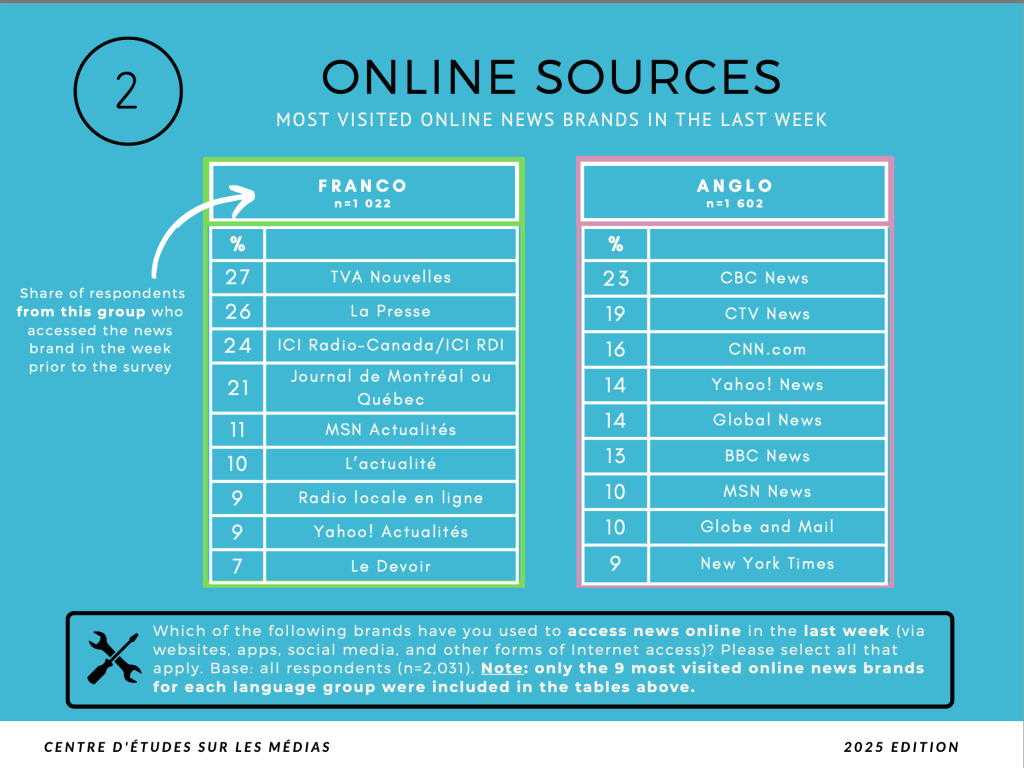
The good news, if you can call it that, is that the free-distribution CBC, CTV, Global News, the Canadian Press and hundreds of community news outlets continue to post news online (see the graphic below, where CBC leads the pack among English speakers).

Should that change, I’m not counting on the news subscription model to bail out liberal democracy. It’s more likely (and this is also reflected in the Report) that Canadians will turn to social media influencers to deliver news, reliably or otherwise. 

***

A couple of follow-up stories for you:

Last month the CAQ Québec government tabled its Bill 109, aiming to deliver seismic changes to the rock bottom consumption levels for French language music on global streaming platforms operating in Québec.

The tabling of the bill by Culture Minister Matthieu Lacombe was timed to coincide with Québec City hosting the 20th anniversary of the UNESCO Convention on the Protection and Promotion of the Diversity of Cultural Expression.

Unamended since its inception in 2005, the Convention is an aspirational international standard for sovereign nations willing to step into the commercial media market and push back against the domination of English-language and mostly American content. 

Lacombe was looking for other countries to sign off on an upgrade to the Convention, specifically to match Bill 109’s claim to cultural diversity as a fundamental right of citizens backed up by regulatory efforts to move the needle on the consumption of domestic media content.

The Québec City meeting didn’t deliver for Lacombe. A few countries said yes, but more gave a muffled maybe.

The muffled included Canada’s federal government. Culture and Identity (and Official Languages) Minister Steven Guilbeault issued a statement that endeavoured to navigate the narrow channel between the cultural nationalism embedded in Lacombe’s bill and, on the port bow, the exclusive federal jurisdiction over broadcasting. Not to mention, Guilbeault’s boss the Prime Minister must be thinking it’s not an ideal time to piss off Donald Trump by making more announcements about regulating foreign streamers.

All this is happening on a parallel time track with the CRTC’s upcoming public consultation on regulating foreign music streamers operating in Canada. 

Apple, which has more of a flair for corporate arrogance than you might think, filed a policy brief with the CRTC that sassed the Québec cultural groups who have asked the CRTC to build a stronger regulatory regime for music streaming. Said Apple:

Apple opposes the requests of groups such as ACCORD and APEM to obtain further information from online audio services in an effort to dictate approaches that supposedly will result in more streams of Canadian songs. Setting aside the remarkable fact that these organizations apparently think that they would be better at running the streaming services than the services themselves, these requests lead to a dead end. As Apple explained in its response to APEM’s application of more than one year ago, much of the information being requested is either not provided to Apple or does not even exist.”

American Big Tech disses Québec cultural leaders. Game on!

In addition to Apple, the world-leading music platform Spotify filed information with the CRTC culled from its annual report “Loud and Clear.” 

The Spotify document claimed surging growth in musician earnings in the global market for French-language music. Musician earnings have doubled globally and in Canada since 2017 thanks to rising royalty payments to music labels. Spotify told MediaPolicy that earnings growth was experienced at all levels, from the poorest bands to superstars (but not broken out by language group). 

The policy implication of Spotify’s claim is that it’s part of the supply-side solution to domestic music and that the demand-side of music consumption ought to be left to the unregulated market.

The earnings data reported by Spotify is 10,000-foot stuff. Royalty payments are probably 20% of total label and musician earnings, says the company. But without the streamers opening their books to public analysis it’s hard to say how well things are working out for individual bands, or in particular for Québec musicians who may be making money in the global francophonie but have less than 10% of their own domestic market. 

The same data problem exists on the consumption side of the equation. Spotify has never contradicted the repeated claims made by Québec’s cultural groups that their third party data shows that less than 10% of streaming in Québec is in French and that French-language songs rarely crack the charts

In response, Spotify says that half of Québec’s streaming audience “regularly” consumes French language music but chooses not to define “regularly” or provide its internal data on the proportion of English versus French language songs.

The coyness about data may come to a point in September when Spotify executives must appear before CRTC commissioners. 

***

In last week’s post, MediaPolicy offered an update on the CRTC’s decision to extend news subsidies from the Independent Local News Fund (ILNF) to the Global News network of local stations. 

Some of the Commissioners were nevertheless unhappy with the funding gap remaining between 34 independent local stations and the 45 operated by “vertically integrated” media companies Bell, Rogers and Québecor. If you want more context, check out last week’s post.

If some Commissioners think that the Big Three are getting the short end of the stick on news subsidies, imagine what the telcos think.

Bell owns 35 local stations in its CTV and Noovo networks and, according to filings, loses $40 million annually on news.

Here’s Bell’s illustration of the news funding gap it provided to the Commission:

But being sensitive to how the big telcos are viewed by their admiring public, Bell isn’t having too much of a moan. 

Instead, Bell’s ask of the Commission is that they be allowed to reassign the remaining $13 million of their cable division’s funding of community programming to their broadcasting division’s network of local news stations. 

In return, Bell wants the Commission to repeal its 2016 regulations requiring the vertically integrated Big Three to allocate 11% of their programming budgets for conventional television to local news.

Also, Bell wants the Commission to remove minimum exhibition requirements for weekly hours of news programming. 

***

The best podcast I listened to this week was four Americans debating trade, Trump and culture war, courtesy of Canada’s Munk Debates

The New York Times’ Ezra Klein was on the panel and he was allowed to post the full length audio on his podcast.

Klein provided the intellectual content; Kellyanne Conway provided the MAGA hubris

***

If you would like regular notifications of future posts from MediaPolicy.ca you can follow this site by signing up under the Follow button in the bottom right corner of the home page; 

or sign up for a free subscription to MediaPolicy.ca on Substack;

or follow @howardalaw on X or Howard Law on LinkedIn.

I can be reached by e-mail at howard.law@bell.net.

This blog post is copyrighted by Howard Law, all rights reserved. 2025.

Catching up on MediaPolicy – Can Québec shove aside the federal Bill C-11? – CBC bonus pay, the epilogue – Will Page’s “screwed losers.”

Former CBC President Catherine Tait defended “bonus pay” in 2024

June 1, 2025

Last week MediaPolicy offered an analysis of whether the Québec CAQ government’s Bill 109 might trigger a constitutional conflict with the federal government’s Online Streaming Act Bill C-11 over who can regulate video and audio streaming platforms with the goal of making French language content more prominent in Québec.

Having federal and provincial governments running active public policy on exactly the same thing is a bit of a problem, something Julie Miville-Dechêne immediately pointed out on the floor of Senate.

The Senate’s Government Representative, Marc Gold, replied that the federal government was thinking about Bill 109 and “may have more to say on this in the coming days.”

What the Carney government might or might not say in the coming days will probably follow some off the record conversations with CAQ Culture Minister Mathieu Lacombe who has already said publicly he doesn’t have to negotiate with Ottawa.

The legal question of whether it’s Parliament or the Québec National Assembly that has jurisdiction over the “discoverability” of Internet-borne content is a juicy orange for the many devoted fans of Canadian constitutional law.

Legal expert Pierre Trudel of the Université de Montréal published his view in Le Devoir. He argues that Québec can take legislative action “to ensure that French-language works can be easily found in the mass of available content, even by someone who isn’t searching for them,” because nowadays the delivery of online content depends so heavily upon consumer data that it becomes a matter of provincially-regulated commercial affairs and consumer protection.

Trudel offers as a legal precedent a 1978 Supreme Court case. In that 6 to 3 majority ruling, the Court upheld a Québec consumer protection law governing the exposure of children to advertising content even when it was applied to federally regulated television programming.

***

In the quiet lull following its miraculous survival of Election 2025, the still-funded CBC released its commissioned report from Mercer compensation consultants that answers some of the outstanding questions about the $18 million in “bonus payments” to 1,200 executives and non-union staff that fed the news cycle for so many months in 2024.

The headline is that Mercer recommended to CBC management that its at-risk “performance pay” component of total compensation is a common practice, a good thing, and ought to be retained in the name of effective staff recruitment and retention. In spite of the advice, CBC management rejected the recommendation to stay the course on performance pay and instead converted those dollars into wages. 

And perhaps that puts an end to the melodrama manufactured by MPs of all parties, as well as many members of the media commentariat, using the bonus payments as a stick to beat the CBC and its unpopular President because she refused to cancel payments owed under employment contracts in a year that the public broadcaster laid off 141 staff and then narrowly avoided mass layoffs. 

Before closing the book on this, there are a few parting observations worth making:

  • Every MP ripping former President Catherine Tait for not cancelling performance pay was well aware of what Mercer confirmed: an at-risk component of total employee compensation is a prevalent business practice throughout the economy. The idea is to keep high achieving employees hungry for success through good performance. It’s not a perq. It’s not a cash grab. 
  • If the unspoken script to the drama is that CBC employees get paid too much, the Mercer Report put that one to bed. CBC executives and non union employees are paid smack in the middle of the spectrum of total compensation for similar work. In fact they would be slightly below median earnings were it not for a solid pension plan.
  • Between MPs asking the wrong questions, Tait clamming up in response to political attacks, and the limited information in the Mercer Report, we still don’t know anything about a number of key questions. Did legal entitlement to performance pay depend in any way on whether the CBC was laying off employees ? (Probably not). Did Tait have any option to reduce or cancel them? (Unlikely). Did employees achieve their targets for full at-risk pay or are the payments gimmes for most employees ? (Unknown).
  • More importantly, now that $18 million of budgeted at-risk pay is being integrated into fixed salary, will that be at a dollar-for-dollar rate or discounted because there is no longer an at-risk portion?

The fact that none of these questions have been pursued, let alone answered, tells you what performative nonsense this has been.

***

Back to the issue of Canadian content made discoverable on the big streaming platforms: I recommend the latest episode of Dan Runcie’s Trapital podcast hosting Will Page, the high profile expert on global music streaming and ex-Chief Economist for Spotify.

Page says that after a decade and a half of audio streaming that fuels “glocalization” of music — where musical cultures cross pollinate across national and linguistic borders — he was surprised at the growth in the US dominance of the global music earnings when he had expected the opposite.

That has implications for Canada:

“I ask you to go to the YouTube artist charts for Brazil…. Google it up and pull down those top 100 artists in Brazil this week.

And you’ll find one, maybe two international artists on that chart is singing in Portuguese, very little Spanish. And if you’re lucky, I think The Weeknd is ranked 95, and Bruno Mars is ranked 65…

Other than that, it’s an entirely Portuguese chart. So there you go. There’s a top 10 global music market that just said, “thank you and good night” to the English language.

If you are a non-English speaking country with a strong identity, glocalization is a force for good. If however, you are an English speaking country that’s not American, glocalization leaves you screwed. So we have winners and we have losers.”

Page has lots more to say about Canada and Canadian music. You can listen to the podcast here.

***

If you would like regular notifications of future posts from MediaPolicy.ca you can follow this site by signing up under the Follow button in the bottom right corner of the home page; 

or sign up for a free subscription to MediaPolicy.ca on Substack;

or follow @howardalaw on X or Howard Law on LinkedIn.

I can be reached by e-mail at howard.law@bell.net.

This blog post is copyrighted by Howard Law, all rights reserved. 2025.

Catching Up on MediaPolicy – Zuckerberg on trial – Poilievre endorses Liberal DST – No merger deal at CN2i – North of Netflix

April 12, 2025

The stock markets roiled by Donald Trump’s tariff yo-yo vaporized a lot of personal savings (ouch), but especially if you held Big Tech stock. Or owned the company. 

Alas, shed a tear for Zuckerberg, Bezos, Musk and the bros. It must be a weird space to be in: grovelling before Trump in the hopes of an unimpeded path to worldwide AI “dominance,” losing billions in share value on any given day of the week and fending off federal anti-trust lawsuits.

The Washington Post has a good story on this.

The US Federal Trade Commission’s anti-trust suit against Zuckerberg’s Meta starts at the trial level on Monday and is expected to go day to day through July. The government is challenging the Facebook-WhatsApp-Instagram business as an anti-competitive monopoly in “personal social networking services.”

Matt Stoller will be covering the trial in his Big Tech on Trial Substack.

Here’s the kernel of his analysis from his opening post describing the legal battle to define “the relevant market” that is allegedly manipulated by Meta market power:

As the politics play out, the FTC’s litigation team has its work cut out for it on showing monopoly power. 

To win its case, the FTC must prove that Meta has a monopoly in a relevant market, and that its acquisitions of Instagram and WhatsApp helped Meta maintain that monopoly through something other than competition on the merits.

The FTC can show monopoly power with direct evidence, like the ability to profitably raise prices or diminish quality. But because Meta does not charge consumers money for its services, it’s difficult to show the classic direct evidence of a price increase. Even so, the FTC has introduced evidence that Meta can engage in price discrimination, one sign of market power, by increasing the number of ads shown to users who have greater demand for social networking. In any event, the FTC will likely rely on indirect evidence of Meta’s market power: high market share plus the existence of barriers to entry that prevent others from whittling away at Meta’s share.

Underpinning whether Meta has a monopoly is the threshold question of how to define the “relevant market” in which it has that power. The relevant market for assessing competition is twofold: a product market and a geographic market. The FTC proposes that Meta is a monopolist in a market for “Personal Social Networking Services” (we’ll call it the “PSN market”) in the United States, which is distinguished by a social purpose: a way to connect with family and friends. Inside that market are Facebook, Instagram, Snapchat, and MeWe. Meta, for its part, disputes that definition and points to other apps that it says it competes with, like LinkedIn, Reddit, and YouTube. The bigger that Meta can make the relevant market, the smaller Meta’s market share in that market, and the more likely it is to defeat the FTC’s case.

***

After keeping his head down on the merits of Chrystia Freeland’s Digital Services Tax on big tech operations in Canada, CPC leader Pierre Poilievre has offered his muted endorsement, tax or no.

“The principle is a fair idea,” he told reporters on the campaign trail. “It’s that these businesses earn revenue here in Canada, so the principle is that they should contribute where they earn the revenue. So I think, on this question, we should keep it in place.”

The Conservatives endorsed the DST in their 2021 election platform at the rate of 3% of Canadian operating revenues, the same amount adopted by the Liberals last year. 

The Liberals in 2021 promised a “minimum global corporate tax.” It was successfully negotiated with the US Biden administration but blocked in US Congress and repudiated by the Trump administration. The fallback DST of 3% was implemented instead. 

***

There’s an industry buzz created by Netflix about its launch of Red Marrow Media’s North of North, the drama-comedy series shot in Iqaluit and premiered on CBC and APTN.

That’s interesting for many reasons.

Because of federal regulations, the Canadian independent producers who made the series retain the intellectual property in the show, including the global streaming rights they licensed to Netflix which was a major pre-production investor.

That in itself is hardly unprecedented and neither is it surprising that Netflix is making a big deal of its investment and licensing deal because of the ongoing battle over its obligations to broadcast Canadian content.

What’s more noteworthy is the reporting that the production infrastructure costs of shooting in the high north were so steep that CBC, APTN and Red Marrow —the recipient of all manner of tax and broadcaster subsidies to make the series —— needed a deep pocketed foreign streaming partner to make a show with high on-screen production values and an authentic locale (as opposed to shooting in Sudbury).

It’s a reminder that our television subsidy regime feeds shows that are a million dollars per episode, not five million like American hits.

The CBC is by far the biggest spender on Canadian dramas and comedies at $195 million per year (Bell is second at $93 million) but it still has to spread that cash far enough to cover several series each season in different regions of the country, as viewers and taxpayers expect. 

Speaking of the CBC, I’ve got an analysis of the defund v. defend debate coming out next week on the Institute for Research on Public Policy’s website Policy Options.

***

For those of you who wanted to know when the CRTC would reschedule its public consultation on radio and audio streaming, it’s September 18th.

The video and television hearing kicks off on May 14. The consultation on “market dynamics and sustainability” (the gatekeeping of content distribution) begins June 18.

The three-day court date for the streamers’ legal challenge to the CRTC’s five per cent levies benefiting Canadian media funds is set for June 9. 

***

The possibility of a merger between Montréal’s LaPresse and the six financially vulnerable “CN2i” Québec news outlets is off.

The LaPresse offer to CN2i staff, which reports imply required an unpalatable number layoffs, was blocked at the last minute and LaPresse informed its own employees that merger discussions were at an end.

With LaPresse out of the picture, Pierre-Karl Pélédeau’s Québecor appears to be poised to make its own merger offer to CN2i. The media-telco conglomerate Québecor owns daily tabloids in Montréal and Québec City as well as the TVA television network and Vidéotron cable.

***

It’s always important to media policy to keep an eye on long-term audience trends, especially in news programming.

ThinkTV is the media marketing group that regularly pumps out polling numbers to remind advertisers where the customers are watching, listening or reading.

Its latest report affirms that television and radio continue to hold their own as the top and third most popular media respectively for national news. The way the polling chart is laid out, you can see that mainstream media is vested in video, audio and text, online or otherwise:

On the same note, American media whiz Evan Shapiro has a new post where he suggests that local news is in high demand regardless of age cohort, although he sees a watershed between GenZ/Millenials and GenX/boomers in terms of platform preferences.

The task is for local TV and radio news operators is to fish for the younger generations where they swim.

None of this is breaking news, but it’s Shapiro’s chart that caught my attention. Check out the age statistics on this one (keeping in mind it’s the American market):

***

And lastly, I recommend Ken Whyte’s latest blog post on book publishing and the trade war. This quote stayed with me:

Search ‘books and tariffs’ on Google and you’ll find a bunch of articles in which booksellers and librarians are begging to dodge the draft into Buy Canada. Frankly admitting that they depend overwhelmingly on US product, they’re asking Ottawa to exempt American books from Canada’s slate of retaliatory tariffs. Otherwise costs will rise, customers will be unhappy, business will suffer. We’ve locked arms with Danielle Smith. 

***

If you would like regular notifications of future posts from MediaPolicy.ca you can follow this site by signing up under the Follow button in the bottom right corner of the home page; 

or sign up for a free subscription to MediaPolicy.ca on Substack;

or follow @howardalaw on X or Howard Law on LinkedIn.

I can be reached by e-mail at howard.law@bell.net.

This blog post is copyrighted by Howard Law, all rights reserved. 2025.