Catching up on MediaPolicy – Québec’s Netflix-Spotify bill is in play – social media ban for teens – hostile bid for Warner Bros and CNN – OpenAI’s Disney video app

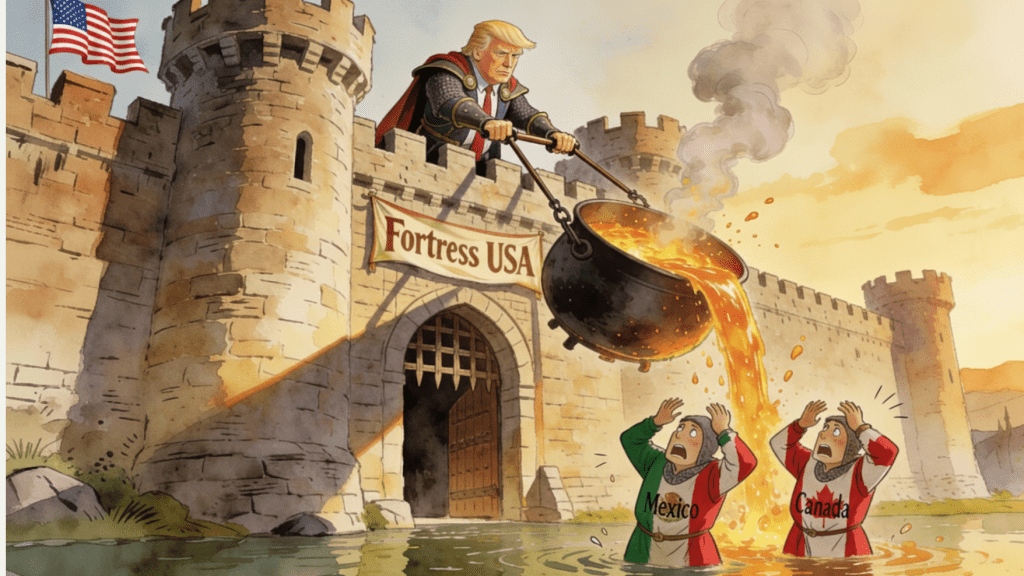
AI generated image from OpenAI

December 13, 2025


This week the Québec National Assembly unanimously passed Bill 109, its version of the federal Bill C-11, the Online Streaming Act.

MediaPolicy has been following this file since the CAQ government commissioned a blue-ribbon committee to recommend how to reverse the low availability and consumption of French language content on global streaming platforms. In reverse chronological order, you can update yourself on this story here, here, here and here.

The CAQ bill is a policy response to the federal cabinet’s and the CRTC’s hesitancy to implement the “content discoverability” provisions of the federal bill as written by Parliament.

The political consensus in Québec on regulating audio-visual and audio content to protect culture and language meant that Bill 109 didn’t spark the controversy that the federal Bill C-11 did two years ago.

But the tinder is dry and the sparks will fly. 

The US Trade Representative will add Bill 109 to its list of American grievances over Canada regulating Hollywood streamers and Big Tech, to be tabled in CUSMA negotiations this spring. (When coincidentally the 2026 Québec election might be called).

So too there must inevitably be an impasse between the Mark Carney government and Québec over legislative jurisdiction. Though brief by comparison, Bill 109 is almost a carbon copy of Bill C-11. Until the Supreme Court says otherwise, Ottawa has exclusive jurisdiction over online broadcasting. 

Québec’s culture minister Mathieu Lacombe has been pretending there’s nothing jurisdictional to talk about with Ottawa. According to the minister, there’s no conflict, only concurrent federal and provincial powers to do the same thing. Good luck with that. A caveat: he might have a provincial claim to the regulation of home screens on Smart TVs and streaming devices. 

The Québec law is founded on a provincially claimed right to cultural discoveryprops to that boldness. Importantly, all of the bill’s cultural measures are focussed on French language content, not Canadian French language content, so the political framing is more linguistic than cultural.

Mess with this if you dare, Ottawa.

From here, things will move slowly at first.

Québec will establish the minister’s Discoverability Office and begin drafting streamer requirements for French language content.

The CAQ’s Lacombe will find out if the streamers are willing to take up his offer to negotiate bespoke agreements in order to avoid cookie cutter regulations set by the province.

On video streaming, he will no doubt benchmark his regulations or voluntary agreements with streamers against the outcomes reached in France since 2021.

Despite a framework EU law that proposes a 30% catalogue minimum (numbers of shows), the French implementation of that policy focusses instead on production investments in French language content, based on a range of 20% to 25% of a streamer’s national operating revenues. So far, the result has been bigger budgets rather than a proliferation of mid-budget shows.

On other hand Lacombe could just stick with catalogue quotas, as the CRTC is expected to announce its own federal expenditure quotas soon.

As the Québec legislation doesn’t require the cash contributions to Canadian media funds that the streamers hate so much in the federal scheme, a deal with Netflix focussing on French language video catalogues doesn’t seem out of the question.

A deal with Spotify to do something dramatic to increase rock bottom consumption of French language music would be tougher. 

Unless Lacombe’s process moves at lightning speed, CUSMA talks and the Québec election will intervene.

***

If you don’t have school age kids, you might have missed the seismic Big Tech event that just shook Australia: its government has banned social media accounts for children under age 16.

Social media companies are expected to rely on age estimation technology but also photo ID.

The Australian communications minister Anika Wells is the first politician in a liberal democracy to tell social media companies, “time’s up.” Apparently so, even Elon Musk says he will obey the law.

There’s a brief explainer in the New York Times on how harmful social media can be for teens and how we got to the point that Big Tech’s safety half-measures have worn out the patience of legislators. 

Still, a ban. Wow. As our federal justice minister Sean Fraser eyes a revised online harms bill, what would be interesting is an opinion poll on a ban, taken from Canadian parents of tweeners and teenagers, parsed out separately for age and gender of the children. 

***

In last weekend’s post, I speculated that Donald Trump would have some fun with the $87 billion USD Netflix-Warner Brothers merger deal, given his donor ties to the losing bidder, Paramount. 

The next business day after Netflix officially announced its winning bid, and media analysts had their say on the prospects for Netflix obtaining the Trump administration’s anti-trust vetting, Paramount unveiled its Plan B: a $108 billion hostile takeover bid for all of Warner Brothers Discovery properties.

Warner Brothers has a week to respond but Paramount CEO David Ellison has already signalled an improved second bid is ready to go.

Among Paramount’s financial backers are the CEO’s dad and second richest man in the world, Larry Ellison, and various gulf state sovereign wealth funds. Oh, and President Trump’s son-in-law Jared Kushner.

The Ellison-Gulf-Kushner bid includes Warner Brothers’ television entertainment channels and the cable news network CNN. 

Ellison-the-younger’s Paramount recently bought the CBS news network and appointed the Free Press’ Bari Weiss as CEO. Pa Ellison is also the key investor in the bid to buy TikTok’s US operations. 

***

A significant AI content licensing deal has been struck between the IP-rich Disney and OpenAI, the developers of Chat GPT and the video-creation app Sora. 

The deal will allow Sora subscribers to create videos with Disney’s classic animated film characters. Imagine making a birthday video card for your kids featuring them with their preferred cuddly creature or action hero.

As reported by The New York Times: “Sora users will be able to make videos with more than 200 characters from Disney’s library, including from “Encanto,” “Frozen,” “Moana,” “Toy Story,” “Zootopia,” “Inside Out” and other animated movies. Animated or illustrated versions of Marvel characters like Deadpool, Iron Man and Black Panther will also be available, along with “Star Wars” characters like Darth Vader and Princess Leia.”

Given all of the chatter about AI companies scraping copyrighted content, the Disney-OpenAI deal will set expectations that licensing deals are the way for Big Tech to make peace with content producers, especially the biggest ones. (Oddly the reporting on the deal noted Disney’s $1B USD investment in OpenAI but was mum on the value of licensing payments that Disney can expect).

The Hollywood Reporter has a good analysis of the deal, the gist of which is Disney isn’t going to rest on its IP laurels while other content companies get rich on AI monetization.

More broadly, the slow drip of licensing deals between AI and content companies might, in the news journalism space, begins to look like the years leading up to Australia’s NewsMedia bargaining code and the Canadian Online News Act: AI companies cherry pick the biggest and most popular news outlets for licensing deals while those left behind look to governments for action on content scraping and monetization. 

***

If you would like regular notifications of future posts from MediaPolicy.ca you can follow this site by signing up under the Follow button in the bottom right corner of the home page; 

or sign up for a free subscription to MediaPolicy.ca on Substack;

or follow 
@howardalaw on X or Howard Law on LinkedIn.

COMMENTS ARE WELCOME. But be advised they are public once I hit the “approve” button, so mark them private if you don’t want them approved. 

I can be reached by e-mail at howard.law@bell.net.

This blog post is copyrighted by Howard Law, all rights reserved. 2025.


Catching Up on MediaPolicy – The BBC lies the truth – Australia dips its toes into C-11 waters – Cohere fails to stop AI lawsuit

November 15, 2025

“I lie the truth,” American film director Oliver Stone once said of his controversial 1991 epic “JFK,” packed as it was with apocrypha and might-have-been speculation.

So did the BBC in its 2024 documentary on America’s insurrection day, January 6th, 2021, “Trump: A Second Chance?”

By now, most have heard about the BBC’s splicing of video clips that juxtaposed Donald Trump urging the crowd to march on the US Capitol with his later suggestion that they “fight like hell” against the Congressional confirmation of Joe Biden’s election victory. He made the “fight” comment 20 times during the speech, but the two comments in the edited clip were spoken 50 minutes apart. 

Omitted in the report was Trump’s suggestion they protest peacefully.

Also omitted was Trump telling the crowd that his Vice President Mike Pence must be stopped from certifying the election results, “We’re just not going to let that happen.”

As the crowd became a mob and surged violently into the Capitol building, some avowing to find Pence and murder him before he could certify, the outgoing President held back for two hours before making a public request to end the violent occupation.

The BBC rightly apologized to Trump for the video editing —-after a leaked document and public pressure made it impossible to do otherwise. The Beeb qualified its mea culpa by suggesting the President had not made a “direct call for violent action.” 

The broadcaster denied defamation but Trump is filing a lawsuit.

It didn’t take long for Canadian commentators to apply the moral of the story to our own public broadcaster, the CBC. 

The Hub’s Full Press podcast offers an intelligent review

Globe & Mail columnist Konrad Yakabuski did the same, writing about recent events in which CBC management’s handling of an ugly anti-Semitic on-air report from a Radio-Canada foreign correspondent remains in blow-over mode.

The fates of the suspended reporter and the unsuspended news host who ignored the remarks are still unclear.

CBC President Marie-Philippe Bouchard told a Parliamentary committee that the public broadcaster’s response ends at its full and immediate public apology, not an investigation into how deep such anti-Semitic views do or don’t run in the newsroom.

Best guess: the spotlight will return to this issue when the CBC Ombud makes a report. 

In the interest of equal time, let’s chalk another stroke on the wall to mark Opposition Leader Pierre Poilievre’s most recent swipe at the CBC when asked a question he would rather not answer (“aren’t you with the CBC?”). If we’re going to hold the CBC responsible for its public reputation, we should hold everyone accountable. 

***

For and CBC doubters and defunders, here’s an insightful and engaging Front Burner podcast featuring the public broadcaster’s three on-the-ground Washington correspondents, Canadians explaining to Canadians what Americans are doing to Canadians.

That’s what you lose without a CBC.

***

There’s a lot of media policy cooking in Australia lately.

A report in The Guardian says that the Labor government is going to move forward with incentives —-i.e. monetary penalties—- to lever Meta into reinstating news content on Facebook and Instagram and return to the bargaining table with news publishers to reinstate mandatory news licensing payments, regardless of Meta’s news ban. 

The idea is to set the fine for Meta’s non-compliance at a level just above the dollar value of its expired agreements with news publishers, something that The Guardian cites as 1.5% of Meta’s annual Australian revenues. The Labor legislation is targeted for 2026. 

If the Australians are baring more teeth than Canada has on our own Meta news ban, they are showing a little less on their new legislation that parallels Canada’s Netflix bill, the Online Streaming Act.

As MediaPolicy noted last week, the new legislation would set a spending quota for Netflix and the major streamers to make “AustralianCon” at either 10% of their local content budget or else 7.5% of their Australian revenues.

The 10% figure replicates the AuzCon spending that Australian-owned broadcasters obey for television dramas. By comparison, Canada requires our major domestic broadcasters spend 30% of revenues on Canadian content, including a 5% envelope for drama. 

Another interesting piece of Australian context is that the streamers’ voluntary spending on AuzCon is over $200 million annually, slightly in excess of the Labor government’s estimates of mandatory spending under the new bill.

A government backgrounder keeps reiterating that the mandatory spending it has in mind would be a “guaranteed” spending. The concern is that Netflix and other global streamers might scale back their Australian spending in response to Hollywood’s contraction of content spending.

As an unregulated English-language market, Australia would be a logical place to start cutting. Better to lock in current levels of streamer spending.

Meanwhile, CRTC watchers in Canada will be interested to learn that the Commission is releasing its ruling on video streaming this coming week.

The decision may order Netflix and the foreign streamers to spend more on Canadian programming. It may also change regulatory rules for Canadian broadcasters who have asked for fewer CanCon responsibilities.

New obligations for the streamers will be closely tied into what the CRTC has to say about the ownership of copyright and intellectual property in Canadian dramas that the streamers will have to buy to fulfill a quota for local content.

The Commission must decide whether to mirror federal rules for CanCon financing that make the payment of crucial television subsidies conditional upon a Canadian producer owning the long term copyright in a show.

The global streamers want the option to demand Canadian producers sell them the copyright if the streamers are going to be compelled by the Commission to spend on CanCon.

Another wild card in the deck is the yet to be released ruling from the Federal Court of Appeal on the Commission’s June 2024 down payment of regulatory obligations for the streamers.

Heard by the court in June 2025, the appellant video and audio streamers are challenging the CRTC’s assessment of an annual cash contribution of $200 million to various media funds that channel the money to the financing of Canadian programming and music.

***

There is an update in the Globe & Mail reporting on the US lawsuit against Cohere that alleges the Canadian owned AI company is ripping off copyrighted content, even behind paywalls, from major North American media companies including the Toronto Star.

A New York judge rejected Cohere’s preliminary argument that the plaintiffs’ news reporting is so puréed in the AI summary that there is no “copy” being made. The case will proceed to trial.

In Germany, a lower court ruled in favour of music companies who sued OpenAI on the grounds that its ChatGPT application violated copyright by scraping lyrics content.

***

If you would like regular notifications of future posts from MediaPolicy.ca you can follow this site by signing up under the Follow button in the bottom right corner of the home page; 

or sign up for a free subscription to MediaPolicy.ca on Substack;

or follow @howardalaw on X or Howard Law on LinkedIn.

I can be reached by e-mail at howard.law@bell.net.

This blog post is copyrighted by Howard Law, all rights reserved. 2025.


Catching Up on MediaPolicy – Canadians don’t want culture thrown under the bus – the CBC’s trust factor – Wikipedia or Wokepedia

(Some classic Canadian humour to start your weekend)

October 25, 2025

MediaPolicy previously made the observation that while Culture and Identity Minister Steven Guilbeault rejects any further trade concessions to Donald Trump on cultural legislation, we haven’t heard from Mark Carney. And probably won’t. The PM is shying away from those kind of red lines as he transitions rhetorically from “elbows up” to bended knee. 

Those of you who recall your history might remember that, according to reports, Canada’s theatrical film legislation was the very last thing on the negotiating table when Brian Mulroney and Ronald Reagan agreed to Free Trade deal number one in 1987. It didn’t go our way.

It’s good to educate ourselves in anticipation of similar cliffhangers. Last weekend the Globe and Mail’s arts staff writers went all out with a collection of stories about the challenges for Canadian artists and media producers as Canada’s trade relationship with the United States wobbles. 

Kelly Nestruck wrote about how television production, stage shows and museum exhibitions are going to manage when access to their main export market, the United States, could be up for grabs.

Brad Wheeler invited Rheostatics’ Dave Bidini to riff on his new album, as well as elbows-up nationalism (“Bumper sticker nationalism is not interesting to me,” says Bidini). 

Josh O’Kane looked at the desperate state of Canadian-owned book publishing.

Kate Taylor offered a solid overview of trade deals and US retaliation (and trade law wonks can check out the latest from Hugh Stephens).

Eric Andrew-Gee explained the warm hearth of Québec’s cultural nationalism to anglophones (“The price of having a culture to protect is constant fretting about the state of that culture”). 

And last of all Barry Hertz broached the sensitive topic of whether collectively we are up to supporting Canadian culture at all. 

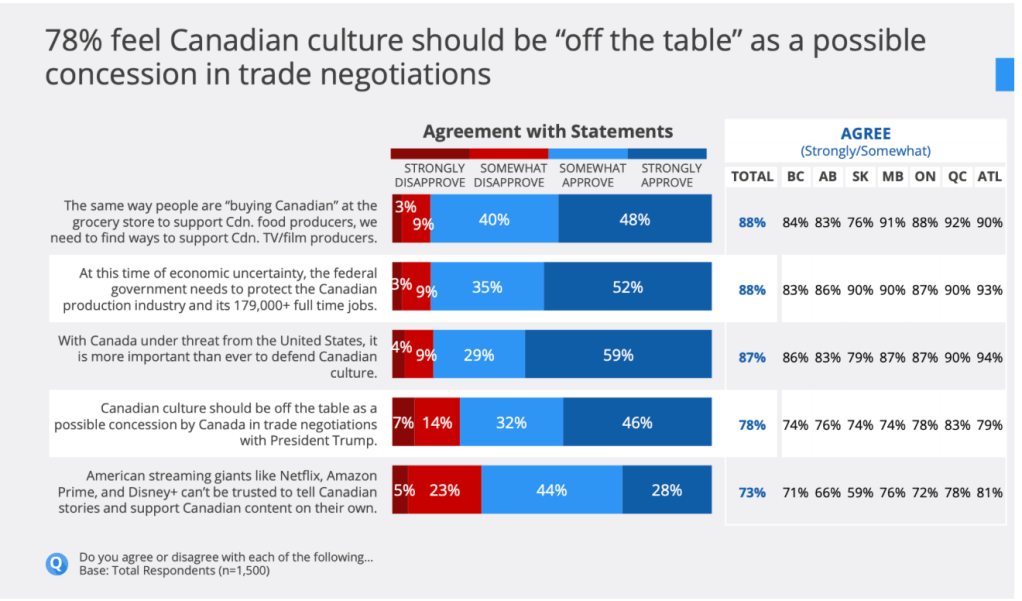
Hertz’s column references a new opinion poll just released by Pollara, sponsored by Canada’s independent television and film producers, that shows Canadians want Mark Carney to defend Canadian culture against American trade aggression. 

The poll says that 87% of Canadians now support the Liberals’ Online Streaming Act Bill C-11 (up from 67% in May 2022). As for having a fight over Canadian culture with Trump, 68% of Canadians say yes, only 13% say throw it under the bus (the rest don’t know).

It’s true that half of Pollara’s respondents had no clue about C-11 in the first place, but the pollster’s “statement” polling below suggests Canadians’ values are nevertheless strongly aligned with defending cultural legislation.

***

In last weekend’s post, MediaPolicy summarized CBC President Marie-Philippe Bouchard’s plan for reinvigorating the public broadcaster. Her two biggest points were “more local” and “more diversity.”

Bouchard did the Parliamentary rounds last week, appearing before the Commons Heritage Committee and the Senate communications committee

Bouchard’s line on ‘more local’ —-she keeps using the word “proximity” to capture both geography and audience affinity with content —- is that digital technology means the CBC can pivot back to local without having to build new stations. 

Sitting next to Bouchard, CBC’s Regional Services GM Jean Francois Rioux also emphasized affinity. Canadians want to see people “like me” or “like us” on CBC. They also want other Canadians to see and hear their concerns on the national stage that CBC provides.

There are others who have a different take on affinity, and they mean ideological affinity, code for “more conservatism” on CBC.

Bouchard treads delicately on this one, although in her Commons appearance she thoughtfully suggested that the CBC’s retreat to major cities as a response to budget cuts in the 1990s probably meant that coverage skewed to metropolitan values, which can feel “more centre and left” to anyone living in the “more centre or right” hinterland of Canada. 

Bouchard was also interviewed by CBC reporter Jayme Poisson on her October 16th Frontburner podcast. Poisson poked reasonably hard on a number of sore points. On ideological diversity, Poisson pointed out that although CBC’s “trust” rating tops the charts, CTV and Global score better with conservative listeners. Maybe more opinion coverage is what’s needed?

Bouchard didn’t immediately bite on the suggestion —- avoiding a debate over whether big-c Conservatives are treated fairly in CBC coverage— but said what was needed was consistent inclusiveness in CBC content:

Well, I mean, there’s all sorts of ways to make people feel reflected and included. It starts by being in the communities where they are. It also means including a more diverse set of points of view. If that’s possible. And it’s also about being constant about it. Not just during an election period or during a specific period of time. It’s just to have that reliable approach to a diversity of points of view.

That sounds like a shift in content curation as a conscious effort. The execution will be the hard part. 

***

A public broadcaster that offers affinity as broadly as possible (my new description of being “highly trusted”) is something we need to keep our democracy glued together. It’s important that everyone is motivated to check in with at least one media source that tells them about all tribes, not just their own.

Wikipedia does something similar. The popular website is quietly just there in our Google Search results. If you read it critically, you’ll get both the uncontroversial facts and the contentious points, the latter helpfully linked to content that you can read and then draw your own conclusions.

That’s unless Wikipedia is a woke, left-wing mind control machine, which is how it gets disparaged these days by the MAGA movement. To that point, Elon Musk says he’s about to release his politically recalibrated competitor to Wikipedia.

Here’s an interesting read from the Washington Post about the political campaign against Wikipedia lead by co-founder Larry Sanders.

***

If you would like regular notifications of future posts from MediaPolicy.ca you can follow this site by signing up under the Follow button in the bottom right corner of the home page; 

or sign up for a free subscription to MediaPolicy.ca on Substack;

or follow 
@howardalaw on X or Howard Law on LinkedIn.

I can be reached by e-mail at howard.law@bell.net.

This blog post is copyrighted by Howard Law, all rights reserved. 2025.

Catching up on MediaPolicy – Dhanraj tells his CBC story – Kimmel is back, really back – Unifor launches CheckFactHere – Western Standard cashs a federal cheque

September 27, 2025

Last week Culture and Identity Minister Steven Guilbeault showed up at the House of Commons’ heritage committee for his root canal.

The Conservatives were on him immediately about former CBC host Travis Dhanraj’s charges that the public broadcaster violated the Human Rights Act by treating him as a token “brown guy.”  MP Rachel Thomas cited CBC’s “toxic environment” as a fact.

Guilbeault appeared to take Dhanraj’s allegations at face value, expressing “regret” at “what happened to him” but distanced himself from the CBC’s handling of the dispute.

MediaPolicy has covered the story here, here and here but I was waiting for more details on Dhanraj’s claims against unnamed colleagues in CBC’s Ottawa bureau and how CBC management handled the whole situation.

Now Dhanraj has given a more fulsome version of his story on episode one of his new podcast, Can’t Be Censored, produced with former CP24 reporter Karman Wong. 

The episode is over an hour long and it’s pretty clear that without naming David Cochrane, the host of CBC’s parliamentary show Power and Politics, that is who Dhanraj is identifying as his nemesis (Cochrane has declined comment). Dhanraj says that “three or four” journalists are running the Ottawa bureau’s news coverage as their own club. 

Dhanraj’s narrative is that CBC headhunted him, first as a national reporter and then as the host of Canada Tonight, a current affairs show. Dhanraj tried to make the show edgy and popular by inviting controversial guests. They included former Fox News host Tucker Carlson, whose appearance CBC management vetoed on the grounds that Carlson is a white nationalist, although Dhanraj says in the podcast he doesn’t agree with that description.

What got him into hotter water was inviting Conservative Party deputy leader Melissa Lantsman onto his show while the Conservatives were boycotting Cochrane’s hot seat on Power & Politics. As it turns out, CBC management already had an internal protocol that forbade the Conservatives end-running Cochrane in favour of a preferred host. Dhanraj tried to convince his boss that it was good journalism and better for the CBC’s reputation as a big tent public broadcaster to get the Conservatives onto any CBC show at all. He even quoted the Broadcasting Act. His boss didn’t buy it.

There’s more in the podcast episode on other friction points between Dhanraj and the Corp. Assuming he has offered his best arguments, it’s hard to see his allegation of racist tokenism as anything other than his editorial gloss. Rather his story comes across as a tale of an ambitious television anchor making a play to upgrade a lesser show into a bigger one, some colleagues resenting that, and CBC not accommodating it. 

If David Cayley’s new book critiquing the CBC had gone to press a little later, I am sure he would have devoted a chapter to Dhanraj. Earlier this week, MediaPolicy posted a review of Cayley’s book.

***

Bob Iger is writing his own history, day by day.

Iger is the Disney CEO responsible for suspending Live! host Jimmy Kimmel for his mockery of the US President’s odd reply to a journalist’s question about grieving Charlie Kirk’s death. Then the viewer and political backlash hit Disney. Iger turned Kimmel’s “indefinite” suspension into a one week cancellation.

US media commentator Evan Shapiro has a LinkedIn post breaking down the events leading up to Iger’s actions against Kimmel.

Bottom line: the threat by Trump’s FCC chair Brendan Carr to strip Disney’s ABC affiliate stations of their broadcasting licenses was an idle one. Up until now media moguls have blinked because they won’t play the long game against the Trump administration’s campaign to tame mainstream media.

Kimmel’s show is back on the ABC network, but initially two major station affiliates refused to air it. One of them is a big Trump supporter. The other needs the FCC to approve a merger. 

That lasted three days. Yesterday the two affiliates that include 56 stations across the US reversed course and agreed to resume airing the show.

It ain’t over. Trump replied on Truth Social, “I think we’re going to test ABC out on this. Let’s see how we do.”

***

It’s World News Day tomorrow which is a reminder from major newsrooms around the liberal democratic globe that you’ll miss them when they’re gone.

Pairing up with that, my alma mater Unifor —-which represents journalists and media workers across the country—- has launched a middle brow version of the same, a public service campaign branded CheckFactHere.

Video and print ads created by Unifor will appear in Canadian media who are donating the inventory. 

***

A few sunny weeks ago MediaPolicy posted a dissent from a Canadian Press story concluding that PM Mark Carney was considering repeal of the government’s Online News Act C-18 and its $100 million tithe on Google that compensates Canadian newsrooms for their stories appearing on Search. I didn’t think that Carney’s mangled response to a Kelowna journalist’s question about C-18 actually said that.

It took some time to pin down the government for a clarification, but Politico.com asked Culture and Identity Minister Steven Guilbeault for comment and his press secretary replied “the federal government has no intention of repealing either of the acts,” referencing both C-18 and the Online Streaming Act C-11.

Then the National Post story added that Guilbeault’s office hedged a bit, saying “for us, currently, the intention is not to repeal those acts… But I can’t pretend to know the end result of the negotiations with the United States” which are “very much” the main factor that will determine the future of both acts.

Somebody needs to put this question to Carney.

While we are talking about C-18, when the Canadian Journalism Collective announced the distribution of the $100 million in August, Media Policy posted that the conservative news outlet Western Standard was getting a $68,000 cheque. What I didn’t mention is that I e-mailed publisher Derek Fildebrandt asking him to confirm that he wasn’t also receiving the federal government’s “QCJO” journalist subsidy. His publication was part of a coterie of anti-subsidy news outlets who published a public oath they would never take that kind of money. Fildebrandt didn’t reply to my e-mail.

Now we know why. He’s taking the money. In an email to his subscribers, Fildebrandt said he couldn’t compete without the federal cash and ——I am reading between his lines here— without Pierre Poilievre in power those subsidies will continue to flow to his competitors. 

Fildebrandt’s books aren’t public, so it’s also possible he couldn’t remain solvent without federal and Google money. In any event, my condolences, climbing down from high moral ground is never fun. Just ask Mark Carney.

***

If you would like regular notifications of future posts from MediaPolicy.ca you can follow this site by signing up under the Follow button in the bottom right corner of the home page; 

or sign up for a free subscription to MediaPolicy.ca on Substack;

or follow 
@howardalaw on X or Howard Law on LinkedIn.

I can be reached by e-mail at howard.law@bell.net.

This blog post is copyrighted by Howard Law, all rights reserved. 2025.

Catching up on MediaPolicy – CRTC begins hearings on music streaming – MAGA media mayhem – RadioCanada’s Jewish problem

September 20, 2025

The CRTC is shaping the regulatory path for streaming services in Canada in three big files: audio content, video content and media distribution. The public hearings for video and distribution were done before the summer break and this week the Commission kicked off hearings on music streaming and radio. 

The Commission has to figure out what more the global streaming services must do for Canadian content, a year after the CRTC levied on the streamers a “5 per cent” cash contribution to Canadian media funds that match those paid by Canadian cable TV providers. 

In music streaming, that could mean new requirements for streamer spending on Canadian songs and musicians through a combination of copyright payments and investments in musician development. It could also mean “prominence” requirements giving an extra push of Canadian songs to the attention of listeners, something that the streamers normally do only if music labels pay them.

Quite significantly, the Commission has already said —-before public hearings kicked off— that it won’t mimic its radio regulations for minimum airtime for Canadian songs. That means the most direct way to address the low consumption of Canadian songs on streaming platforms is already off the table.

The pro-CanCon advocacy group Friends of Canadian Media (I’m a volunteer) says the regulatory algebra should be straightforward. 

The streamers’ spending requirements ought to be benchmarked at the same level of radio broadcasters’ budgeted spending on Canadian music and local programming, about 30% of revenues according to the Ontario Association of Broadcasters. 

With the benchmark set, next would come the detailed arguments about what streamer expenditures on Canadian music count towards the 30%. The streamers will point to their current budget for copyright payments to Canadian musicians whose songs are uploaded to their platforms, but those don’t come anywhere near filling up a 30% bucket.

Then the “discoverability” requirements would get assessed and Friends has proposed that the Commission require the streamers to promote Canadian music with home-screen prominence, e-mailed song recommendations, more song picking of Canadian music in staff-curated playlists and an algorithmic responsiveness to listeners’ Search inquiries for different types of music. The cash value of these prominence measures to Canadian music producers would be calculated and set off against the streamers’ spending obligations. 

The streamers are looking for two things and they want both.

They want the repeal of the five per cent cash levy that supports touring and special development projects for Canadian musicians under the stewardship of independent Canadian media funds.  The streamers don’t want to pay and have appealed the levy to the courts.

Also they have filled the ears of the Trump administration and US Congress on how unfairly Canada is treating them (Canadian radio broadcasters pay only a one-half per cent cash levy because they already carry the heavy airtime quotas.)

The other thing the streamers want is no Canadian regulation. Or to put that in regulatory vocabulary, they want whatever efforts they care to make to support Canadian music deemed sufficient. It’s worth recalling that Canada is the first country to regulate streaming audio, even the Europeans haven’t done it yet.

This audio hearing is also the opportunity for Canadian radio broadcasters to bang away at air-time quotas for Canadian songs. As well, they want to water down the “MAPL” definition of what counts as Canadian music for the purpose of meeting those quotas.

The dispute about MAPL —which provides a point system for counting song contributions from performers and songwriters—- will drive some headlines if only because Canadian rock star Bryan Adams publicly trashs it. At some point, MediaPolicy will chime in (again) on that topic. 

***

It is hard to keep up with dizzying pace of the Trump administration’s rolling offensive against mainstream media outlets (excepting Fox News of course).

The FCC Chair’s threats of regulatory action against Disney/ABC and the television stations that carried the Jimmy Kimmel comedy show were successful in getting Disney to kill the show after Kimmel lampooned the President’s response to a question about the assassination of his friend and ally, Charlie Kirk. 

A day later, the President said that he expected NBC to fire two more late night comedians, Seth Meyers and Jimmy Fallon. He also promised more FCC regulatory action against television networks if they don’t put more conservative guests on air. 

As well, this week Trump filed a $15 billion libel lawsuit against the New York Times. A district judge punted the statement of claim as too long and rhetorical, giving Trump’s lawyers a month to refile.

Stepping back from the daily drama, I recommend Matt Stoller’s most recent Substack that sees recent developments as the consequence of successive Republican and Democrat administrations allowing rampant corporate consolidation of telecommunications and media over the last four decades. 

Stoller argues that repression of free expression was made possible by a consolidated media landscape, compounded by monopolies in Big Tech. 

He has a lengthy list of recommendations, combining anti-trust break-ups of major tech and media companies with new regulatory action that favours more diverse ownership of media.

The ambition of his wish list is considerable, perhaps unrealistic, but it looks to be a campaign proposal to the Democratic Party based on the idea the people are ready to break up Big Media into smaller and more lovable independent media outlets.

***

Lest this blog space seem to be picking on the Americans, I draw your attention to MediaPolicy’s last post spotlighting an on-air anti-Semitic rant from Radio-Canada‘s Washington correspondent.

Élisa Serret described Jewish influence in American politics as “a big machine” fuelled by Jewish money and claimed that “the Jews run Hollywood” and (a new one) that Jews are the mayors of America’s “big cities.”

There’s also a good opinion piece from the Globe and Mail‘s Tony Keller that you might like.

***

If you would like regular notifications of future posts from MediaPolicy.ca you can follow this site by signing up under the Follow button in the bottom right corner of the home page; 

or sign up for a free subscription to MediaPolicy.ca on Substack;

or follow 
@howardalaw on X or Howard Law on LinkedIn.

I can be reached by e-mail at howard.law@bell.net.

This blog post is copyrighted by Howard Law, all rights reserved. 2025.

Catching Up on MediaPolicy – European digital regulation in the crosshairs – performative press freedoms – ominous TV earnings

August 31, 2025

If you track news reports about President Donald Trump’s tariffs, you may recall that he struck a one-sided framework agreement with the European Union on July 28th. The headline was 15% American tariffs on imported goods arriving from the EU. On the flip side, the US gained tariff-free access to the EU market. 

Initially the deal seemed more of an armistice than a fully fledged agreement, since nothing was signed off until a one-page Framework was published three weeks later. Notably there was no repeal of the EU’s digital services taxes on American companies (like the one that Canada scrapped on June 29th). 

At the time, the White House made a point of describing EU DSTs as unfinished business while the EU news release stated that the agreement “fully respects the EU’s regulatory sovereignty.

Now for round two. 

Deal or no deal, this week Trump threatened to retaliate against 15 EU nations that maintain DSTs and also denounced as discriminatory the full gamut of EU tech regulation under its Digital Services Act (online harm and safety) and Digital Markets Act (anti-competitive practices).  The threats include new tariffs, presumably in excess of the 15% “deal.” Trump also threatened export bans or taxes on American AI micro processing chips. 

The European response was defiant: “it is the sovereign right of the EU and its member states to regulate economic activities on our territory, which are consistent with our democratic values.”

As for Trump’s new trade cudgel of export taxes, last month he reversed a Biden-era export-ban on Nvidia’s AI chips destined for China after meeting with CEO Jensen Huang. The New York Times published an illuminating feature story on why.

***

I have some updates on recent MediaPolicy posts. 

Earlier this month I wrote about the US State Department claiming that press freedoms are threatened in Canada. As I said at the time, the State Department’s Report was performative, written for the benefit of a majority-Republican Congress. If you found that post interesting, you’ll find Hugh Stephens’ bluntly worded post to your taste.

I’ll just add one more citation to my own post about North American press freedoms: this past week President Trump again invited his appointee as FCC chair to de-license ABC and NBC local news stations on the grounds that “they give me 97% bad news stories” and act as “an arm of the Democratic Party.”

MediaPolicy also posted an interview with Senatrice Julie Miville-Dechêne, the sponsor of Bill S-209 that will impede kids from accessing online porn by implementing age verification technology, an increasingly common public policy in the US and the UK. 

In the interview, Miville-Dechêne expressed doubts about the wisdom of extending age verification technology to social media apps. The state of Mississippi is not so doubtful and implemented a parental consent requirement for minors under age 18 with age verification of adult users as enforcement.

Last week the news sharing app Bluesky, a progressive alternative to the X app, responded by exiting that deepest of red states, Mississippi. A Bluesky statement described age verification regulation as too big a hassle for too small a company.

Perhaps the size of the “Mississippi progressive” market was a factor too. 

***

As the fortunes of broadcasting businesses rise and fall, certain bellwether events stand out among the steady drumbeat of quarterly and annual reports.

Here’s two you may not have noticed.

Québecor took the occasion of announcing its fall television programming line-up for its TVA network to make another plea for regulatory relief from the CRTC. 

What popped out in CEO P-K Pélédeau’s press release was that the combined revenue of TVA’s specialty and conventional television businesses has crossed the profitability line into negative territory. “In absolute terms, TVA and its specialty channels have lost $34.9 million in television advertising revenue over the past three years.” 

The MTM numbers from 2023 indicate that Québecor’s revenue situation is typical: as a group, Canadian broadcasters boasted a mere 1.6% net profit on total broadcaster revenues. The new CRTC chart (2023-24) below suggests it has become a net loss.

That calls into question the “regulatory bargain” cited by the Commission in 2016 that committed the major networks to paying for money-losing news programming out of the robust profits earned in specialty television, thanks to the majors holding Canadian distribution rights to high-margin American programming. 

The other ominous development for conventional broadcasting was the announcement by Wildbrain that it is exiting broadcast television and is removing the restriction on its non-Canadian shareholder voting that is required by broadcasting regulations. Wildbrain is (was) the only independent Canadian children’s programmer that operated Canadian children’s channels (Family Channel and WildbrainTV) until the CRTC blessed the decisions by Rogers and Bell cable to drop them. Steve Faguy’s blog has more.

[Update and correction: the original publication of this post inaccurately stated that Wildbrain was “selling its growing online business to American interests.”)

The prevailing financial and audience trends in Canadian broadcasting were updated in the CRTC’s new annual report (with now year-old data).

Here’s the Report:


***

I was very much saddened to read an obituary for Hudson Janisch who is well known to those in the telco community. He taught me Public Law in first year law school and made quite an impression. A great teacher and a mensch.

***

If you would like regular notifications of future posts from MediaPolicy.ca you can follow this site by signing up under the Follow button in the bottom right corner of the home page; 

or sign up for a free subscription to MediaPolicy.ca on Substack;

or follow 
@howardalaw on X or Howard Law on LinkedIn.

I can be reached by e-mail at howard.law@bell.net.

This blog post is copyrighted by Howard Law, all rights reserved. 2025.

The State of the Union: what the White House thinks of Canadian Media

August 20, 2025

The Canadian Press reported last week that the US State Department has an opinion on Canada’s respect for the independence of the press and freedom of expression. And it isn’t good. In fact, we got the MAGA raspberry.

The US produces “country reports” every year to satisfy US Congress that its foreign aid is going to the right place or, in our case, that we’re a suitable trading partner.

Some context first: the Report is a compliance document for Congress. It was not written for us. If the Report’s allegations against Canada happen to line up with Congressional trade complaints against the Online Streaming Act and the Online News Act, that’s part of the compliance.

Trade irritants or not, the Report picks up the vocabulary of Canadian opponents of public broadcasting, federal aid to journalism and any manner of mandatory payments to support Canadian news journalism such as the Broadcasting Act and the Online News Act. It’s “discriminatory,” it’s “censorship.”

The State Department’s special contribution to the debate is it’s view that our federal government’s $10 million enrichment of existing Canadian media funds to support news reporting in minority communities smacks of “DEI” and discriminates against white journalists.  

Not that we needed the State Department to remind us, but the Report goes on to list incidents that occurred in 2024 which, in Washington’s opinion, raise “significant human rights issues including credible reports of serious restrictions on freedom of expression and media freedom, including unjustified arrests or prosecutions of journalists and activists.”

The Report gets one right, off the top, by reminding us that in January 2024 the RCMP arrested Indigenous journalist Brandi Morin when she refused to leave the federal police force’s inflated “media exclusion zone” at an Indigenous protest she was covering for Ricochet Media. What the Americans might have added was that this is hardly the RCMP’s first offence on media exclusion zones. The Crown withdrew the charges and the RCMP’s Civilian Review committee took Morin’s side and an apology was issued

Another incident cited may or may not clear the bar of a “credible” report of press freedoms violated, that will be up to a judge if lawsuits proceed. 

The State Department takes at face value the allegations raised by Rebel News against a venue landlord and a Liberal MP that Rebel was wrongly arm-twisted into paying $37,000 in security costs for a MAGA-themed rally it organized in Toronto, headlined by the US President’s son. 

Canada doesn’t do country reports on American freedoms. It’s probably just as well. But the United Nations does. All UN signatories to the Convention of Human Rights participate in a five-year “peer review” of each other that includes press freedoms

Here are a few items that might come up:

During street protests against the immigration-related arrests in Los Angeles in June, an LAPD officer deliberately aimed and shot an on-camera news journalist with a rubber bullet, hitting her in the foot.

The Federal Communications Commission initiated an investigation of Media Matters, a left-leaning critic of right-wing media, Elon Musk’s X platform and the Republican Party. A federal judge issued an injunction against the investigation on the grounds of 1st amendment rights of free speech.

By President Trump’s executive order, the US government defunded and put almost all 1,300 reporters working for the Voice of America on leave. His appointee to run the VOA, Kari Lake, accused the VOA of a liberal bias and mooted putting the news organization under the direct control of the State Department. VOA is the official US government news agency mandated to communicate government messaging to foreign nations.

US Congress withdrew all federal funding from the Corporation for Public Broadcasting, accounting for 15% of the overall financing of NPR and PBS. House Republican Marjorie Taylor Greene stated that Congress was acting because of alleged liberal bias.

While running for President, Donald Trump proposed that the FCC pull the broadcasting licenses of CNN, NBC, ABC and CBS because of their news coverage of him (although the FCC only licenses local stations, not cable news).

The President also sued CBS, alleging that a 60 Minutes interview with Democratic presidential candidate Kamala Harris had been edited and sanitized to her advantage.

The Trump lawsuit resulted in a $16 million settlement without any admission of wrongdoing from the network.

However credible news reports suggested that the FCC might have struck down the $8 billion sale of CBS-parent Paramount to Skydance were it not for a last-minute agreement between Paramount and the FCC that the new owners would scrutinize the CBS newsroom for “multiple viewpoints” and abolish all DEI hiring and personnel policies. According to the President, Paramount committed to providing him with $20 million in free advertising and public service announcements although that was refuted by Skydance.

***

As noted above, the State Department Report repeatedly criticizes the Online News Act and the Canadian Press story on the Report states that “Prime Minister Mark Carney indicated last week he is open to repealing the legislation.”

It’s contentious to report that the Prime Minister said he was open to repealing Bill C-18, although its not surprising that Canadian Press (and the National Post) are surmising it to be true, given his one-eighty on the Digital Services Tax in late June.

The CP and Post descriptions of Carney’s thoughts on repeal are based on a question and answer session with Kelowna Now.

Here is the reporter’s question:

“Bill C-18 stands in our [publication’s] way to get back onto Facebook and Instagram, are the Liberals looking at an alternative or rescinding that so that we can get that news [about wildfires] back on those platforms?

And here is Carney’s answer:

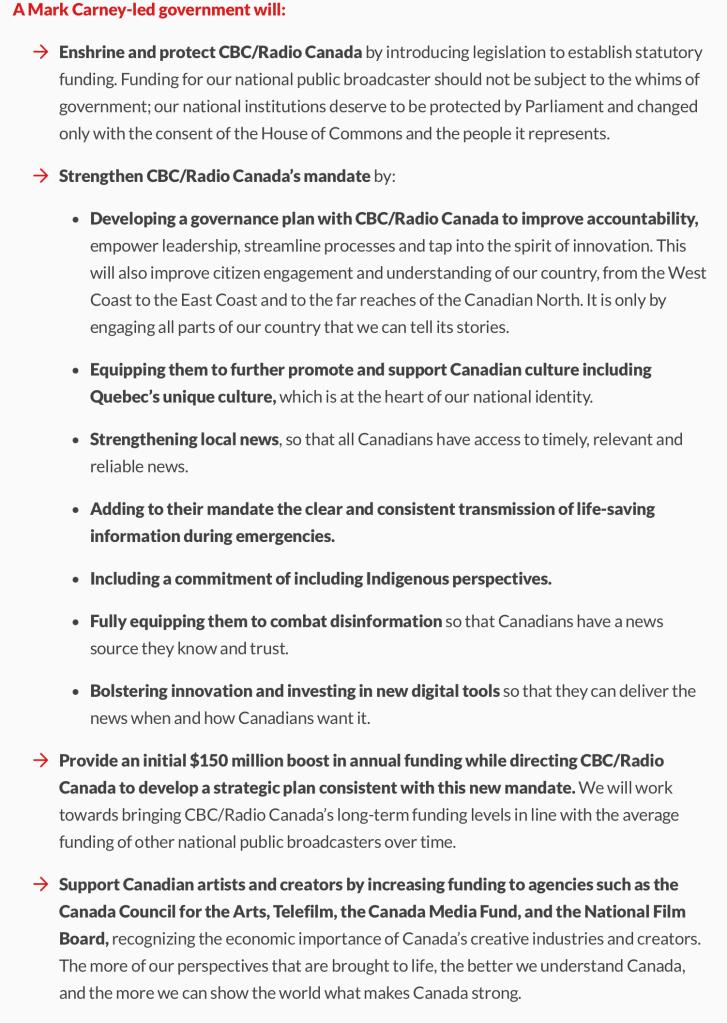
I’ll say this Steve thank you for the question. First thing and one of the things that we have done —and I will answer your specific question, but let me make a point on something we have done, and you may not like this part of the answer but I am going to give it to you— which is that one of the roles of CBC-Radio Canada is to provide unbiased, local, immediate information particularly in regards in situations such as you are referring to. And that’s why we made the commitment to invest and reinforce and actually change the governance of CBC-Radio Canada to ensure that they are providing those essential services.

Now to your specific question. Personally, this government is a big believer in the value of what you do. I’m going to use you as the representation in local news. And the importance for ensuring that that is disseminated as widely and as quickly as possible. So we will look for avenues to do that and I understand your question and it’s part of our thinking around that, thank you.

If we parse closely, the important nuance here is that Carney said he is “looking for avenues to do that and it’s part of our thinking around that.”

Grammatically, the “that” refers both to disseminating local news (especially in light of his comments about CBC-Radio Canada) and “in response to the question” which refers to “rescinding” and/or “alternatives” (or “avenues”). It’s hard to tell what he meant or whether he intended the ambiguity.

If Trump puts enough pressure on Carney, would the Prime Minister cave like he did on the DST ? Unlike the unimplemented DST, the $100 million in Google money is the bird in hand, not in the bush. The mandatory news licensing payments are already in the bank accounts of over a hundred Canadian online news outlets.

Keep in mind, the last time the Liberals came under pressure on implementing the Online News Act was in 2023 when Meta implemented and Google threatened Canadians with a ban on news content, resulting in an approximate $135 million shortfall in anticipated news licensing payments from Google and Meta.

At the time, the government softened the blow of disappointed expectations by increasing the federal QCJO journalist salary subsidies by $30 million.

***

I have a long article to recommend: a New York Times feature that tells the story of Donald Trump’s lawsuit against Paramount’s CBS, the FCC’s approval of the Paramount-Skydance merger and the cancellation of Stephen Colbert’s The Late Show on CBS.

The reporting is based on embargoed access to Paramount owner Sheri Redstone. It’s sympathy for Redstone is not subtle, but it’s an informing read anyway.

***

If you would like regular notifications of future posts from MediaPolicy.ca you can follow this site by signing up under the Follow button in the bottom right corner of the home page; or sign up for a free subscription to MediaPolicy.ca on Substack; or follow @howardalaw on X or Howard Law on LinkedIn.

I can be reached by e-mail at howard.law@bell.net.

This blog post is copyrighted by Howard Law, all rights reserved. 2025.

Catching Up on MediaPolicy – Kings, jesters and cable lords – the AI Death Star – PBS and NPR defunded – the next Dhanraj leak – how to fix the CBC

July 24, 2025

It’s a sheepish admission I make this week, but sometimes American culture wars can be so darn entertaining.

Take the recent exchange of verbal gun fire between President Trump, the US cable lords, and late night TV hosts that began with Stephen Colbert slagging his show’s owner, Paramount, for paying off on a meritless Trump lawsuit against CBS.

In case you’ve been ignoring it all, here’s a short news report from Global News explaining it.

More to my low brow taste, I enjoyed Jon Stewart’s satiric bird-flip to all those bending the knee to Trump, “Go Fuck Yourself.”

***

And then there’s the end of the world as we know it, otherwise known as AI.

I say this only half facetiously. What AI tools like Google Overview appear poised to do to news journalism may well be catastrophic, it depends on consumer adoption. 

But it’s entirely plausible that Big Tech’s scraping of copyrighted Internet content —-there are now third party web crawlers that steal and sell paywalled stories to AI companies —— could mean that a handful of global AI engines become our dominant “news” outlets so long as there remain employed journalists somewhere to be scraped.

The US Senate is holding some hand wringing hearings on AI scraping but, so far, it has a performative feel to it. Congress doesn’t do anything anymore without the White House saying so.

Our own federal government is taking a wait and see approach. Or to put it in their own words, AI Minister Evan Solomon is “closely monitoring the ongoing court cases and market developments.” 

***

There are no obituaries written yet for public broadcasting in the United States.

Congress finally passed the defunding of NPR radio and PBS television. In the US, public broadcasting was not as robustly funded as it is around the rest of the world. The annual Congressional allocation of $500M (USD) was about half of CBC funding for eight times the population and ten times the number of stations.

The federal dollars were only a sliver of overall funding of 1,000 local NPR stations, 350 PBS outlets and the national flagship operations. But funding was always heavily weighted towards local stations and local programming: the “left wing” national content that Republicans so despise is almost entirely privately funded. 

The precise consequences of defunding at the national and local level will unfold in the coming months after the scheduled September payment doesn’t arrive.

Perhaps it’s not a surprise that NPR CEO Edith Chapin just quit. 

***

The real-life CBC drama of Travis Dhanraj’s lawsuit and public campaign against his former employer released another episode this week. 

The National Post posted a story sporting a “leaked” audio clip of Dhanraj and his union representative in a meeting with CBC manager Andree Lau. The occasion was a discussion of his April 2024 X-post criticizing CBC President Catherine Tait for declining to be interviewed about CBC finances on his show, Canada Tonight.

The edited audio file is a bit of a nothing burger. Dhanraj tries to get Lau to spar with him about the journalistic ethics of CBC coming down hard on him for the post. He gets the better of the argument, mostly by default. That’s about it.

It’s not clear from the clip whether the meeting was a formal grievance meeting, normally a privileged and off the record discussion. CBC responded to the Post story by saying Dhanraj broke his promise not to record the meeting.

***

The McGill University Centre for Media, Technology and Democracy released a report on its two-year study of what is to be done about the CBC. The Hill Times covered it here and CBC News reported on it too.

You may recall that the Centre published an opinion poll in October 2024 that revealed very high public support for the CBC, qualified by strong desire for “changes.”

One of the weird things about this result is that the CBC-is-no-longer-needed vote goes up after a hypothetical addressing of major criticisms.

As the report authors observe dryly, it’s difficult to distill “a single perspective” about what needs improvement other than the fact that 78% of Canadians want to keep the CBC running.

One thing the report is very good on is that “Canadians need to be assured of the value of the product they will be paying for. Regular and in-depth demographic reviews of the audience should be established to determine the kind of content Canadians require and the way they need to receive it. Models for this form of consolation include nation-wide town hall meetings, citizens’ assemblies and comprehensive surveys of the public (not merely existing members of the CBC/Radio Canada’s audience).”

In addition, the report says that Parliament should enshrine a cycle of five-year mandate reviews of the CBC so that the relevance of the public broadcaster to what Canadians want keeps up to date.

Times two, I say.

The report goes on to say that the CBC must “create meaningful, not performative, representation [in its content]. This goal addresses equity, diversity and inclusion, but more broadly, political and regional diversity as well.”

Put bluntly, the CBC needs to convincingly reflect an audience that is broader than the heavily urban demographics of its newsroom if it’s going to be funded and enjoyed by all Canadians.

Parliamentary funding of CBC is of course the bottom line, whether up or down. The Carney government has adopted former Heritage Minister Pascale St.-Onge’s report on the CBC and made European levels of funding its aspirational long-term target. According to St.-Onge, that would mean the moving the yardsticks from $32 per Canadian annually to $62.

Give the authors of the report credit, they have broken the taboo on pointing out that French-language Radio Canada already matches European levels of funding of $79 per head while English-language services (from which Indigenous language programming is financed) languish at $25 per capita.

The taboo remains powerful enough that the report doesn’t recommend what to do about this funding gap.

In the end the authors suggest their own idea of what Canadians want out of the CBC: “information sovereignty.” In other words, a public broadcaster that protects the national interest in reliable news and information.

Their argument is made in the context of rising existential threats to our national security; including extreme weather catastrophes, pandemics, threats to our territorial sovereignty, and the surprising aggression from the United States, a country that controls much of the media we already consume. They might have added AI as yet another existential threat to information sovereignty, as noted above in today’s post.

The 80-page report comes with a three page Executive Summary.

***

If you would like regular notifications of future posts from MediaPolicy.ca you can follow this site by signing up under the Follow button in the bottom right corner of the home page; 

or sign up for a free subscription to MediaPolicy.ca on Substack;

or follow @howardalaw on X or Howard Law on LinkedIn.

I can be reached by e-mail at howard.law@bell.net.

This blog post is copyrighted by Howard Law, all rights reserved. 2025.

Catching up on MediaPolicy – dirge for the DST – Hollywood gets state cash – online harms legislation still cooking – who stole the music grants?

CBC explainer on the repeal of the Digital Services tax

July 5, 2025

Soon the wake for Canada’s digital services tax (DST) will be over and the news cycle will re-fire for the next trade battle with the United States.

Prime Minister Carney’s repeal of the DST was mocked by the victorious White House as a Canadian “cave.” Within hours, Canadian critics were queueing up, condemning Carney’s move as “bootlicking” (Lloyd Axworthy) and “bending the knee” (Le Devoir). On the other hand, Jean Charest described it as “a legitimate choice in a world of very bad choices.”

The MediaPolicy take on it is here.

The CBC has a hip two-minute cut-for-social video explainer narrated by the tattoo-embossed Nick Parker.

And for another take, here’s Paul Wells interviewing Canadian tax expert Allison Christians.

President Trump has promised to re-announce tariffs this week. Carry on Canada.

***

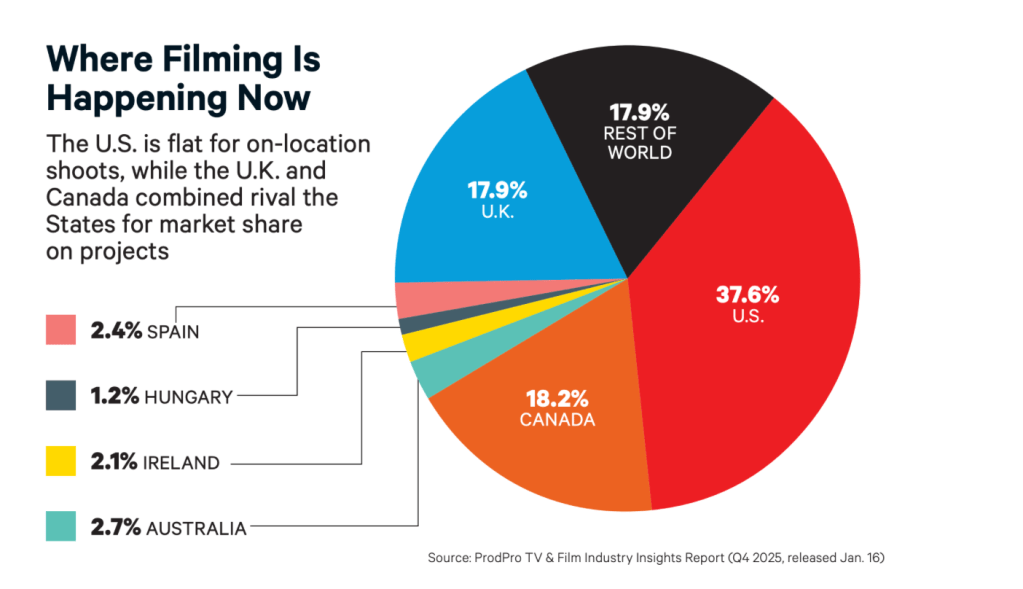
Two months ago when Donald Trump blurted out his desire to tariff US movies filmed abroad he got a tepid response from the supposed beneficiaries, Hollywood studios and the Big Tech streamers.

That’s because the studios and streamers make so many movies in Canada, at a competitive and government-subsidized cost, with world class quality.

What Hollywood really wanted was production subsidies from the US federal government, but so far that has not happened.

Now California is stepping up to the plate. Governor Gavin Newsom is prepared to double existing state subsidies to the tune of $750 million, quite a slice of the pie in what is otherwise a major austerity budget for the state.

***

The Canadian Press has reported that Justice Minister Sean Fraser is having a close look at the federal Liberals’ online harms legislation before re-tabling it.

Bill C-63 died on the order table when Mark Carney called a federal election in March. The core of the Online Harms Bill was to require social media platforms to establish content safety codes, legislation that polling suggests is a winner.

The add-ons to the bill were more controversial. The opportunity for private citizens to file anti-hate complaints against each other under federal human rights legislation, abolished by Parliament in 2012, is to be revived.

And the anti-hate provisions in the Criminal Code are to be strengthened with more severe punishments. MediaPolicy offered some perspective on that, here and here.

Prior to the election, then Justice Minister Arif Virani reluctantly split the controversial from the core elements of the bill into separate legislation. Neither bill was taken up by Parliamentary committees in the months leading up to the election call.

The CP story quotes the new Minister as wanting to make his own “fresh consideration of the path forward.”

At the very least the Minister may steal the best ideas from the Conservative election promise on deep fakes.

***

There are two 15-minute weekend reads on media that I can recommend.

In his personal blog “Fagstein,” the Montreal Gazette’s Steve Faguy has posted a short history of the CRTC’s decades long struggle to keep local television news solvent.

He’s done a great job. I know how hard it was as I tried to do the same in a shorter space in chapter six of my book on the Online Streaming Act. Faguy’s post is the learning resource that has been missing.

The other read is a feature story from the Globe and Mail’s Josh O’Kane. He’s updated his whodunnit reporting on the cyber-theft of $10 million from FACTOR, the music funding organization that distributes dollars contributed by government, radio stations and (subject to a court appeal) music streaming companies to Canadian musicians.

***

If you would like regular notifications of future posts from MediaPolicy.ca you can follow this site by signing up under the Follow button in the bottom right corner of the home page; 

or sign up for a free subscription to MediaPolicy.ca on Substack;

or follow @howardalaw on X or Howard Law on LinkedIn.

I can be reached by e-mail at howard.law@bell.net.

This blog post is copyrighted by Howard Law, all rights reserved. 2025.

Carney’s “cave” to Trump on the DST roils Canadians

July 2, 2025

Mark Carney’s shock repeal of Canada’s digital services tax on the eve of Canada Day was greeted by a gloating fan-dance by President Trump’s press secretary who claimed that “Carney and Canada caved to Donald Trump and the United States of America.”

In a brief news interview the Prime Minister suggested that the corporate tax measure, designed to capture offshoring of Canadian revenues by US tech companies, was never going to be in the final trade deal that he is working on with Donald Trump. MediaPolicy expressed its view on all of this in Monday’s post.

This might end up as a historic moment of humiliation, pending future events.

The backlash against Carney has come from all sides. He may be fortunate that Parliament is not in session and his minority government doesn’t have to face the music until the Fall. No doubt, that was his calculation.

Today the Toronto Star published an open letter signed by Canadians for Digital Sovereignty who describe themselves as “a group of patriotic Canadians and civil society organizations who care deeply about the future of Canada.” The letter expresses the concern that backing off the digital services tax will embolden Trump to press other trade demands, in particular where Big Tech and Hollywood are involved.

Carney might regard some coalition members as the usual suspects in public policy matters affecting digital and cultural sovereignty, but the inclusion of others suggest a broader opposition that ought to disquiet the Prime Minister.

The members of the coalition hail from English speaking Canada. From what I have seen on social media, their French-speaking counterparts in Québec are angered by Carney’s DST climb-down and their displeasure will be expressed.

Here’s the Open Letter:

Open Letter: Canada cannot afford to concede more to foreign tech giants

Dear Prime Minister Carney and Minister Champagne, 

We are a group of patriotic Canadians and civil society organizations who care deeply about the future of Canada. We are disappointed by the government’s decision yesterday to both halt collection of the Digital Services Tax and eventually repeal the Digital Services Tax Act. As a result, on Canada Day, foreign tech giants will enjoy an immediate $2.5 billion windfall and a $7.2 billion tax break over the next 5 years. While we recognize the difficult choices facing the government, we feel that we cannot ‘build Canada strong’ while surrendering ever more of our digital sovereignty and security.

We urge the Government of Canada to:

(i)                  Find ways to use foreign tech giants’ massive untaxed profits to fund homegrown alternatives, despite proposing that Parliament repeal the Digital Services Tax Act 

(ii)                Strengthen Canada’s digital sovereignty in trade negotiations and in undertaking a reset of Canada’s forward digital policy agenda, and

(iii)              Make no further concessions to foreign tech giants, including on legislation passed by Parliament (the Online Streaming ActOnline News Act) or in addressing urgent matters including combatting online harms, regulating artificial intelligence, ensuring the integrity of the information environment (including for health information), protecting privacy, among other measures to rein in foreign tech giants’ negative impacts on our economy and society.

 Foreign tech giants, especially U.S.-based companies, have made hundreds of billions of dollars in Canada in recent decades and yet have not paid their fair share in taxes. Many enjoy tax breaks on digital advertising paid for by Canadians thanks to a loophole in the Income Tax Act. We are one of the largest digital markets in the world, with a highly online population, skilled workers, and innovative companies. Yet in 2023 alone, U.S. tech giants made $20.7 billion in Canada from distributing online content. U.S. tech giants are crushing domestic competition, dominating our markets and imposing a range of externalities on Canadians. They profit from the amplification of online harms, including the spread of false and manipulated information, hurting the mental and physical health of children along with all Canadians. They are eroding the economic basis for the professional news media and feeding the toxification of our increasingly digital public sphere upon which our democracy depends.

The Digital Services Tax is a modest yet much-needed measure that will ensure foreign tech giants are more fairly taxed and held accountable for their enormous power over Canada’s society and economy. We are disturbed to see the alignment of CEOs of Alphabet, Meta, Apple, Amazon and X Corp. with the current U.S. administration’s agenda, which threatens Canada’s political and economic independence.

Rather than repealing the DST, we urge you to consider how foreign tech giants’ massive unfair profits in Canada could be taxed to invest in Canada’s digital sovereignty, building homegrown alternatives to U.S. monopolies. At many times in our history, Canada has invested to build communications infrastructure in the national interest. Canadian companies can help build platforms, networks, and tools that reflect Canadian values, strengthen our cultural and information ecosystems, and nourish our diversity as a country with two official languages and three founding peoples – Indigenous, French, and English – so that Canadians in communities across our far-flung country can better serve their own needs to communicate and connect.

We note that the U.K. did not make concessions to their digital services tax to get a trade deal with the US.

We stand ready to help our government, to inform and rally Canadians to help build our digital sovereignty and a better digital society.

Regards, 

Organizational signatories

ACTRA National
Amanda Todd Legacy Society
Broadbent Institute
Canadian Anti-Monopoly Project 
Canadian Centre for Policy Alternatives
Canadian Centre for Child Protection
Canadian Federation of Nurses Unions
Canadian Medical Association
Canadian Media Guild
Canadians for Tax Fairness
Centre for Media, Technology and Democracy
Children’s Healthcare Canada
Community Radio Fund of Canada
The Dais 
Documentary Organization of Canada
Friends of Canadian Media
Goodbot Society
Inspiring Healthy Futures
Open Media
Pediatric Chairs of Canada
Reset Tech
Unifor National & Local 87-M

Individual signatories
Mike Ananny, former advisor to Canadian Heritage on the future of CBC/Radio-Canada, and Associate Professor of Communication and Journalism, University of Southern California

The Right Honourable Adrienne Clarkson, CC

Linda McQuaig, author and journalist

Taylor Owen, Director of the Centre for Media, Technology and Democracy and Associate Professor at McGill University

John Ralston Saul, CC

Leslie Regan Shade, Professor Emerita, Faculty of Information, University of Toronto

Paul Valée, CEO of Tehama.io 

Dwayne Winseck, Director Global Media and Internet Concentration Project, and Professor School of Journalism and Communication, Carleton University

***

If you would like regular notifications of future posts from MediaPolicy.ca you can follow this site by signing up under the Follow button in the bottom right corner of the home page; 

or sign up for a free subscription to MediaPolicy.ca on Substack;

or follow @howardalaw on X or Howard Law on LinkedIn.

I can be reached by e-mail at howard.law@bell.net.

This blog post is copyrighted by Howard Law, all rights reserved. 2025.