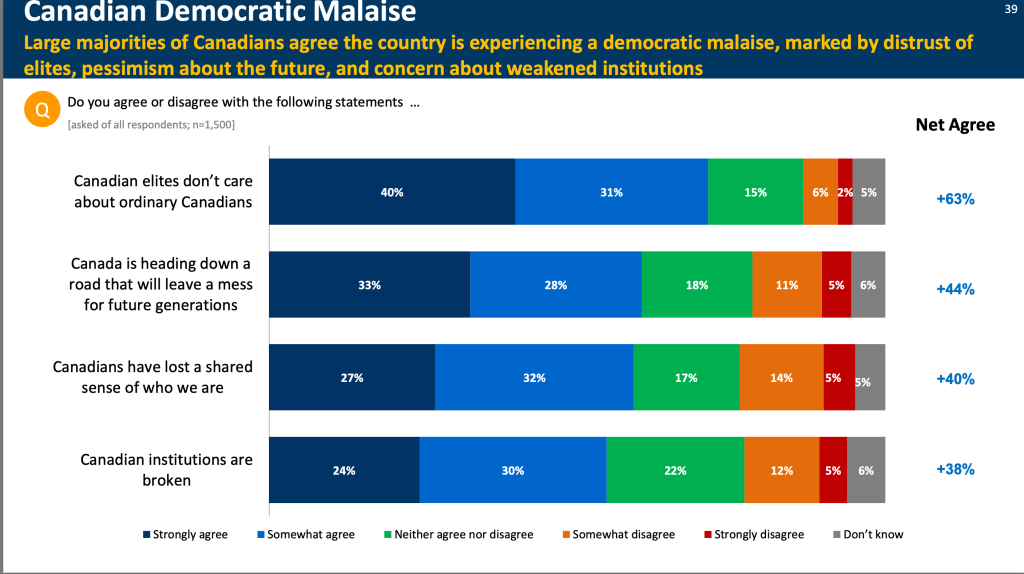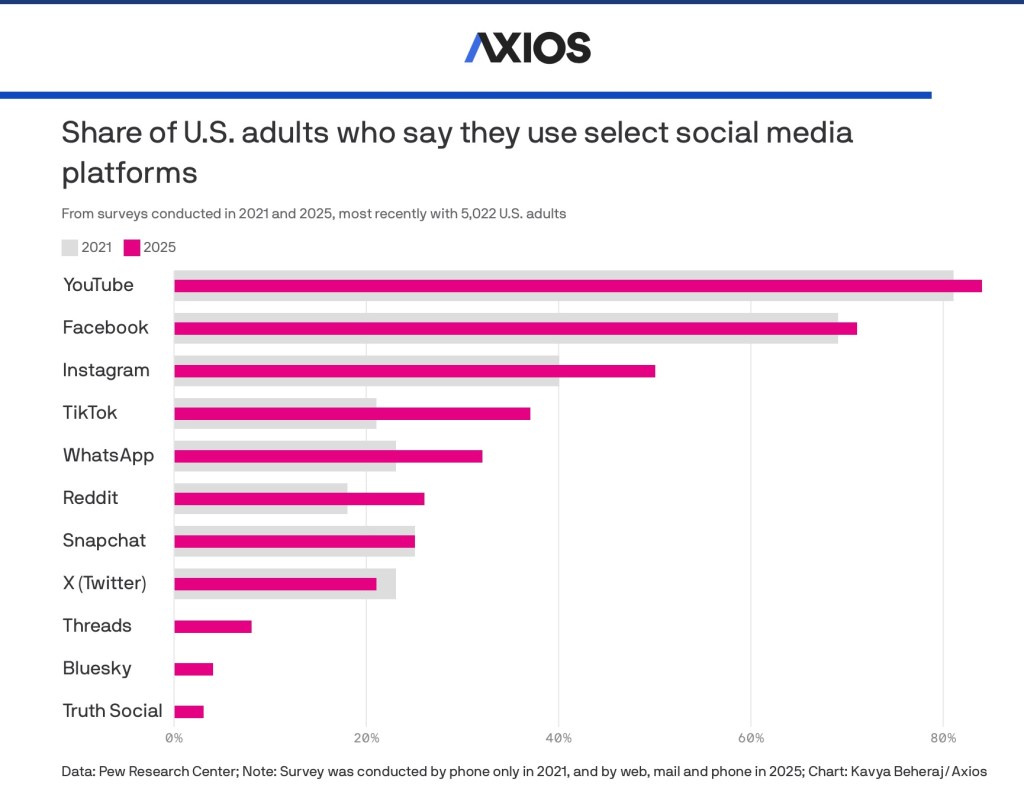
I’ve fallen behind on catching you up on media policy news because I felt compelled to write a series of three posts commenting on the CRTC’s ruling on Canadian content. The last one, the rant I promised, was published this week in Cartt.ca.
While I was ranting, one of the things I let slide was telling you about a new report out of Denmark proposing to refashion its policy design for government aid to news journalism.
The Danes are serious about news subsidies: they spend 540 million krone ($120M CDN) every year on private media in nation of six million people (Canada spends about $200 million in country of 42 million).
According to the Reuters Oxford Digital News Report, Denmark’s “public trust in media” score is 56% and it ranks sixth out of 180 in the Reporters Without Borders’ press freedom index at 86.93. By comparison, Canada’s trust score is 39% with a press freedom index of 78.5, 21st in the world.
The Danes also have something we don’t: a 2018 Media Liability law that established an independent national press council and conferred the force of law on editorial independence from ownership.
The Danish subsidy report was commissioned by government and written by a committee led by Rasmus Nielsen, the former chief of the Reuters Institute for the Study of Journalism.
Despite the ocean separating us, there are strong parallels between the Danish system of news subsidy and Canada’s jigsaw of federal programs: we have the QCJO subsidy of journalist salaries, the Local Journalism Initiative that funds 700 full time reporters in under-serviced regions across the country, and the Canadian Periodical Fund which supports editorial expenditures by community weeklies.
The untranslated 144-page Danish report covers a lot of ground, but Nielsen’s own English language summary of it captures the essence: a weighted emphasis on supporting news outlets that are regional, local or “independent” (owners of single-titles) rather than mere incumbency as a news organization.
***
The Senate deliberations of Senatrice Julie Miville-Dechêne’s Bill S-209, that would require age verification for online pornography is on hold until February while the Senate justice committee deals with other matters.
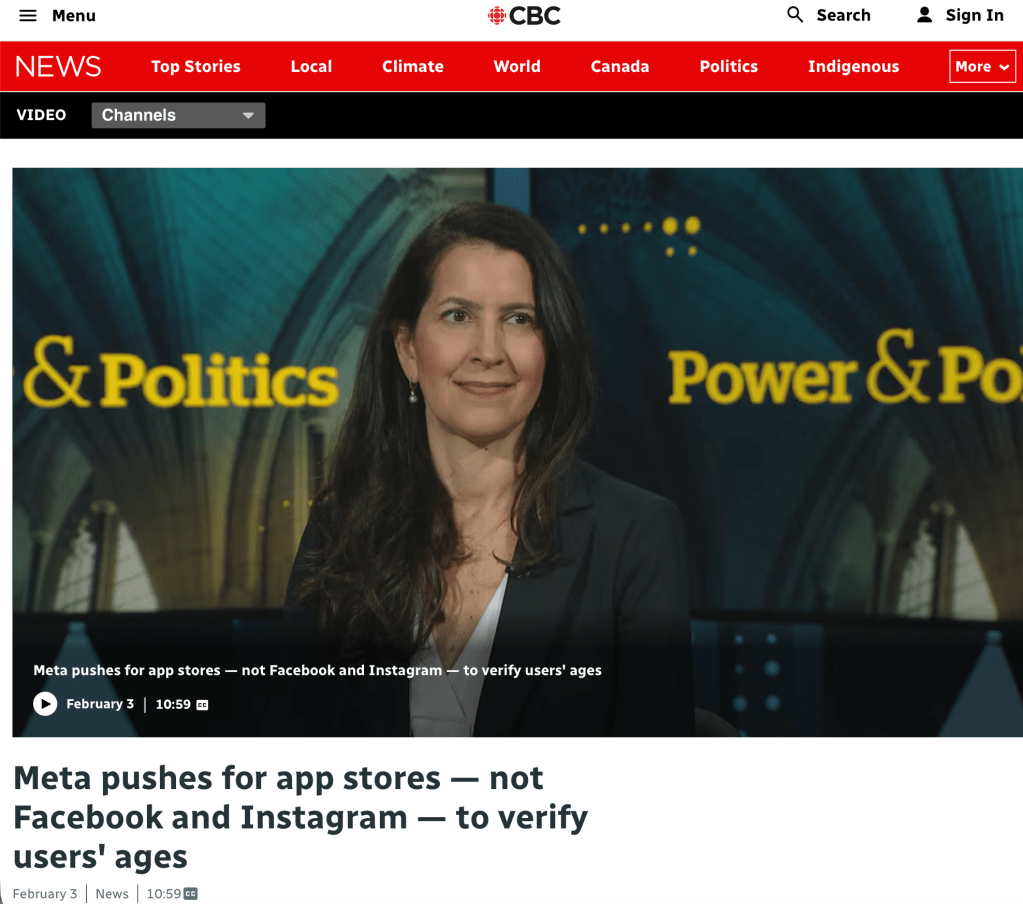
During the pause, the Canadian Press reports that Meta has joined the fray by lobbying the federal Liberals to step in with their own bill that would shift the age verification responsibility from pornography websites and social media platforms to app stores.
Meta obviously doesn’t run an App Store, as do Google and Apple, and the latter two Big Tech companies are cheesed about what Meta is up to.
Meanwhile, Canadian children continue to be exposed to online pornography featuring choking and slapping. The CP story is well done and informative.
Meta is having a good month of course. It won the anti-trust trial brought by the US Justice Department that claimed Meta was running a monopoly in personal social networking. In the interim five year period between filing and judgment, TikTok greatly improved its market share.
Matt Stoller has a very good analysis of the lawsuit, the trial, the judge, and why he thinks Big Tech will never be slowed down by anti-trust litigation: he says it takes public policy and legislatures to change things.
A test of his theory may happen soon: the trial judge in the Google Ad Tech case will be handing down her decision on whether to dismantle that illegal monopoly in the new year.
Meanwhile a consortium of US school boards just filed a new lawsuit against Meta and several other Tech companies.
Their allegation against Meta in particular is that company documents reveal CEO Mark Zuckerberg squelched evidence of harm to teenage girls while Meta designed lax safety features, including ineffective measures to expel sex traffickers from the platform. Of course, the allegations must be proven in court, probably over several years.
This does raise the question of whether Americans (and Canadians) should count on US courts to adjudicate Big Tech’s excesses by giving full due process and demanding conclusive evidence of the allegations, or whether governments should just cut to the chase, stop litigating whether the harms to kids persist, and legislate a solution.
The National Film Board’s website is recommending “Ghosts of the Sea,” a riveting documentary about the ill-fated Norwegian father-and-son sailors, Peter and Thomas Tangvald.
The filmmaker is Thomas’ half sister Virginia, who settled in her mother’s hometown of Montreal. The father Peter was married seven times and two of his wives died at sea.
I’ll say this: the film offers a visceral take on “intergenerational trauma.”
I think you will enjoy the one hour and 37 minute film and I absolutely guarantee you’ll have strong opinions afterwards.
***
If you would like regular notifications of future posts from MediaPolicy.ca you can follow this site by signing up under the Follow button in the bottom right corner of the home page;
or sign up for a free subscription to MediaPolicy.ca on Substack;
You won’t be sorry you spent five minutes with it. It’s a compelling read. Stursberg is one of the few commentators who puts as much emphasis on CBC’s entertainment programming as he does the news service.
Stursberg sets a simple performance bar for the CBC: is it good television? And then he offers a hypothetical new season(s) of great shows that could meet that standard and bring a real buzz to the CBC’s CanCon offerings, while satisfying our Canadian cultural cravings.
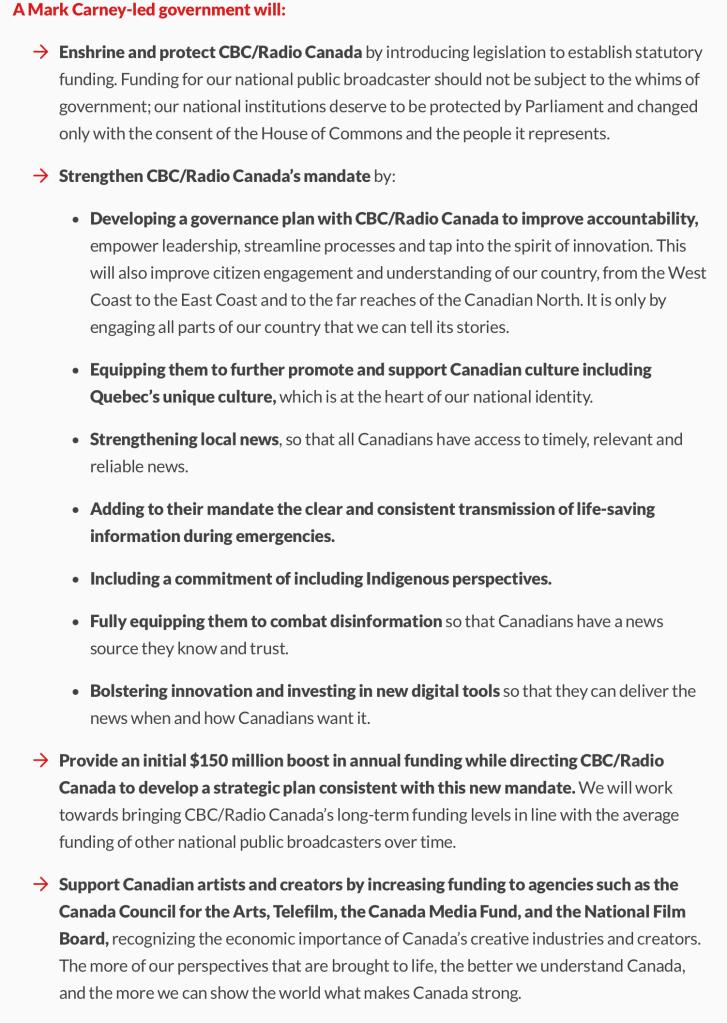
The CBC just got its $150 million booster shot in the federal budget. That money fulfilled an election promise. The 11% increase to the $1.4 billion Parliamentary grant (70% of CBC’s overall $2 billion revenue) won’t necessarily go into a bigger budget for entertainment programming: the Five Year Plan prioritizes local and regional news reporting. But it does give the public broadcaster more options.
The CBC’s new money was the Carney government’s sole increase to cultural funding in this week’s budget. Culture and Identity minister Steven Guilbeault told the Globe and Mail that the public broadcaster had also been spared from the “15% savings” spending review announced by the government several months ago.
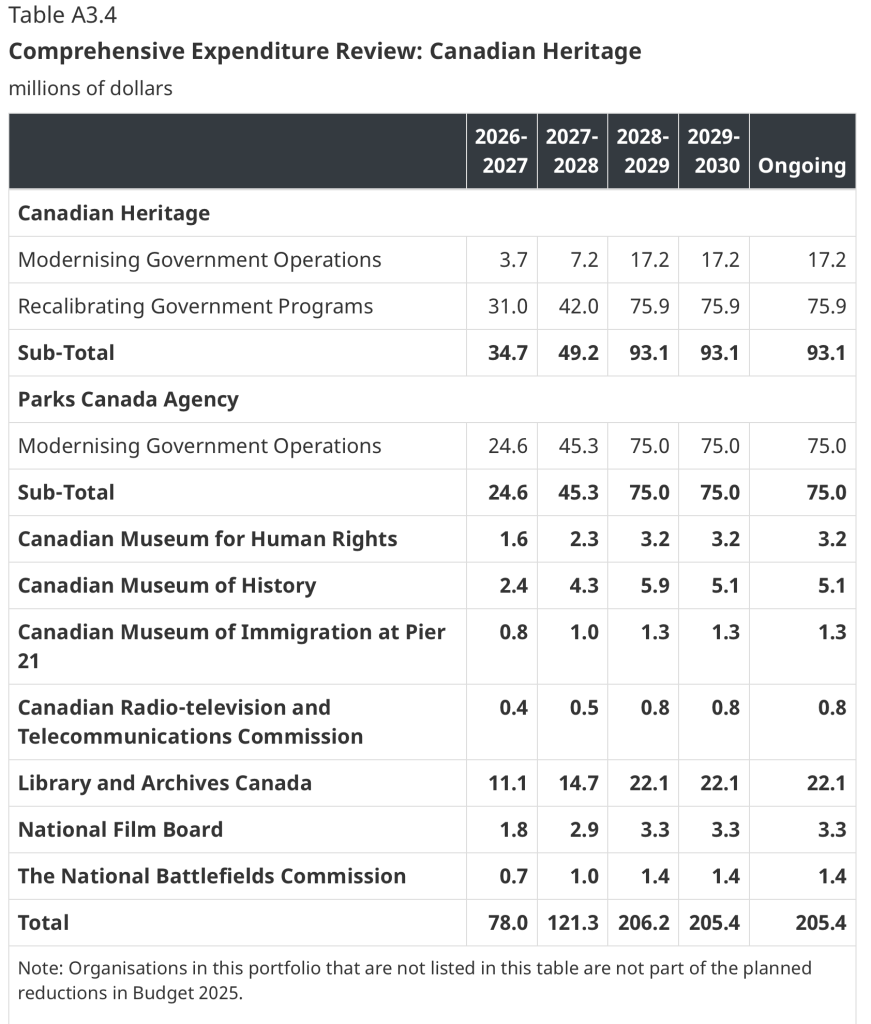
On the other hand, the budget document includes projected cuts to Canadian Heritage expenditures which might be either civil servant salaries or “recalibrated” program spending. Guilbeault pointed out to the Globe that the $93 million savings figure was 5%, not 15% of expenditures.
The numbers on recalibrated programs might include the scheduled reduction of the federal labour tax credit from 35% to 25% of journalist salaries on January 1, 2027. As well, Guilbeault told the Globe the government was exploring a merger of the Canada Media Fund, Telefilm and the National Film Board.
The budget document included a brief note that changes are in the works for the Canadian Periodical Fund that subsidizes weeklies and magazines (the government only told me that the details would be communicated at a later date).
The status quo on cultural funding shouldn’t be surprising, given other priorities in 2025.
Still, TV and radio news outlets were miffed that the government didn’t end its arbitrary exclusion of broadcasting companies from accessing federal aid for their online news websites that —-but for the television and radio properties operated by their parent companies—- would be eligible for the $75 million pool of journalist salary subsidy available to all online news outlets.
***
There’s a useful explainer posted in Paula Clark’s Substack about the Blacklock’s Reporter litigation with the federal government over Parks Canada’s sharing of a paywall password obtained from an individual subscription, giving unlimited access to every article in the Reporter’s database.
The watchdog news website was in court last month, appealing a controversial trial ruling in favour of the government which appeared to bless the government’s actions and give short shrift to copyright protection.
Among the many legal frailties of the trial judge’s decision is that it appears to expand the public right of “fair use” sharing of quotations or text snippets to authorize redistribution of full articles and, thanks to the password sharing, Blacklock’s entire news archive.
It’s a legally complicated appeal, which is why’s Clark’s piece is helpful.
***
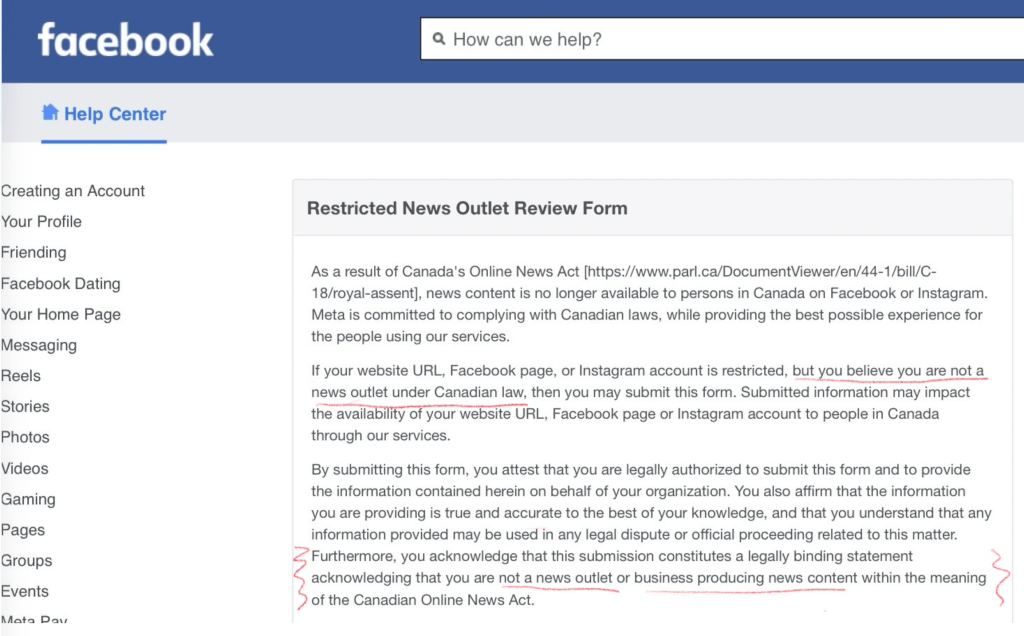
As you know, in 2023 Meta responded to Parliament passing the Online News Act by banning most news content from Facebook and Instagram in Canada (a news outlet can pay Meta to post content as an advertisement).
The ban hit the many Canadian news outlets relying heavily upon Meta platforms for content distribution. While the news blackout probably impacted free sites harder, paywalled sites were affected too.
The marketing director at Le Devoir is claiming a measurable success in making up for the lost distribution by working a lot harder at its direct engagement with readers, especially demonstrating the value of content to new subscribers.
Meta hasn’t entirely given up on Canadian news journalism of course. Just last week The Hub published a well argued commentary advocating against the federal government pursuing a digital sovereignty strategy. Meta sponsored the article.
***
The Australian government has moved the yardsticks on implementing something like Canada’s Online Streaming Act for Netflix and the other foreign video streamers, a move it has been mulling over since early 2023.
The legislation hasn’t been tabled with details yet, but the announcement suggests the streamers will have to spend 7.5% of their Australian revenues on local entertainment programming. Australian-owned television companies are already required to meet spending quotas for local content and they see the new law as a measure to “level the playing field.”
The news coverage of the announcement is unclear as to the impact of the legislation, as Netflix already invests in video production shot in Australia. It may depend upon the definition of local Australian content.
Significantly for Canadian observers, Australia is not proposing that the foreign streamers make financial contributions to Australian programming through contributions to third party production funds.
A report by the Australian Broadcasting Corporation speculates on whether the announcement will provoke a reaction from the Trump administration.
***
If you have the twenty minutes, I recommend Natalia Antelava’s incendiary interview of Google’s Richard Gingras in Coda, just for sheer entertainment if not enlightenment. Gingras is Google’s former VP of News and is currently the board chair of Canada’s Village Media.
Antelava goes after Gingras for some of Google’s controversial decisions in foreign autocracies, like agreeing to Vladimir Putin’s demand to spike a voting app set up for the Russian 2021 elections by the dissident, Alexei Navalny, who later died, possibly poisoned, in a Putin prison.
However on the main interview topic of the power asymmetry between Google and the news industry, Gingras sticks to his story that Google’s relationship with publishers is collaborative, not exploitive, which requires him to engage in some grimace-inducing denialism about Google’s abuse of market power over news outlets in Search and digital advertising, both of which have been ruled illegal monopolies by US courts.
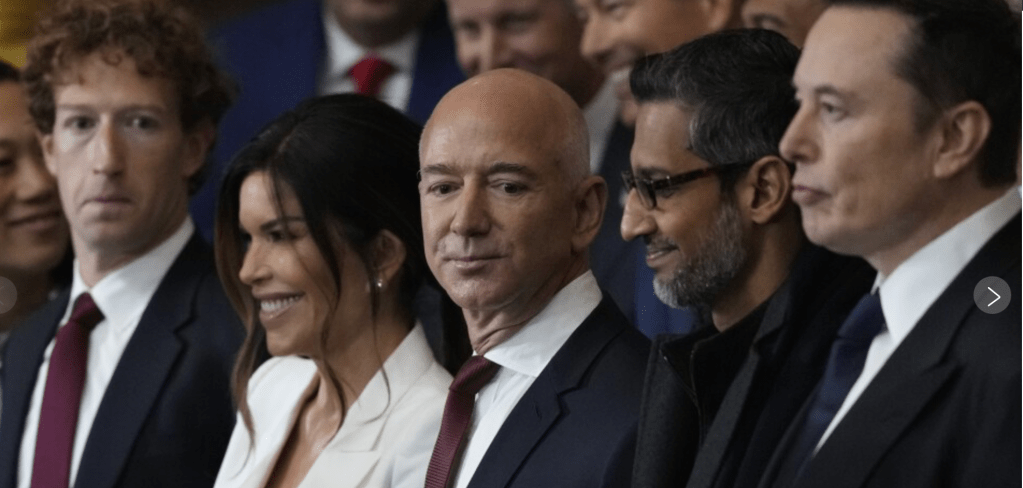
Another tidbit: Gingras claims that Google CEO Sundar Pichai was embarrassed by the now famous line-up of tech CEOs attending the Trump inauguration and suggests the photo op was “cleverly staged” by the White House.
“That’s the last photo Sundar ever wanted taken,” says Gingras. “We don’t support this administration.”
Associated Press photo of Tech CEOs Zuckerberg, Bezos, Pichai and Musk.
***
If you would like regular notifications of future posts from MediaPolicy.ca you can follow this site by signing up under the Follow button in the bottom right corner of the home page;
or sign up for a free subscription to MediaPolicy.ca on Substack;
In October CBC President Marie-Philippe Bouchard unveiled her eagerly anticipated five year plan for the public broadcaster.
MediaPolicy commented on her map here and here. Months earlier, I also provided a platform for a number of guest columns or interviews with former CBC insiders and pundits who offered some broad brushed comments on how the CBC ought to reinvent itself, one of the nation’s great and never-ending dialogues.
In 1965, Robert Fowler, the Chair of The Royal Commission on Broadcasting and The Advisory Committee on Broadcasting, noted in a much quoted observation that:
“The only thing that really matters in broadcasting is program content; all the rest is housekeeping.”
He was, of course, quite right. The measure of a successful broadcaster is the quality and popularity of its shows. All the rest – technologies, personnel, locations, financing, studios and platforms – are housekeeping, there to support programming.
Recently, the new President of the CBC, Marie-Philippe Bouchard, announced her new five year plan for the corporation, her vision for its future. It is called: Here For Canada, 2025-2030 Strategy.
The plan begins by stating – correctly – that “the core purpose of the CBC (is) ‘to contribute to shared national consciousness and identity.’” She then goes on to discuss the audiences she will target and the housekeeping measures she will employ to get there.
Her focus, she says, will be on children and youth, who she acknowledges are largely lost to digital platforms, newcomers, and “non-users and dissatisfied users”. She is planning to focus CBC’s programming on those least likely to consume it. This seems a tough assignment.
She goes on to target small towns, the North and minority language communities. Canadians, however, mostly live in large cities. Almost 60% of the population lives in the ten largest urban areas that produce 75% of the country’s economic output. Her focus on the places where Canadians are least likely to live also feels like a tough assignment.
Having established her target populations, the President describes the housekeeping measures she will employ. She proposes to be “digitally agile”, to emphasise “partnerships”, to get “closer to communities”, to expand “FAST channels”, and to”increase investments in independent productions”, among other things. These are no doubt sensible things to do; they should receive The Good Housekeeping Seal of Approval.
There is, however, little or no discussion in the President’s plan of programming, “the only thing that really matters in broadcasting”. There is no indication of what kinds of shows will be financed over the next five years. There is nothing in the plan that describes the types of dramas, news, documentaries or comedies that will be produced. It provides no discussion of what Canadians can expect to see, hear or read on the CBC’s many platforms.
Mme. Bouchard is not alone in providing a plan that emphasises housekeeping. Almost all of her predecessors did the same thing. Despite Robert Fowler’s caution, they have produced strategies, plans and visions that decade after decade have been preoccupied with the nuts and bolts of broadcasting, and only rarely with its content.
What, then, might a real plan look like, one centred on programming and not housekeeping?
In producing one, it would be wise to start with Mme. Bouchard’s observation that the core purpose and mandate of the CBC is “to contribute to shared national consciousness and identity”.
It must also recognise that – as the president makes clear – “social and political polarisation are on the rise, as are threats to national sovereignty”. Canada feels badly divided: the West is alienated; Quebec is flirting again with independence; indigenous people are rightly aggrieved; and the young feel deeply disadvantaged. At the same time, Canada is confronted with a belligerent and unpredictable neighbour to the south that threatens the very existence of the country. Whatever program plan is created, it must speak to the moment.
The programming must also stand out in what is a very crowded field. New, beautiful foreign shows are available everywhere There is more content than anyone can consume, and the sheer excess dictates that only the really original, dramatic, relevant and exciting will be watched, listened to or read.
By way of a simplistic formulation, let’s break shared national consciousness and identity into three key questions and see what kind of programming might speak to them. The questions are:
1. The classic: Who are we?
2. The obverse: Who are we not?
3. The Northrop Frye: Where are we?
Here For Canada: 2025-2030: The Program Strategy
Who are we?
Twenty-five years ago, the CBC released Canada: A People’s History. Its narrative connected the different periods of our history into an overall account of Canada’s national identity. It was an enormous hit.
The CBC will produce three new histories.
– An Indigenous people’s history of Canada. The history of the conquered is invariably different from that of the conquerors. For Reconciliation to be achieved, it is essential that all Canadians understand what happened. It will be dramatic and revelatory.
– A history of French Canada. The struggle to preserve French Canada’s language and culture is little known in English Canada. Understanding is the key to shared consciousness.
– A history of Western Canada. The emergence of a Western identity is not well understood in the East; its grievances, triumphs and ambitions are often met with scorn. To create a national consciousness, its story needs to be told.
With these three new histories, the CBC will reclaim its position as the principal source of broad public debate about who we are and the events that formed us. The new histories will inevitably precipitate debate. While we will try to make them as factually accurate as possible, there will surely be controversy. We welcome it. Arguing together is how we find out who we are.
Who are we not?
The answer, of course, is not Americans. Canada has historically defined itself in opposition to the United States, now perhaps more than ever. But not wanting to be American is not the same as not wanting to understand them. In the current circumstances, with the ongoing trade war and threats of annexation, it is essential to understand deeply what is happening south of the border.
The CBC will explore Canada’s relationship to the United States through comedy, news, documentaries and drama.
It will resurrect its comic exploration of the States. A new version of Rick Mercer’s Talking to Americans will be produced, with a sparkling new host.
A new half hour situation comedy will also be commissioned about a Canadian family that has to move to the heart of MAGA-land. It will be similar to Schitt’s Creek, but funnier – if that is possible. Think of it as MAGA Creek.
The news department will expand its coverage of the Republican strongholds in the Red states. It is no longer possible to understand US politics and society with reporters only in LA, New York and Washington; Canadians also need to hear what people are thinking and doing in Florida, Texas, Alabama and Utah.
The CBC will initiate new documentary and current affairs coverage of the key sectors of the MAGA movement, providing in depth explorations of American gun culture, the manosphere, evangelical Christianity, and white nationalism. They will look not only at what is happening in the US, but how these movements overlap developments in Canada. Our coverage of the Americans will focus on how what happens there matters to us.
Finally, a major dramatic series is in development about the invasion of Canada by the US. It has happened twice before.This series is set in 2029 and features tense negotiations. Doomed lovers, drone warfare, blockades, split families cyber attacks, tragedy, excitement and victory – but for whom?
Where are we?
Many of the CBC’s most successful shows have criss-crossed the country, letting us know and laugh at ourselves. The Debaters and The Rick Mercer Report showed us who we are in all our variety. The new season will bring back travelling shows that explore the country’s music, sense of humour, accents and general weirdness in all our regional variety.
A big unscripted exploration is also planned, a sort of Survivors: The Winter. It will be short on swimsuits, but long on snowstorms, frozen lakes, treachery, huskies, snowmobiles, ice fishing and bad behaviour. Where are we if not in The Great White North?
The physical country has increasingly given way to a virtual one. Canadians live more and more online, in social media, through avatars and artificial intelligence, the CBC will explore our new digital environment through news, documentaries, drama and comedy.
The news department will assign journalists to the major platforms, as they are assigned now to major cities. They will be covered as distinct places with, like all places, their own characters, myths, values and events. Their reporting will be enhanced by documentaries on how these worlds are structured, how they treat their citizens, and what they mean for Canadians’ sense of their own identity.
The CBC has a number of dramedies in development that will explore what happens when people are stuck in and cannot escape their favourite social media platforms, how they respond to falling in love with an AI based lover, and what it means to give up normal life altogether for the pleasures of a purely digital one.
These new programs will supplement the great shows the Corporation already produces.
We will also update our flagships with a broader set of views and guests. The National will be modernised; and the News Network will search out a broader set of voices. We will invite Canadians to see not just politicians and “experts” but also the vast range of thought leaders throughout the country: the zany, the ignored, the keepers of secrets, the ideologically marginal and the hilarious.
The CBC will judge the success of its five year plan on how Canadians respond to our programming. We will measure our success not just in terms of audiences, but also the debates and controversies it engenders. Our hope is to be funny, wise, difficult, exciting and unforgettable. Our ambition is to be as charming, cantankerous, funny and well informed as the country itself.
This may not be the best program strategy for the CBC in 2025-2030. It may be too ambitious, too expensive, too hard to execute or simply wrong headed. The point of it is not that it’s right but that it provides a point of departure to talk about what the CBC should be programming over the next five years.
If not this approach, then what? After all, “The only thing that really matters in broadcasting is program content; all the rest is housekeeping”.
***
If you would like regular notifications of future posts from MediaPolicy.ca you can follow this site by signing up under the Follow button in the bottom right corner of the home page;
or sign up for a free subscription to MediaPolicy.ca on Substack;
It’s not exactly breaking news, but YouTube is taking over television. Or to put it more vividly, YouTube is threatening to storm the Alamo of television programming, live sports and scripted drama.
The Hollywood Reporter has a lengthy feature story about how that’s happening in the US where, in addition to YouTube’s mushrooming ecosystem of self-broadcasting “creator” YouTubers, the paid subscription service YouTubeTV is a much bigger player in premium television programming than it is in Canada.
The Reporter story begins by breathlessly anticipating that YouTubeTV might, someday soon, elbow its way into the inner circle of exclusive rights to broadcasting NFL games (currently parcelled out among Disney’s Fox and ESPN, Amazon Prime, Comcast and a few others).
But an even bigger breakout for YouTube would be joining the platinum club of streamers like Netflix, Disney, Amazon and Paramount who dominate the market for premium scripted drama.
YouTube’s relationships with a seemingly endless parade of YouTuber stars could morph into something very different from, and competitive with, the fraternity of big studios and streamers, i.e Hollywood.
As AI drives down production costs for premium video, and advertising slowly migrates from television drama to the most successful YouTubers, we could witness an explosion of independent producers of scripted drama who toggle back and forth between selling to the big streamers or else broadcasting on their own YouTube channel.
YouTube CEO Neal Mohan is so cocky that the Reporter quotes him proclaiming “today, YouTube has become the epicentre of culture. And I don’t mean short-lived fads or a one-off hit show. I mean culture with a capital ‘C.’ The place where day after day, year after year, the events, conversations and voices that define the moment break through.”
The Reporter doesn’t put it this way, but YouTube is uniquely positioned to offer audiences both premium and non-premium content with an unbeatable distribution algorithm.
What the Reporter story doesn’t do is explore the deeper ideas about video consumption that media futurist Doug Shapiro is talking about in his most recent blog post “Big Media’s Structural Disadvantage”.
A dumbed down summary of Shapiro’s column is that the cheaply produced videos flooding YouTube and social media apps make our brains happy because it’s both addictive and passive, like a getaway spa session: we don’t have to expend energy (or money) finding just the right kind of premium content, we just lay there.
Shapiro’s argument is that tut-tutting about quality is a waste of time, this shift in audience attention is happening and the advertising dollars are following.
***
The CRTC has this handy way of telling you what’s on the commissioners’ collective mind when it publishes a post-hearing list of questions for industry and cultural groups to answer. What the questions tell you is where the public record is light on key issues and that the Commission wants to fill those gaps.
One of the intriguing ideas that Commissioner Bram Abramson kept raising during the hearings was a concept he called “pay or play.”
The idea he’s running up the flagpole is that each streamer might be allowed to make trade-offs of direct expenditures on Canadian audio content in favour of making special efforts to give prominence to Canadian content on its services, something that’s worth money to music labels and artists and hypothetically is a cost to audio streamers.
Abramson is only one of five commissioners deliberating on the audio file, but in question 20 of the CRTC’s list the commissioners ask “what kind of exchange rate between financial contributions and Canadian content aired would be appropriate? For example, for every 1% increase or decrease from a hypothetical baseline percentage of Canadian content, what should be the corresponding percentage or dollar-value change in the required financial contribution?” (Emphasis added)
As a speculative example, if the Commission expects Spotify to spend 30% of its Canadian revenues on Canadian content (including the 5% cash contribution to media funds) Spotify could reduce the 30% to 15% if it made heroic efforts to increase listening to Canadian songs through more recommendations or song selection for playlists.
More radically, the Commission might be thinking of reducing Spotify’s 5% media fund contributions by, say 1%, if it ups its streams of Canadian music from the current 10% of its top 10,000 songs to something like 20%.
That’s analogous to what the Commission already did with video content. Last year the Commission said it will allow Netflix to reduce its 2% cash contribution to the Canada Media Fund —-a contribution that Netflix appealed to Federal Court—-to 0.5% by using the money to buy more Canadian shows for its streaming service.
***
And now for something completely different: news subsidies and news consumers.
When writing about the sustainability of news organizations, I always think about the importance of news outlets making information about current affairs available to Canadians who aren’t news junkies.
My thinking is undoubtedly too binary, but you could divide the world into those who are interested enough in current affairs to pay for news, or at least coaxed into doing so, and those who say to themselves “if news is important, it will find me.”
If the news avoiders aren’t engaged with current affairs —unless it’s free, intriguing and right in front of them— our democracy is kind of screwed.
Cue this new poll conducted by the Globe Strategy Group in the US, summarized by Joshua Benton in Nieman Lab.
The poll divides Americans into active and passive news consumers and it would be fascinating if someone ran the same poll in Canada. The results don’t reveal a single litmus test that predicts who’s a news junkie and who’s not, but the results offer signposts to where the less engaged, passive consumers are to be found.
***
This week MediaPolicy posted an update on the Parliamentary journey of Bill S-209, the age verification law aimed at protecting children from pornography. Judging from the readership numbers (thanks to Reddit), folks are interested in this law which also raises issues of viewer privacy.
***
If you would like regular notifications of future posts from MediaPolicy.ca you can follow this site by signing up under the Follow button in the bottom right corner of the home page;
or sign up for a free subscription to MediaPolicy.ca on Substack;
Last fall, when the CBC seemed destined to fall at the hands of an incoming Conservative government, MediaPolicy published a numberofposts on “what is to be done” if the CBC received a stay of execution.
One post (MediaPolicy’s most popular ever) was a guest column from ex-CBC VP Richard Stursberg welcoming the new CBC President Marie-Philippe Bouchard with some advice for a re-engineered public broadcaster.
One federal election later and we are now getting a clearer picture of what a rethought CBC might look like.
This week Bouchard disclosed an advance copy of her five year plan to Canadian Press which published reports in English and French. The latter story is more in-depth, based on an interview with Bouchard.
Combing through the obligatory recitals for something new, Bouchard’s vision has some promising ideas.
The Plan document makes the familiar aspirational points about connecting Canadians with each other and fostering dialogue.
More concretely, her Plan commits to increasing CBC’s presence in local communities, “aiming to fund additional overage and hire sufficient journalists to cover 15-20 communities with a population greater than 50,000, that currently have no or little local CBC/Radio-Canada presence.”
Keeping that promise no doubt depends on the Carney government following through on its election promise for $150 million in additional funding.
Then there is the CBC’s platform problem. There are too many of them. But the CBC needs to be on them if it’s going to reach the nation’s audience —-multi regional, multi generational, multi lingual and so on. That’s a resource challenge for Bouchard.
Bouchard says CBC has to follow that national audience, youth in particular on digital platforms. The public broadcaster’s analog-to-digital transformation has been underway for years now —over time, television and radio funding has been cannibalized to support digital, especially the CBC News website. Its YouTube audience has grown quickly and TikTok is a must-do opportunity. Bouchard says the logic of the transition necessarily means cutting costs on other platforms, “stopping or transforming certain activities,” though she doesn’t say where or how much.
As for the CBC’s uneasy relationship with private sector media, always frayed because of CBC’s competition for advertising dollars on television and digital, Bouchard wants to focus on where the CBC can collaborate with local media and independent journalists, but also with the content creators and influencers who are popular with youth.
Bouchard also says the CBC should be “a pollinator, a helper to the [journalism] industry.” She told CP that “when we have services to share or offer, we should offer them on terms that are affordable for these media outlets. We have premises, we have space. We can consider facilitating access to [our] assets at zero cost or at a reduced cost that promotes budgetary balance for our colleagues.”
Finally, she grabs hold of the elephant’s leash: the widespread perception that the CBC isn’t ideologically ecumenical in its editorial curation; that it’s insufficiently conservative by content and temperament.
There will be no pleasing the CBC’s harshest critics, but Bouchard says the CBC wants to make a big effort to win over those who don’t tune in or else “undervalue” (what a euphemism!) the public broadcaster’s content. A step in the right direction is devoting more resources to the West and in rural Canada.
But that doesn’t just require money, it requires a migration of corporate culture.
The five-year Plan is officially unveiled on October 28th.
***
There is no sign of the federal government retabling its online harms bill in Parliament. It died on the order table at the last election.
Instead, Senator Julie Miville-Dechêne’s has revived her Bill S-209 which zeroes in on harmful pornography being made available to kids. The debate rages in the Senate’s Legal and Constitutional Affairs committee and MediaPolicy reported on it this week.
***
The much-slagged Online News Act Bill C-18 took another hit this week from The Hub publisher Rudyard Griffithswho told the Parliamentary Heritage Committee that C-18 protects Google from potential copyright lawsuits for ingesting and repurposing Canadian news content in its AI tools, Overview and Mode, embedded in its search engine.
The bill, Griffiths told MPs, “requires all news organizations [accepting money under C-18] must make all of their content available to Google. If you are a recipient of funding through the Online News Act, you are unable to prevent Google from scraping behind your paywall, scraping subscriber-only content to serve up in their [large language model]”
Sections 2and 26 of the Act grant a copyright waiver for news content that Google “makes available” on Search by “ranking and indexing” so long as Google reaches a compensation agreement with news publishers.
The Conservatives’ slagger-in-chief of the Online News Act, MP Rachel Thomas, jumped on Griffiths’ claim and posed it as rhetorical question to subsequent witnesses appearing before the Heritage’s committee that is investigating the impact of AI on Canadian media and cultural industries.
As Canadian news outlets have yet to sue Google for ingesting their news content and repurposing it in Overview and Mode, this remains a hypothetical issue for now. If it got before a judge, the court would have to decide if “ranking and indexing” is what an AI tool does, as opposed to ingesting, summarizing and rewriting from multiple sources. The fact that Mode and Overview are embedded in Search, as opposed to a separate AI app, could be important too.
This idea that that Google might have snagged a windfall immunity from copyright challenges to its content-scraping for AI tools arose previously when Google struck its agreement in June 2024 with the Canadian Journalism Collective for the distribution of Google’s $100 million compensation for Canadian news content, a year after the Overview prototype was launched in the United States.
Taking its cue from section 26 of the Act, Google inserted a clause into its agreement with CJC:
7(h) The Collective will not initiate or participate in, and will include a similar requirement of the Members in the Members Agreement, from initiating or participating in, (i) any bargaining process or (ii) proceeding before the Commission, a mediator, an arbitration panel, or a court of competent jurisdiction, in each case related to (A) any bargaining process in connection with Google, any of its Affiliates, or any Intermediaries pursuant to the Act or the Regulations, or (B) infringement of copyright in relation to making available news content of Members by Intermediaries in the manner permitted by the Act. The Collective will enforce such provision in the Members Agreements to the fullest extent and in a timely manner.
When the Google-CJC agreement was submitted to the CRTC for approval, the Commission appeared to say that the copyright waiver didn’t apply to AI tools so there was no need for action “at this time”:
Some interveners, including the CP group, Village Media, The Logic, and Unifor, raised issues with clause 7(h) in the Agreement, which forbids news businesses from pursuing Google for “infringement of copyright in relation to making available news content of Members by Intermediaries in the manner permitted by the Act.” The interventions raised concerns that this would limit their ability to enforce their copyright against Google for uses beyond making news content available on Google Search. In particular, interveners were concerned about potential use on DNIs other than Google Search, or used to train artificial intelligence (AI) models. Google argues that the provision is drafted specifically to reflect the use considered under the Act, namely the making available of news content on the DNI covered by the Agreement.
Section 26 of the Act protects an operator from copyright liability in certain circumstances where its DNI makes news content available. Clause 7(h) of the Agreement extends a similar protection to Google in respect of the making available by Google Search of the news content of news businesses in the collective. (Original Footnote: Clause 7(h) refers to news content made available by “Intermediaries” of Google. Under the Agreement “Intermediaries” is defined as DNIs operated by Google to which the Act applies, which is only Google Search). To the extent that this clause reflects protections from liability set out in the Act, the Commission notes that there is no need for any further action at this time. As a result, the Commission makes no order with respect to clause 7(h) of the Agreement.
So far there’s no copyright lawsuit, so there’s no issue. That might change.
While you’re thinking about news organizations and AI scraping, you might find interesting copyright expert Hugh Stephens’ latest post about the debate that is unfolding at the Heritage committee.
***
If you would like regular notifications of future posts from MediaPolicy.ca you can follow this site by signing up under the Follow button in the bottom right corner of the home page;
or sign up for a free subscription to MediaPolicy.ca on Substack;
There is a good analysis piece by Gretel Kahn that reviews the distribution of the $100 million Bill C-18 Google payments to Canadian news outlets and the Meta ban on Canadian news.
The criticisms from various publishers and commentators on where the Google money landed are fairly predictable. Mainstream media, especially the US-controlled Postmedia chain, come in for a bashing and the most vivid quote comes from Christopher Curtis, the online publisher of local news outlet The Rover, who opines that “this whole thing has been a huge gift for foreign-owned legacy media and a spit in the face of small outlets like ours and Indigenous-owned outlets.”
Got it.
The fresh stuff that Kahn digs out is how news outlets are adapting to the Meta ban on Canadian news. One publisher points out that Meta’ s traffic referrals to news sites were falling well before Mark Zuckerberg responded to the Online News Act Bill C-18 by banishing most news organizations from his platform.
Many of these publishers are figuring out work arounds on Meta applications, buying Facebook ads to promote their hyperlinked news or posting unlinked news items on Instagram. Others are leaning more heavily on YouTube and TikTok distribution. As one publisher comments in the story, it’s “better not to build on rented land,” a nod to heavier reliance on their own e-mail and subscription distribution instead of Search and Social platforms.
But all of that may be yesterday’s problem. The new disruptors of journalism are the Internet-scraping AI companies, including the same Big Tech platforms that make news available through hyperlinked news snippets.
Canada’s Online News Act C-18 doesn’t regulate AI ingestion of Canadian news content. So far, the AI companies have got away with being the dog that eats your book, barfs it, and claims the ingestion was okay because it’s no longer a book.
If the Liberal government has any concern about that, or any interest in amending copyright law to get at the problem more quickly, it has yet to show such interest.
In the meantime, the referrals of audience traffic from AI-enhanced search engines to news sites are way down. Yet a news report suggests that the few AI companies deigning to make licensing agreements with a handful of news agencies are sending more traffic to these chosen outlets. In these early days, the AI horizon facing news organizations appears to range from catastrophic to not-so-catastrophic scenarios and the question of which news sites get licensing deals may be determinative. If this sounds like the problem of oligopoly in content distribution that lead to Bill C-18, it should.
Federal AI Minister Evan Solomon just announced the advisory panel for his federal AI Strategy Task Force. The list of strategic priorities does not include news media. The panel is dominated by experts on AI development and economic opportunities. The only member appointed to the 23-person panel who is focussed on the downside harms to the media ecosystem is McGill University’s Taylor Owen.
Whatever is coming from AI, so far the Liberal government does not seem interested in riding to the rescue of the media or creative industries. The Parliamentary Heritage committee is scheduling hearings beginning October 6th and 8th that may put the issue into the public policy spotlight.
***
The Bari Weiss deal is done now. The iconoclastic publisher of The Free Press has sold her publication to the newly consolidated Paramount, owned by David Ellison.
Weiss becomes the editor-in-chief of CBS News and, given her MAGA affinities, the editorial curation of the mainstream broadcaster could change.
Paramount joins Fox, Warner Brothers Discovery (CNN, TBS), Disney (ABC, ESPN) and Comcast (NBC) as a media superpower in both news and sports & entertainment. But Ellison has a special edge and the potential to dominate global media to the extent that he works in cooperation with his father Larry Ellison, the second richest man in the world. Ellison pater is expected to become a significant minority owner of the US-operations of TikTok once that deal with Chinese-owned ByteDance is consummated.
The Washington Post has a good story on the Ellisons, their businesses, and their relationships with the White House.
And if you want to listen to an interview full of unexpected personal insights, I recommend the engrossing New York Timespodcast interview of the actor, artist and activist Sean Penn. The interview was recorded in two parts, divided chronologically by the assassination of Charlie Kirk.
***
If you would like regular notifications of future posts from MediaPolicy.ca you can follow this site by signing up under the Follow button in the bottom right corner of the home page;
or sign up for a free subscription to MediaPolicy.ca on Substack;
The former producer of CBC’s radio show Ideas has a new book that asks and answers a question too often ignored: what is a public broadcaster and why isn’t the CBC behaving like one?
David Cayley’s “The CBC: How Canada’s Public Broadcaster Lost Its Voice (And how to get it back)” is prosaically titled but elegantly written. Cayley loves ideas of course and his argument is grounded in a series of cerebral set pieces that situate his message that CBC News is too much the storyteller and too little the convenor of open-minded dialogue.
If theories of media communications and linguistics are your thing, Cayley explores and applies the ideas of Marshall McLuhan, Harold Innis, Noam Chomsky, The Frankfurt School and a host of other thinkers you may never heard of. If you have a taste for this (I do) or consider yourself a left libertarian, there’s lots to eat. Otherwise, you may need to be patient with Cayley.
Each of his excursions into theory provide the context for his core message, which goes something like this:
For decades now, the CBC has strayed from its Parliamentary mandate, for which it is provided with big subsidies, to be the non-judgmental convenor of public debate instead of just another corps of journalists holding inflated ideas of their clairvoyant understanding of Canadians. The CBC suffers from cultural orthodoxy —let’s call it an overweening confidence in the destiny of liberal progressivism— and the newsroom’s belief that it has a special talent for divining truth and misinformation.
It’s a heck of an indictment and the prosecutor makes his case, beginning with Exhibit A: CBC’s coverage of the Covid pandemic and the three-week occupation of downtown Ottawa by the so-called Freedom Convoy, whose participants “manifested a large and vibrant new public,” according to Cayley.
In his view, the federal government, echoed in its messaging by mainstream media and the CBC, treated the participants in this “generally moderate Freedom Convoy” as enemies of the state and this demonstrates the dangerous polarization of the Canadian polity and the pressing need for more civic dialogue in this country. Cayley just published therelevant bookexcerpts in the National Post. On the other hand, the CBC Ombud’s judgment is here.
If you choke a bit on that lionization of the Freedom Convoy, you may be recalling that it was riddled with avowed insurrectionists and defiers of public health directives enacted by a democratically elected government in the name of reducing critical infections that threatened to kill untold thousands and overwhelm hospital emergency rooms. The incipient threat of violence associated with clearing the occupation was never far away.
Cayley is a skeptic of anything described as a consensus by the medical and science establishments and he reminds us of this when he lampoons the worldwide public health response to Covid as “comprised of speculative computer models whose probative value lies just north of tea leaves and bird entrails.”
He argues that Convoy participants were vindicated in their opposition to Covid vaccine mandates by later findings that vaccines became less effective over time in preventing the spread of the disease. Meanwhile the CBC and other media organizations disparaged the occupiers’ dissent as “misinformation,” unworthy of serious news reporting.
In this review I am not going to litigate this public health issue, or the openness of media coverage, to a conclusion. But suffice it to say it’s a contentious point on which to rest his argument that the CBC newsroom is swaddled in its own filter bubble.
How the CBC became its own biggest fan, says Cayley, can be traced back to its early departure from a more neutral role in public dialogue and its quest for mojo as an edgy news organization in television shows like the investigative journalism of This Hour Has Seven Days. Despite the fact that Seven Days, which ran only two seasons from 1964 to 1966, was cancelled by CBC management —guaranteeing its legendary status as Canada’s media iteration of the Avro Arrow fighter jet— its strong editorial voice and visually manipulative narrative style exemplifies for Cayley what’s always been wrong about CBC’s news journalism.
Cayley connects the immense popularity of Seven Days with a “populism” that seats media gatekeepers into the role of the audience’s surrogate, as its watchdog over the powerful, its advocate for justice, or (using just one more metaphor) the high priests of a media church sermonizing the congregation, vindicated in their righteousness so long as attendance remains high.
What suffers when the CBC insists on being the audience’s surrogate, he says, is the neglect of its core Parliamentary mandate, articulated by the first two words in its mission “to inform, enlighten and entertain.”
Once upon a time, the old guard in the early CBC were more inclined towards “adult education” and news you can use, rather than theatrical news reporting and laying claim to Canada’s voice. Cayley wants the CBC to get back to that “inform and enlighten.”
Cayley never makes it clear if he wants to blow up CBC’s editorial identity as a news reporting organization entirely or just re-set the newsroom mindset to something better aligned with “inform and enlighten.” He cautions that he is not advocating for a University of CBC.
Mostly, he critiques the CBC’s workplace culture as suffering from a baked-in orthodoxy of thought. He can be quite funny writing about this: his insider account of CBC management’s top-down reset of its corporate culture is relatable to anyone who has ever endured the same. His cheeky disparagement of Jian Ghomeshi’s popular radio show Q may leave a smile on your face or okay boomer on your lips.
But the prosecutor Cayley gets himself into trouble when he puts forward Exhibit B which purports to quantify the pervasive reach of the orthodoxy inside the newsroom.
He begins by citing a Léger poll commissioned by the Macdonald Laurier Institute that self-identified leftists outnumber conservatives in Canadian universities by a ratio of nine to one and that this is killing dissent and fostering self-censorship among the minority. From this poll he links to the CBC’s culture, claiming “the case is the same at the CBC, as I have already shown.”
Well no, he doesn’t show that at all.
To rebut, let me first note that the Léger poll was non-randomized and relied on voluntary participation. It collected lopsided data culled mostly from faculty in the humanities and social sciences —prolix socialists, all— and under participation from STEM departments.
More to the point, where’s the proof that CBC staff are nine-to-one lefties versus righties? Cayley points to three journalists (Exhibit C), one of whom is neither a journalist nor works for CBC but once wrote an analysis of CBC’s news coverage of Saskatchewan’s transgender laws.
He notes the troubling story of a veteran CBC Winnipeg reporter Marianne Klowak who quit in disgust at a management kibosh on her reporting that gave voice to vaccine dissenters.
He cites the departure of CBC Toronto news producer Tara Henley who also quit in disgust, issuing a public indictment of the “cognitive dissonance” created by the CBC newsroom’s groupthink.
Two journalists (make it three including Cayley) out of 3,000 is not enough evidence to support his claim, but to be fair it would be difficult to rely on anything but anecdotal evidence without the kind of newsroom polling that is impossible to provide.
Still, Cayley once lived in the belly of the beast and is likely on to something. Common sense tells you that a newsroom where most reporters live in three big cities may well list to the leftish values of urban progressivism.
On the other hand, my own experience of a lifetime representing reporters and journalists —although never at the CBC — convinces me that the left-right thing is for the opinion pages and eclipsed by the dominant spirit in all newsrooms: a Watchdog ideology that posits white-knight journalists at the service of the public by “comforting the afflicted and afflicting the comfortable.” Nevertheless, Cayley views the CBC’s self-coronation as public champion as the problem that needs replacement by a more passive role as the convenor of civic dialogue, the aforementioned “inform and enlighten.”
His intriguing idea is there for your consideration. But in Exhibit D, the prosecuting Cayley again goes too far when he says that “what is more serious is the way the CBC has lost the country’s attention”.
I beg your pardon, it has not. CBC radio is a market leader across the country. Its online news website earns top ratings, vying each year with CTV for the most consumed or most trusted online source. Even CBC’s much maligned television ratings —which lag behind CTV and Global— are weighted down by flagging audiences for CBC’s entertainment programming which must compete head-on during prime time against American hit shows on private Canadian networks and also a little streamer named Netflix.
Cayley’s overstatements don’t detract from his deepest conviction: that Canada is becoming increasingly polarized, even a “fatally divided polity,” and a public broadcaster needs to engage the participation of all. A more open-minded programming culture of inquiry and intellectual curiosity may be the tonic. More reflection, fewer snap judgments.
Most book-length critiquesof CBC tend to focus on news programming rather than television drama, which is too bad (Richard Stursberg being a notable exception). In fact, Chris Waddell and the late David Taras go so far as to recommend jettisoning entertainment programming altogether and saying uncle to Netflix.
Cayley discusses entertainment programming briefly, mostly in the context of the unstoppable tide of American shows that sets the cultural tone for Canadian content.
He calls upon the CBC to rely less on knock-off genres of television drama, set in classic Canadian landscapes, and more on historical and contemporary stories of Canadian self-discovery. Amen to that, but it’s not clear to me that the CBC isn’t already doing this with the limited production budgets that it has. When it wants to step up its game for bigger audiences, it makes co-venture deals with Netflix.
Finally, Cayley says almost nothing about Radio-Canada, an understandable limitation on the scope of his essay. The application of his critique and his solution, the question and answer about the CBC’s public broadcasting mission, might provoke more insights if anyone in Québec were to take up and explore his views.
***
If you would like regular notifications of future posts from MediaPolicy.ca you can follow this site by signing up under the Follow button in the bottom right corner of the home page;
or sign up for a free subscription to MediaPolicy.ca on Substack;
The ka-ching is the responsibility of the Google-appointed gatekeeper, the Canadian Journalism Collective, to decide who gets what.
The conservative website The Hub gets $22,248 and is donating it to the March of Dimes charity. The Western Standard, operated by former Wildrose Party MLA Derek Fildebrandt, is down for $68,377. Rebel News didn’t apply.
None of that is surprising. The Hub and the Western Standard were previously vetted by the Canada Revenue Agency as Qualified Canadian Journalism Organizations, becoming eligible for federal news subsidies or reader tax credits (but not necessarilycollecting them). Rebel Newswas not.
An unusual outcome of the Canadian Journalism Collective’s distribution was that the CJC approved the licensing cash for the current affairs website The Conversation (sub nom the Academic Journalism Society) after the CRA rejected it as ineligible for the QCJO subsidy program. The CRA’s rejection (on the recommendation of its independent advisory panel) was upheld by the Federal Court of Appeal in 2024.
The difference in result appears to be how the CJC is interpreting what it means to produce “original news.” That’s a requirement under both the CRA guidelines for QCJO and the Online News Act regulation 2023-276 for Google news payments.
But the difference seems to be that CRA guidelines explicitly require first-hand news gathering “such as independent research, interviews, and fieldwork. For example, a news article orreport about an event would be original if it is written or reported by a journalist and is based on first-hand knowledge that journalist gained by conducting independent research, attending or witnessing the event, or interviewing people who organized, attended, or witnessed the event.”
The CJC guidelines are far less precise. Tersely, “news content should be original, produced on an ongoing basis.”
I did my best to get the Canadian Journalism Collective to explain how it arrived at a different assessment than the Canada Revenue Agency of whether The Conversation is now producing original news with first hand reporting, or if the CJC rules are somehow more forgiving.
All I got was that the CJC’s eligibility criteria was applied and the news content submitted by The Conversation, like all applicant news organizations, will be reviewed each time there is a new cash distribution.
The Conversation’s parent organization, the Academic Journalism Society, has an unusual structure. Its newsroom consists of staff editors who collaborate with university professors who do the writing, based on the academic work of others or their own scholarly writing.
AJS funding comes 80% from participating universities and 20% from readers, philanthropists or government programs. But its financial structure is not an obstacle to qualifying for either QCJO or Google funds. It still comes down to whether the content is original. The QCJO program requires first-hand reporting but it’s unclear if the Google cash distributed by the CJC requires it. In the end I couldn’t get a satisfactory answer.
It’s important to get that answer, in fact it’s vital.
If there is no requirement for first-hand reporting activity, then news organizations are either aggregators of first-hand reporting done by other newsrooms and contribute nothing of their own, or they are opinion websites.
Opinion is cheap to produce and plentiful in supply. Do we need to underwrite opinion writing, or in the case of the Online News Act, devote Parliamentary bandwidth to wresting cash out of the hands of Big Tech?
In a sea of online opinion, commentary and blather, talk is cheap. Meanwhile the far more costly endeavour of news gathering is the value proposition that journalism offers to the public. Looking in the mirror, MediaPolicy.ca isn’t “original news” and deserves no subsidy or special favour.
And there are more good reasons to draw the line between news gathering and opinion.
The Online News Act was opposed by some as an unwarranted state intervention into the ecosystem of online information that Google and social media platforms have provided.
Sure, the monopolistic platforms Google and Meta exploit their market power in content distribution, stiffing news organizations on fair (or any) licensing payments.
But to critics of the Online News Act, this was justified by the overriding public interest in free information, benefiting both liberal democracy and public education.
On the other hand, what the EU, Australia, and Canada did with their legislative intervention on behalf of news organizations was to carve out news journalism from the unregulated Internet as a special case because of the public interest in, well, political and educational information.
As I said, news gathering is the value proposition of journalism.
I could be wrong of course. When Scott White moved on from his role as editor of The Conversation a year ago, he published acri de coeur on LinkedIn. The gist was that the CRA ruling against his news outlet was narrow minded and rooted in legacy thinking.
In an academic article published earlier this year, Nicole Blanchett and her co-writers suggested that “rigid journalism definitions risk excluding hybrid platforms like The Conversation Canada, limiting innovation and diverse voice in public discourse.”
Not to be coy about it, the authors speculated that the troubles encountered by The Conversation should be seen through the lens of legacy media defending its turf:
Answers to these [research] questions were primarily analyzed through boundary work. Boundary work is at play “when the goal is expansion of authority or expertise into domains claimed by other professions or occupations” (Gieryn, 1983, p. 791). Specific to journalism, it includes “expansion” of journalistic practice that can lead to the attempted “expulsion” of outside actors or inside agitators, as a means to protect the professional “autonomy” of journalists (Carlson, 2015, p. 9). As media startups look to attract the same eyeballs as legacy organizations, “efforts to restrict or extend access to technologies, reporting resources, or press credentials are all acts of boundary work that are simultaneously material and discursive in nature. As such, talk about journalism cannot be isolated from practice and context” (Carlson & Lewis, 2019, p. 132).
If you would like regular notifications of future posts from MediaPolicy.ca you can follow this site by signing up under the Follow button in the bottom right corner of the home page;
or sign up for a free subscription to MediaPolicy.ca on Substack;
The Canadian Pressreported last week that the US State Department has an opinion on Canada’s respect for the independence of the press and freedom of expression. And it isn’t good. In fact, we got the MAGA raspberry.
The US produces “country reports” every year to satisfy US Congress that its foreign aid is going to the right place or, in our case, that we’re a suitable trading partner.
Some context first: the Report is a compliance document for Congress. It was not written for us. If the Report’s allegations against Canada happen to line up with Congressional trade complaints against the Online Streaming Act and the Online News Act, that’s part of the compliance.
Trade irritants or not, the Report picks up the vocabulary of Canadian opponents of public broadcasting, federal aid to journalism and any manner of mandatory payments to support Canadian news journalism such as the Broadcasting Act and the Online News Act. It’s “discriminatory,” it’s “censorship.”
The State Department’s special contribution to the debate is it’s view that our federal government’s $10 million enrichment of existing Canadian media funds to support news reporting in minority communities smacks of “DEI” and discriminates against white journalists.
Not that we needed the State Department to remind us, but the Report goes on to list incidents that occurred in 2024 which, in Washington’s opinion, raise “significant human rights issues including credible reports of serious restrictions on freedom of expression and media freedom, including unjustified arrests or prosecutions of journalists and activists.”
The Report gets one right, off the top, by reminding us that in January 2024 the RCMP arrested Indigenous journalist Brandi Morin when she refused to leave the federal police force’s inflated “media exclusion zone” at an Indigenous protest she was covering for Ricochet Media. What the Americans might have added was that this is hardly the RCMP’s first offence on media exclusion zones. The Crown withdrew the charges and the RCMP’s Civilian Review committee took Morin’s side and an apology was issued.
Another incident cited may or may not clear the bar of a “credible” report of press freedoms violated, that will be up to a judge if lawsuits proceed.
The State Department takes at face value the allegations raised by Rebel News against a venue landlord and a Liberal MP that Rebel was wrongly arm-twisted into paying $37,000 in security costs for a MAGA-themed rally it organized in Toronto, headlined by the US President’s son.
Canada doesn’t do country reports on American freedoms. It’s probably just as well. But the United Nations does. All UN signatories to the Convention of Human Rights participate in a five-year “peer review” of each other that includes press freedoms.
Here are a few items that might come up:
During street protests against the immigration-related arrests in Los Angeles in June, an LAPD officer deliberately aimed and shot an on-camera news journalist with a rubber bullet, hitting her in the foot.
The Federal Communications Commission initiated an investigation of Media Matters, a left-leaning critic of right-wing media, Elon Musk’s X platform and the Republican Party. A federal judge issued an injunction against the investigation on the grounds of 1st amendment rights of free speech.
US Congress withdrew all federal funding from the Corporation for Public Broadcasting, accounting for 15% of the overall financing of NPR and PBS. House Republican Marjorie Taylor Greene stated that Congress was acting because of alleged liberal bias.
While running for President, Donald Trump proposed that the FCC pull the broadcasting licenses of CNN, NBC, ABC and CBS because of their news coverage of him (although the FCC only licenses local stations, not cable news).
The President also sued CBS, alleging that a 60 Minutes interview with Democratic presidential candidate Kamala Harris had been edited and sanitized to her advantage.
The Trump lawsuit resulted in a $16 million settlement without any admission of wrongdoing from the network.
However credible news reports suggested that the FCC might have struck down the $8 billion sale of CBS-parent Paramount to Skydance were it not for a last-minute agreement between Paramount and the FCC that the new owners would scrutinize the CBS newsroom for “multiple viewpoints” and abolish all DEI hiring and personnel policies. According to the President, Paramount committed to providing him with $20 million in free advertising and public service announcements although that was refuted by Skydance.
***
As noted above, the State Department Report repeatedly criticizes the Online News Act and the Canadian Press story on the Report states that “Prime Minister Mark Carney indicated last week he is open to repealing the legislation.”
The CP and Post descriptions of Carney’s thoughts on repeal are based on a question and answer session with Kelowna Now.
Here is the reporter’s question:
“Bill C-18 stands in our [publication’s] way to get back onto Facebook and Instagram, are the Liberals looking at an alternative or rescinding that so that we can get that news [about wildfires] back on those platforms?
And here is Carney’s answer:
I’ll say this Steve thank you for the question. First thing and one of the things that we have done —and I will answer your specific question, but let me make a point on something we have done, and you may not like this part of the answer but I am going to give it to you— which is that one of the roles of CBC-Radio Canada is to provide unbiased, local, immediate information particularly in regards in situations such as you are referring to. And that’s why we made the commitment to invest and reinforce and actually change the governance of CBC-Radio Canada to ensure that they are providing those essential services.
Now to your specific question. Personally, this government is a big believer in the value of what you do. I’m going to use you as the representation in local news. And the importance for ensuring that that is disseminated as widely and as quickly as possible. So we will look for avenues to do that and I understand your question and it’s part of our thinking around that, thank you.
If we parse closely, the important nuance here is that Carney said he is “looking for avenues to do that and it’s part of our thinking around that.”
Grammatically, the “that” refers both todisseminating local news (especially in light of his comments about CBC-Radio Canada) and “in response to the question” which refers to “rescinding” and/or “alternatives” (or “avenues”). It’s hard to tell what he meant or whether he intended the ambiguity.
If Trump puts enough pressure on Carney, would the Prime Minister cave like he did on the DST ? Unlike the unimplemented DST, the $100 million in Google money is the bird in hand, not in the bush. The mandatory news licensing payments are already in the bank accounts of over a hundred Canadian online news outlets.
I have a long article to recommend: a New York Times feature that tells the story of Donald Trump’s lawsuit against Paramount’s CBS, the FCC’s approval of the Paramount-Skydance merger and the cancellation of Stephen Colbert’s The Late Show on CBS.
The reporting is based on embargoed access to Paramount owner Sheri Redstone. It’s sympathy for Redstone is not subtle, but it’s an informing read anyway.
***
If you would like regular notifications of future posts from MediaPolicy.ca you can follow this site by signing up under the Follow button in the bottom right corner of the home page; or sign up for a free subscription to MediaPolicy.ca on Substack; or follow @howardalaw on X or Howard Law on LinkedIn.
I can be reached by e-mail at howard.law@bell.net.
This blog post is copyrighted by Howard Law, all rights reserved. 2025.
The Public Policy Forum has followed up its February report “The Lost Estate” on the state of local news with a study of news poverty at election time.
“Uncovered” advocates scaling up a philanthropy-funded news pilot project launched during April’s federal election in select Canadian cities and rural areas.
The harm identified in the Report is the lack of public engagement with federal MP candidates over election issues that have special resonance in the local area, for example fishery issues on either coast.
The report includes vignettes of five local races where news poverty might have been a big problem in April. The most glaring was the news desert of Bonavista in Newfoundland and Labrador, a rural riding won by the Conservatives in a razor-thin judicial recount.
On the other hand, the report finds that Yellowknife NWT was well served during election time by a robust local news ecosystem in an isolated regional hub.
The report echoes what TMU’s Local News Research Project identified some time ago: the worst effects of deteriorating news ecosystem are felt in rural areas but also in neglected suburbs of media-rich cities (Richmond BC and Vaughan ON are two such vignettes in the Uncovered study).
Uncovered recommends more philanthropic fundraising for local reporting in future federal elections.
The message running throughout the Report is the importance of local news as a gateway to civic engagement —-and voter education—- for Canadians that are exhausted by polarizing national and international news and hungry for information about local issues that more directly affect their daily lives.
***
The meme of New France’s fall to the English runs throughout the L’Actualité feature story, “What will remain of our national idols?”
Québec’s Culture Minister Mathieu Lacombe enthusiastically reposted thisfeature story in L’Actualitéwritten by Guillaume Bourgault-Côté on Bill 109. That legislation tabled just prior to the summer recess is the CAQ government’s bid to compel foreign streamers to make French language audio and video content more prominent in Quebec.
I’ve written about this issue more than once, I think it’s a political sleeper.
Lacombe’s bill is probably unconstitutional because the plan to make streamers offer a library of French language content as well as giving it prominence on the prime real estate of streamer and SmartTV home pages intrudes on federal jurisdiction over Internet broadcasting in the Online Streaming Act.
Were the CRTC already taking bolder steps to make French language content more easily discovered, his bill could be dismissed as performative politics. But the Commission hasn’t, at least not yet.
The L’Actualité story covers all of this familiar ground. Bourgault-Côté opines that “digital giants are now burying local cultures under tons of American productions. Quebec, supported by Senegal, France, and Switzerland, among others, is leading the resistance… while Ottawa dithers.”
Louise Beaudoin, the former provincial culture minister who wrote the key government report creating the policy foundation for Bill 109, is quoted saying “we absolutely must be as numerous as possible. Otherwise, the Americans will run us over.”
But the good inside baseball stuff comes at the end of the feature.
Bourgault-Côté chronicles the political tension between Lacombe and federal Culture minister Steven Guilbeault over the Carney government’s tip-toed support for Lacombe’s efforts to entrench stronger international legal standards, specific to Internet streaming, in amendments to the 2005 UNESCO convention on cultural diversity.
The energy in that tension is Lacombe’s opportunity to drive Bill 109 into the public eye during an election year in Québec and a minority Parliament in Ottawa.
Lacombe’s CAQ is trailing the Parti Québécois in the polls and language policy is one way to make up that ground.
In Ottawa, the Bloc Québécois may take up the standard. A federal Liberal minority government that owes its incumbency to its voter base in Québec cannot afford to leave too large a gap between a cautious approach to regulating foreign streamers and cultural nationalism.
And then there’s the uncomfortable situation for the new leader of the provincial Liberals, former federal Heritage minister Pablo Rodriguez (the sponsor of Bill C-11, the Online Streaming Act). If it comes to a federal-provincial scrap over Bill 109 or Canada’s approach to strengthening the UNESCO convention, whose side is Mr Rodriguez on?
The next UNESCO event is scheduled in Barcelona at the end of September and no doubt Lacombe will try to put the federal Liberals on the spot.
And when Lacombe’s Bill becomes law and his government implements regulations on French language content, there’s the strong possibility of a legal challenge by the foreign streamers. At that point, the federal government will have to decide whether to endorse the streamer argument that a provincial government has no jurisdiction over online broadcasting.
***
Here’s a short but interesting read. Harrison Lowman interviews Andrew Coyne in the The Hub.
I think we could designate Coyne as Canada’s best known English-speaking intellectual, thanks to his considerable talent but also his privileged positions in the Globe and Mail editorial pages and CBC’s At Issue television panel.
I’ve long written off Coyne as an irredeemable libertarian (sorry, libertarians) who is only brilliant when I agree with him (which is usually when he’s being pragmatic about domestic policy or commenting on international affairs).
In the interview, Coyne gives us some insights into his thinking about what it means to be Canadian as opposed to North American.
His comments about the Canadian Charter of Rights suggest his free market liberalism is tempered by a pragmatism and respect for collectivist public policy. It takes a true policy nerd to say I’m a fan of constitutionally reasonable limits on freedom.
But when it comes to media and cultural issues, what Coyne is missing or dismissing is an appreciation of the overwhelming, anti-competitive American market power in the Canadian attention economy.
That was why he could never see how the Online News Act was (at least in its original design) a competition remedy to Google and Meta abusing their gatekeeper power to stiff Canadian news outlets on a fair licensing fee for their content.
Same thing with the foreign media-tech juggernaut in video and audio entertainment. Same thing with his support for defunding the CBC.
***
The AI Death Star posts that recently appeared in this space raised the question of where the AI giants are going to get reliable information for their products if they put news outlets out of business.
That prompted a reader to remind me about the agricultural aphorism “don’t eat your seed corn.”
Wouldn’t you know it, the Globe and Mail’s Ian McGugan had the same thought in this insightful analysis.
***
If you would like regular notifications of future posts from MediaPolicy.ca you can follow this site by signing up under the Follow button in the bottom right corner of the home page;
or sign up for a free subscription to MediaPolicy.ca on Substack;