
(AI illustration)
November 7, 2026
Finance minister François-Philippe Champagne’s Budget 2026 proposes substantial cultural spending including greater support for privately owned news media.
Here is a rundown, beginning with news journalism.
The five-year federal journalist salary subsidy to news organizations introduced in 2020 has been extended yet again, to 2031/32.
The Journalism Labour Tax Credit‘s temporary bump (since 2023) from 25% to 35% of salaries is extended by Budget 2026 for two more years, to the end of calendar year 2028. The 2023 elevation of the cap on subsidized salaries to $85,000 appears to be permanent.
More journalists will qualify. As Culture & Identity minister Marc Miller announced in March, the JLTC is now available to video and audio broadcasters, effectively doubling the number of journalist positions supported by the program to 7,500. Once the 35% falls back to 25% in 2029, the government projects an annual $85M budget line. The current program cost is $75M.
Aside from the JLTC, the Carney government reshuffled the remainder of federal support targeting smaller news outlets.
The $21M annual funding for the Local Journalism Initiative is increased to $33 million for the next four years and then again to $41M in the fifth year in what the budget document describes as “ongoing” funding.
At the moment, LJI money is allocated by an industry committee and supports about 700 reporter positions at 350 news organizations. Having aggressively expanded the number of positions over several years without an increase in funding, the LJI’s salary subsidy currently floats around 40% of journalist pay instead of full salary as originally designed. Private broadcasters are not eligible for the LJI and this did not change in Budget 2026.
More money for local news, yes, but the doubling of funding for the Local Journalism Initiative is effectively offset by the reduction of $13M to the $85M Canadian Periodical Fund for magazines, digital periodicals and community newspapers and a further $14M in 2028/29. (Note: News organizations cannot collect the JLTC subsidy and the Periodical Fund in the same year).
And more reshuffling of funding, the government’s $2M reduction of its $13M annual contribution to the French language TV5, announced in the Main Parliamentary Estimates in February, remains in place.
As for the CBC/Radio-Canada, the Liberal government confirmed a two-year renewal of the $150M funding increase that it campaigned on in the 2025 election as the first rung in a laddered increase to bring the public broadcaster’s Parliamentary grant more in line with European benchmarks.
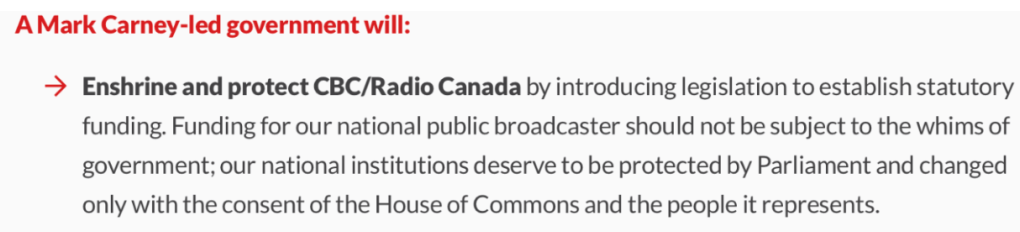

But the government did not go further up the ladder and even failed to renew the $42M in CBC funding that the Trudeau administration introduced in 2024 as a response to the broadcaster’s plan to lay off hundreds of employees, a reduction not mentioned in its campaign document. Once Budget 2026 passes, the Parliamentary grant will be approximately $1.53 billion to cover an expanded mandate, especially more local news. That’s a 16% increase in real dollars, post-inflation, since the Trudeau Liberals were elected in 2015.
The CBC employs about a third of Canada’s 11,000 professional journalists and editorial staff.
Meanwhile, federal CanCon funding for entertainment video, music and books remains unclear.
In February, Ottawa announced a $68M cut to its $203M (in 2025/26) annual federal contribution to the Canada Media Fund. The CMF juices private and public investment in Canadian dramas, documentaries and kids’ television programming. It is co-funded with Canadian cable TV companies and it was poised—until the Carney government struck down the CRTC’s ruling last June— to get funding from Netflix and the other Californian streaming services.
It’s almost certain that minister Miller intends to give the CMF a healthy slice of the previously announced $600 million in new funding, a make good for the Prime Minister’s regulatory relief for Netflix et al. Budget 2026 did not provide any itemization of the $600M or a timetable for further announcements.
Canadian books were front of mind in Budget 2026. A national online lending library of Canadian literature is in the works at the cost of about $9 million annually to cover copyright fees for publishers and authors. As for the Canada Book Fund —which supplements Canada Council grants to underwrite Canadian-authored books— the projected $3.4 million cut to its $40M budget appears to have been replaced with a $5M increase to its annual budget.
The $16M cut to the federal government’s $40M contribution to the Canada Music Fund —-supporting Canadian musicians’ production and touring expenses— previously announced in February 2026 was cancelled when Budget 2025 received Royal Assent the following month, extending the $16M in funding for three more years.
Aside from these existing programs, the Finance minister announced an attention-grabbing budget line item: a personal income tax break for an as yet unidentified cohort of Canadian creative artists.
Dubbed the Canada Creative Credit, but perhaps better described as the starving artists’ tax deduction, the program will raise the effective threshold for tax free income combined with the Basic Personal Amount “up to $45,000 of annual qualifying net business income derived from original and creative artistic works.” The tax saving might be as much as $4,000 for each artist. The Finance minister did not offer a price tag for the tax expenditure.
The special tax status for artists is similar to programs in Ireland, France and the province of Québec.
The Liberals did not campaign on this item in 2025 and no public consultation was held so the shape of the program is unclear. Details were promised for the spring of 2027. One thing to watch is whether the program will apply to the growing ranks of YouTubers and online influencers who create original content and what kind of media content is contemplated. Freelance writers and photographers are another potential category of creators. The income tax relief was one of several policy proposals put forward by Richard Stursberg for Canadian book publishing in his recent book Lament for a Literature.
Caveat emptor readers, I expect I have will have some corrections or revisions to this post. The ministry of Finance did not respond by my deadline to a series of requested clarifications.
***
One of the big things left hanging by Budget 2026 is how and when the $600M in promised cultural funding, linked by minister Miller to cancelling streamer levies, will be allocated. Budget 2026 only made reference to a single year of this special funding although Miller has told reporters it is intended to be permanent.
In any event, two weeks ago I listed the top items on the Carney government’s To Do list for media funding. Here’s a reminder:
- The federal budget clarifies when and how the $600 million in cultural spending is to be allocated.
That includes the fate of the apparent spending cuts for the CBC, the Canada Media Fund, the Canada Book Fund, Canada Music Fund, Canadian Periodical Fund, and the French language TV5.- The government is then cleared to publish its policy direction to the CRTC on what it wants to see in terms of streamer contributions to Canadian content. The CRTC will have to decide whether to hold another round of lengthy public hearings and written submissions or to cut to the chase and simply rewrite the rulings that the Carney government appears to have vacated.
- The government will also have the opportunity to publish its revised policy governing the structure and mandate of federal video production tax credits, the Canada Media Fund, Telefilm, and the National Film Board.
***
In late October I told you about Meta’s latest content grab where it claimed the right to ingest the full editorial archive of any news organization using its AI products, even if the content was not posted to Meta platforms.
CEO Mark Zuckerberg has now backed down, at least temporarily, by announcing a “pause” on its unilateral change to terms and conditions for business accounts.
***
If you would like regular notifications of future posts from MediaPolicy.ca you can follow this site by signing up under the Follow button in the bottom right corner of the home page;
or sign up for a free subscription to MediaPolicy.ca on Substack;
or follow @howardalaw on X or Howard Law on LinkedIn.
I can be reached by e-mail at howard.law@bell.net.
This post is copyrighted by Howard Law, all rights reserved. 2026.


