Catching up on MediaPolicy – Québec’s Netflix-Spotify bill is in play – social media ban for teens – hostile bid for Warner Bros and CNN – OpenAI’s Disney video app

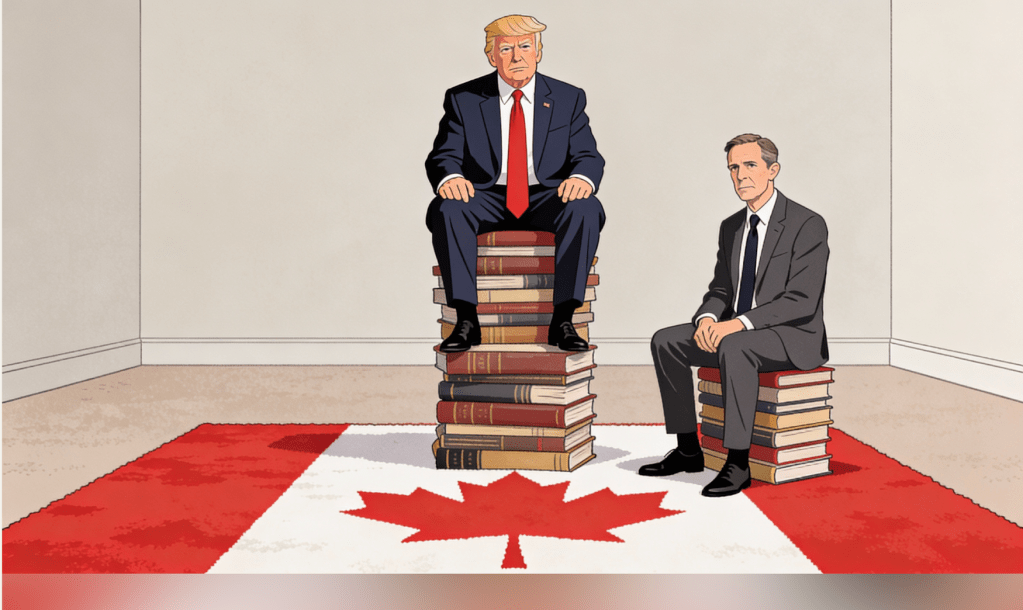
AI generated image from OpenAI

December 13, 2025


This week the Québec National Assembly unanimously passed Bill 109, its version of the federal Bill C-11, the Online Streaming Act.

MediaPolicy has been following this file since the CAQ government commissioned a blue-ribbon committee to recommend how to reverse the low availability and consumption of French language content on global streaming platforms. In reverse chronological order, you can update yourself on this story here, here, here and here.

The CAQ bill is a policy response to the federal cabinet’s and the CRTC’s hesitancy to implement the “content discoverability” provisions of the federal bill as written by Parliament.

The political consensus in Québec on regulating audio-visual and audio content to protect culture and language meant that Bill 109 didn’t spark the controversy that the federal Bill C-11 did two years ago.

But the tinder is dry and the sparks will fly. 

The US Trade Representative will add Bill 109 to its list of American grievances over Canada regulating Hollywood streamers and Big Tech, to be tabled in CUSMA negotiations this spring. (When coincidentally the 2026 Québec election might be called).

So too there must inevitably be an impasse between the Mark Carney government and Québec over legislative jurisdiction. Though brief by comparison, Bill 109 is almost a carbon copy of Bill C-11. Until the Supreme Court says otherwise, Ottawa has exclusive jurisdiction over online broadcasting. 

Québec’s culture minister Mathieu Lacombe has been pretending there’s nothing jurisdictional to talk about with Ottawa. According to the minister, there’s no conflict, only concurrent federal and provincial powers to do the same thing. Good luck with that. A caveat: he might have a provincial claim to the regulation of home screens on Smart TVs and streaming devices. 

The Québec law is founded on a provincially claimed right to cultural discoveryprops to that boldness. Importantly, all of the bill’s cultural measures are focussed on French language content, not Canadian French language content, so the political framing is more linguistic than cultural.

Mess with this if you dare, Ottawa.

From here, things will move slowly at first.

Québec will establish the minister’s Discoverability Office and begin drafting streamer requirements for French language content.

The CAQ’s Lacombe will find out if the streamers are willing to take up his offer to negotiate bespoke agreements in order to avoid cookie cutter regulations set by the province.

On video streaming, he will no doubt benchmark his regulations or voluntary agreements with streamers against the outcomes reached in France since 2021.

Despite a framework EU law that proposes a 30% catalogue minimum (numbers of shows), the French implementation of that policy focusses instead on production investments in French language content, based on a range of 20% to 25% of a streamer’s national operating revenues. So far, the result has been bigger budgets rather than a proliferation of mid-budget shows.

On other hand Lacombe could just stick with catalogue quotas, as the CRTC is expected to announce its own federal expenditure quotas soon.

As the Québec legislation doesn’t require the cash contributions to Canadian media funds that the streamers hate so much in the federal scheme, a deal with Netflix focussing on French language video catalogues doesn’t seem out of the question.

A deal with Spotify to do something dramatic to increase rock bottom consumption of French language music would be tougher. 

Unless Lacombe’s process moves at lightning speed, CUSMA talks and the Québec election will intervene.

***

If you don’t have school age kids, you might have missed the seismic Big Tech event that just shook Australia: its government has banned social media accounts for children under age 16.

Social media companies are expected to rely on age estimation technology but also photo ID.

The Australian communications minister Anika Wells is the first politician in a liberal democracy to tell social media companies, “time’s up.” Apparently so, even Elon Musk says he will obey the law.

There’s a brief explainer in the New York Times on how harmful social media can be for teens and how we got to the point that Big Tech’s safety half-measures have worn out the patience of legislators. 

Still, a ban. Wow. As our federal justice minister Sean Fraser eyes a revised online harms bill, what would be interesting is an opinion poll on a ban, taken from Canadian parents of tweeners and teenagers, parsed out separately for age and gender of the children. 

***

In last weekend’s post, I speculated that Donald Trump would have some fun with the $87 billion USD Netflix-Warner Brothers merger deal, given his donor ties to the losing bidder, Paramount. 

The next business day after Netflix officially announced its winning bid, and media analysts had their say on the prospects for Netflix obtaining the Trump administration’s anti-trust vetting, Paramount unveiled its Plan B: a $108 billion hostile takeover bid for all of Warner Brothers Discovery properties.

Warner Brothers has a week to respond but Paramount CEO David Ellison has already signalled an improved second bid is ready to go.

Among Paramount’s financial backers are the CEO’s dad and second richest man in the world, Larry Ellison, and various gulf state sovereign wealth funds. Oh, and President Trump’s son-in-law Jared Kushner.

The Ellison-Gulf-Kushner bid includes Warner Brothers’ television entertainment channels and the cable news network CNN. 

Ellison-the-younger’s Paramount recently bought the CBS news network and appointed the Free Press’ Bari Weiss as CEO. Pa Ellison is also the key investor in the bid to buy TikTok’s US operations. 

***

A significant AI content licensing deal has been struck between the IP-rich Disney and OpenAI, the developers of Chat GPT and the video-creation app Sora. 

The deal will allow Sora subscribers to create videos with Disney’s classic animated film characters. Imagine making a birthday video card for your kids featuring them with their preferred cuddly creature or action hero.

As reported by The New York Times: “Sora users will be able to make videos with more than 200 characters from Disney’s library, including from “Encanto,” “Frozen,” “Moana,” “Toy Story,” “Zootopia,” “Inside Out” and other animated movies. Animated or illustrated versions of Marvel characters like Deadpool, Iron Man and Black Panther will also be available, along with “Star Wars” characters like Darth Vader and Princess Leia.”

Given all of the chatter about AI companies scraping copyrighted content, the Disney-OpenAI deal will set expectations that licensing deals are the way for Big Tech to make peace with content producers, especially the biggest ones. (Oddly the reporting on the deal noted Disney’s $1B USD investment in OpenAI but was mum on the value of licensing payments that Disney can expect).

The Hollywood Reporter has a good analysis of the deal, the gist of which is Disney isn’t going to rest on its IP laurels while other content companies get rich on AI monetization.

More broadly, the slow drip of licensing deals between AI and content companies might, in the news journalism space, begins to look like the years leading up to Australia’s NewsMedia bargaining code and the Canadian Online News Act: AI companies cherry pick the biggest and most popular news outlets for licensing deals while those left behind look to governments for action on content scraping and monetization. 

***

If you would like regular notifications of future posts from MediaPolicy.ca you can follow this site by signing up under the Follow button in the bottom right corner of the home page; 

or sign up for a free subscription to MediaPolicy.ca on Substack;

or follow 
@howardalaw on X or Howard Law on LinkedIn.

COMMENTS ARE WELCOME. But be advised they are public once I hit the “approve” button, so mark them private if you don’t want them approved. 

I can be reached by e-mail at howard.law@bell.net.

This blog post is copyrighted by Howard Law, all rights reserved. 2025.


Catching up on MediaPolicy – Netflix is Rex – Miller is minister – CRTC vets Meta’s news ban

AI image

December 7, 2025

This week’s blockbuster news is that Netflix edged out Paramount to buy Warner Brothers for $82 USD billion. The deal immediately depleted the supply of adjectives at the disposal of media analysts. 

If the deal closes as scheduled in late 2026, Netflix buys up the world’s biggest movie archive and keeps it out of the hands of a major rival with the second biggest (Netflix is number three).

Netflix is paying a heavy price tag and arguably overpaid (you know who pays for inflated merger valuations, it’s subscribers and workers). Netflix goes from its status as the streaming industry’s 900-pound gorilla to, I dunno, T-Rex stature?

The public commentary on the deal is mostly doomsaying. 

It speeds up the chiselling of the tombstone for the theatrical release industry.

In a press release, Netflix CEO Ted Sarandos said shareholder value would flow from adding HBO and the full Warner Brothers archive to the Netflix “best in class streaming service:” his pro forma commitment to theatre release was relegated to a subordinate sentence clause.

But if the merciless dispatch of theatrical-release seems inevitable, and just the law of the marketplace jungle, what is of long term concern is the anti-competitive effect on the pipeline of big-budget premium video entertainment. The Globe & Mail’s Barry Hertz has a good analysis here.

The Netflix deal is a prime candidate for anti-trust review by the Trump administration (especially as Netflix outbid Friend-of-Trump Paramount). 

That review could go in any direction but things to watch for include (a) Trump reviving his threat to levy tariffs on foreign movies and the offshore shooting of Hollywood blockbusters, and/or (b) using the anti-trust hammer to get something that he personally wants, which could be commitments to US-based production or some vanity trophy we can’t imagine right now.

It’s not that Sarandos can’t see that coming. In his press release he said the acquisition would allow Netflix to expand its US based production, a gimme that doesn’t commit him to a rate of new releases equal to “Netflix plus Warner Brothers” but only “Netflix plus a dollar.”

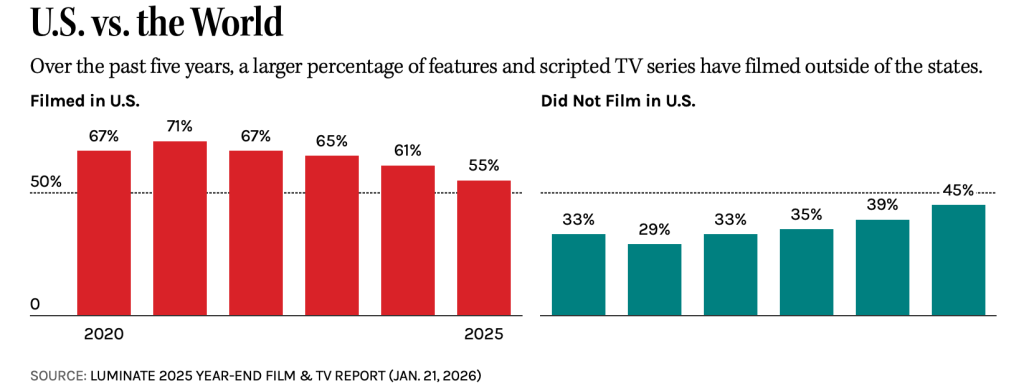
Any Trump-driven re-shoring of studio production could hurt the two offshore leaders of Hollywood production, the UK and Canada (and hurt Hollywood too, but that’s a longer discussion).

Beyond that, the effect on Canadian-owned broadcasting could be massive. Netflix is buying Warner Brothers’ Home Box Office streaming service and catalogue which may or may not be integrated into the Netflix platform, once subscription pricing is figured out. The press release suggests HBO content will be on the Netflix platform, at least in the US. 

Here in Canada, there is no HBO streaming service and Bell Media holds the exclusive license to distribute HBO on the only Canadian streaming service of consequence, Crave TV.

You would have to question whether Netflix has any interest in continuing that Canadian licensing arrangement when it expires and, in fact, Netflix has an excellent opportunity to severely wound its only Canadian-owned competitor.

Without that profitable HBO content, Bell’s ability to keep funding Canadian content takes a big hit. 

***

Canada has a new Heritage minister, Marc Miller.

That’s the fallout from Steven Guilbeault’s cabinet resignation over Prime Minister Mark Carney scrapping the Trudeau/Guilbeault policies on oil production, emissions, pipelines, oil tankers and clean energy regulations.

Miller continues a long tradition of the Liberals appointing an MP from the island of Montréal to the Heritage portfolio.

But of course Miller is the first anglophone the Libs have picked for that job since Hamilton’s Shiela Copps —-who was born ready to butt heads with the US on cultural sovereignty. She did the job from 1996 to 2003 under Prime Minister Jean Chrétien. 

The feisty Miller is prone to speaking with candour, as a rule. That’s already got him into a spat with CAQ premier François Legault who didn’t like Miller insisting on making a distinction between “the decline” and “fragility” of the French language in Canada and Québec. The Bloc dutifully piled on.

Guilbeault was the federal champion of Canadian and French language content in Québec and as the new Heritage minister no less will be expected of Miller. His life will get very interesting in about six months when CUSMA negotiations begin.

Will Miller become the political reincarnation of Shiela Copps? It’s up to Mark Carney, just as it was up to Jean Chrétien.

***

It looks like the CRTC’s investigation into whether Meta is selectively enforcing its made-in-Canada ban on news content has come an end. The CRTC’s brief discharge letter to Meta was published last week.

You can still find news items on Facebook and Instagram in Canada, despite Meta’s avowal that it banned news to take itself outside of the scope of the compulsory licensing of “news content” in the Online News Act.

Meta must have satisfied the Commission staff that it is sticking to its ban by taking down news items posted by Canadian users and by deleting user screenshots of articles. If you want to know how the Commission reached its conclusion, you won’t find it in the letter. 

What remains unresolved, or perhaps resolved only to the Commission’s private satisfaction, is Meta permitting posts from news outlets like Narcity and The Peak who successfully applied to Meta for what they describe as “exemptions” from the news content ban.

Without more transparency, one can only guess if Meta’s exemption of hand picked news outlets violates the statutory prohibition against digital platforms discriminating for or against selected news outlets. 

In the case of Narcity, its publisher claimed that Meta granted an exemption because Narcity was refused certification for federal journalism labour tax credits on the grounds that it doesn’t publish enough original news on current affairs. 

But certification for federal subsidies program doesn’t mean that a news outlet isn’t producing some news content, or pieces of news content, as defined by the Online News Act, which Meta says its banning to avoid paying for it. 

The Peak also recently announced that Meta gave it “an exemption” and I invite you to have a look at the news articles it’s allowed to post on Facebook and Instagram.

If you go looking, keep in mind that the “news content” that Meta is supposed to be banning in order to escape the gravitational pull of the Act includes “any portion” of news content. 

The Commission’s original inquiry into the news ban appears to have been its own idea, so the fact that it hasn’t published its reasons at any length is not a total surprise. No Canadian news organization has filed a complaint. 

***

If you would like regular notifications of future posts from MediaPolicy.ca you can follow this site by signing up under the Follow button in the bottom right corner of the home page; 

or sign up for a free subscription to MediaPolicy.ca on Substack;

or follow @howardalaw on X or Howard Law on LinkedIn.

COMMENTS ARE WELCOME. But be advised they are public once I hit the “approve” button, so mark them private if you don’t want them approved. 

I can be reached by e-mail at howard.law@bell.net.

This blog post is copyrighted by Howard Law, all rights reserved. 2025.

Catching Up on MediaPolicy – Ranting about CanCon – Danish news subsidies – Meta lobbies Feds on age verification – the NFB’s gripping sailing documentary

November 29, 2025

I’ve fallen behind on catching you up on media policy news because I felt compelled to write a series of three posts commenting on the CRTC’s ruling on Canadian content. The last one, the rant I promised, was published this week in Cartt.ca.

While I was ranting, one of the things I let slide was telling you about a new report out of Denmark proposing to refashion its policy design for government aid to news journalism.

The Danes are serious about news subsidies: they spend 540 million krone ($120M CDN) every year on private media in nation of six million people (Canada spends about $200 million in country of 42 million).

According to the Reuters Oxford Digital News Report, Denmark’s “public trust in media” score is 56% and it ranks sixth out of 180 in the Reporters Without Borderspress freedom index at 86.93. By comparison, Canada’s trust score is 39% with a press freedom index of 78.5, 21st in the world.

The Danes also have something we don’t: a 2018 Media Liability law that established an independent national press council and conferred the force of law on editorial independence from ownership. 

The Danish subsidy report was commissioned by government and written by a committee led by Rasmus Nielsen, the former chief of the Reuters Institute for the Study of Journalism.

Despite the ocean separating us, there are strong parallels between the Danish system of news subsidy and Canada’s jigsaw of federal programs: we have the QCJO subsidy of journalist salaries, the Local Journalism Initiative that funds 700 full time reporters in under-serviced regions across the country, and the Canadian Periodical Fund which supports editorial expenditures by community weeklies. 

The untranslated 144-page Danish report covers a lot of ground, but Nielsen’s own English language summary of it captures the essence: a weighted emphasis on supporting news outlets that are regional, local or “independent” (owners of single-titles) rather than mere incumbency as a news organization. 

***

The Senate deliberations of Senatrice Julie Miville-Dechêne’s Bill S-209, that would require age verification for online pornography is on hold until February while the Senate justice committee deals with other matters.

During the pause, the Canadian Press reports that Meta has joined the fray by lobbying the federal Liberals to step in with their own bill that would shift the age verification responsibility from pornography websites and social media platforms to app stores.

Meta obviously doesn’t run an App Store, as do Google and Apple, and the latter two Big Tech companies are cheesed about what Meta is up to.

Meanwhile, Canadian children continue to be exposed to online pornography featuring choking and slapping. The CP story is well done and informative.

Meta is having a good month of course. It won the anti-trust trial brought by the US Justice Department that claimed Meta was running a monopoly in personal social networking. In the interim five year period between filing and judgment, TikTok greatly improved its market share.

Matt Stoller has a very good analysis of the lawsuit, the trial, the judge, and why he thinks Big Tech will never be slowed down by anti-trust litigation: he says it takes public policy and legislatures to change things.

A test of his theory may happen soon: the trial judge in the Google Ad Tech case will be handing down her decision on whether to dismantle that illegal monopoly in the new year.

Meanwhile a consortium of US school boards just filed a new lawsuit against Meta and several other Tech companies.

Their allegation against Meta in particular is that company documents reveal CEO Mark Zuckerberg squelched evidence of harm to teenage girls while Meta designed lax safety features, including ineffective measures to expel sex traffickers from the platform. Of course, the allegations must be proven in court, probably over several years.

This does raise the question of whether Americans (and Canadians) should count on US courts to adjudicate Big Tech’s excesses by giving full due process and demanding conclusive evidence of the allegations, or whether governments should just cut to the chase, stop litigating whether the harms to kids persist, and legislate a solution.

In related stories, Australia’s social media ban on under 16s comes into force in December. The EU Parliament just passed a non-binding resolution to do the same.

***

The National Film Board’s website is recommending “Ghosts of the Sea,” a riveting documentary about the ill-fated Norwegian father-and-son sailors, Peter and Thomas Tangvald.

The filmmaker is Thomas’ half sister Virginia, who settled in her mother’s hometown of Montreal. The father Peter was married seven times and two of his wives died at sea.

I’ll say this: the film offers a visceral take on “intergenerational trauma.”

I think you will enjoy the one hour and 37 minute film and I absolutely guarantee you’ll have strong opinions afterwards. 

***

If you would like regular notifications of future posts from MediaPolicy.ca you can follow this site by signing up under the Follow button in the bottom right corner of the home page; 

or sign up for a free subscription to MediaPolicy.ca on Substack;

or follow @howardalaw on X or Howard Law on LinkedIn.

I can be reached by e-mail at howard.law@bell.net.

This blog post is copyrighted by Howard Law, all rights reserved. 2025.

The CRTC’s ruling on television copyright: for a branch-plant CanCon economy

November 27, 2025

In October 2022 Netflix was appearing at the Senate committee reviewing the proposed Bill C-11, the Online Streaming Act, when the Conservative senator Fabian Manning pitched a softball question: what was the Hollywood giant’s “main priority” in amending a bill it didn’t welcome?

The Canadian spokesperson for the streamer was succinct in his answer: “If I had to choose just one, it would be the issue of copyright ownership.”

Last week, Netflix got what it wanted

Continue reading at Cartt.ca…

What did the CRTC just do to CanCon?

November 22, 2025

Earlier this week the CRTC released a major ruling on Canadian content. MediaPolicy provided a quick bottom line reaction but you could do just as well with any of the many media reports.

More depth of analysis is called for but I’m going to do that over two posts.

Today I was going to go on a rant. But I will save that for the next post, because I think those interested in policy supporting Canadian television drama often find themselves in a situation not unlike a novice driver raising the hood of a car engine to gape at a maze of parts. An explainer might help, so here goes, with the opinionating to follow.

The important thing to get about the CanCon engine is that the interconnected parts include Canadian broadcasters, government agencies, Hollywood streamers and independent Canadian filmmakers who collectively follow CRTC regulations that put Canadian television dramas on a screen to be enjoyed by a Canadian audience whose dollars rarely cover the costs of those shows.

As a general rule CanCon is unprofitable in our modestly populated country. If we had a population of 340 million, we wouldn’t need a CanCon policy.

That’s why as a matter of Canadian cultural policy we offer production subsidies bankrolled by Canadian cable companies as well as federal and provincial governments. It’s the feds and the provinces that put up most of the money. 

At the heart of the CanCon engine are the “independent” Canadian TV and filmmakers—by law, independently-owned at arms length from Canadian broadcasters— who make Canadian drama and comedy and sell it to broadcasters and, coming soon, to Hollywood streamers too. 

As a matter of Canadian cultural policy it’s the Canadian producers, and only them, who get the subsidies that make up half of filming budgets (though eligible for these subsidies, the broadcasters rarely make their own dramas in-house). Federal policy aptly describes the independents as the vital cog in the broadcasting machine.

Living hand to mouth in relative anonymity, these modestly capitalized enterprises have been the creative force behind CanCon for decades, at least as important as the big broadcasters whom the public knows better. As far as television drama is concerned, the broadcasting engine runs on the content the independents make. 

Until now, we haven’t had a Hollywood-style system for making Canadian television dramas. No wannabe studio giants here. The Canadian independents are many and mostly small, moving from project to project, slowly building a sustainable business, locked into frenemy relationships with the Canadian broadcasters who buy their stuff.

But those Canadian broadcasters, big and small, are on their way down, if not out (watch this space). 

Netflix and the streamers are increasingly on top. The federal Liberals’ Online Streaming Act, Bill C-11, was the engine overhaul necessary if the ascendant streamers are to be recruited to finance and distribute Canadian drama, filling the growing void for that programming that results from Canadian broadcasters steadily losing cable subscribers and advertising revenue.

The streamers are not willing conscripts to the cause. Just ask them. They despise the mandatory cash contributions to Canadian media funds that subsidize television dramas and local news.

But making their own Canadian content might be something the streamers could live with. This recent CRTC ruling was about setting the conditions for that.

From their point of view, the streamers would like total freedom of action to make Canadian content on their own terms. Those terms include hiring the creative talent they want and dictating commercial terms to the independent Canadian production houses they engage to make the content. The CRTC is trying to bend to the streamers’ desires without the regulatory engine seizing up.

On hiring the top creative talent that drive a production, the CRTC has long sponsored the famous ten-point headcount that certifies dramas as CanCon, a certification that the broadcasters need in order to meet the CRTC’s quotas for CanCon spending. 

Until this week, that headcount system was straightforward enough. The idea is that in the long run Canadian talent will make Canadian content, without a need for a state-arbitrated test of “what is Canadian.”

The ten points recognize up to eight talent roles: Director (2 points), Screenwriter (2 points), first and second lead actors, cinematographer, art director, music composer and picture editor. 

If a production house hires enough Canadians to rack up at least six points, the CRTC certifies their program. In addition to the six-point talent, the CRTC requires the producer —the quarterback of the entire production who does the hiring and approves the scripts— to be a Canadian and demonstrably in charge of the creative team without interference from investors. As well, 75% of the set production and post-production payroll must be paid to Canadian workers.

There are equally compelling cultural arguments to leave this system alone, or to change it up. Last week, the CRTC changed it up, although much of it might seem mundane at first glance. 

There’s a new category of Showrunner (2 points), a recognition of the Hollywood practice of a putting a hybrid writer/producer in charge of a production. The screenwriter’s guild ain’t thrilled, but the CRTC is just adapting to reality. 

There’s an ecumenical nod towards giving points for hiring a Canadian behind-the-screen team of hair, make-up and costume designers. Collectively, a Canadian team can earn one point.

Ditto, the CRTC is now adding the special effects director to its approved list. 

In a move towards critics who believe that certification of Canadian content ought to be less about the nationality of talent and more about the Canadian narrative, look and feel of the story, the Commission is giving points for visibly Canadian locales, landscapes, and characters.

It’s also giving credit for dramas based on Canadian novels as well as soundtracks featuring a majority of previously recorded Canadian songs.

All of this Canadianography earns “bonus” points, shorthand for saying that a more effusively Canadian drama can be certified as CanCon with less Canadian talent.

This was an unexpected development, as the Commission’s preliminary view published last year was that it wasn’t going to do this. However the Commission cites the feedback from a public opinion poll it commissioned and interprets as supporting a popular desire for more classically Canadian stories. 

With a longer list of roles into which Canadian hires are credited towards CanCon certification, the Commission expanded the 10 point test to as much as a 14 point test, but made it scaleable (smaller productions might combine roles) up or down: so long as 60% of the roles are filled by Canadians, the spirit of the old six out of ten test is met.

But crucially the importance of Canadian directors, writers and actors has been diluted. This will please the Hollywood streamers who can be expected to tell the Canadian independent producers that if they want the commission they will hire more of the streamers’ key Hollywood people. 

There are however more seismic changes afoot and let me draw the connection between those big moves and the incremental amendments to the point system. 

First, the all-powerful producer who pilots the production, approves the script, and hires the six-point creative team might not have to be Canadian after all.

In this newest CRTC ruling, when Netflix commissions a CanCon project and insists upon taking a majority copyright position in the production, which it will do routinely, the lead producer can be an American so long as two of the three junior producers are Canadian. 

That brings us to the second big change: the Canadian ownership of copyright and intellectual property in a drama production.

This is a bit of long winded explanation but stick with me and follow the money.

Until now the Commission has never bothered with any rules regulating ownership of copyright in a production.

In the past the Commission didn’t need to impose Canadian ownership on the control of copyright in a CanCon program because all the financing partners were Canadian: the independent producer selling the show, the broadcaster commissioning the show, the federal and provincial governments providing the first layers of subsidy for the show and the public-private Canada Media Fund providing the second layer.

The Media Fund and Canadian governments that control the CanCon subsidies want to support the capitalization and long term viability of the independents. They insist that the independent producer —not its broadcast partner— must own 100% of the copyright and intellectual property flowing from the production. 

The Media Fund supercharges that by green-lighting its subsidy only if hiring of Canadians on a production is a full ten points out of ten. Since the Media Fund subsidy is crucial to CanCon financing, ten points becomes the norm even if the CRTC and federal subsidies only require six.

But since the CRTC has never been in charge of subsidies and is only concerned with getting Canadian content to broadcasting screens, its thinking was that one Canadian media business is as good as another, be it an independent producer or broadcaster.

Then we decided to regulate the US streamers. Oops, now the CRTC needs a copyright rule.

The new reality is that if the CRTC is going to require the streamers to spend money making CanCon, the streamers are going to want as much control of the return on their investment across Canada and a global audience as they can get. That return comes from domestic release, global release, long term residency in the Netflix library, control of spin-offs and sequels, trademark revenue, etc. 

That means three things are important: copyright, copyright and copyright. 

When Netflix appeared before Parliamentary committees considering Bill C-11, the Online Streaming Act, its Canadian policy director bluntly stated that the amendment Netflix wanted the most was copyright ownership of the CanCon it would be required to commission.

He then disarmingly claimed that the streamer wouldn’t necessarily want majority ownership of every CanCon production it commissioned ——even though it does exactly that when commissioning US shows that are shot in Canada. 

The Commission knew it had to find a balance between Netflix’s commercial interests and the viability of Canadian independents, the standard bearers for cultural production. The question was, where to strike the compromise?

Last week it struck that compromise by offering the streamers one of three options: 100% Canadian ownership of copyright, minority American ownership, and majority American ownership (to a maximum of 80%).

The first bucket of 100% Canadian ownership is status quo, allowing for the tweaks to the six-point rule. 

The minority US ownership bucket means that Netflix can choose a non-Canadian lead producer although technically the Canadian production house retains an equal share of creative control.

The majority US ownership bucket obviously means that Netflix effectively owns the show and the lion’s share of its success. The only price it must pay is to move up from six to eight points (or 80%) on hiring Canadians with the aid of Canadianography points, hairstylists, make up artists, etc.

Chart from Canadian Media Producers Association, circulated to its members

Nevertheless it’s important to mark this mental footnote: the new CRTC copyright rule does not apply to subsidies controlled by Canadian governments and the Canada Media Fund, at least for now. As mentioned above, those rules currently guarantee that the Canadian independent owns the copyright, in fact for 25 years. But the streamers can ignore those federal copyright rules if they forego the subsidies.

What does the CRTC copyright rule mean when it comes to making money on a show? 

“Copyright” is just the price of admission to commercial negotiations over profit sharing that is supposed to match investment to the return on that investment. Still, whomever controls the majority of copyright holds the hammer in negotiations over splitting profits and return on investment, often described as the long term commercial exploitation of intellectual property.

It’s perhaps unknowable how much extra muscle that gives the deep pocketed Netflix than it currently flexes as an equity investor in the occasional CanCon production (for example, CBC/APTN’s North of North). 

But copyright is an undeniably important part of leverage in commercial negotiation, which is why Netflix tried so hard but unsuccessfully to persuade Parliamentarians to guarantee streamer copyright interests in Bill C-11. 

Conversely, the Canadian independents wanted Parliament to guarantee full Canadian ownership. The final text of the bill genuflected support for the independents’ interests, but provided no guarantees, handing the difficult task of balancing interests to the CRTC.

Now that the CRTC has opened the door to the streamers’ majority ownership of copyright —expect them to rush through it at pace— the question is whether the CRTC will allow Netflix and Hollywood to dictate commercial terms to Canadian independents, treating them in effect as employees on wages set by the studios. 

The Commission is hardly unaware of the problem, addressing it in this crucial paragraph:

The Commission adopts the following guiding principles in negotiations among production partners: 

Fair compensation and exploitation: Ensure that remuneration, rights, and revenues are allocated in a way that fairly reflects the financial and human contributions to the production, while ensuring Canadian producers retain significant, equitable control and benefit from long-term exploitation. 

Good-faith negotiation: Production partners negotiate in good faith.

The Commission may assess the effectiveness of these non-binding principles in the future. (emphasis added).

In other words, Netflix be nice.

More on this in a further post.

***

If you would like regular notifications of future posts from MediaPolicy.ca you can follow this site by signing up under the Follow button in the bottom right corner of the home page; 

or sign up for a free subscription to MediaPolicy.ca on Substack;

or follow 
@howardalaw on X or Howard Law on LinkedIn.

I can be reached by e-mail at howard.law@bell.net.

This blog post is copyrighted by Howard Law, all rights reserved. 2025.

CRTC shakes up CanCon rules

November 18, 2025

The CRTC has released the first of a hugely consequential two-part ruling on video streaming and television.

The famous “10 point” headcount of key Canadian creative talent that is required before the CRTC will recognize a “Canadian program” as fulfilling a broadcaster’s CanCon budget gets a make-over.

The most significant changes are:

  • The “minimum six points” rule that requires Canadian directors and/or screenwriters and lead actors remains intact. But other key Canadian talent can be displaced for up to half of those six points if the screenplay is based on a Canadian fictional or non-fiction written work; the screenplay features Canadian characters or locations; or the soundtrack features previously recorded Canadian songs.
  • Netflix and the foreign streamers have been cleared to own majority copyright in a Canadian program acquired from a Canadian producer for distribution on their services. The ruling essentially allows streamers to buy that copyright by hiring Canadians in both Director and Screenwriter roles, either worth two points, to reach a minimum of eight instead of six points overall.

The CRTC did not previously have a Canadian copyright rule because it did not regulate non-Canadian broadcasters or streamers until now.

Nevertheless the CRTC’s new copyright rule is significant because it leaves a gap between CRTC policy governing a streamer’s CanCon expenditures and, on the other hand, federal government and media fund rules that gate keep supplemental subsidies for making CanCon.

Those subsidy rules, administered by Heritage Canada and the Canada Media Fund, maintain 100% Canadian copyright to support long-term economic opportunity for independent Canadian producers who typically make Canadian programs and sell them to broadcasters and streamers.

The Commission has stated that it expects the streamers to treat Canadian producers fairly when negotiating the economic opportunity flowing from shared copyright but has not stated if or how it will enforce that.

The second part of the Commission’s ruling, to be released “in the near future,” will “focus on the funding and support for Canadian programming, including funding for news and at-risk programming.”

That’s a reference to overall “Canadian programming expenditures” expected of the streamers, in addition to the 5% cash contributions already levied in favour of independent Canadian Media funds, as well as potential funding for public service media and local news.

More to come.

***

If you would like regular notifications of future posts from MediaPolicy.ca you can follow this site by signing up under the Follow button in the bottom right corner of the home page; 

or sign up for a free subscription to MediaPolicy.ca on Substack;

or follow 
@howardalaw on X or Howard Law on LinkedIn.

I can be reached by e-mail at howard.law@bell.net.

This blog post is copyrighted by Howard Law, all rights reserved. 2025.

Catching Up on MediaPolicy – The BBC lies the truth – Australia dips its toes into C-11 waters – Cohere fails to stop AI lawsuit

November 15, 2025

“I lie the truth,” American film director Oliver Stone once said of his controversial 1991 epic “JFK,” packed as it was with apocrypha and might-have-been speculation.

So did the BBC in its 2024 documentary on America’s insurrection day, January 6th, 2021, “Trump: A Second Chance?”

By now, most have heard about the BBC’s splicing of video clips that juxtaposed Donald Trump urging the crowd to march on the US Capitol with his later suggestion that they “fight like hell” against the Congressional confirmation of Joe Biden’s election victory. He made the “fight” comment 20 times during the speech, but the two comments in the edited clip were spoken 50 minutes apart. 

Omitted in the report was Trump’s suggestion they protest peacefully.

Also omitted was Trump telling the crowd that his Vice President Mike Pence must be stopped from certifying the election results, “We’re just not going to let that happen.”

As the crowd became a mob and surged violently into the Capitol building, some avowing to find Pence and murder him before he could certify, the outgoing President held back for two hours before making a public request to end the violent occupation.

The BBC rightly apologized to Trump for the video editing —-after a leaked document and public pressure made it impossible to do otherwise. The Beeb qualified its mea culpa by suggesting the President had not made a “direct call for violent action.” 

The broadcaster denied defamation but Trump is filing a lawsuit.

It didn’t take long for Canadian commentators to apply the moral of the story to our own public broadcaster, the CBC. 

The Hub’s Full Press podcast offers an intelligent review

Globe & Mail columnist Konrad Yakabuski did the same, writing about recent events in which CBC management’s handling of an ugly anti-Semitic on-air report from a Radio-Canada foreign correspondent remains in blow-over mode.

The fates of the suspended reporter and the unsuspended news host who ignored the remarks are still unclear.

CBC President Marie-Philippe Bouchard told a Parliamentary committee that the public broadcaster’s response ends at its full and immediate public apology, not an investigation into how deep such anti-Semitic views do or don’t run in the newsroom.

Best guess: the spotlight will return to this issue when the CBC Ombud makes a report. 

In the interest of equal time, let’s chalk another stroke on the wall to mark Opposition Leader Pierre Poilievre’s most recent swipe at the CBC when asked a question he would rather not answer (“aren’t you with the CBC?”). If we’re going to hold the CBC responsible for its public reputation, we should hold everyone accountable. 

***

For and CBC doubters and defunders, here’s an insightful and engaging Front Burner podcast featuring the public broadcaster’s three on-the-ground Washington correspondents, Canadians explaining to Canadians what Americans are doing to Canadians.

That’s what you lose without a CBC.

***

There’s a lot of media policy cooking in Australia lately.

A report in The Guardian says that the Labor government is going to move forward with incentives —-i.e. monetary penalties—- to lever Meta into reinstating news content on Facebook and Instagram and return to the bargaining table with news publishers to reinstate mandatory news licensing payments, regardless of Meta’s news ban. 

The idea is to set the fine for Meta’s non-compliance at a level just above the dollar value of its expired agreements with news publishers, something that The Guardian cites as 1.5% of Meta’s annual Australian revenues. The Labor legislation is targeted for 2026. 

If the Australians are baring more teeth than Canada has on our own Meta news ban, they are showing a little less on their new legislation that parallels Canada’s Netflix bill, the Online Streaming Act.

As MediaPolicy noted last week, the new legislation would set a spending quota for Netflix and the major streamers to make “AustralianCon” at either 10% of their local content budget or else 7.5% of their Australian revenues.

The 10% figure replicates the AuzCon spending that Australian-owned broadcasters obey for television dramas. By comparison, Canada requires our major domestic broadcasters spend 30% of revenues on Canadian content, including a 5% envelope for drama. 

Another interesting piece of Australian context is that the streamers’ voluntary spending on AuzCon is over $200 million annually, slightly in excess of the Labor government’s estimates of mandatory spending under the new bill.

A government backgrounder keeps reiterating that the mandatory spending it has in mind would be a “guaranteed” spending. The concern is that Netflix and other global streamers might scale back their Australian spending in response to Hollywood’s contraction of content spending.

As an unregulated English-language market, Australia would be a logical place to start cutting. Better to lock in current levels of streamer spending.

Meanwhile, CRTC watchers in Canada will be interested to learn that the Commission is releasing its ruling on video streaming this coming week.

The decision may order Netflix and the foreign streamers to spend more on Canadian programming. It may also change regulatory rules for Canadian broadcasters who have asked for fewer CanCon responsibilities.

New obligations for the streamers will be closely tied into what the CRTC has to say about the ownership of copyright and intellectual property in Canadian dramas that the streamers will have to buy to fulfill a quota for local content.

The Commission must decide whether to mirror federal rules for CanCon financing that make the payment of crucial television subsidies conditional upon a Canadian producer owning the long term copyright in a show.

The global streamers want the option to demand Canadian producers sell them the copyright if the streamers are going to be compelled by the Commission to spend on CanCon.

Another wild card in the deck is the yet to be released ruling from the Federal Court of Appeal on the Commission’s June 2024 down payment of regulatory obligations for the streamers.

Heard by the court in June 2025, the appellant video and audio streamers are challenging the CRTC’s assessment of an annual cash contribution of $200 million to various media funds that channel the money to the financing of Canadian programming and music.

***

There is an update in the Globe & Mail reporting on the US lawsuit against Cohere that alleges the Canadian owned AI company is ripping off copyrighted content, even behind paywalls, from major North American media companies including the Toronto Star.

A New York judge rejected Cohere’s preliminary argument that the plaintiffs’ news reporting is so puréed in the AI summary that there is no “copy” being made. The case will proceed to trial.

In Germany, a lower court ruled in favour of music companies who sued OpenAI on the grounds that its ChatGPT application violated copyright by scraping lyrics content.

***

If you would like regular notifications of future posts from MediaPolicy.ca you can follow this site by signing up under the Follow button in the bottom right corner of the home page; 

or sign up for a free subscription to MediaPolicy.ca on Substack;

or follow @howardalaw on X or Howard Law on LinkedIn.

I can be reached by e-mail at howard.law@bell.net.

This blog post is copyrighted by Howard Law, all rights reserved. 2025.


Catching Up on MediaPolicy – the new season of Stursberg’s CBC – the federal budget – Le Devoir’s Meta work around – Australia will regulate Netflix

Image by OpenAI

Are you not entertained? Richard Stursberg wants CBC audiences to say yes

November 8, 2025

This week MediaPolicy posted a guest column from Richard Stursberg, the former Vice President of CBC’s English language service, reflecting on the public broadcaster’s recently announced Five Year Plan

You won’t be sorry you spent five minutes with it. It’s a compelling read. Stursberg is one of the few commentators who puts as much emphasis on CBC’s entertainment programming as he does the news service.

Stursberg sets a simple performance bar for the CBC: is it good television? And then he offers a hypothetical new season(s) of great shows that could meet that standard and bring a real buzz to the CBC’s CanCon offerings, while satisfying our Canadian cultural cravings. 

The CBC just got its $150 million booster shot in the federal budget. That money fulfilled an election promise. The 11% increase to the $1.4 billion Parliamentary grant (70% of CBC’s overall $2 billion revenue) won’t necessarily go into a bigger budget for entertainment programming: the Five Year Plan prioritizes local and regional news reporting. But it does give the public broadcaster more options. 

The CBC’s new money was the Carney government’s sole increase to cultural funding in this week’s budget. Culture and Identity minister Steven Guilbeault told the Globe and Mail that the public broadcaster had also been spared from the “15% savings” spending review announced by the government several months ago.

Budget announcements for the Canada Media Fund, the Canada Music Fund, TV5MondePlus, Telefilm, the National Film Board and Special Measures for Journalism (community weeklies) are all multi-year extensions of supplemental funding previously put in place by the Justin Trudeau government.

On the other hand, the budget document includes projected cuts to Canadian Heritage expenditures which might be either civil servant salaries or “recalibrated” program spending. Guilbeault pointed out to the Globe that the $93 million savings figure was 5%, not 15% of expenditures.

The numbers on recalibrated programs might include the scheduled reduction of the federal labour tax credit from 35% to 25% of journalist salaries on January 1, 2027. As well, Guilbeault told the Globe the government was exploring a merger of the Canada Media Fund, Telefilm and the National Film Board.

The budget document included a brief note that changes are in the works for the Canadian Periodical Fund that subsidizes weeklies and magazines (the government only told me that the details would be communicated at a later date).

The status quo on cultural funding shouldn’t be surprising, given other priorities in 2025.

Still, TV and radio news outlets were miffed that the government didn’t end its arbitrary exclusion of broadcasting companies from accessing federal aid for their online news websites that —-but for the television and radio properties operated by their parent companies—- would be eligible for the $75 million pool of journalist salary subsidy available to all online news outlets. 

***

There’s a useful explainer posted in Paula Clark’s Substack about the Blacklock’s Reporter litigation with the federal government over Parks Canada’s sharing of a paywall password obtained from an individual subscription, giving unlimited access to every article in the Reporter’s database. 

The watchdog news website was in court last month, appealing a controversial trial ruling in favour of the government which appeared to bless the government’s actions and give short shrift to copyright protection. 

Among the many legal frailties of the trial judge’s decision is that it appears to expand the public right of “fair use” sharing of quotations or text snippets to authorize redistribution of full articles and, thanks to the password sharing, Blacklock’s entire news archive.

It’s a legally complicated appeal, which is why’s Clark’s piece is helpful. 

***

As you know, in 2023 Meta responded to Parliament passing the Online News Act by banning most news content from Facebook and Instagram in Canada (a news outlet can pay Meta to post content as an advertisement).

The ban hit the many Canadian news outlets relying heavily upon Meta platforms for content distribution. While the news blackout probably impacted free sites harder, paywalled sites were affected too.

The marketing director at Le Devoir is claiming a measurable success in making up for the lost distribution by working a lot harder at its direct engagement with readers, especially demonstrating the value of content to new subscribers.

Meta hasn’t entirely given up on Canadian news journalism of course. Just last week The Hub published a well argued commentary advocating against the federal government pursuing a digital sovereignty strategy. Meta sponsored the article.

***

The Australian government has moved the yardsticks on implementing something like Canada’s Online Streaming Act for Netflix and the other foreign video streamers, a move it has been mulling over since early 2023.

The legislation hasn’t been tabled with details yet, but the announcement suggests the streamers will have to spend 7.5% of their Australian revenues on local entertainment programming. Australian-owned television companies are already required to meet spending quotas for local content and they see the new law as a measure to “level the playing field.” 

The news coverage of the announcement is unclear as to the impact of the legislation, as Netflix already invests in video production shot in Australia. It may depend upon the definition of local Australian content.

Significantly for Canadian observers, Australia is not proposing that the foreign streamers make financial contributions to Australian programming through contributions to third party production funds. 

A report by the Australian Broadcasting Corporation speculates on whether the announcement will provoke a reaction from the Trump administration.

***

If you have the twenty minutes, I recommend Natalia Antelava’s incendiary interview of Google’s Richard Gingras in Coda, just for sheer entertainment if not enlightenment. Gingras is Google’s former VP of News and is currently the board chair of Canada’s Village Media.

Antelava goes after Gingras for some of Google’s controversial decisions in foreign autocracies, like agreeing to Vladimir Putin’s demand to spike a voting app set up for the Russian 2021 elections by the dissident, Alexei Navalny, who later died, possibly poisoned, in a Putin prison.

However on the main interview topic of the power asymmetry between Google and the news industry, Gingras sticks to his story that Google’s relationship with publishers is collaborative, not exploitive, which requires him to engage in some grimace-inducing denialism about Google’s abuse of market power over news outlets in Search and digital advertising, both of which have been ruled illegal monopolies by US courts.

Another tidbit: Gingras claims that Google CEO Sundar Pichai was embarrassed by the now famous line-up of tech CEOs attending the Trump inauguration and suggests the photo op was “cleverly staged” by the White House.

“That’s the last photo Sundar ever wanted taken,” says Gingras. “We don’t support this administration.”

Only the ballroom.

Associated Press photo of Tech CEOs Zuckerberg, Bezos, Pichai and Musk.

***

If you would like regular notifications of future posts from MediaPolicy.ca you can follow this site by signing up under the Follow button in the bottom right corner of the home page; 

or sign up for a free subscription to MediaPolicy.ca on Substack;

or follow 
@howardalaw on X or Howard Law on LinkedIn.

I can be reached by e-mail at howard.law@bell.net.

This blog post is copyrighted by Howard Law, all rights reserved. 2025.

Are you not entertained? Richard Stursberg’s five year plan for the CBC

November 6, 2025

In October CBC President Marie-Philippe Bouchard unveiled her eagerly anticipated five year plan for the public broadcaster.

MediaPolicy commented on her map here and here. Months earlier, I also provided a platform for a number of guest columns or interviews with former CBC insiders and pundits who offered some broad brushed comments on how the CBC ought to reinvent itself, one of the nation’s great and never-ending dialogues.

One of those guest columns was from Richard Stursberg, the former CBC Vice President of English language programming, “welcome Ms.Bouchard, here’s some advice.”

Now that President Bouchard has weighed in, it’s the right time for another guest column from Stursberg, the author of The Tower of Babble: Sins, Secrets and Successes inside the CBC.

***

The CBC’s Five Year Plan

By Richard Stursberg

In 1965, Robert Fowler, the Chair of The Royal Commission on Broadcasting and The Advisory Committee on Broadcasting, noted in a much quoted observation that:

         “The only thing that really matters in broadcasting is program content; all the rest is housekeeping.”

He was, of course, quite right. The measure of a successful broadcaster is the quality and popularity of its shows. All the rest – technologies, personnel, locations, financing, studios and platforms – are housekeeping, there to support programming.

Recently, the new President of the CBC, Marie-Philippe Bouchard, announced her new five year plan for the corporation, her vision for its future. It is called: Here For Canada, 2025-2030 Strategy.

The plan begins by stating – correctly – that “the core purpose of the CBC (is) ‘to contribute to shared national consciousness and identity.’” She then goes on to discuss the audiences she will target and the housekeeping measures she will employ to get there.

Her focus, she says, will be on children and youth, who she acknowledges are largely lost to digital platforms, newcomers, and “non-users and dissatisfied users”. She is planning to focus CBC’s programming on those least likely to consume it. This seems a tough assignment.

She goes on to target small towns, the North and minority language communities. Canadians, however, mostly live in large cities. Almost 60% of the population lives in the ten largest urban areas that produce 75% of the country’s economic output. Her focus on the places where Canadians are least likely to live also feels like a tough assignment.

Having established her target populations, the President describes the housekeeping measures she will employ. She proposes to be “digitally agile”, to emphasise “partnerships”, to get “closer to communities”, to expand “FAST channels”, and to”increase investments in independent productions”, among other things. These are no doubt sensible things to do; they should receive The Good Housekeeping Seal of Approval.

There is, however, little or no discussion in the President’s plan of programming, “the only thing that really matters in broadcasting”. There is no indication of what kinds of shows will be financed over the next five years. There is nothing in the plan that describes the types of dramas, news, documentaries or comedies that will be produced. It provides no discussion of what Canadians can expect to see, hear or read on the CBC’s many platforms.

Mme. Bouchard is not alone in providing a plan that emphasises housekeeping. Almost all of her predecessors did the same thing. Despite Robert Fowler’s caution, they have produced strategies, plans and visions that decade after decade have been preoccupied with the nuts and bolts of broadcasting, and only rarely with its content.

What, then, might a real plan look like, one centred on programming and not housekeeping?

In producing one, it would be wise to start with Mme. Bouchard’s observation that the core purpose and mandate of the CBC is “to contribute to shared national consciousness and identity”. 

It must also recognise that – as the president makes clear – “social and political polarisation are on the rise, as are threats to national sovereignty”. Canada feels badly divided: the West is alienated; Quebec is flirting again with independence; indigenous people are rightly aggrieved; and the young feel deeply disadvantaged. At the same time, Canada is confronted with a belligerent and unpredictable neighbour to the south that threatens the very existence of the country. Whatever program plan is created, it must speak to the moment.

The programming must also stand out in what is a very crowded field. New, beautiful foreign shows are available everywhere There is more content than anyone can consume, and the sheer excess dictates that only the really original, dramatic, relevant and exciting will be watched, listened to or read. 

 By way of a simplistic formulation, let’s break shared national consciousness and identity into three key questions and see what kind of programming might speak to them. The questions are:

 1. The classic: Who are we?

 2. The obverse: Who are we not?

 3. The Northrop Frye: Where are we?

Here For Canada: 2025-2030: The Program Strategy

Who are we?

Twenty-five years ago, the CBC released Canada: A People’s History. Its narrative connected the different periods of our history into an overall account of Canada’s national identity. It was an enormous hit.

The CBC will produce three new histories.

– An Indigenous people’s history of Canada. The history of the conquered is invariably different from that of the conquerors. For Reconciliation to be achieved, it is essential that all Canadians understand what happened. It will be dramatic and revelatory.

 – A history of French Canada. The struggle to preserve French Canada’s language and culture is little known in English Canada. Understanding is the key to shared  consciousness.

 – A history of Western Canada. The emergence of a  Western identity is not well understood in the East; its grievances, triumphs and ambitions are often met with scorn. To create a national consciousness, its story needs to be told.

With these three new histories, the CBC will reclaim its position as the principal source of broad public debate about who we are and the events that formed us. The new histories will inevitably precipitate debate. While we will try to make them as factually accurate as possible, there will surely be controversy. We welcome it. Arguing together is how we find out who we are.

Who are we not?

The answer, of course, is not Americans. Canada has historically defined itself in opposition to the United States, now perhaps more than ever. But not wanting to be American is not the same as not wanting to understand them. In the current circumstances, with the ongoing trade war and threats of annexation, it is essential to understand deeply what is happening south of the border.

The CBC will explore Canada’s relationship to the United States through comedy, news, documentaries and drama.

It will resurrect its comic exploration of the States. A new version of Rick Mercer’s Talking to Americans will be produced, with a sparkling new host.

A new half hour situation comedy will also be commissioned about a Canadian family that has to move to the heart of MAGA-land. It will be similar to Schitt’s Creek, but funnier – if that is possible. Think of it as MAGA Creek.

The news department will expand its coverage of the Republican strongholds in the Red states. It is no longer possible to understand US politics and society with reporters only in LA, New York and Washington; Canadians also need to hear what people are thinking and doing in Florida, Texas, Alabama and Utah.

The CBC will initiate new documentary and current affairs coverage of the key sectors of the MAGA movement, providing in depth explorations of American gun culture, the manosphere, evangelical Christianity, and white nationalism. They will look not only at what is happening in the US, but how these movements overlap developments in Canada. Our coverage of the Americans will focus on how what happens there matters to us.

Finally, a major dramatic series is in development about the invasion of Canada by the US. It has happened twice before.This series is set in 2029 and features tense negotiations. Doomed lovers, drone warfare, blockades, split families cyber attacks, tragedy, excitement and victory – but for whom?

Where are we?

Many of the CBC’s most successful shows have criss-crossed the country, letting us know and laugh at ourselves. The Debaters and The Rick Mercer Report showed us who we are in all our variety. The new season will bring back travelling shows that explore the country’s music, sense of humour, accents and general weirdness in all our regional variety.

A big unscripted exploration is also planned, a sort of Survivors: The Winter. It will be short on swimsuits, but long on snowstorms, frozen lakes, treachery, huskies, snowmobiles, ice fishing and bad behaviour. Where are we if not in The Great White North?

The physical country has increasingly given way to a virtual one. Canadians live more and more online, in social media, through avatars and artificial intelligence, the CBC will explore our new digital environment through news, documentaries, drama and comedy.

The news department will assign journalists to the major platforms, as they are assigned now to major cities. They will be covered as distinct places with, like all places, their own characters, myths, values and events. Their reporting will be enhanced by documentaries on how these worlds are structured, how they treat their citizens, and what they mean for Canadians’ sense of their own identity.

The CBC has a number of dramedies in development that will explore what happens when people are stuck in and cannot escape their favourite social media platforms, how they respond to falling in love with an AI based lover, and what it means to give up normal life altogether for the pleasures of a purely digital one.

These new programs will supplement the great shows the Corporation already produces.

We will also update our flagships with a broader set of views and guests. The National will be modernised; and the News Network will search out a broader set of voices. We will invite Canadians to see not just politicians and “experts” but also the vast range of thought leaders throughout the country: the zany, the ignored, the keepers of secrets, the ideologically marginal and the hilarious.

The CBC will judge the success of its five year plan on how Canadians respond to our programming. We will measure our success not just in terms of audiences, but also the debates and controversies it engenders. Our hope is to be funny, wise, difficult, exciting and unforgettable. Our ambition is to be as charming, cantankerous, funny and well informed as the country itself.  

 This may not be the best program strategy for the CBC in 2025-2030. It may be too ambitious, too expensive, too hard to execute or simply wrong headed.  The point of it is not that it’s right but that it provides a point of departure to talk about what the CBC should be programming over the next five years. 

If not this approach, then what? After all, “The only thing that really matters in broadcasting is program content; all the rest is housekeeping”. 

***

If you would like regular notifications of future posts from MediaPolicy.ca you can follow this site by signing up under the Follow button in the bottom right corner of the home page; 

or sign up for a free subscription to MediaPolicy.ca on Substack;

or follow 
@howardalaw on X or Howard Law on LinkedIn.

I can be reached by e-mail at howard.law@bell.net.

This blog post is copyrighted by Howard Law, all rights reserved. 2025.

Letter to the Editor: there’s an alternative to S-209 choice of age verification

November 2, 2025

In response to the October 30, 2025 post from MediaPolicy.ca, I have some ideas on how Canada could proceed with accomplishing the objectives behind S-209, “An Act to restrict young persons’ online access to pornographic material”, while respecting user privacy and dramatically reducing the chances of a data breach.

Who am I? I’m a Java software developer with over 25 years of experience not only paid to write code, but participate design software solutions, assess requirements, work with product managers, and occasionally lead times. As part of our profession, we’re expected to proactively address potential security vulnerabilities, such as upgrading software libraries before they become outdated, and thus, more likely to be vulnerable.

Prologue:

First of all, I have no fundamental objections to restricting internet porn from minors via an age verification scheme that guarantees anonymity.

My issues with S-209 are how it captures many sites and services that are not primarily for porn, and how it risks violating user security and privacy, especially for those not seeking porn, by storing their age (and possibly identity) proofs on the internet, where they could be breached.

Maximizing Privacy and Limiting Data Breaches:

Any age verification scheme ought to maintain biometric data used as an input exclusively on the client device.

By client device I mean the phone, table, or PC used to access the internet, but on no server on the internet itself. In turn, this client-side software sends proof of the user’s age, in a way that can be authenticated as legitimate, to the site in question. This means no server on the internet would have the biometric data, such as a face scan or government ID.

This doesn’t eliminate risk, but since each piece of user-identifiable data is on one client device at a time, it means a far lesser incentive for bad actors to try to steal such data. That is, it’s far more work for far less benefit than targeting a single server.

Lower Compliance Costs for Sites Hosting Porn:

Any site that’s captured by this law would still have compliance costs, but would be much lower than what is currently proposed under S-209.

The client device vendors (Google, Apple, Samsung, etc) would be responsible for implementing this scheme. They’d be tasked with providing software for the sites in question, and those sites would simply have to install and configure this software in order to complete the verification process.

Blast radius of the law:

In addition, I propose there be clear guidelines for a site to opt out of being captured by this law.

Part of the controversy of S-210 and its current iteration S-209 is the number of sites captured by the statute. This would have included search engines and social media sites, which are light years away from primarily hosting porn but on which porn is hosted to a small degree.

In my opinion, the proposal to exempt search engines is insufficient, since many people including myself largely use AI instead of Google/Bing/DuckDuckGo searches. Also, social media has a whole series of non-porn uses. I believe the vast majority of AI and social media users are not interested in porn, at least, not while using those vehicles.

So what I propose is a way for any site, such as with news under the Online News Act Bill C-18, to opt out of this law by meeting guidelines to not expose porn at all to the users of those sites.

I admit to not having fully considered the mechanisms under which this would, but likely it would involve AI scanning for pornographic images and text. Obviously, it wouldn’t be 100% bulletproof, so sites would have to merely prove a good faith effort to accomplish this. Such sites could then offer premium versions, which would be captured by age verification mandates.

Furthermore, many computing devices are “headless” and quite simply can’t comply with an age verification scheme to access the internet. Among these devices are servers like NAS’s, which must access the internet for updates. There are also minitower PCs, which don’t come with cameras.

Final thoughts:

Many users have zero interest in porn, but are very adamant about accessing the internet anonymously, and are understandably wary of data breaches given the Discord experience in the UK.

Furthermore, many minors have a long list of legitimate reasons to access the internet, AI, and social media while having no interest in porn.

Why risk blocking non-porn seeking minors from accessing the internet, or make it harder for non-porn seeking adults to access the internet?

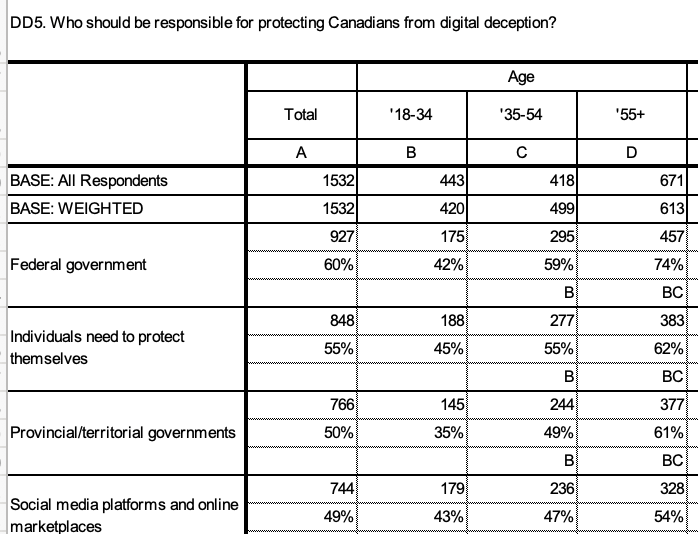
According to many polls, Canadians are wary of digital ID schemes. On the other hand, many are also rightfully concerned about minors accessing pornography.

The solutions to the stated objectors to the framers of S-209 is a client-based age authentication scheme that maintains biometrics and other age proofs on the client device, and off servers.

It also involves allowing any general site to make porn unavailable to the vast majority of its users and thus opt out of being captured by new porn-gating mandates.

Luke deGruchy, Cornwall, ON