The most casual observer of public opinion on Ottawa taking action against harmful online content will have long concluded, this ain’t no battle.
Canadians categorically support government action against online harms.
The leading policy proposals focus on harms to kids with the prescribed remedies of bans on youth accounts and regulatory take-down laws to shield tweens and teens from porn, self-harm content and predators.
The only roadblocks to federal action in Canada —and they should not be underestimated— are the potential for Trump-induced trade chaos and on the other hand the possibility that the Official Opposition will keep a Liberal online harms bill, once tabled, bottled up in Parliamentary committee.
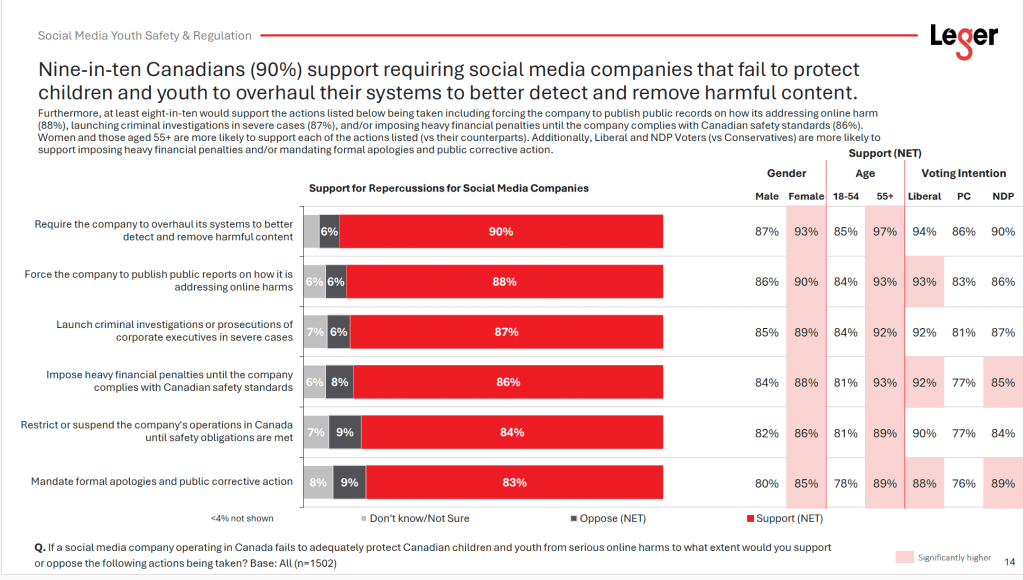
The poll shows extremely high levels of concern about addictive and otherwise harmful content, and similarly high support for regulation (90%) delivered by an independent regulator (79%). Significantly the support for regulating AI tools, in addition to social apps, is also strong (75%).
Broken down by the genre of harmful content, the Léger poll suggests Canadians are “veryconcerned” about fake news (76%), harms to kids (74%), incitement to violence (67%), and hate speech (66%). The responses by parents versus non-parents were not very different.
There is a high degree of support for core of online harms policy contemplated in the Liberals’ earlier draft of online harms Bill C-63, which is the legal expectation that platforms will design safer algorithms and content controls and effectively take legal responsibility for content.
Perhaps counterintuitively, polled support for mandatory safety controls prescribed by government ran at a much lower level of approval, a narrow majority. As well, 65% agreed with the statement that “parents, not government, should make decisions about their children’s social media or online activity.”
The Liberal vs Conservative disagreement over how to deliver enforcement of online safety —through a civil regulation scheme versus judges sitting in criminal courts— may be resolved in the Liberals’ favour: 76% of Canadians are good with federal regulation and even 61% of Conservative voters support it.
The poll didn’t solicit opinions on the wisdom of relying more heavily upon criminal charges, but demonstrated a high support (87%) for government launching criminal investigations and prosecutions of corporate executives in “severe cases” of online harm.
And in a final point of opinion punctuation, the Léger poll also demonstrated high public support for the general notion that some level of collateral damage to freedom of expression was acceptable.
While 85% agreed to the statement that “my right to freedom of expression be maintained,” the principle of “freedom of expression online should not come at the expense of other people’s safety” won the same 85% level of high support.
As for joining the budding global movement to ban youth accounts, the support for different age cut-offs ranged from 12 to 17: but only 3% supported no minimum age at all.
As for the scenario of the US President coming to the rescue of Big Tech platforms in some kind of trade-related intimidation of Canadian government, 53% supported the federal government going ahead anyway with another 27% saying “it depends on the situation.” Those figures were heavily skewed by political allegiances, with Conservative voters more likely to be doing the hedging.
If you would like regular notifications of future posts from MediaPolicy.ca you can follow this site by signing up under the Follow button in the bottom right corner of the home page;
or sign up for a free subscription to MediaPolicy.ca on Substack;
The travails of the CBC always beg comparisons to the British Broadcasting Corporation. Earlier this month, the BBC announced a formal partnership with YouTube that, if the BBC follows through over the long term, will make it a YouTube-first broadcaster.
So happy Valentine’s Day.
The BBC’s idea is to fish where the fish are, at least when it comes to the younger demographic whose media consumption leans very much into short-form video content on YouTube and social media apps.
The BBC says it’s going all in on micro-drama series and verticals (so called because video clips are shot in portrait mode, the better to consume on phones).
That means the Beeb will invest more heavily in developing its supply chain into the digital “creator community” of video artists and studios. It also plans to launch far more BBC YouTube channels built around popular genres and local communities and feed them with digital-first content.
The BBC isn’t completely reinventing itself. It’s going to keep using the YouTube platform as a marketing strategy to push audiences back to its main streaming services BBC iPlayer and BBC Sounds. It would be reckless to do otherwise lest it put the BBC’s audience growth entirely within the grasp of a big US tech company that controls the discoverability of content through its algorithms (I mean, what could go wrong?).
A recent report in Britain marked the occasion of YouTube overtaking the once-dominant BBC as the UK’s market leader in video consumption. The early commentary on the YouTube-BBC partnership has been a mix of optimism and dread, here’s one insightful view.
***
A big trial just started in Los Angeles where a 20-year old woman is suing YouTube and Meta’s Instagram for degrading her mental health by feeding her harmful content through addictive content algorithms.
The plaintiff KGM’s lawsuit is hardly frivolous: TikTok and Snap already settled to escape trial.
Her lawyer found his Johnny Cochran stride when he told the jury that his case was “easy as ABC…addicting the brains of children.”
The US maintains a Congressional exemption of Internet companies, especially social media apps, from liability for content uploaded by third parties (incidentally that litigation shield pops up in the digital chapter of the CUSMA trade agreement but Canadian courts have interpreted it narrowly). Given the exemption, KGM has to prove that YouTube and Meta are liable for creating addictive algorithms that push unhealthy content rather than paying a price for accepting the content in the first place.
The US is a more litigious society than we are and lawsuits don’t create legislation: KGM may claim damages but it’s highly unlikely she will force Big Tech to do anything differently.
***
I’m concluding this weekend’s post with something boring: weird publishing things happening with this blog.
Last weekend’s post included a three paragraph quote of the European Union’s regulatory indictment of TikTok for addictive algorithms pushing harmful content with inadequate safety features. Due to a WordPress software glitch, the e-mailed version to subscribers dropped out two of the paragraphs, which made for a strange narrative flow. If you found it jarring, you can go back and read the more fulsome EU statement.
The other oddity was an unprecedented two-day surge in MediaPolicy viewing in the US which puzzled me given the Canadian focus of MediaPolicy posts. It coincided with a MediaPolicy reader receiving a scam e-mail with an embedded link to MediaPolicy.ca (offering a marketing opportunity). The e-mail was associated with the digital marketing website Blogger Tuesday and I have nothing to do with it.
Please let me know if you received one.
***
If you would like regular notifications of future posts from MediaPolicy.ca you can follow this site by signing up under the Follow button in the bottom right corner of the home page;
or sign up for a free subscription to MediaPolicy.ca on Substack;
The European Commission has fired a shot across the bow of TikTok, and by implication other social media, by finding the social media giant culpable of addictive algorithm design and inadequate safety measures.
The Commission explained its preliminary ruling, which TikTok can either appeal or fix, as follows:
TikTok seems to fail to implement reasonable, proportionate and effective measures to mitigate risks stemming from its addictive design.
For example, the current measures on TikTok, particularly the screentime management tools and parental control tools, do not seem to effectively reduce the risks stemming from TikTok’s addictive design. The time management tools do not seem to be effective in enabling users to reduce and control their use of TikTok because they are easy to dismiss and introduce limited friction. Similarly, parental controls may not be effective because they require additional time and skills from parents to introduce the controls.
At this stage, the Commission considers that TikTok needs to change the basic design of its service. For instance, by disabling key addictive features such as ‘infinite scroll’ over time, implementing effective ‘screen time breaks’, including during the night, and adapting its recommender system.
The EU finding is made against the Chinese-owned app in the European market, not the American-owned TikTok across the Atlantic. But it will heat up the tension between the US and the EU over the regulation of online harms impacting US-owned apps operating in Europe.
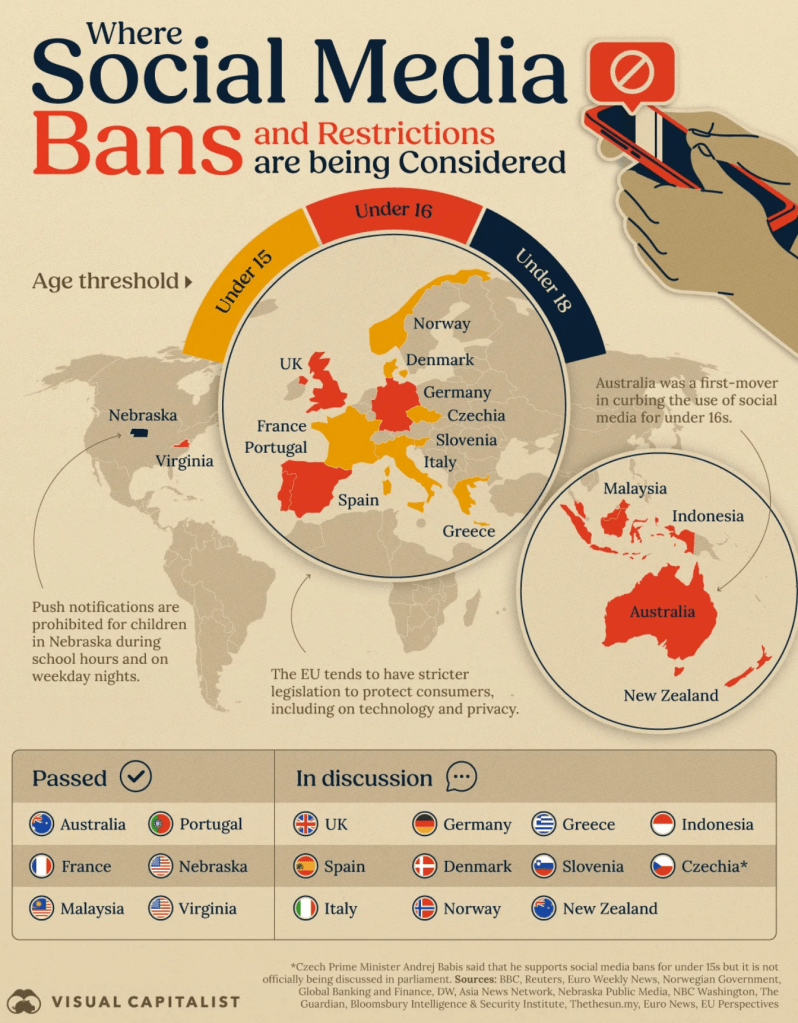
The momentum of regulatory intervention around the globe picked up more steam when Spain indicated its intention to follow Australia and France in banning underage social media accounts.
As for Canada, Heritage Minister Marc Miller isn’t saying yet if a ban on underage access is part of the online harms bill he is preparing.
Last Monday, the influential Taylor Owen and his McGill colleague Helen Hayes called for a moratorium on underage access to social media while online harms legislation gets tabled, works its way through Parliament, and gets implemented.
Judging from Canada’s last two pieces of media legislation, the Online Streaming Act and the Online News Act, the length of the entire process might be measured in years.
Last week Senatrice Julie Miville-Dechêne, the bill’s sponsor, obtained committee approval for a series of technical amendments as well as a change that defined porn more narrowly to get at “X-rated” content and scope out the nudity and implied sexual activity common in mainstream drama. The new definition requires the exhibition of explicit sexual activity and exposed genitalia for the purpose of sexual excitement.
As drafted, S-209 still leaves the decision on whether to scope in porn-permissive social media apps to the federal government, either in a House vote on the bill or afterwards.
***
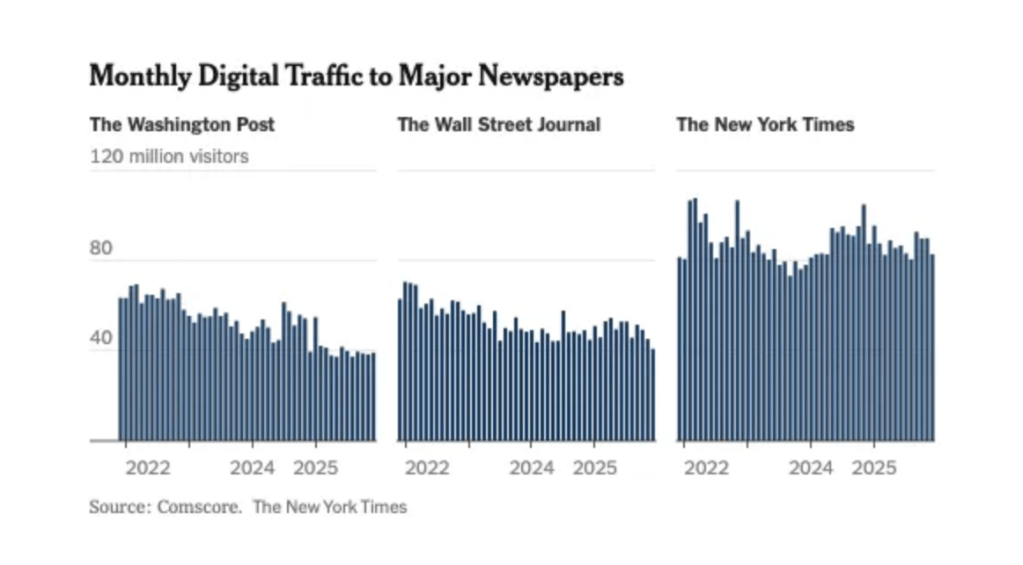
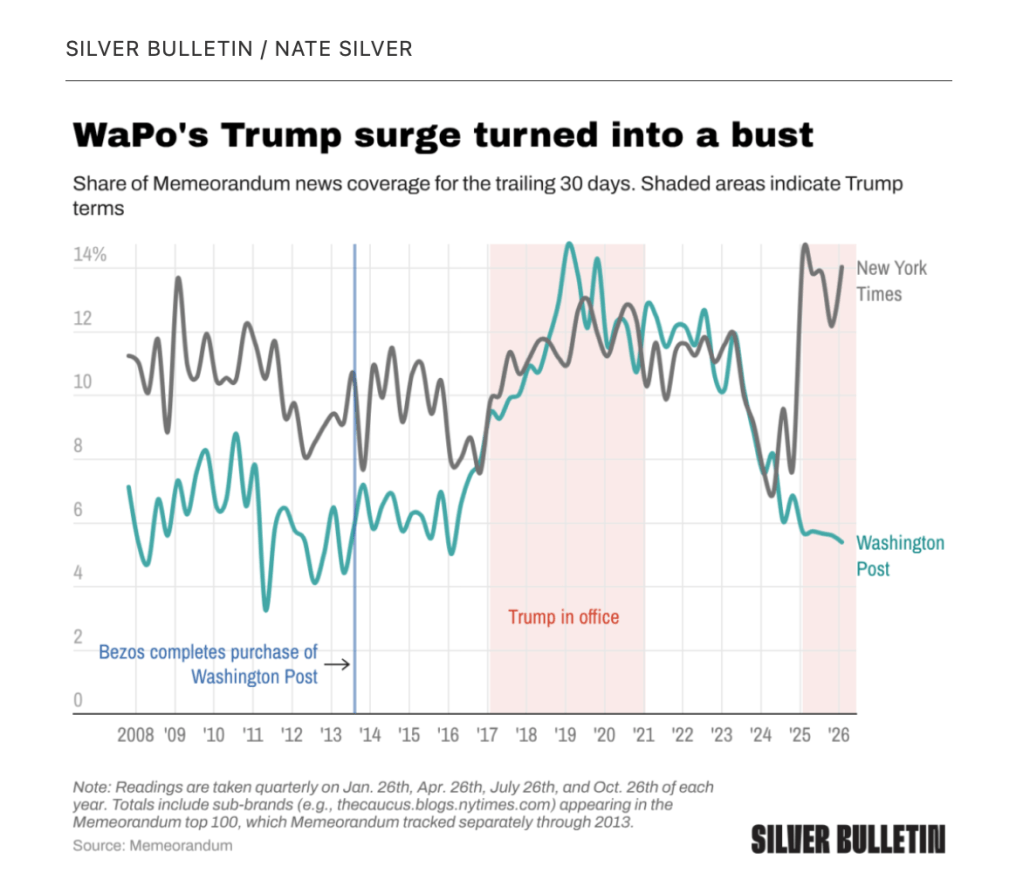
Last weekend MediaPolicy noted the diverging fortunes of the New York Times and the Washington Post with the Times getting the Trump-bump in digital views and the Post sagging in the other direction.
Then American anti-monopoly advocate Matt Stoller published a long Substack post where he suggested that Bezos bought the Post in 2013 as political insurance against the Obama administration taking anti-trust action against his Amazon e-commerce business. The insurance policy, Stoller suggested, has become unnecessary or overpriced as Bezos literally put his money on Trump.
One piece of context is that while the Post’s declining audience numbers may be attributable to anti-Trump readers voting with their feet, the conservative and pro-Trump Wall Street Journal is experiencing the same decline, although not as steep as the Post.
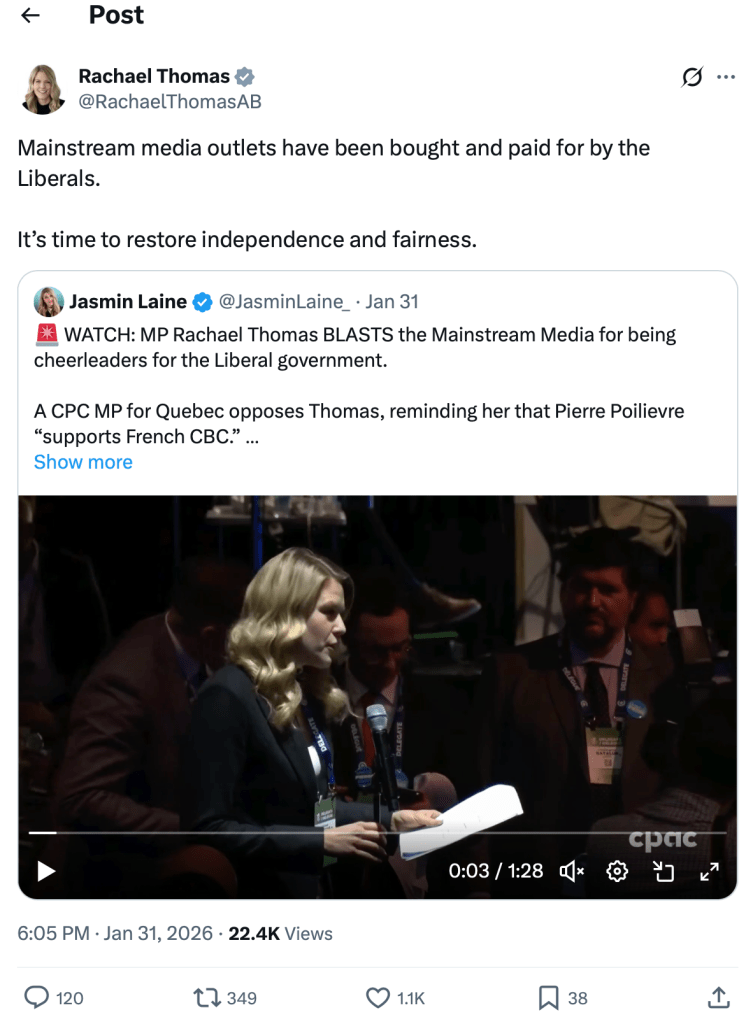
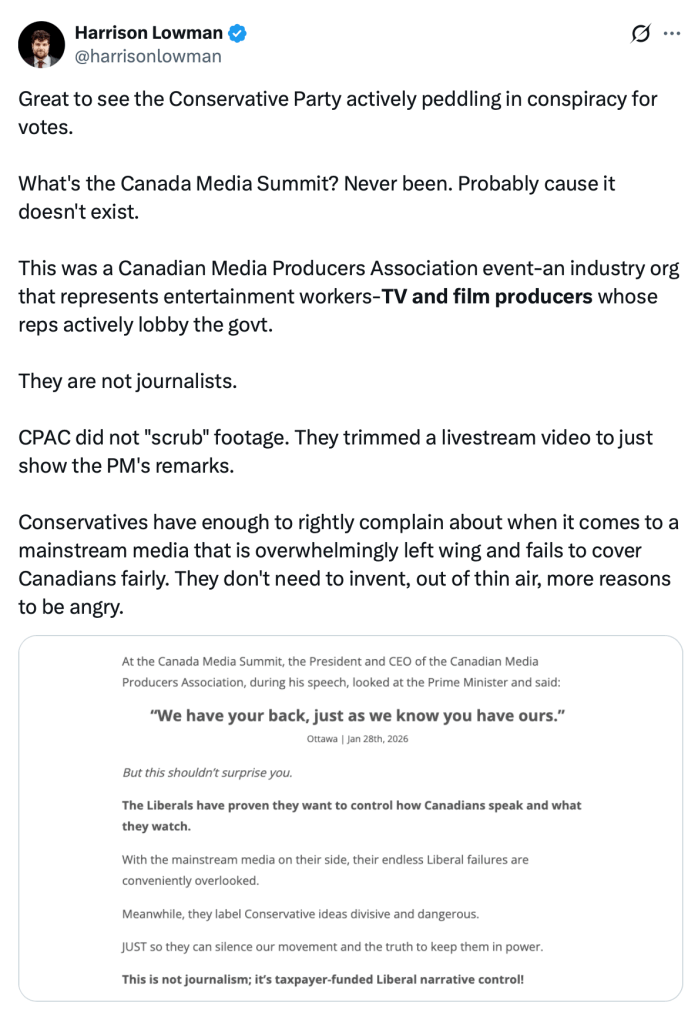
The gong show otherwise known as the right-wing frenzy over mainstream media went viral last week when a video clip surfaced of Reynolds Mastin publicly thanking Prime Minister Mark Carney for “having our backs” and gushing that “we have your back too.”
There it was, proof of the blood pact between the federal Liberal Party and the mainstream news media.
But who the heck is Reynolds Mastin?
Mastin is the President of the Canadian Media Producers Association (CMPA), the industry group representing independent Canadian production companies that make entertainment programming. He was chairing the CMPA’s annual Prime Time conference in Ottawa when he made the remarks.
Readers may know, Mastin is not a journalist and he (and the CMPA) has nothing to do with news journalism. He was encouraging Carney to resist American trade pressure on the Online Streaming Act which requires US streamers to contribute to the Canada Media Fund.
Independent movie and television producers draw CanCon subsidies from the Canada Media Fund to make dramas and comedies. The CMF doesn’t spend a dime on news, although some make the mistake of thinking it does.
Nevertheless, the timing was was perfect for frenzy: the Conservative Party was in the midst of its annual convention in Calgary.
Here is Conservative Heritage critic Rachael Thomas MP describing “the Canadian media summit” as a news journalism event:
Thomas’ falsehoods then found their way into Conservative fund raising e-mails.
At that point, some conservative pundits urged Conservatives to do a fact check. The managing editor of The Hub, Harrison Lowman, was as brave as he was blunt:
Now speaking of Mr. Lowman and The Hub, I can recommend an excellent podcast he did in January with ex-New York Times editorial page editor James Bennet.
In June 2020, Bennet (whose brother is a Democratic Senator) cleared for publication an opinion column from Republican Senator Tom Cotton arguing that Donald Trump ought to deploy the military if necessary to deal with rioting and looting that flared in the aftermath of the police murder of George Floyd.
Bennet’s employment did not survive the newsroom uprising that followed.
A similar newsroom conflagration occurred the same month at Canada’s National Post when columnist Rex Murphy opined that Canada “is not a racist country.”
In any event, I found myself gripped by the full 35 minutes of Lowman’s interview of Bennet and you may find it worth the time as well.
***
If you would like regular notifications of future posts from MediaPolicy.ca you can follow this site by signing up under the Follow button in the bottom right corner of the home page;
or sign up for a free subscription to MediaPolicy.ca on Substack;
Last week Heritage Minister Marc Miller walked back the tough talk of his predecessor Steven Guilbeault: cultural issues are no longer “off the table” in the upcoming trade talks with the US and Mexico.
In an interview with The Logic, Miller said Canada would have to be “flexible” in dealing with the US demands that Canada repeal the Online Streaming Act and the Online News Act although there are “lines that can’t be crossed.”
There will be no Davos speeches for Canadian culture. At least not in English. It probably escaped nobody’s notice that Guilbeault’s ultimatum was never repeated by the Prime Minister.
Miller also suggested that Canada needs to design its online harms bill with a clear eyed acknowledgement of Big Tech’s influence in the Trump administration. Miller said “we’re not oblivious to the fact that large American companies do have access to the administration, and colour a lot of the views coming out of the White House when it comes to the way they’re behaving.”
Despite an earlier news story that Miller was considering Australian and French bans on social media accounts for minors, he was quoted by The Logic as undecided about a Canadian ban.
“A simple ban, with doing nothing else, would be overly simplistic and probably wouldn’t achieve the goal that we’re trying to achieve, which is to make sure kids are safe, physically, emotionally and mentally,” he said. In a separate interview with the Globe & Mail, Miller said he was considering online harms legislation that would govern how AI chatbots impacted children.
That sounds very much in line with a new LinkedIn post from McGill University’s Taylor Owen, the most influential voice on online harms in Canada:
The core problem is that tech companies have failed to build safe products, and governments have failed to hold them accountable. Parents and teachers are rightly frustrated and so the impulse toward radical action is understandable.
But a ban treats exclusion as the end goal. It punishes users rather than the products causing harm. It restricts children’s rights rather than enhancing their safety. And when a kid turns 15, they enter an online ecosystem with no protections whatsoever.
Every jurisdiction that has studied this seriously—Australia, the UK, the EU—arrives at the same place: an enforcement body that can hold platforms accountable through risk assessments, mitigation plans, and transparency requirements. Age-appropriate design standards that eliminate targeted ads, auto-scrolling, data harvesting, and stranger contact for minors.
Canada had a bill [C-63] that did much of this. It should be retabled—and updated to include AI chatbots, which are now one of the main sources of consumer safety risk for young people.
(Update 2/2/26: The Globe & Mailpublished an op-ed by Owen and his colleague Helen Hayes recommending Ottawa proceed with an online harms bill based on a duty to protect children that obliges social media apps and AI chatbots to implement safety procedures. They recommend a moratorium, a temporary ban on underage access until such time that the bill is passed and tech companies have complied).
However, the challenges in legislating an online harms bill in a minority Parliament are considerable.
The Conservatives have a different vision of legislating online safety, preferring to criminalize online harms so the law is enforced by judges and not government regulators.
Unlike the last minority Parliament, the Liberals can’t just make a deal with the NDP to form a House majority to pass an online harms bill. The NDP’s loss of official party status in the 2025 election means they aren’t on Parliamentary committees and can’t team up with the Liberals to break filibusters that bottle up legislation in committee hearings.
The Liberals would need the Bloc Québécois to get them out of that jam.
***
I said there would be no Davos speeches for Canadian culture.
There almost was: Prime Minister Carney’s seven-minute hit at this week’s Prime Time conference sponsored by the Canadian Media Producers Association was funny and spontaneous and, by pointedly celebrating great home grown shows like Heated Rivalry “at this moment,” comes close enough to a bold statement of cultural sovereignty.
***
It would be easy to write a blog about the pyrotechnics going off inside American media so long as one was prepared to post, oh, about every fifteen minutes.
What I am finding interesting is Bari Weiss’ ascendancy at CBS News as the new CEO appointed by Paramount owners David and Larry Ellison (after bagging $150M US for her news website The Free Press).
Unsurprisingly, Weiss is moving CBS news coverage to the right. How far to the right, and how deep into Donald Trump’s embrace, we shall see. There’s a fair amount of moral panic that CBS will just be a Fox News Two, as if the centre and left is not adequately populated by ABC, NBC, CNN and MSNBC. There’s an illuminating NPR story on Weiss’ shake up at CBS, here.
Speaking of NPR, the New York Timespublished a story noting that the Congressional revocation of federal funding of the now-dissolved Corporation for Public Broadcasting (which provided 15% of NPR and PBS funding) has not resulted in station closings, at least not immediately. For now, donations are filling the gap.
And speaking of the New York Times (and The Washington Post too), data-cruncher extraordinaireNate Silver posted the following graph on his Substack that measures the news cycle buzz of political coverage:
It seems that the Jeff Bezos-owned WAPO did not get an attention-boosting “Trump bump” after the 2024 US Election but rather is experiencing something more like a “Trump sunk” effect.
Possibly that’s because Bezos alienated some readers by nixing a newsroom editorial endorsement of Kamala Harris and then, after Trump won, cuddled up to the White House. The eyeballs appear to be marching off to the Times.
All of it a damn shame: WAPO is replete with good watchdog journalism.
***
In November, the CRTC issued a major decision about on-screen Canadian content. Two biggies began with a revised point system to define the “Canadian” in Canadian programs under the Online Streaming Act, C-11.
The other opened the door for the first time to foreign streamers owning majority copyright rights in Canadian programs.
The Commission’s November ruling was the first of a two-part decision on video streaming: the crucial issue of streamer expenditures on Canadian programs remains outstanding.
Well, don’t hold your breath.
In a speech to the Canadian Media Producers Association on January 29th, the CRTC’s Broadcasting Vice-Chair said the Commission was not ready to issue new rulings.
“There is still more work to be done, and I cannot tell you exactly what to expect as we continue deliberating,” Nathalie Théberge told the crowd, who might have noted that the Commissioners are still deliberating seven months after hearings concluded.
“What I can tell you, however, is that there will be follow-up decisions in the coming months. This includes decisions to address spending on Canadian programs, distribution rules for services, measures to ensure discoverability of Canadian content, dispute resolution and audio policy.”
The coming months catches the attention. The Commission owes Canadians and the industry the aforementioned Part Two (“spending on Canadian programs”) as well as two separate files on the other topics Théberge mentioned.
All of this after the Commission was ordered, not asked, by federal cabinet in November 2023 to get the job done of implementing a new regulatory framework under Bill C-11 in two years.
And on Wednesday February 11th the Coalition for the Diversity of Cultural Expressions is holding a one day event in Ottawa to discuss the impact of AI on cultural production, a lead in to the federal government’s invitation-only policy summit, March 16th-17th in Banff.
***
If you would like regular notifications of future posts from MediaPolicy.ca you can follow this site by signing up under the Follow button in the bottom right corner of the home page;
or sign up for a free subscription to MediaPolicy.ca on Substack;
Hola from the centre of the universe, Toronto, where the biggest snowfall since 1999 (50 cm) has everyone on the watch for the army to be deployed, shovels in hand.
Here are a few things happening in Canadian media policy:
Canadian culture and the 2026 CUSMA trade talks
I’m going to be giving a ten-minute explainer on this topic at the Digital Media at the Crossroads annual conference on February 6-7 in snow-bound Toronto. The program and registration link is here.
No foolish predictions from me other than taking note that the US trade agenda goes far, far beyond Canadian cultural legislation such as the Online Streaming Act, the Online News Act or a potential online harms bill.
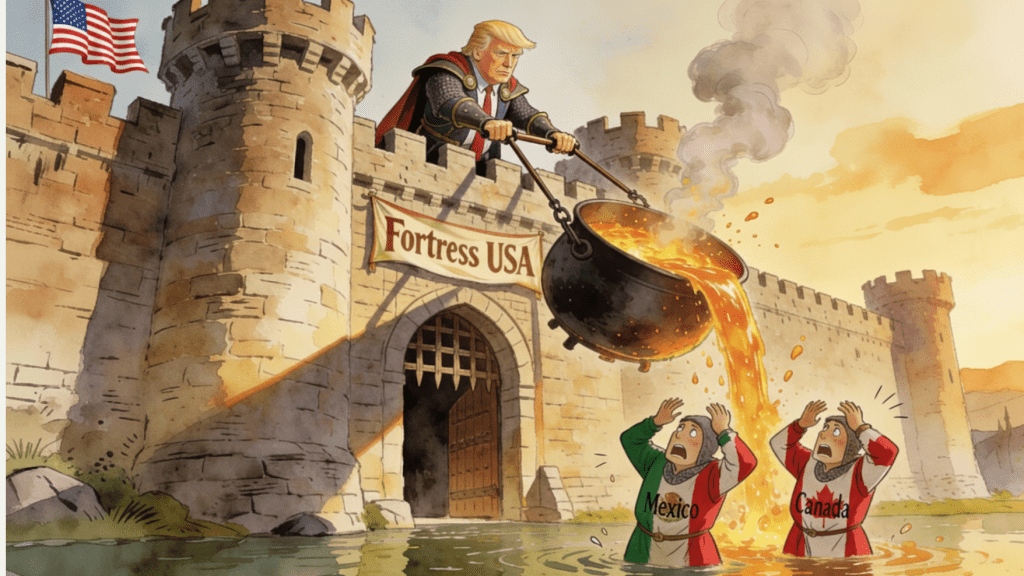
US chief negotiator Jamison Greer is floating the idea of a North American customs union which sounds a lot like double-digit Trump tariffs in exchange for Washington blocking Canadian trade diversification.
Regarding the Canadian streaming legislation that Netflix wants Greer to kill, last week MediaPolicy published a guest column from Peter Grant on how the CRTC might extend an olive branch to Netflix by allowing foreign streamers (and Canadian broadcasters) a CanCon credit for licensing and distributing Canadian shows abroad.
MediaPolicy also posted a book review of Richard Stursberg’s Lament for a Literature, a call to revive the nearly dead Canadian-owned book publishing industry. The Globe’s John Ibbitson also reviewed it. Stursberg’s “what is to be done” menu of policy action requires CUSMA’s “cultural exemption” of CanCon to survive the trade talks.
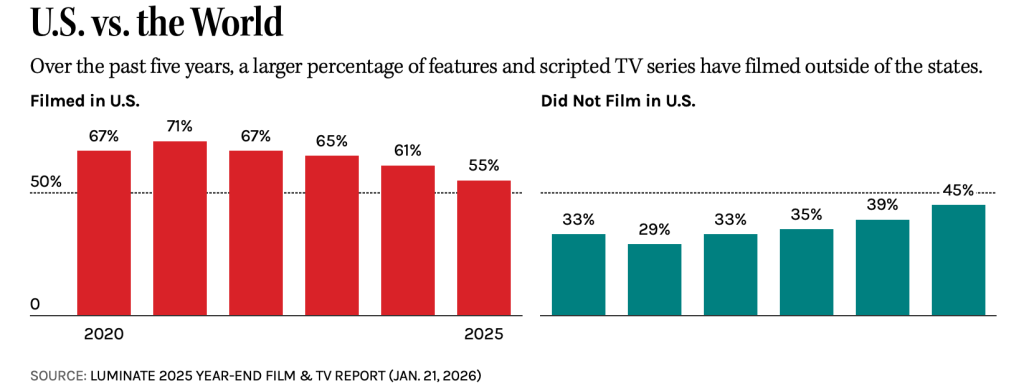
The context of this is the retrenchment of streamer spending on new productions since 2022. The Hollywood Reporter has fresh data about where US shows are being made and the only thing that is indisputable is that California is hurting and in an incremental way non-US foreign location shooting is taking a bigger share of a reduced production market . Canada’s volume is steady over time; UK and Irish shooting has gone up.
Within the United States, a game of musical chairs has resulted in New Jersey and New York gaining business, while Georgia and California have lost work.
The Trudeau government’s 2024 ban on the TikTok’s business activity in Canada (but not the app itself) followed a bipartisan Congressional ban in the United States on the grounds of national security.
Now that the Trump administration has completed the transition of the Chinese-owned TikTok into a separate US company, controlled by American interests with a minority Chinese ownership stake, the national security concern has evaporated in both the US and Canada.
Our federal government has agreed to a judicial consent order that reinstates TikTok’s right to carry on business in Canada (and presumably jump starts its investments in Canadian creators).
The odd thing: it’s the Chinese TikTok company, not the American-Chinese joint venture, that will operate in Canada. But the national security concern, which was never revealed by the federal government, has disappeared.
***
If you would like regular notifications of future posts from MediaPolicy.ca you can follow this site by signing up under the Follow button in the bottom right corner of the home page;
or sign up for a free subscription to MediaPolicy.ca on Substack;
You like to think you’ll never fall for a digital fishing scam. You like to think you’ll never fall for a deep fake news video.
Ahem, I fell for a deep fake news video.
YouTube, in its algorithmic omniscience, pushed to me as its top daily recommendation a video of the famous Washington Post political corro George Will. As the NeverTrump Reaganite we know him to be, Will delivered a withering critique of US tariffs by pointing to Toyota’s investment of $40 billion in Canada. Later, after I searched for a news announcement and found none, I wised up. (My friend in the auto industry kindly reminded me that $40 billion equals eight new car plants).
But for a good ten minutes, I was all in. The AI-video had George Will on the screen, live and in the flesh, saying exactly what George Will would say and how he would say it, but strangely looking twenty years younger than his 85 years. Then checking the meta-data, the video creators claimed to be a George Will fan site. I very much doubt they were licensed to impersonate George. A week later, YouTube had taken it down.
A few days later YouTube pushed me a similar fake, this time tech journalist Kara Swisher. Fool me once, etc.
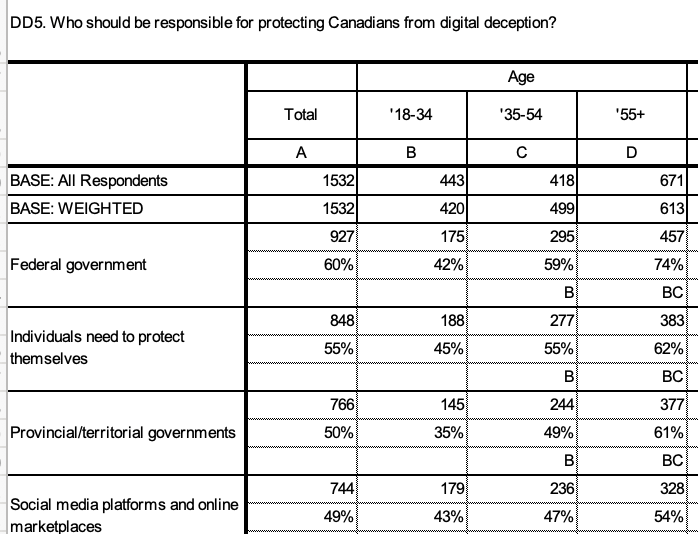
Digital deception is now a daily event, according to a Canadian poll. Fifty-two per cent of us are “very concerned” about it; a full 88% are concerned.
Canadians generally want action against digital deception and hold a mix of views on who ought to do the acting:
Meanwhile, news publishers are soaking their heads in an icy bucket of water.
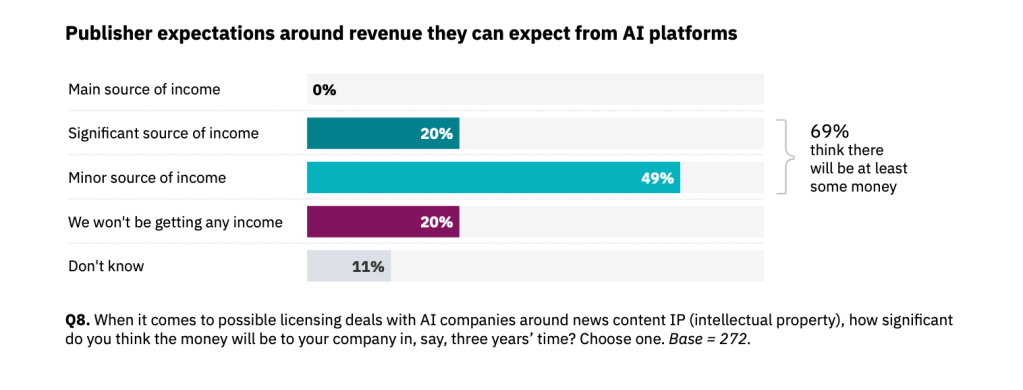
The collective wisdom was that news journalism is getting squeezed for audience attention (and ultimately revenue) on either side by AI and social media influencers. Thanks to AI-generated videos and Chat summaries, the latter published with or without links to digital news sites, publishers are expecting referral traffic to keep declining and more or less crash and burn.
If there’s a silver lining, twenty per cent of publishers believe they will make deals for significant licensing revenues, another 49% see a minor stream of revenue, and another 20% expect none. The latter group are concentrated in local media, public broadcasting and smaller countries.
A cause for optimism is that a lot of publishers are innovating by hiring digital creators to work with their journalists to compete in the influencer /video/ social media world.
Watch that space: I am waiting for someone to come up with a licensed AI-generated celebrity journalist/influencer who gets content up on the ‘net tout de suite in the news cycle. Someone like George Will.
***
As I’ve been griping about for some time now, the CBC has been slow out of the blocks to put its five year plan into action and earn that $150M raise in the Parliamentary grant.
We may be getting somewhere.
Editor in chief Brodie Fenlon just announced that CBC “will add 33 local journalists and create 11 new bureaus, increasing [our] Canadian footprint from 66 to 77 locations. This “boots-on-the-ground” investment is in addition to last year’s local service expansion of 30 journalists hired in 22 communities across Canada. Many of the new positions are based in Central and Western Canada.”
Now for context, CBC has about 3600 news journalists in television, radio and online. It’s long been underweighted in western Canada, likely because of where the television and radio stations were located decades ago when our demography was a lot more central Canadian. In British Columbia, for example, the private television broadcasters collectively outspend CBC television 7:1.
The CBC has also hired a new head of English language services to replace the retiring Barb Williams. The new EVP is Doug Smith. He’s arriving from Paramount Canada and his CV stretches back to ViacomCBS, Rogers, and Alliance Atlantis.
A streaming guy. Let’s give him a couple of years and see what he can conjure up at CBC Gem.
Maybe we’ll see a shift to buzzy blockbusters that emulate the recent success of Crave’s Heated Rivalry in Canada and abroad.
Making hit Canadiana television that is validated by successful export is not new: Canadian broadcasters have done it repeatedly with Transplant, Flashpoint, DaVinci’s Inquest, Degrassi, etc.
At home, Bell Media can take credit for a hitting streak of popular and authentic Canadian shows, smacking doubles like Shorsey, LetterKenny and Late Bloomer, and now Heated Rivalry, a centre-field blast worthy of Bo Bichette (sorry, too soon?).
There’s no reason CBC can’t do the same. It can and has (Sort Of was genius). But as a paid subscriber to Gem (how many of us is a secret), my personal request is to pour money into the functionality of the high friction, algorithmically anemic streaming site.
(Correction: An earlier version of this post identified the number of CBC newsroom employees at 3400.)
***
This year’s annual coven of Media Policy conspirators is scheduled in Toronto in the first weekend of February.
Digital Media at the Crossroads will be held at the Faculty of Music building, University of Toronto, on Friday 6th- Saturday 7th. Here’s the program. See you there.
***
If you would like regular notifications of future posts from MediaPolicy.ca you can follow this site by signing up under the Follow button in the bottom right corner of the home page;
or sign up for a free subscription to MediaPolicy.ca on Substack;
The Online Harms bill is coming back to the House of Commons.
The Liberal Bill C-63 that died on the order table when the April 2025 federal election was called was initially a three-in-one omnibus.
It was an anti-hate bill that increased prison terms for existing Criminal Code hate speech offences and hate-motivated crimes as well as codifying the judge-made law on defining hate.
It also reinstated the abolished right of individuals to bring human rights complaints against hate speech.
And it charged social media companies with the responsibility of developing and enforcing safety practices to mitigate online harms, particularly to kids. This was the long expected policy piece that was born of lengthy public consultations, taking aim at Facebook and Instagram.
Michael Geist was right (he is, occasionally) in condemning C-63 as three controversial bills wedged into one. Others agreed and the Justice Minister Arif Virani split the legislation into two bills. But the election call killed them anyway and when the government reformed the new Justice Minister Sean Fraser messaged he wasn’t committed to C-63 as it stood.
Since then, Fraser has tabled bills that are policy-cousins to C-63. Bill C-9 takes up the supercharging of prison terms for hate-motivated offences, permits the police to charge hate offences without waiting for the green light from the Attorney-General, and picks up the judge-made law on defining hate (detestation or vilification is hate, but disdain or dislike is not.)
As part of a broader criminal justice reform, Fraser also introduced Bill C-16 to make it easier to prosecute blackmail threats of online sexual humiliation and deem the posting of deep fake sex videos a criminal act.
Now the Hill Times is reporting that Fraser will return some time in the new year with an online harms bill that may offer an organized government policy on online hate, harms and safety.
***
There are the standard ways that we like to take the temperature of public opinion on media.
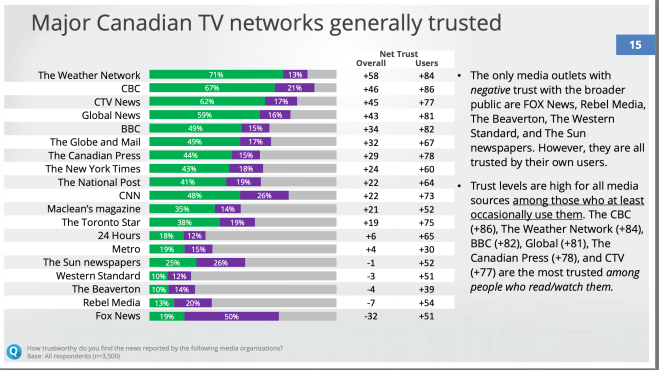
The go to is whether one “trusts” media. Asked that simply, the polling outcomes reflect likes and dislikes of news outlets as much as reliability or manipulation.
I like this news outlet; I trust it. I hate this news outlet; I don’t trust it.
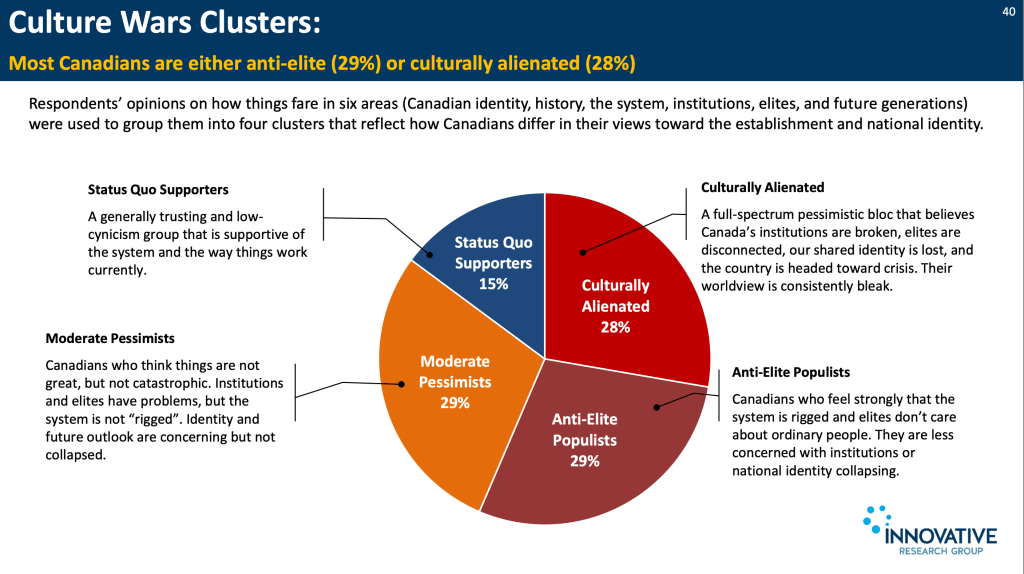
Occasionally pollsters try to dig a little deeper. The latest poll from Innovative Research doesn’t probe trust-in-media per se but rather the thing that drives trust and mistrust of public institutions: “cultural alienation,” a state of disengagement from the other, where the other is believed to be harmfully powerful.
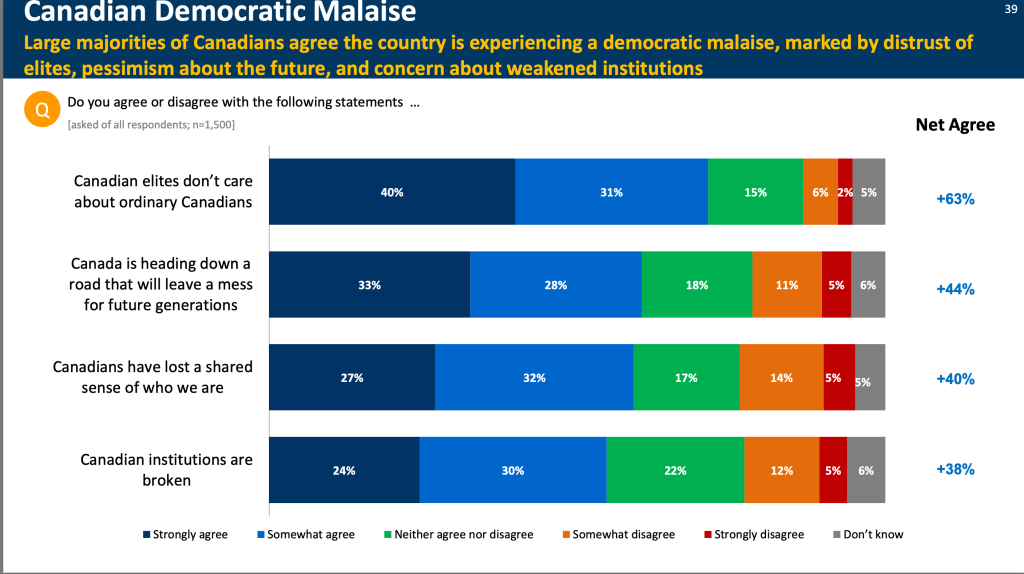
The Innovative poll reports shocking levels of popular alienation from Canadian “elites” (another piece of terminology, like “trust,” that can barely shoulder the weight it is asked to bear).
As for the pollster, it describes “culturally alienated” thus: “A full-spectrum pessimistic bloc that believes Canada’s institutions are broken, elites are disconnected, our shared identity is lost, and the country is headed toward crisis. Their worldview is consistently bleak.”
According to the poll, there is a large pool of culturally alienated Canadians, about 28%.
The culturally alienated are joined in their disaffection by “anti-elite populists” who are “Canadians who feel strongly that the system is rigged and elites don’t care about ordinary people. They are less concerned with institutions or national identity collapsing.” That’s another 29%. I know a lot of people matching the description and I am guessing so do you.
Added together, the numbers look dire.
Now if that puts you into too dark a mood, keep in mind the poll was taken from a standing opinion panel of opted-in respondents, not a random sample of Canadians, so it is disproportionately asking questions of opinionated Canadians.
Also, the results might be skewed pessimistic by the questions. Many of the mood-testing questions are necessarily binary, asking respondents to answer yes or no to questions like “Canadian institutions are broken” and “Canadian elites don’t care about ordinary Canadians.”
Ask an emotional question, get an emotional answer.
I keep telling myself, it isn’t as bad as it looks. That makes me a moderate pessimist, apparently.
***
An all-party committee of the Manitoban legislature is recommending Premier Wab Kinew’s NDP government follow the lead of provincial governments in Ontario and Québec to financially support local media.
If the NDP acts on the recommendation, it will copy the Ontario procurement practice of reserving 25% of $200 million in government ad spends for placement with local media.
Also, the MLAs propose that Manitoba offer a journalist salary subsidy similar to Québec which provides a 35% salary subsidy (up to $26,250 annually) that stacks on top of the federal 35% salary subsidy (up to $29,000).
***
If you would like regular notifications of future posts from MediaPolicy.ca you can follow this site by signing up under the Follow button in the bottom right corner of the home page;
or sign up for a free subscription to MediaPolicy.ca on Substack;
The political consensus in Québec on regulating audio-visual and audio content to protect culture and language meant that Bill 109 didn’t spark the controversy that the federal Bill C-11 did two years ago.
But the tinder is dry and the sparks will fly.
The US Trade Representative will add Bill 109 to its list of American grievances over Canada regulating Hollywood streamers and Big Tech, to be tabled in CUSMA negotiations this spring. (When coincidentally the 2026 Québec election might be called).
So too there must inevitably be an impasse between the Mark Carney government and Québec over legislative jurisdiction. Though brief by comparison, Bill 109 is almost a carbon copy of Bill C-11. Until the Supreme Court says otherwise, Ottawa has exclusive jurisdiction over online broadcasting.
Québec’s culture minister Mathieu Lacombe has been pretending there’s nothing jurisdictional to talk about with Ottawa. According to the minister, there’s no conflict, only concurrent federal and provincial powers to do the same thing. Good luck with that. A caveat: he might have a provincial claim to the regulation of home screens on Smart TVs and streaming devices.
The Québec law is founded on a provincially claimed right to cultural discovery —props to that boldness. Importantly, all of the bill’s cultural measures are focussed on French language content, not Canadian French language content, so the political framing is more linguistic than cultural.
Mess with this if you dare, Ottawa.
From here, things will move slowly at first.
Québec will establish the minister’s Discoverability Office and begin drafting streamer requirements for French language content.
The CAQ’s Lacombe will find out if the streamers are willing to take up his offer to negotiate bespoke agreements in order to avoid cookie cutter regulations set by the province.
On video streaming, he will no doubt benchmark his regulations or voluntary agreements with streamers against the outcomes reached in France since 2021.
Despite a framework EU law that proposes a 30% catalogue minimum (numbers of shows), the French implementation of that policy focusses instead on production investments in French language content, based on a range of 20% to 25% of a streamer’s national operating revenues. So far, the result has been bigger budgets rather than a proliferation of mid-budget shows.
On other hand Lacombe could just stick with catalogue quotas, as the CRTC is expected to announce its own federal expenditure quotas soon.
As the Québec legislation doesn’t require the cash contributions to Canadian media funds that the streamers hate so much in the federal scheme, a deal with Netflix focussing on French language video catalogues doesn’t seem out of the question.
A deal with Spotify to do something dramatic to increase rock bottom consumption of French language music would be tougher.
Unless Lacombe’s process moves at lightning speed, CUSMA talks and the Québec election will intervene.
***
If you don’t have school age kids, you might have missed the seismic Big Tech event that just shook Australia: its government has banned social media accounts for children under age 16.
The Australian communications minister Anika Wells is the first politician in a liberal democracy to tell social media companies, “time’s up.” Apparently so, even Elon Musk says he will obey the law.
There’s a brief explainer in the New York Times on how harmful social media can be for teens and how we got to the point that Big Tech’s safety half-measures have worn out the patience of legislators.
Still, a ban. Wow. As our federal justice minister Sean Fraser eyes a revised online harms bill, what would be interesting is an opinion poll on a ban, taken from Canadian parents of tweeners and teenagers, parsed out separately for age and gender of the children.
***
In last weekend’s post, I speculated that Donald Trump would have some fun with the $87 billion USD Netflix-Warner Brothers merger deal, given his donor ties to the losing bidder, Paramount.
The next business day after Netflix officially announced its winning bid, and media analysts had their say on the prospects for Netflix obtaining the Trump administration’s anti-trust vetting, Paramount unveiled its Plan B: a $108 billion hostile takeover bid for all of Warner Brothers Discovery properties.
Warner Brothers has a week to respond but Paramount CEO David Ellison has already signalled an improved second bid is ready to go.
Among Paramount’s financial backers are the CEO’s dad and second richest man in the world, Larry Ellison, and various gulf state sovereign wealth funds. Oh, and President Trump’s son-in-law Jared Kushner.
The Ellison-Gulf-Kushner bid includes Warner Brothers’ television entertainment channels and the cable news network CNN.
Ellison-the-younger’s Paramount recently bought the CBS news network and appointed the Free Press’ Bari Weiss as CEO. Pa Ellison is also the key investor in the bid to buy TikTok’s US operations.
***
A significant AI content licensing deal has been struck between the IP-rich Disney and OpenAI, the developers of Chat GPT and the video-creation app Sora.
The deal will allow Sora subscribers to create videos with Disney’s classic animated film characters. Imagine making a birthday video card for your kids featuring them with their preferred cuddly creature or action hero.
As reported by The New York Times: “Sora users will be able to make videos with more than 200 characters from Disney’s library, including from “Encanto,” “Frozen,” “Moana,” “Toy Story,” “Zootopia,” “Inside Out” and other animated movies. Animated or illustrated versions of Marvel characters like Deadpool, Iron Man and Black Panther will also be available, along with “Star Wars” characters like Darth Vader and Princess Leia.”
Given all of the chatter about AI companies scraping copyrighted content, the Disney-OpenAI deal will set expectations that licensing deals are the way for Big Tech to make peace with content producers, especially the biggest ones. (Oddly the reporting on the deal noted Disney’s $1B USD investment in OpenAI but was mum on the value of licensing payments that Disney can expect).
The Hollywood Reporterhas a good analysis of the deal, the gist of which is Disney isn’t going to rest on its IP laurels while other content companies get rich on AI monetization.
More broadly, the slow drip of licensing deals between AI and content companies might, in the news journalism space, begins to look like the years leading up to Australia’s NewsMedia bargaining code and the Canadian Online News Act: AI companies cherry pick the biggest and most popular news outlets for licensing deals while those left behind look to governments for action on content scraping and monetization.
***
If you would like regular notifications of future posts from MediaPolicy.ca you can follow this site by signing up under the Follow button in the bottom right corner of the home page;
or sign up for a free subscription to MediaPolicy.ca on Substack;
I’ve fallen behind on catching you up on media policy news because I felt compelled to write a series of three posts commenting on the CRTC’s ruling on Canadian content. The last one, the rant I promised, was published this week in Cartt.ca.
While I was ranting, one of the things I let slide was telling you about a new report out of Denmark proposing to refashion its policy design for government aid to news journalism.
The Danes are serious about news subsidies: they spend 540 million krone ($120M CDN) every year on private media in nation of six million people (Canada spends about $200 million in country of 42 million).
According to the Reuters Oxford Digital News Report, Denmark’s “public trust in media” score is 56% and it ranks sixth out of 180 in the Reporters Without Borders’ press freedom index at 86.93. By comparison, Canada’s trust score is 39% with a press freedom index of 78.5, 21st in the world.
The Danes also have something we don’t: a 2018 Media Liability law that established an independent national press council and conferred the force of law on editorial independence from ownership.
The Danish subsidy report was commissioned by government and written by a committee led by Rasmus Nielsen, the former chief of the Reuters Institute for the Study of Journalism.
Despite the ocean separating us, there are strong parallels between the Danish system of news subsidy and Canada’s jigsaw of federal programs: we have the QCJO subsidy of journalist salaries, the Local Journalism Initiative that funds 700 full time reporters in under-serviced regions across the country, and the Canadian Periodical Fund which supports editorial expenditures by community weeklies.
The untranslated 144-page Danish report covers a lot of ground, but Nielsen’s own English language summary of it captures the essence: a weighted emphasis on supporting news outlets that are regional, local or “independent” (owners of single-titles) rather than mere incumbency as a news organization.
***
The Senate deliberations of Senatrice Julie Miville-Dechêne’s Bill S-209, that would require age verification for online pornography is on hold until February while the Senate justice committee deals with other matters.
During the pause, the Canadian Press reports that Meta has joined the fray by lobbying the federal Liberals to step in with their own bill that would shift the age verification responsibility from pornography websites and social media platforms to app stores.
Meta obviously doesn’t run an App Store, as do Google and Apple, and the latter two Big Tech companies are cheesed about what Meta is up to.
Meanwhile, Canadian children continue to be exposed to online pornography featuring choking and slapping. The CP story is well done and informative.
Meta is having a good month of course. It won the anti-trust trial brought by the US Justice Department that claimed Meta was running a monopoly in personal social networking. In the interim five year period between filing and judgment, TikTok greatly improved its market share.
Matt Stoller has a very good analysis of the lawsuit, the trial, the judge, and why he thinks Big Tech will never be slowed down by anti-trust litigation: he says it takes public policy and legislatures to change things.
A test of his theory may happen soon: the trial judge in the Google Ad Tech case will be handing down her decision on whether to dismantle that illegal monopoly in the new year.
Meanwhile a consortium of US school boards just filed a new lawsuit against Meta and several other Tech companies.
Their allegation against Meta in particular is that company documents reveal CEO Mark Zuckerberg squelched evidence of harm to teenage girls while Meta designed lax safety features, including ineffective measures to expel sex traffickers from the platform. Of course, the allegations must be proven in court, probably over several years.
This does raise the question of whether Americans (and Canadians) should count on US courts to adjudicate Big Tech’s excesses by giving full due process and demanding conclusive evidence of the allegations, or whether governments should just cut to the chase, stop litigating whether the harms to kids persist, and legislate a solution.
The National Film Board’s website is recommending “Ghosts of the Sea,” a riveting documentary about the ill-fated Norwegian father-and-son sailors, Peter and Thomas Tangvald.
The filmmaker is Thomas’ half sister Virginia, who settled in her mother’s hometown of Montreal. The father Peter was married seven times and two of his wives died at sea.
I’ll say this: the film offers a visceral take on “intergenerational trauma.”
I think you will enjoy the one hour and 37 minute film and I absolutely guarantee you’ll have strong opinions afterwards.
***
If you would like regular notifications of future posts from MediaPolicy.ca you can follow this site by signing up under the Follow button in the bottom right corner of the home page;
or sign up for a free subscription to MediaPolicy.ca on Substack;
In response to the October 30, 2025 post from MediaPolicy.ca, I have some ideas on how Canada could proceed with accomplishing the objectives behind S-209, “An Act to restrict young persons’ online access to pornographic material”, while respecting user privacy and dramatically reducing the chances of a data breach.
Who am I? I’m a Java software developer with over 25 years of experience not only paid to write code, but participate design software solutions, assess requirements, work with product managers, and occasionally lead times. As part of our profession, we’re expected to proactively address potential security vulnerabilities, such as upgrading software libraries before they become outdated, and thus, more likely to be vulnerable.
Prologue:
First of all, I have no fundamental objections to restricting internet porn from minors via an age verification scheme that guarantees anonymity.
My issues with S-209 are how it captures many sites and services that are not primarily for porn, and how it risks violating user security and privacy, especially for those not seeking porn, by storing their age (and possibly identity) proofs on the internet, where they could be breached.
Maximizing Privacy and Limiting Data Breaches:
Any age verification scheme ought to maintain biometric data used as an input exclusively on the client device.
By client device I mean the phone, table, or PC used to access the internet, but on no server on the internet itself. In turn, this client-side software sends proof of the user’s age, in a way that can be authenticated as legitimate, to the site in question. This means no server on the internet would have the biometric data, such as a face scan or government ID.
This doesn’t eliminate risk, but since each piece of user-identifiable data is on one client device at a time, it means a far lesser incentive for bad actors to try to steal such data. That is, it’s far more work for far less benefit than targeting a single server.
Lower Compliance Costs for Sites Hosting Porn:
Any site that’s captured by this law would still have compliance costs, but would be much lower than what is currently proposed under S-209.
The client device vendors (Google, Apple, Samsung, etc) would be responsible for implementing this scheme. They’d be tasked with providing software for the sites in question, and those sites would simply have to install and configure this software in order to complete the verification process.
Blast radius of the law:
In addition, I propose there be clear guidelines for a site to opt out of being captured by this law.
Part of the controversy of S-210 and its current iteration S-209 is the number of sites captured by the statute. This would have included search engines and social media sites, which are light years away from primarily hosting porn but on which porn is hosted to a small degree.
In my opinion, the proposal to exempt search engines is insufficient, since many people including myself largely use AI instead of Google/Bing/DuckDuckGo searches. Also, social media has a whole series of non-porn uses. I believe the vast majority of AI and social media users are not interested in porn, at least, not while using those vehicles.
So what I propose is a way for any site, such as with news under the Online News Act Bill C-18, to opt out of this law by meeting guidelines to not expose porn at all to the users of those sites.
I admit to not having fully considered the mechanisms under which this would, but likely it would involve AI scanning for pornographic images and text. Obviously, it wouldn’t be 100% bulletproof, so sites would have to merely prove a good faith effort to accomplish this. Such sites could then offer premium versions, which would be captured by age verification mandates.
Furthermore, many computing devices are “headless” and quite simply can’t comply with an age verification scheme to access the internet. Among these devices are servers like NAS’s, which must access the internet for updates. There are also minitower PCs, which don’t come with cameras.
Final thoughts:
Many users have zero interest in porn, but are very adamant about accessing the internet anonymously, and are understandably wary of data breaches given the Discord experience in the UK.
Furthermore, many minors have a long list of legitimate reasons to access the internet, AI, and social media while having no interest in porn.
Why risk blocking non-porn seeking minors from accessing the internet, or make it harder for non-porn seeking adults to access the internet?
According to many polls, Canadians are wary of digital ID schemes. On the other hand, many are also rightfully concerned about minors accessing pornography.
The solutions to the stated objectors to the framers of S-209 is a client-based age authentication scheme that maintains biometrics and other age proofs on the client device, and off servers.
It also involves allowing any general site to make porn unavailable to the vast majority of its users and thus opt out of being captured by new porn-gating mandates.








 MediaPolicy.ca