“Knowing those [streamer] players as we do, they were not going to say, ‘Thank you very much. We’re done.’ They were only going to regard that as the appetizer.”

August 29, 2026

The how and why of last Friday’s breakdown in US-Canadian trade talks preoccupied us for most of last week.

The Canadians weighed in on why things went sideways after Trump announced a “deal” several days before the deadline. The Americans spun their narrative in the other direction. Commerce secretary Howard Lutnick’s performance is not to be missed.

It would help to know what was in those negotiating documents that will never become public. Or to start demanding polygraphs that will never be taken.

Without those here is my take, based on what negotiators said and what might have happened.

Carney and Trump talked on the Tuesday night. Clearly they agreed on something. Probably it was some high level numbers on key tariffs. Looking for a public win, Trump couldn’t restrain himself and rushed to announce a deal the next morning. The key thing is that Trump thought he had hooked Carney by giving him enough and that the US would then steamroller the Canadians on the fine print and all of the remaining issues. Saying there was already a deal was part of his strategy.

That is the bargaining dynamic that often occurs when one negotiating party has, or believes it has, the hammer. Trump expected to run the table. If there was any truth to the rumours of the impending demise of the Online News Act, the Canadian team was half expecting the same.

But Trump miscalculated and overreached. On trucks and pickups. On culture. On Canada’s options to make other trade deals without Trump’s permission. This provided an opportunity for Ontario premier Doug Ford to signal Carney that he was about to go offside. Manitoba premier Wab Kinew already was. The Bloc Québécois was making noise about cultural concessions.

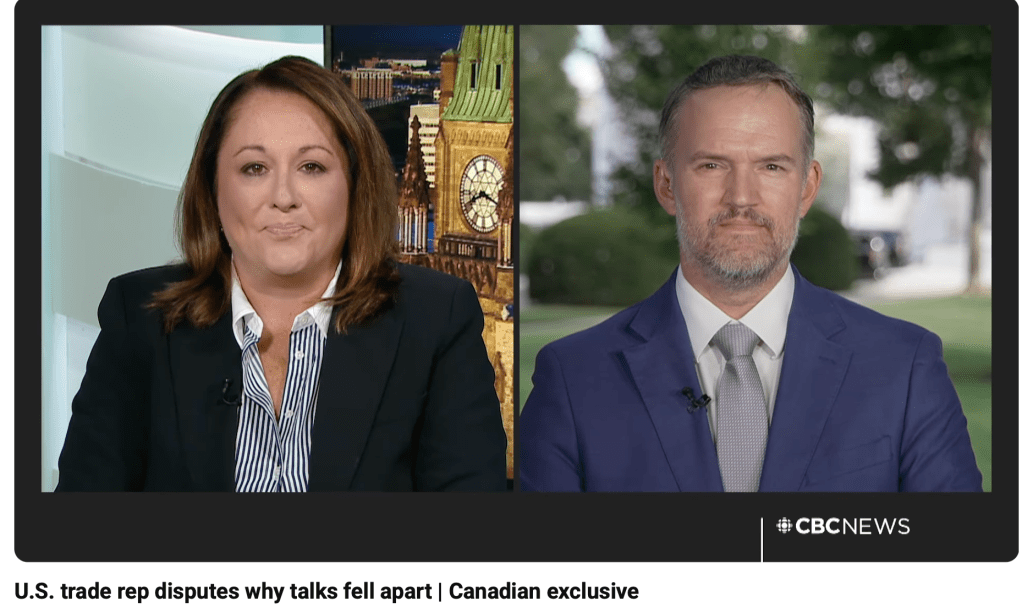
When CBC interviewed Trump’s trade envoy Jamieson Greer on Thursday he claimed that the cultural issue embedded in the federal Online Streaming Act —-repeatedly and narrowly confined to “the discoverability of French language content”—- was, shucks, never a big deal for the US. 

“It’s the furthest thing from a red line,” Greer told CBC host Rosemary Barton. “We highlighted [it at the end] yes, but our view is you should let capitalism do its thing and let people pick. We know it’s important to people in Quebec….We would not have let it get in the way of a good deal.” (Roll the video from the nine minute mark).

Slick and slippery, yes. But more likely a sign that Trump thought the Canadians were already hooked and would swallow anything to get a deal across the line.

Greer still found time to have another moan to CBC’s Barton about streamer cash payments to Canadian media funds: “What we don’t like is a situation where Canada forces American tech companies to take their earnings to give a percentage to their competitors.”

Putting aside that mischaracterization of how cash payments to media funds get recycled to all contributors, Carney had already taken them off the table three months ago by overruling the CRTC.

Yet here Greer was still fixated on them, raising them on both Canadian and US television networks, even after the breakdown of talks and in the same breath in which he claimed that “the French language” issue raised by the federal Online Streaming Act and Québec’s counterpart Bill 109 was no big deal.

Canada’s trade envoy Dominic Leblanc responded to Greer’s claims tactically. He publicly thanked the Americans for taking the streamer issue off the table. 

While Leblanc was thanking Greer, the Canadian cultural community was effusively and publicly thanking Carney for fending off the Americans. 

Every iota of that effusiveness was proportional to a residual mistrust that the Online Streaming Act and the Online News Act are off the table for good, or that a Prime Minister who would give away the digital services tax for nothing, humiliate the CRTC by overruling their implementation of cash payments, and for Pete’s sake would even submit to a shameless Trump shakedown on a bridge we paid for, might yet fold again on culture.

Reynolds Mastin of the Canadian producers’ union CMPA, which has emerged as the de facto spokesperson for the English-language cultural community, described the near-death of the Online Streaming Act as “an inflection point” for Canadian culture and trade talks.

Mastin also politely chided the Carney government if it had indeed assumed that its climb down on the streamer payments in June had sated the US streamers’ hunger to get rid of the OSA altogether. “Knowing those players as we do, they were not going to say, ‘Thank you very much. We’re done.’ They were only going to regard that as the appetizer.”

This weekend Mastin’s CMPA and another 40 cultural organizations took the time and expense to express their gratitude to Carney “for standing up for Canada’s cultural sovereignty” in full-page newspaper ads. Newsmedia Canada’s Paul Deegan did much the same on the Online News Act. 
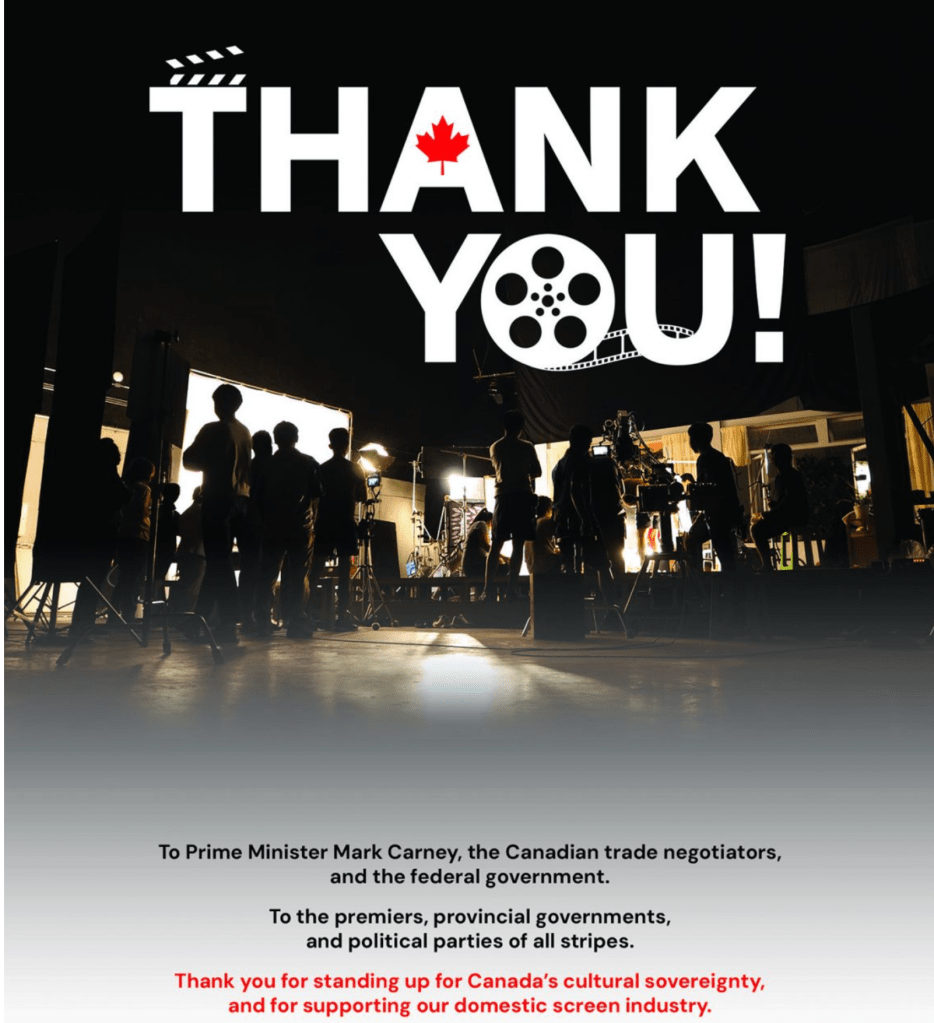
In Québec, the Coalition for the Diversity of Cultural Expression went a step further, calling for Carney to throw it into reverse gear and reinstate the $200 million in audio-visual and audio streamer payments. 

Carney is now in a pickle of his own making. 

The Americans may or may not have let go of the cultural concessions. All it would take to revive them is an American reporter asking Trump the question.

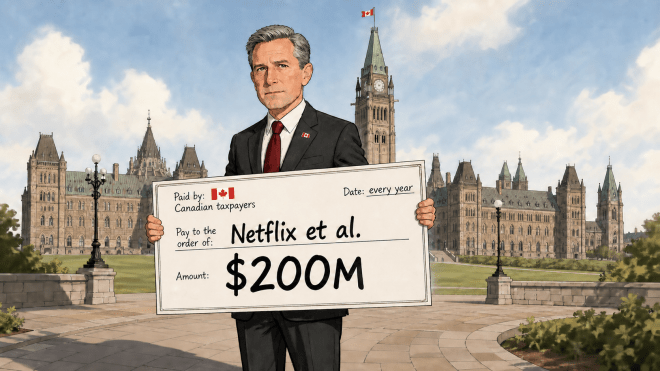
Canadians have increasingly seen cultural issues as a defining issue of our dignity and resistance to Trump humiliation, at high levels of support that were already elevated according to year-old public polling. 

Meanwhile Carney has his $600 million pot of cultural spending that, contrary to MediaPolicy’s initial skepticism, might actually be doing something more than taking the sting out of his climb down on cultural issues. 

A leaked page grab from an internal Canadian Heritage document suggests that the $600 million will cover the $134 million in foregone streamer payments to Canadian audiovisual media funds for broadcast news and Canadian content. But the document also suggests that the remaining “unallocated” $467M is earmarked for “additional audiovisual stabilization funding” and the “audio sector.”
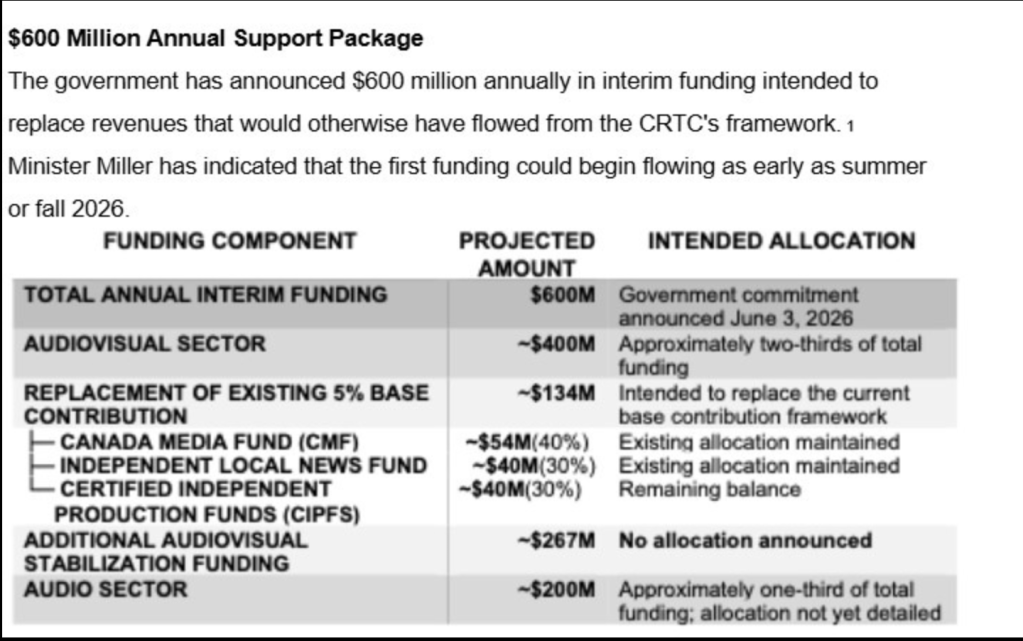
The vagueness of this $467 million commitment may sustain skeptics like myself. But other internal documents from Heritage suggest an earnest and far reaching rethink of how to spend not only the $467M but all of the $850 million in various federal programs for audio visual production on a growth and export strategy for Canadian content.

I’ve buried the lede here. More to come on that. 

***

If you would like regular notifications of future posts from MediaPolicy.ca you can follow this site by signing up under the Follow button in the bottom right corner of the home page; 

or sign up for a free subscription to MediaPolicy.ca on Substack;

or follow 
@howardalaw on X or Howard Law on LinkedIn.

COMMENTS ARE WELCOME. But be advised they are public once I hit the “approve” button, so mark them private if you don’t want them approved. 

I can be reached by e-mail at howard.law@bell.net.

This post is copyrighted by Howard Law, all rights reserved. 2026.

Catching up on MediaPolicy – The $600M waterhole – Australia’s new C-18 – Paramount merger drama continues

August 22, 2026

I was pleased with myself this week to be quoted in a news story that described the Carney government’s promise of $600 million annually for cultural spending, in replacement of the CRTC’s $200M levy on foreign streamers, as “the world’s biggest lollipop.” 

So clever, but ultimately the wrong metaphor even though the soporific effect of a big wad of federal cash was meant to take the edge off of the angry reaction among Canadian producers, broadcasters and the public at large after Carney overruled the CRTC.

No, the right metaphor is “the $600 million watering hole.”

I say that only because the Prime Minister and cabinet minister Marc Miller have been so coy about where the money is headed. After all, $600M is three times the overruled $200M. It’s not just a Netflix bailout. 

But we’re still in the dark about the destination of those federal dollars. Members of the minister’s newly appointed advisory committee on audiovisual production have been sworn to secrecy, according to the Wire Report’s story about signing NDAs. The Wire Report story quotes one member of the committee as saying we will not see the product of their deliberations “for a few months.”

I would expect that the producers (CMPA), the broadcasters (CAB), and news publishers (Newsmedia Canada) are engaged in an all-hands-on-deck lobbying effort to influence where that $600M gets spent. If the government is telling them anything useful, no one is talking.

Ergo, let’s give uninformed speculation a try. Some of the additional $400M might be new spending. Some of it might relabel existing federal cultural dollars.

Government Priority 1?: Media Funds

Presumably the first $200M of the $600M is to do what minister Miller promised: replace the CRTC’s 5% cash levy on audiovisual (Netflix et al) and audio (Spotify et al) streamers. 

The $200M figure came from the CRTC’s 2024 estimate and is now two years out of date. Of the total, the CRTC earmarked $140M for additional CanCon contributions to the Canada Media Fund for entertainment and children’s programming, the Independent Local TV News fund, the Indigenous Screen Office and a variety of smaller production funds that finance shows by and for diverse communities and official minority language communities. 

Another $60M of music streamer cash was intended for artist development funds (Factor, MusicAction, Starmaker, and RadioStar). It was also to support Community Radio Fund and the newly established Indigenous Music Office.

There was also money for news reporting in small and mid-sized radio markets. 

The audio streamers weren’t part of Carney’s June 3rd quash of the CRTC ruling on video streamers, but a subsequent communication by the federal Attorney-General to the judges hearing Spotify’s appeal to the Federal Court means that $60 million is gone too.

Based on the minister’s public statements, expect these media funds to be the first to drink from the $600M watering hole.

Priority 2?: Reversal of the fake cuts

The next speculative tranche of the $600M is a relabelling exercise: the restoration of 2026 federal budget cuts to cultural funding. 

That would reverse the $192M cut to the CBC, the $68M cut to the Canada Media Fund, $13M cut from the Canadian Periodical Fund for magazines and community news publishers, and $2M from French-language TV5 News. Perhaps the Liberals will pick the moment to restore their cuts to the Canada Book Fund ($3.4M) and the Canada Music Fund ($16M). Final tally: nearly $300M.

Ever since the minister tabled these cuts in the “Main Estimates” federal budget back in February, the word on the street was that the CBC and Canada Media Fund cuts would be restored or mitigated in a Supplementary estimate. 

Priority 3?: Double counting of budget dollars already announced for broadcaster access to the QCJO journalism labour tax credit

In March 2026 the Liberals announced (by my estimate) a $115M expansion of the QCJO journalism labour tax credit to television and radio broadcasters. The public pressure for policy action hasn’t let up: since then, Rogers and Global News announced layoffs in television and radio as well as closures of several AM radio station. Quebecor has threatened a fresh round of layoffs “if nothing changes.”

If Carney counts this as a piece of the $600M, this is also a relabelling of previously committed federal dollars.

Priority 4?: Replace the CRTC’s recent 1.55% cash levy on streamers and Canadian broadcasters, quashed by Carney’s announcement

The 1.55% would have relieved Canadian cable companies from the obligation to subsidize public service television channels mandated for basic cable TV by the CRTC (e.g. APTN, TV5, CPAC).

When the CRTC announced this cash levy in May I estimated the cost at $42M for foreign streamers and $93M for Canadian broadcasters.

If taken out of the $600M, that’s another $135M draw from the waterhole. 

Priority 5?: More money to replace the lower than expected streamer investments in CanCon productions

The CRTC ruling that Carney overruled would have compelled foreign streamers to invest directly in Canadian shows at 8.5% of revenues (the cash levies of 5% and 1.55% made up the remainder of the overall 15%). 

We won’t know until minister Miller unveils his new policy direction to the CRTC, but these “Canadian Programming Expenditure” investments could be metered at the same 8.5%, or more or even less. I say with a straight face: it all depends on what Carney promised Netflix CEO Ted Sarandos in that New York hotel room meeting in late May.  

If Carney agreed to reduce that 8.5%, I figure it will cost about $28M in federal money to replace each percentage point of the 8.5%. 

Priority 6?: the Online News Act

I hate saying this out loud, but others have as a matter of wish fulfillment. Between American trade bullying and Carney’s propensity to cave on cultural legislation, is the Online News Act on the chopping block? 

If it doesn’t get thrown under the bus in trade negotiations, should we expect another hotel room meeting where the Prime Minister promises to sunset Google’s $100M news licensing payments to Canadian news organizations which are up for renewal in 2029? (A note here: Apple got an in-person meeting with the Prime Minister on June 11th to talk about the Safe Social Media Act, recorded in the lobby registry).

And if so, is Carney planning to replace Google’s $100M out of the $600M? 

Priority 7?: Anything

There is the chance that the $600M includes money for some good public policy, independent of the expediency of the moment.

Not that I am stumping for it, but it would not surprise me at all if the Liberals committed more money to the export of Canadian shows through Telefilm, or special funding for international co-productions with France or other trading partners. It would rhyme with their overall approach to big investments with, um, non-hegemonic trading nations.

If you’ve done the math, that’s a $850M draw down from a $600M waterhole.

If Canadian producers, artists and broadcasters have also done the math, that would explain the flurry of lobbying activity since Miller announced the $600M. 

***

While we Canadians speculate on the future of the Online News Act, this week the Albanese government in Australia legislated version 2.0 of its 2021 news licensing scheme, rechristened as the News Bargaining Incentive.

The NBI expands the scope of its 2021 legislation to add TikTok and Microsoft’s LinkedIn to the previous law that required Google and Meta to make licensing deals with most Australian news outlets. Meta refused to renew its deals that expired in 2024. The NBI is the government’s response. 

The new legislation sets a price on compliance: the four tech companies must pay 2.5% of their Australian advertising revenues into a news fund.

However, each of the digital platforms can substantially reduce their cost by making licensing agreements directly with at least eight news organizations. The tech platforms get 150% credit toward their 2.5% target by making deals with large news organizations, and 200% credit for agreements made with small and medium sized news outlets. 

If there’s any shortfall on meeting the 2.5% target, the government will levy the remainder in cash from the platforms with proceeds banked in a national news fund. That pool of money will be presumptively distributed to news organizations based on a journalist headcount, as in Canada. Unlike Canada, the Australian news fund can tweak the headcount formula to be more generous to smaller news outlets. 

I have not seen estimates of news licensing payments the NBI will generate, but the 2.5% figure looks substantially less than the value of the 2021 deals which totalled $190M annually. And if deals get made to offset the 2.5%, it would be worth something closer to 1.5% of ad revenues. 

There’s no word yet on when the NBI legislation will be proclaimed by the Albanese government. Not surprisingly, the Trump administration is opposed to the NBI and a spokesperson told the Australian Financial Review back in April that the White House regarded the NBI, which it did not differentiate from a digital services tax, as “foreign extortion.”

***

The Paramount/Warner Brothers merger drama refuses to take a week off.

As you recall, twelve US state attorneys general led by California’s Rob Bonta are contesting the $111B merger under the federal antitrust Clayton Act. A trial date is set for March 2027.

After threatening to move all of its studios out of Los Angeles, Paramount owner David Ellison’s new tactic is to ask the federal judge who granted an interim injunction against the merger to impose a $1.9 billion surety bond on the states. The purpose of the bond is to cover the $210 million per month “ticking fee” that Ellison will begin paying on October 1st to Warner Brothers Discovery shareholders who voted “yes” to the merger. 

The judge previously declined to require the bond finding that the states’ lawsuit raises important matters of public policy. As for Bonta, he says Ellison made a grown up’s decision to agree to the ticking fees in the first place. 

Meanwhile, the mayor of Los Angeles Karen Bass appears to have been swayed by Ellison’s threat of a capital strike and is urging Bonta to make a deal now instead of pursuing the lawsuit. Her challenger in the upcoming municipal election supports going to trial instead.

The Trump administration looms large on the sideline. The White House is close to David Ellison’s father, the world’s second-richest man Larry, who is bankrolling the merger. Ellison Pater’s wealth comes from his Oracle Corporation. Oracle is carrying a lot of debt and is badly exposed in the event of financial instability in the AI industry. 

Whether Bonta and the other attorneys-general want a court-ordered restructuring of the merger or just more financial commitments, delay is clearly their leverage. 

One gets the feeling that with so much money and so many jobs at stake, a deal will get made long before trial. Late yesterday, California Governor Gavin Newsom expressed interest in an early deal and the Democratic nominee to replace the termed-out governor is also a proponent of settlement.

***

If you would like regular notifications of future posts from MediaPolicy.ca you can follow this site by signing up under the Follow button in the bottom right corner of the home page; 

or sign up for a free subscription to MediaPolicy.ca on Substack;

or follow 
@howardalaw on X or Howard Law on LinkedIn.

COMMENTS ARE WELCOME. But be advised they are public once I hit the “approve” button, so mark them private if you don’t want them approved. 

I can be reached by e-mail at howard.law@bell.net.

This post is copyrighted by Howard Law, all rights reserved. 2026.

Catching up on MediaPolicy – Film industry throws down on Carney – ambitions for Canadian media tech – Paramount’s runaway shop

August 15, 2026

Canadians, it seems, are not looking for a national moment of humiliation in the face of US trade aggression. Public polling tell us so and hats off to The Line’s Jen Gerson for spelling it out.

“Canada is working to secure some kind of interim deal, and if the leaks are to be believed, we’re going to give the Americans essentially everything they want while they maintain most tariffs on us. It appears to be a shit deal for us, and one that puts us directly in the glide path toward vassal state.”

Visceral, yes. True, also yes.

The film and television production community thinks so too and said so this week, more politely, in an Open Letter to Prime Minister Mark Carney’s federal government.

The Open Letter published by the Canada Media Producers Association, and signed by 50 industry organizations, restates the industry’s dismay at the federal government’s decision to overrule the CRTC’s cash and investment obligations for US streamers. 

The government’s current position is that later this year it will formally instruct the CRTC to strike down media fund cash levies on Hollywood streamers while the federal cabinet dictates a new figure for the direct streamer investments in Canadian programming that will be required. The government says it will dip into federal coffers to make up the difference. 

“The government’s $600 million per year pledge, though appreciated and welcome, is not a substitute for durable, legally enforceable contribution obligations,” CMPA President Reynolds Mastin is quoted in the press release. “Discretionary funding is subject to budget and external political pressures; a regulated contribution framework is not.”

The CMPA and the broad spectrum of industry signatories to the Open Letter appear to be a content to stick with the CRTC’s overall 15%-of-revenues benchmark for streamer investments in Canadian content, even if it is missing the cash contributions to Canadian media funds that recycle the money into Canadian-produced programming that becomes available to the streamers through licensing agreements. 

The signatories to the Open Letter also appear comfortable with the CRTC’s new investment obligations for Canadian broadcasters, reduced from 30% to 25% of revenues in May. No broadcasters signed the letter. 

Notable absentees from the otherwise exhaustive list of signatories include the Los Angeles-headquartered film crew union IATSE Canada and the Toronto International Film Festival. TIFF chair Cameron Bailey was recently appointed by the federal government to represent the media industry on the federal government’s advisory committee on US-Canada trade talks.

***

Flying below the radar, the Canada Media Fund just announced that it has signed an Expression of Interest agreement with the Los Angeles-based Interlink Investment Group. A consortium of Canadian cultural groups signed on to the EOI, including the Vancouver Asian Film Festival, Racial Equity Screen Office, and Muslims in Media.

The CMF exists to allocate production funding, contributed by the federal government and Canadian cable companies, to independent Canadian producers creating and licensing Canadian content for television and streaming broadcast.

The project that CMF CEO Valerie Creighton has in mind is to create a public-private investment fund to support “a new model for international collaboration in the media and technology sectors that would complement Canada’s screen-sector ecosystem, creating new pathways for investment, co-production, technology development, content creation, and international distribution across a range of sectors, including film, television, digital media, gaming, creator economy ventures, artificial intelligence, virtual production, and emerging content technologies.”

Apparently, funding for a Canadian media tech stack.

The text of the EOI agreement has not been made public. 

There are a million questions that arise out of the Fund’s surprise announcement. The first is whether this is a freewheeling Creighton floating a trial balloon or, on the other hand, a subtle move by an unseen hand on the federal government’s chessboard of media policy. 

Heritage Canada has yet to comment on the proposal and no money has been committed by either public or private investors. 

The semi-autonomous CMF is majority-funded by the federal government, seats two government appointees on its board, and reports on its programming activity through the Department of Canadian Heritage. 

The Canadian-educated Interlink chairman, Shezad Rokerya, is a member of the World Economic Forum and chairman of the Canada–UAE Sovereign Wealth Fund Council. The Council appears to be an investment platform with personal endorsements from Canadian diplomats but not a formal status within government.  

The policy idea of a Canadian owned media technology stack suggested by the CMF press release is consistent with at least two ideas much in general discussion of late: exports of Canadian audiovisual content and Canadian sovereign control over the distribution network for that content.

***

Is Paramount chair David Ellison planning a runaway shop to punish California for challenging its merger with Warner Brothers Discovery ?

After a federal judge sided with 12 plaintiff state governments to delay a trial date for their anti-trust lawsuit until March 2027, Ellison has threatened to move his entire studio operation out of Hollywood to another state if California does not negotiate an out of court settlement with him now.

Paramount begins paying $7 million per day to Warner Brothers Discovery shareholders on October 1st while the merger remains unconfirmed. 

***

If you would like regular notifications of future posts from MediaPolicy.ca you can follow this site by signing up under the Follow button in the bottom right corner of the home page; 

or sign up for a free subscription to MediaPolicy.ca on Substack;

or follow 
@howardalaw on X or Howard Law on LinkedIn.

COMMENTS ARE WELCOME. But be advised they are public once I hit the “approve” button, so mark them private if you don’t want them approved. 

I can be reached by e-mail at howard.law@bell.net.

This post is copyrighted by Howard Law, all rights reserved. 2026.

Letter from a Canadian: On the meaning of trade ‘discrimination’

August 7, 2026

“I don’t know what you mean by ‘glory,’” Alice said.

Humpty Dumpty smiled contemptuously. “Of course you don’t—till I tell you. I meant ‘there’s a nice knock-down argument for you!‘”

“But ‘glory’ doesn’t mean ‘a nice knock-down argument,’” Alice objected.

“When I use a word,” Humpty Dumpty said in rather a scornful tone, “it means just what I choose it to mean — neither more nor less.”

“The question is,” said Alice, “whether you can make words mean so many different things.”

“The question is,” said Humpty Dumpty, “which is to be master — that’s all.”

― Lewis Carroll, Through the Looking Glass

***

It’s a post-modern cliché, but there is something to the idea that to name a thing is an expression of power.

Last November, 15 Republicans and 12 Democrats sitting on the House Ways and Means committee wrote to Canada’s trade minister Dominic Leblanc. They thanked Canada for rescinding its digital services tax. Then they called for the repeal of our Online Streaming Act (the “OSA”) because it’s “discrimination.”

Today, news reports in the Canadian press habitually list the OSA as laying square in the US trade cross-hairs.

Now that stop-and-start trade talks are heating up again it’s a good time to separate fact and fiction on the OSA.

Despite our long border and our differing origin stories, Canada and the United States have many things in common. We are democracies and we are neighbours. And we are global traders.

What we also have in common, although it seems to be slipping lately, is that in matters of cross border trade in goods and services, we respect each other’s sovereign decision-making provided they respect principles of fair treatment.

Of US companies operating on Canadian soil, or vice versa.

We wrote it all up in a trade treaty ratified by Canadian Parliament and the US Congress, the 2018 CUSMA deal (“USMCA” to Americans) and the two earlier versions signed in 1988 and 1992.

November’s congressional letter invited Canada to rescind the OSA because, according to its signatories, the OSA is “discriminatory” against US streamers and in violation of USCMA.

The TL:DR version of this post is to say the OSA is neither of those things.

…Continue reading at Cartt.ca

***

If you would like regular notifications of future posts from MediaPolicy.ca you can follow this site by signing up under the Follow button in the bottom right corner of the home page; 

or sign up for a free subscription to MediaPolicy.ca on Substack;

or follow 
@howardalaw on X or Howard Law on LinkedIn.

COMMENTS ARE WELCOME. But be advised they are public once I hit the “approve” button, so mark them private if you don’t want them approved. 

I can be reached by e-mail at howard.law@bell.net.

This post is copyrighted by Howard Law, all rights reserved. 2026.

On Canada-US Friendship Day

August 1, 2026

On July 28th the Toronto Blue Jays suited up for nine innings against the Washington Nationals on “Canada-US Friendship Day.”  The game was played in the US capital, home to the Nationals, the onetime franchise of the Montreal Expos. The friendship day was sponsored by the Canadian embassy in Washington, partnering with the Nationals’ organization. 

The Jays won 6-3 and “Canada” came before “US” on the centre field jumbotron. How sweet it is.

Only as you can see above, the event was also sponsored by Google, Amazon, and Netflix, three of the Big Tech and Hollywood companies that have mobilized US Congress to demand the gelding of Canada’s Online Streaming Act. A spokesperson for the Canadian embassy told MediaPolicy that the Nationals arranged the corporate sponsorships. 

Our cross border friendship was celebrated the same week that the Wire Report broke a story about the federal Attorney General’s court filing on behalf of Prime Minister Mark Carney’s government. The AG advised the Federal Court of Appeal that it was rolling back every cent of the CRTC’s five percent cash levy on Netflix, Google, Amazon and the rest of the foreign streamers and replacing it with federal cash. 

That’s old news of course, but the court had asked for clarification with an eye to dismissing the streamers’ appeal to strike down the CRTC levies on the grounds that the outcome no longer mattered.  The court hearing was thirteen months ago in June 2025 and the final decision on a matter of pressing national importance remains outstanding. It sounds like the judges are looking for a back door to the courthouse.

Even though it was old news, the revelation that the government would instruct the CRTC that its streamer cash levy must be set at zero caused a stir because Culture and Identity minister Marc Miller had explicitly told reporters on June 14th that the cash levy would be lower but not zero, chastising the Opposition Bloc Québécois for suggesting otherwise. That sounded plausible because even Netflix had agreed to a two per cent levy back in 2023.

But now confusion reigned. A brief statement given by the minister’s office to the Globe and Mail misdescribed the levies. The Canadian Association of Broadcasters publicly expressed surprise at “zero” because it had been quietly advised otherwise in the past few weeks.

The Carney government keeps assuring the public that in due course it will publish its official policy direction to the CRTC on what it wants to see in place of the 15% streamer contribution to Canadian content (currently set at 6.5% cash contributions to Canadian media funds and another 8.5% in licensing or commissioning Canadian content for its own services). 

Carney also told reporters that the government would meet with the CRTC commissioners “in the coming weeks” to “discuss” Canadian content. 

In a formal sense, a “policy direction” and “discussion” is not as blatant a transgression against the CRTC’s independence from government as it seems. 

The Broadcasting Act contemplates the federal government issuing to the CRTC “directions of general application on broad policy matters with respect to…any of the objectives of the regulatory policy set out in section 5(2),” a laundry list of broad regulatory goals. 

But the statute does not permit a cabinet policy direction to overrule or modify the specific orders of a CRTC decision concerning streamers. Ironically, in drafting the Online Streaming Act the government intentionally denied itself this more direct power to second guess CRTC rulings in application to foreign streamers, while retaining the kill switch for rulings that involve licensed Canadian broadcasters.

So given the government’s self imposed restriction on the legal power to overrule the CRTC and the necessity to rely entirely on policy directions of “general application on broad policy matters,” how can the Carney and Miller instruct the CRTC to set cash levies at zero? And how can they dictate a specific number other than 15% for direct investments in Canadian content?

In the Broadcasting Act‘s formal process for issuing such a “broad” direction, minister Miller gets an otherwise forbidden face-to-face with the CRTC commissioners because of the federal cabinet’s statutory duty to “consult” the CRTC before publishing its marching orders in the Canada Gazette. It’s an opportunity for, um, candour that might not be appropriate in a published policy direction. Let’s not expect the meeting to be open to the media. 

Depending on how this all plays out, it’s possible that some interested party might sue the Carney government for stretching too far the meaning of a “direction of general application on broad policy matters.” 

There’s already litigation on the very same point. Telco provider SaskTel has gone to Federal Court of Appeal to challenge the federal cabinet’s very specific directions to the CRTC on requiring SaskTel and other telcos to rent out aggregated high-speed access on its wireline network to other Internet retailers. The legalese of the Telecommunications Act on “policy directions” is the same as the Broadcasting Act. 

The majority Carney government probably is not agonizing over potential lawsuits. To speak plainly, the Liberals say they have an annual budget of $600 million in their pocket to replace $200 million in streamer levies and otherwise make supporters of Canadian content happy.

All of this is in the name of rewarding American trade pressure and the constant ratcheting threats of more American trade pressure. 

Last November, members of a key US Congressional committee expressed their thanks to Canada for repealing our digital services tax and asked us to do the same with the Online Streaming Act. 

Now that’s what I call friendship.

***

***

If you would like regular notifications of future posts from MediaPolicy.ca you can follow this site by signing up under the Follow button in the bottom right corner of the home page; 

or sign up for a free subscription to MediaPolicy.ca on Substack;

or follow 
@howardalaw on X or Howard Law on LinkedIn.

COMMENTS ARE WELCOME. But be advised they are public once I hit the “approve” button, so mark them private if you don’t want them approved. 

I can be reached by e-mail at howard.law@bell.net.

This post is copyrighted by Howard Law, all rights reserved. 2026.
Catching up on MediaPolicy – Village Media expands to middle America – Meta says Canadian news ban is good for its stock price – Paramount and US states face off over Warner Bros. merger

Facebook post, Narcity Canada

July 25, 2026

The late and first Lord Thomson of Fleet, Canada’s Roy Thomson, built the ground floor of his media empire on home turf in northern Ontario. During the 1930s and 1940s he expanded into a string of radio stations and 20 daily Canadian newspapers, most of them in mid sized and small towns. He bought the British establishment newspaper, The Times. Today his grandson David Thomson owns the Globe and Mail and the global media giant Thomson Reuters. 

Now that’s a tough act to follow but Village Media’s Jeff Elgie seems to have picked up the Thomson vibe, if not the empire.

Village Media is a network of digital community media websites in 27 modestly sized Ontario communities. Like Thomson, Elgie started in Ontario’s near north. 

This week Elgie announced a joint venture of a further 15 community sites in Wisconsin, Pennsylvania and Illinois in partnership with the Knight Foundation, the well known American charitable fund with close historical ties to news journalism. The partners will quite literally find out whether the Village business model plays in Peoria, Illinois. 

Including Peoria, the tentative list of fifteen US communities are all under 115,000 in population. 

The green light for launch in each case will depend upon Elgie’s success in recruiting the local staff he wants. Village will run the network day to day and control editorial. 

Village Media’s business model is strictly digital publishing, 100% ad supported, and seeks out smaller markets that have a strong local identity but an unsaturated supply of local journalism: watering news deserts, in other words.

Unlike many single-outlet Canadian digital news start-ups, Village’s multi-location network provides operational scale and financial ballast for launching start-ups in additional communities. 

And although Elgie has licensed his proprietary digital publishing software to Canadian community news networks outside of Ontario, he has yet to expand his own operations into other provinces. 

He told me that his move across the border into the US market was motivated by the right market opportunity and the personal connections between Village (whose board is chaired by Google’s former VP News Richard Gingras) and the Knight Foundation. 

Knight is investing in the three state news network. Unlike Canadian charitable tax rules, US laws permit “program related investments” in for-profit news journalism. According to Elgie, it is possible that Knight might liquidate its investment in a couple of years if its collaboration with Village Media is successful and move on to similar local news projects in other states.

Elgie says he is not ruling out future expansion for Village Media into other Canadian markets but for now the US project with Knight fits within his corporate bandwidth. 

***

For months MediaPolicy has been following this story: is Meta cheating on its ban on postings of Canadian news articles on Facebook and Instagram?

The Meta ban began in August 2023 as a legal maneuver designed to escape from mandatory licensing payments under the Online News Act. That left Google as the only “digital news intermediary” liable to make payments to Canadian news outlets.

It took 18 months of Meta’s news ban being in place before a Canadian news entity —in this case, the “LITS” coalition of local independently-owned television stations— challenged it by filing a complaint with the CRTC. The LITS allegation is that despite its “news ban” Meta turns a blind eye to the posting of original Canadian news content by unbanned news outlets or by ordinary Canadian citizens.

Meanwhile, mainstream news outlets, their news reporting, and even their opinion commentary all remain banned from the two Meta platforms. 

LITS wants the CRTC to name Meta as a digital media intermediary under the Online News Act in order to trigger the mandatory news licensing scheme in the statute.

The legal filings are complete now. The Commission closed its portal for public comment (File 2026-0066-8) at the end of March.

Meta’s lawyer filed its response in April (see the letter below). Meta says it tries its best to maintain the integrity of its ban by deleting hyperlinks to original news content as users post them. Of interest to legal beagles, Meta insists the posting of news content screen shots falls outside the Online News Act’s definition of the “news.” 

The days pass like months in Ottawa but the CRTC may some day sort out the LITS allegations of which Exhibit A is that Meta allows Rogers City-TV to post digital content from its Breakfast Television show while blocking digital content from BT’s direct morning show competitor, Hamilton’s CHCH-TV.

MediaPolicy’s Exhibit B (not filed at the Commission) is that Meta has allowed Narcity Canada to post breaking news stories from Canadian Press on a daily basis. Canadian Press qualifies as a news outlet under the Online News Act.

Mostly a travel and lifestyle site, Narcity does not publish enough of its own original news to qualify for federal QCJO subsidies and, by implication, news payments under the Online News Act. According to Narcity CEO Chuck Lapointe, he signed Meta’s waiver that says Narcity is not a “news outlet” under the Online News Act and will not claim compensation from Meta. 

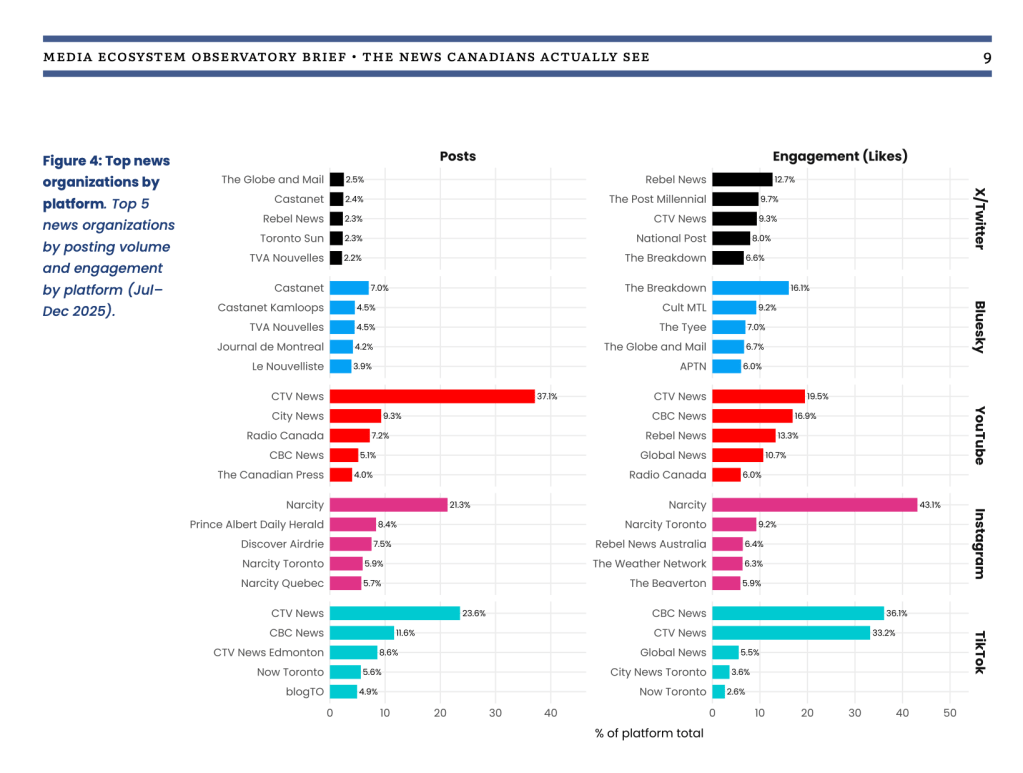
In case you think I am nitpicking about the selective nature of the news ban, a recent academic study found that Narcity is now the leading Canadian publisher of news on Instagram (the study did not have data on Facebook posts).

In this graph from the study, note which Canadian news organizations lead in posts and engagement on YouTube and TikTok, compared to Meta’s news-embargoed Instagram:

And in case you are wondering why Canadian Press did not intervene in the CRTC proceeding initiated by LITS and has nothing to say about CP content being published daily on Facebook and Instagram by Narcity, well so am I. My direct inquiry to Canadian Press on this matter did not elicit a reply. 

In related news, the municipal council of Sturgeon County in the greater Edmonton region had Meta’s Canadian spokesperson Rachel Curran in front of them last week to answer questions about the $13 billion data centre planned for the area. 

When the questions turned from the proposed data centre to the Meta news ban, Curran had a quotable defence for it:

“These publishers share information and articles on our platforms because it benefits them in the form of distribution. We have a responsibility not to do things that are going to unnecessarily exert downward pressure on our stock price.”

***

Paramount can see the finish line in obtaining approval of its $111 USD billion merger with Warner Brothers Discovery. But first it faces a court hearing in two weeks: numerous Attorney Generals for California and 12 other states will ask for an injunction blocking the deal while they seek to derail the merger on anti-trust grounds.

Paramount’s Ellison family ownership has the wind at its back. The US Department of Justice took a pass on blocking the merger and this week both Canadian and European Union competition authorities did the same. 

Paramount is offering the courts a legal justification that will be familiar to Canadians who followed the Rogers-Shaw merger, blessed by the CRTC in 2022: that no matter how big a streamer, film studio and television company that Paramount becomes, it’s still a smaller media conglomerate than Netflix, Google, or Apple. 

***

If you would like regular notifications of future posts from MediaPolicy.ca you can follow this site by signing up under the Follow button in the bottom right corner of the home page; 

or sign up for a free subscription to MediaPolicy.ca on Substack;

or follow 
@howardalaw on X or Howard Law on LinkedIn.

COMMENTS ARE WELCOME. But be advised they are public once I hit the “approve” button, so mark them private if you don’t want them approved. 

I can be reached by e-mail at howard.law@bell.net.

This post is copyrighted by Howard Law, all rights reserved. 2026.
Catching up on MediaPolicy – Carney’s Fleecing – Honest Reporting’s tax troubles – what CRTC chairs do – huzzah Canada!

July 5, 2026

Of the gamut of emotions that supporters of the Online Streaming Act ran through when Prime Minister Mark Carney overruled the CRTC’s 15% contribution scheme for Netflix and the foreign streamers, the most gut wrenching was betrayal.

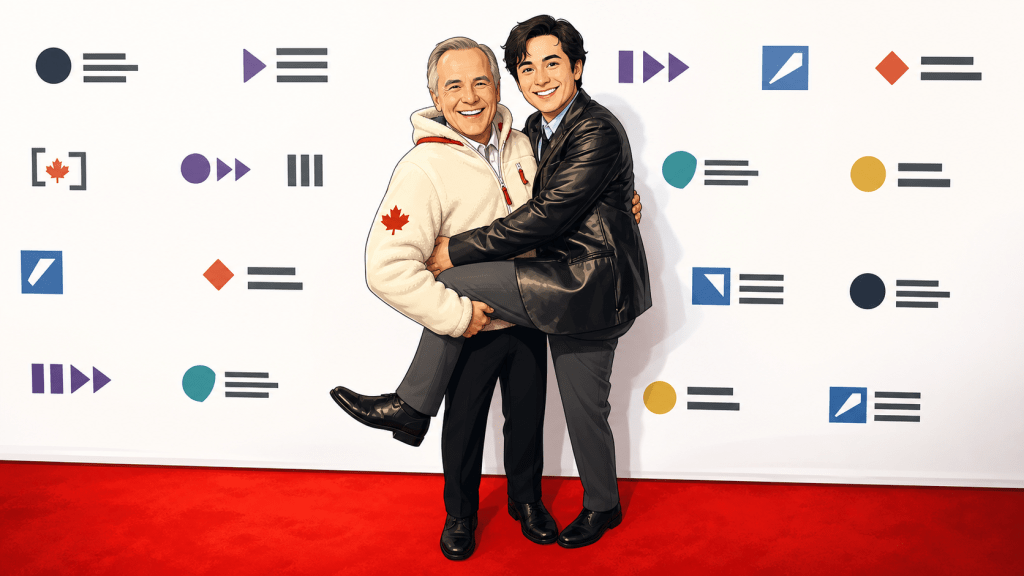
Who could forget only 125 days earlier Carney horsing around with Hudson Williams at the CMPA Prime Time conference, donning the iconic Team Canada fleece jacket from the TV series Heated Rivalry? The smash cultural hit was a demonstration of Canada’s “soft power,” said the PM, as he snuggled deeper into the jacket.

In my high school days, wearing the football team jacket was the prerogative accorded to the girlfriends of the young men on the championship team, showing up to class on a daily basis sporting the team colours. 

Well, Carney’s bromance with film producers is over. Or at least they are very seriously taking some time apart. So there’s the problem of the jacket, you see.

Marie Woolf has a delightful story in the Globe & Mail reporting that the executive producer of Heated Rivalry, Brendan Brady, is taking back the fleece (or more precisely, putting on hold his promise to send it to Carney). 

Said Brady, “We actually have one of those fleeces on hold for him that we want to send to him. But obviously I think we’re waiting to see how this goes and making sure that everything gets cleared up for the Online Streaming Act to be enacted for real for us, so we might just be holding off on that.

“If we’re on pause with the government, then the fleece is on pause until we know.”

Alternatively, Brady could raffle it off. 

***

The Investigative Journalism Foundation published a story last week on the tax troubles of Honest Reporting Canada (HRC).

HRC is a media watchdog that appears to have two main functions: the first to stridently criticize by-lined journalists whose news stories it considers treat Israel unfairly. 

The other is to offer journalist-facing content to educate reporters about controversial assumptions often made about the Israeli-Arab conflict without sufficient historical depth or geographic breadth. 

The tax trouble is that as of a year ago the Canada Revenue Agency has been seeking to revoke the charitable status (“as a qualified donee”) of a related organization, Honest Reporting Canada Charitable Organization (HRCCO) on the grounds that it does not engage in any of the tax code’s short list of charitable activities.

Examples of the CRA’s approved spending on charitable objects include the relief of poverty or the advancement of education. 

Also, the CRA told HRCCO that from the audit it performed HRCCO appears to be diverting charitable donations to pay the expenses of the media website, Honest Reporting Canada, which is not a registered charity. 

The tax dispute is headed to the Federal Court of Appeal and in the meantime HRCCO has stopped accepting donations and the CRA has paused deregistration.

Honest Reporting Canada’s publishing generally does not include original news, which explains why it could not obtain “qualified donee” status directly under the federal government’s QCJO program of news subsidies. Probably for a similar reason, HRC is not eligible for Google journalism funds under the Online News Act.

The QCJO program allows non profit journalism organizations to become “qualified donees” of public donations, as an expansion beyond traditional tax parameters limited to education or the relief of poverty. 

In general, US charity tax laws are more hospitable to public interest journalism than the Canadian tax code. 

Meanwhile charities are free under Canadian law to engage in public policy dialogue and development activities connected to the legal purpose of the charity as long as they are not directly or indirectly partisan. Previously no more than 10% of donations were permitted to support political advocacy.

Oxfam Canada Facebook ad

***

It’s not every day you ask yourself, “what would Konrad von Finckenstein do?” 

In February 2011 the one-term CRTC chair (2007-2012) made a ruling he thought was good public policy —-allowing ISP providers to charge more to heavy consumers of data —only to be publicly slapped down by the Harper government that had appointed him. 

Von Finckenstein was outspokenly defiant in response to the government’s public rebuke although in the end his Commission came up with a compromise. He was not reappointed when his term expired a year later.

In a recent appearance on Michael Geist’s half-hour podcast, Mark Musselman is unsparingly candid about the current CRTC chair Vicky Eatrides meekly submitting to her now diminished independence on implementing the Online Streaming Act.

Musselman has the gift of the explanatory gab and calls it as he sees it (and his narrative just happens to line up with the MediaPolicy’s posts on this topic). We part company at about the 27th minute when he describes the current federal policy on supporting film and television as outdated and in need of something new.

Still, the podcast is well worth your time. 

***

If this was a blog site devoted to American media policy, not Canadian, we could spend a lot of time tracking the never ending mergers and corporate somersaults that feature south of the border.

Here are a few in the recent past:

The latest is that Comcast is spinning off its content division, NBC Universal, into a separate company.

This is seen as an acknowledgement of the fading benefits of combining NBC Universal content with Comcast cable distribution, despite Comcast going out of its way to buy NBC in 2011.

Comcast shares bounced up following the announcement that it was cutting NBC Universal loose. More long term, the plan is for Comcast to focus its efforts and its capital on competing with other cable and fixed wireless distribution networks and to free itself of the less predictable media business.

The new NBC Universal would arguably be in a better position to make deals with other distributors not named Comcast. But the sleeper in this new arrangement may be that it becomes a takeover target for Netflix.

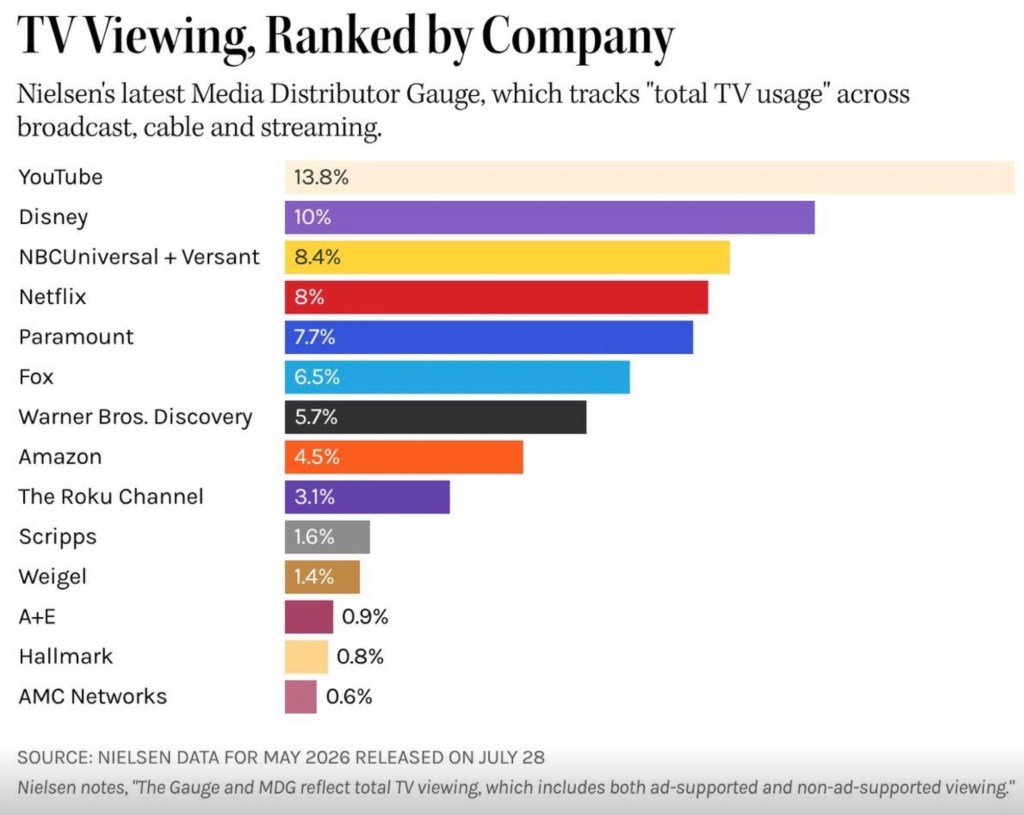
Meanwhile, the 900 pound gorilla YouTube has asked that its sleep not be disturbed. 

from The Hollywood Reporter

***

I cannot sign off this week without stating my admiration of the Canadian men’s national soccer team.

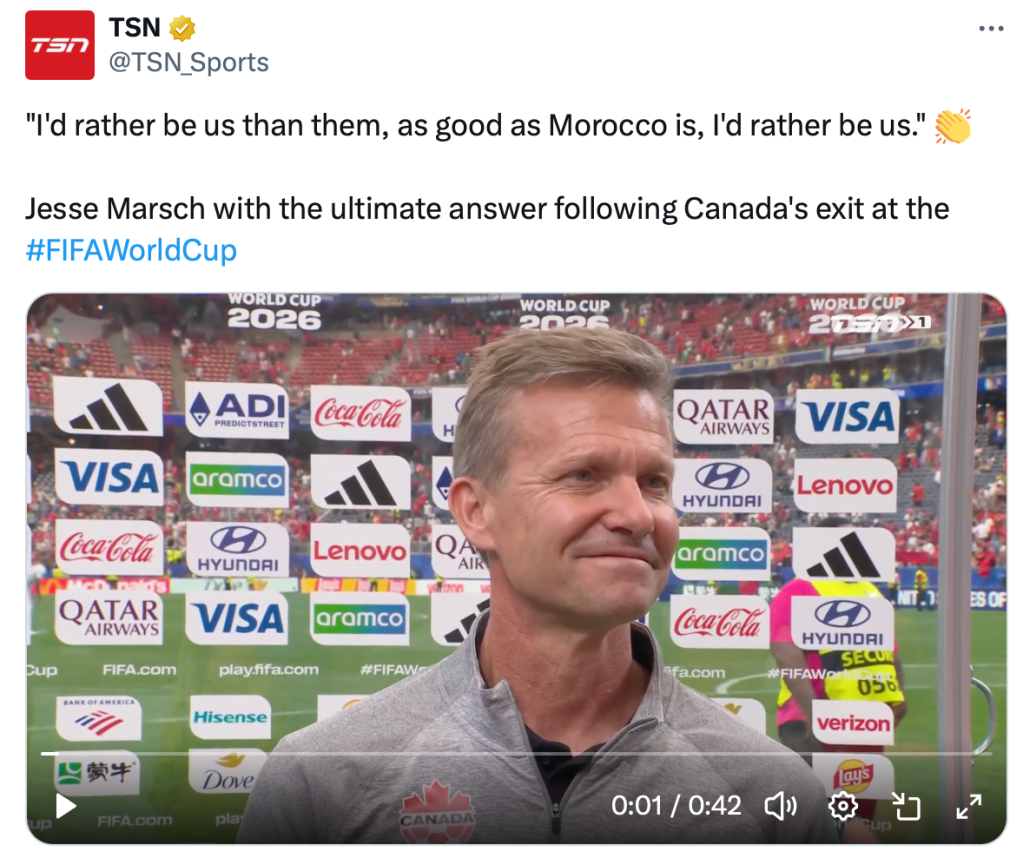
If you watched their 3-0 exit —not reflective of the balance of play—-from the World Cup against a superior team from Morocco, you would have witnessed a special cultural moment of Canadian self belief, ambition, and a brotherhood of young men utterly unafraid of the odds.

Instead of doing the classic underdog routine of turtling in a defensive shell and playing 120 minutes for a penalty shoot out, the Canadians went for the jugular from the opening whistle. They were the better team for most of the game.

Other than the injured Alphonso Davies, there are no world class stars on this team. Yet they played as if it was the ghost of Admiral Horatio Nelson whispering in their ears, “ne’er mind the maneuvers lads, always go straight at ‘em.”

Huzzah.

***

If you would like regular notifications of future posts from MediaPolicy.ca you can follow this site by signing up under the Follow button in the bottom right corner of the home page; 

or sign up for a free subscription to MediaPolicy.ca on Substack;

or follow 
@howardalaw on X or Howard Law on LinkedIn.

COMMENTS ARE WELCOME. But be advised they are public once I hit the “approve” button, so mark them private if you don’t want them approved. 

I can be reached by e-mail at howard.law@bell.net.

This post is copyrighted by Howard Law, all rights reserved. 2026.

Miller has no idea what Carney and Sarandos discussed – will Montreal voters punish the Netflix bailout? – Senate publishes CBC report – US media giants continue to merge

June 20, 2026

After getting challenged by CTV’s Vassy Kapelos for his government’s June 3rd “capitulation” on the Online Streaming Act, culture and identity minister Marc Miller travelled to the Banff World Media Festival this week where the Globe and Mail’s Barry Hertz put the same proposition to him.

“Look, well, it’s wrong,” said Miller rejecting the “capitulation” label. The minister is preparing to issue new instructions to the CRTC on foreign streamer contributions to Canadian content.

“There isn’t a chance that we won’t stand up and make sure that Canadian culture gets supported. I certainly do understand the frustration, because there’s been a lot of blood shed and battles fought on these grounds. … But you can have all the aspirations in the world to make sure that people are doing what they’re supposed to be doing, but if that doesn’t work, we have to act. And this reflects my impatience, and the Prime Minister’s impatience, to make sure that we are creating some stability in the system.”

Hertz also asked Miller if Netflix and the other US streamers would ever pay anything into Canadian media funds that subsidize Canadian content, given that Netflix had volunteered to the CRTC in 2023 that a two per cent levy was acceptable.

Miller responded that “we have to have that conversation with streamers, which has yet to occur in any developed form. My colleagues in the Bloc Québécois assume that it will go down to zero. That isn’t the case. We want people to pay what they would on a fair basis, and you can compare it to some other jurisdictions. It may be a staggered process of policy directions. I want to get it set out quickly, so we can get the ball rolling.”

Miller’s answer appears to contradict a government source in an earlier Globe and Mail story who said the government would direct the CRTC to levy no cash contributions on streamers at all. 

Next, Miller was asked if the government is confident in its assumption that streamers can successfully pass along the CRTC’s 6.55% cash levy to Canadian subscribers given the aggressive price increases of the past years in an industry notorious for subscriber churn. Research from the EU suggests regulatory charges don’t necessarily get passed along. 

“Not to minimize the counterpoint that you’re making,” he responded, “but we have seen in some of those jurisdictions an increase in production costs, which is an affordability issue from another angle.”

In other words, the government’s assumption of a subscriber paid “Netflix tax” is based not only on the CRTC’s order of 6.55% streamer cash contributions to media funds but also an assumed increase in streamer production costs arising from the CRTC order for streamers to spend 8.5% of Canadian revenues on making Canadian shows for their own platforms. (The EU study did however take that into account).

Finally, Hertz got to the salacious stuff and asked Miller what he knew about the private meeting that the Prime Minister had with Netflix CEO Ted Sarandos a week before his June 3rd announcement of the government bailout.

The minister said he didn’t know.

“I don’t know what was discussed, to be honest I know they met, and he meets with a lot of people in the industry. I don’t think that anyone meeting would shape policy in any way that’s material.”

Meanwhile according to Hertz’s further reporting, the Canadian producers attending the Banff festival were generally in a state of disorientation following the government striking down the Netflix levies and promising to replace the CanCon production money from a $600 million increase in federal cultural spending. 

Like any entrepreneurs investing in multi-year projects, Canadian film producers need to know where their financing is coming from before they start taking out loans and passing on other projects. More than half of their production budgets come from government tax credits, media funds, and direct investments by broadcasters and, until June 3rd, foreign streamers too. 

The government promised to replace the streamer money with taxpayer cash but for now no one knows when, how much, or what the program rules might be.

Yet despite all appearances to be making it up as they go along, there are signs that the federal Liberals know what they are doing but are keeping their cards close to their vest.

One clue is the special industry committee that Miller created in April to advise on the future of Canadian video production. In a press release, the government offered no details on the committee’s mandate. Neither did officials for the Canada Media Fund, the public-private subsidy fund central to any changes in the bundle of financing sources that consists of investments from independent Canadian producers, Canadian broadcasters, foreign streamers, and federal and provincial governments.

Now we have a second clue: a document obtained by veteran journalist Dean Beeby (who was kind enough to share it with me) written in October 2025 by former deputy heritage minister Isabelle Mondou for then-minister Steven Guilbeault. Commissioned immediately after the Carney government was elected in April 2025, the lightly redacted report appears to have three major recommendations:

  • Identify efficiencies by combining the program administration of Canada Media Fund, the National Film Board and Telefilm Canada. 
  • Formulate an “integrated vision of audio-visual production.” 
  • Align the funding mandates of federal subsidies (i.e. the Canada Media Fund and the CPTC tax subsidies) with that vision.

One of the salient points made by the deputy minister is that government CanCon subsidy is overwhelmingly dedicated to production financing and is underwhelming in its support of pre-production development and post-production distribution and export strategies. Although the final recommendations are redacted in the document, the deputy minister’s observation correlates with advice from some Canadian commentators that a policy shift is overdue (and see the item on the Fox-Roku merger, below). 

The Mondou memo was signed off eight months ago by Guilbeault, so it may be that since then civil servants in the Department of Heritage have fleshed out a plan they want to run past the industry volunteers on the minister’s new committee. 

It’s unknown if the new vision that emerges will dovetail with the minister’s other big files: rewriting instructions to the CRTC on streamer contributions, figuring out what that means for “equitable” contributions from Canadian broadcasters, and then replacing any shortfall from the $600 million bank account for federal cultural subsidies, also announced on June 3rd.

On another front, there is the policy storm moving in from a different direction: what to do about federal funding of news journalism. 

Miller announced in May that the Carney government plans to extend federal QCJO journalism salary subsidies to broadcasting companies. The public consultation was also announced on June 3rd, the same day as the CRTC’s streamer levies were struck down. Those QCJO subsidies are scheduled to drop from 35% to 25% of journalist salary rates in 2027. 

As well, the Netflix bailout scotched the annual $45 million in expected streamer contributions to the Independent Local Television News Fund earmarked as relief for the financially distressed Global News network and 19 other independent television stations. 

The quashed streamer cash levies were also expected to put $40 million in annual radio news funding.

On yet another funding front, the federal government is cutting $10 million of the funding for weekly newspapers in the $85M Canada Periodical Fund . 

With all of those funding cuts in the wind comes the news that Heritage is continuing its five-year review of the Periodical Fund but now also the $20M Local Journalism Initiative which was only recently reviewed.

Something’s up.

***

Another potential outcome of the Netflix bailout is whether the Liberals pay the price for their decision in Québec where electors rank cultural issues —-deeply intertwined with language issues—- near the top of their list. The Carney government’s shredding of the Trudeau-Guilbeault environmental policies is also on the list. 

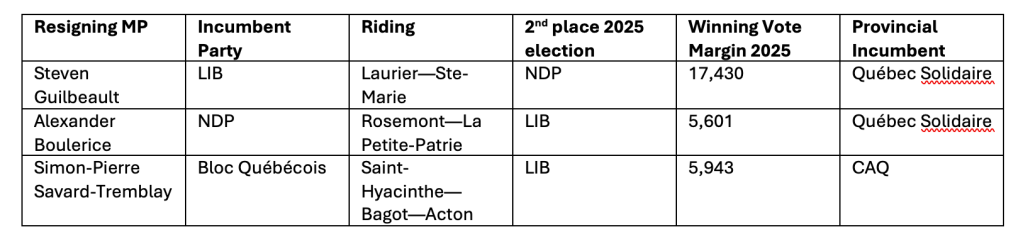
Not only is there a provincial election in October that could produce a separatist government spoiling for a fight with Ottawa, but the Bloc Québécois is gearing up for three federal by-elections in the greater Montréal area triggered by pending resignations from the House of Commons by Liberal Steven Guilbeault, the Bloc’s Simon-Pierre Savard-Tremblay, and NDP MP Alexander Boulerice. Two of the three ridings are sufficiently progressive to have elected Québec Solidaire provincially. 

The Carney Liberals currently hold majority government by a three-seat margin. 

***

The Senate Transportation & Communications Committee has released its report on the CBC. 

The report made only seven recommendations, three of which can be summed up as arguing for a major pivot of the public broadcaster into local news. 

What grabbed headlines of course was the recommendation of a regular audit of CBC News content by an external consultant to assess for bias in news reporting. 

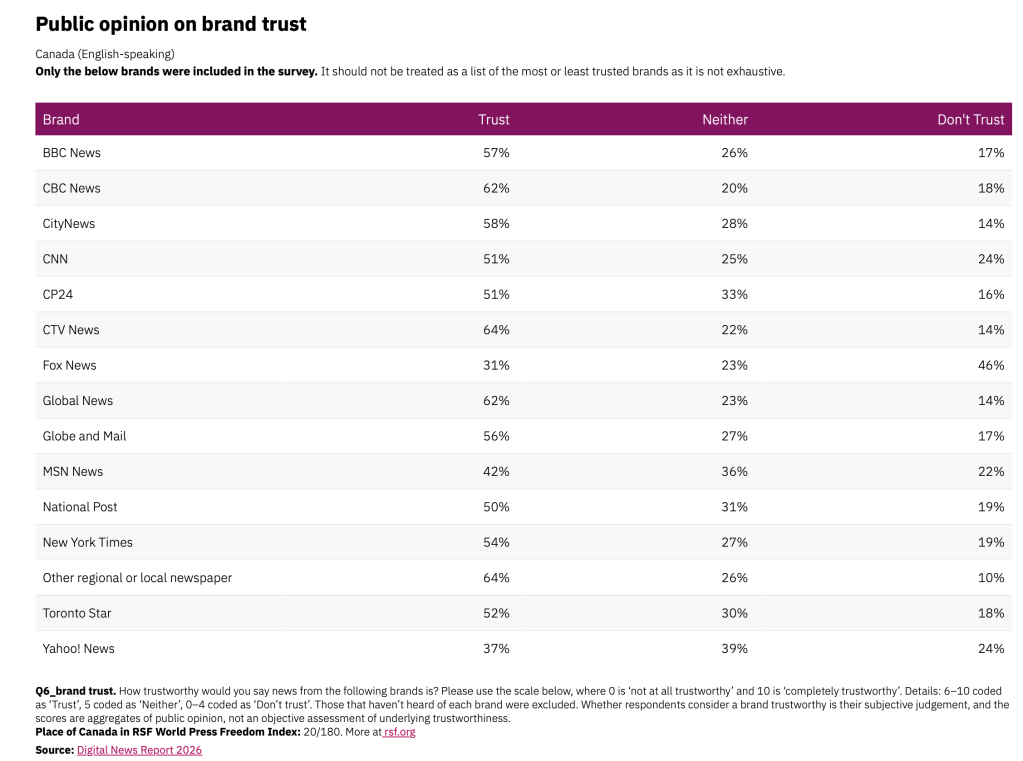
Source: Reuters Oxford Digital News Report, 2026

***

Media merger activity in the US is getting frothy.

After the US Department of Justice announced it had no anti-trust concerns about the Paramount $110 USD billion takeover of Warner Brothers Discovery, the Wall Street Journal published a story with sources from “people familiar with the matter.”

The story was that DOJ staff lawyers were “leaning towards recommending” a DOJ anti-trust lawsuit blocking the merger when senior DOJ officials unexpectedly announced the green light for a “pro-competitive” merger. The focus of the staff investigation had been whether Paramount CEO David Ellison can deliver on a promise to increase, not decrease, the number of feature film productions given the extraordinary debt load incurred to buy Warner Brothers. 

In an unrelated announcement, the Murdoch-owned and content-rich Fox Corporation is paying $22 USD billion to buy streaming distribution giant Roku. 

Fox already runs its own free advertising streaming television (FAST) platform Tubi that engages 100 million active users each month. Fox will consolidate Tubi with the Roku’s industry-leading 80 million accounts that are integrated into its streaming hardware and content launch screens.

***

If you would like regular notifications of future posts from MediaPolicy.ca you can follow this site by signing up under the Follow button in the bottom right corner of the home page; 

or sign up for a free subscription to MediaPolicy.ca on Substack;

or follow 
@howardalaw on X or Howard Law on LinkedIn.

COMMENTS ARE WELCOME. But be advised they are public once I hit the “approve” button, so mark them private if you don’t want them approved. 

I can be reached by e-mail at howard.law@bell.net.

This post is copyrighted by Howard Law, all rights reserved. 2026

Catching Up on MediaPolicy – What comes after “No Netflix tax”? – British regulator backs news publishers vs Google AI

“Elbows up, eh?”

June 7, 2026

Eight months is a long time in politics and we have come a long way since former Heritage minister Steven Guilbeault proclaimed that “culture is not on the table” in CUSMA trade talks.

Despite Prime Minister Mark Carney vetoing the core ruling of the CRTC’s application of the Online Streaming Act to Netflix and the Hollywood streamers last Wednesday, a wag might suggest Guilbeault has been vindicated. Culture never even got to the table.

If you have any lingering doubts about my view on all of this, you can go back and read my opinion column published last Friday in Cartt.ca. If on the other hand you would rather just soak your head in some sardonic humour, there’s always Mark Musselman’s satiric piece.

Carney may have made his political calculations shrewdly. His cave on streamer contributions to Canadian content and his embrace of the Conservative Party’s “no Netflix tax” anthem wasn’t much more than a one day story in English Canadian media. The Globe & Mail’s television critic Kelly Nestruck stood out as a dissenter.

In Québec media commentators were critical, but not in the hair-on-fire manner you might have expected. Perhaps everyone is waiting to see where the big fat $600 million in public subsidies, tabbed to replace streamer dollars, is going to land. Brilliant stuff sir, keeping your critics hungry like that.

Nobody in the national media, save one journalist, thought to ask the Prime Minister what transpired in his private meeting with Netflix CEO Ted Sarandos a week before handing him a multi million dollar windfall. If the Prime Minister was ever to attend Question Period, an MP might ask him.

Now perhaps there is reason for optimism, or at least less pessimism.

We know nothing about the $600 million. It could be good news.

Also, we haven’t seen the minister’s new Policy Direction to the CRTC that is supposed to guide the regulator’s reconsideration of its government-vetoed ruling.

The PMO’s lawyers will be hard at it, drafting the new Policy Direction so that it stays on the legal side of the line that separates “advice” from “command.” A PMO dictat to ban streamer cash contributions to Canadian media funds will be tricky. As will any bottom line demands on direct streamer investments in Canadian programming.

As well, we have to wait to see if the new Policy Direction quietly delves into other parts of the CRTC’s ruling that the government may or may not like.

Rethinks of copyright partnerships, priority treatment for English language dramas, and funding for “services of exceptional importance” are possible.

And of course, the biggest conundrum that seems to escape all notice is what to tell the CRTC to do with respect to the yawning gap between foreign streamer contributions to Canadian content and those made by Canadian broadcasters.

After all, the law that Parliament passed requires the regulatory load be spread “equitably” and the first CRTC ruling did that (with fingers crossed behind back) by fixing a 15% (of revenues) CanCon spending quota for streamers and 25% for broadcasters.

You can expect Canadian broadcasters to tell the CRTC that they want the deal that Netflix got.

Well played, Mr.Prime Minister.

[Update: “Ottawa to roll back implementation of the Online Streaming Act, an irritant in US trade talks” – Globe & Mail, June 7, 2026]

***

I like to track below-the-radar stuff for you.

Here’s one: the British Competition and Markets Authority just ruled that Google must reveal to news publishers whether it’s ingesting their content into its AI models and give them a window into who is engaging with their content. According to Press Gazette, the CMA will require Google to:

“– provide publishers with effective controls over the use of their search content in generative AI

“– publish clear, comprehensible and user-friendly information explaining how publishers’ search content is used by Google in its generative AI

“– provide publishers with clear and detailed metrics on user engagement with their search content in search generative AI features

“– take reasonable steps to ensure that search content is attributed clearly and accurately in general search, and that end users have a clear means to access that search content.”

The CMA also says that it plans to force Google to let news publishers opt-out of AI ingestion of their content and —this is a big one— stop Google from forcing news publishers to de-index their linked snippets from appearing in Search as the condition of withholding their content from the maw of Google’s AI models.

Said the regulator, “Publishers will now have effective tools to prevent their content being used to power AI features in search, such as AI Overviews. This will put publishers, like news organisations, in a stronger position to negotiate content deals with Google.”

Keep in mind, the CMA’s move is a competition remedy to an anti-competitive practice by a single monopoly tech player. On another continent. By a public regulator that could be overruled by elected officials. Although as we know, that so rarely happens.

***

If you would like regular notifications of future posts from MediaPolicy.ca you can follow this site by signing up under the Follow button in the bottom right corner of the home page; 

or sign up for a free subscription to MediaPolicy.ca on Substack;

or follow 
@howardalaw on X or Howard Law on LinkedIn.

COMMENTS ARE WELCOME. But be advised they are public once I hit the “approve” button, so mark them private if you don’t want them approved. 

I can be reached by e-mail at howard.law@bell.net.

This blog post is copyrighted by Howard Law, all rights reserved. 2026.
Mark Carney’s big pivot on the Online Streaming Act: Elbows Up, this isn’t.

June 5, 2026

This week’s announcement by Culture and Identity minister Marc Miller that the federal government is striking down the CRTC’s ruling on streamer contributions to Canadian content is perhaps more shocking in its timing than its substance.

After all, Prime Minister Mark Carney’s government has an appetite for jettisoning government policy that he considers unwanted baggage. Recall the climb down from the Digital Services Tax, the carbon tax, and the suite of Trudeau-era environmental policies…

Continue reading at Cartt.ca

***

If you would like regular notifications of future posts from MediaPolicy.ca you can follow this site by signing up under the Follow button in the bottom right corner of the home page; 

or sign up for a free subscription to MediaPolicy.ca on Substack;

or follow 
@howardalaw on X or Howard Law on LinkedIn.

COMMENTS ARE WELCOME. But be advised they are public once I hit the “approve” button, so mark them private if you don’t want them approved. 

I can be reached by e-mail at howard.law@bell.net.

This blog post is copyrighted by Howard Law, all rights reserved. 2026.