The political consensus in Québec on regulating audio-visual and audio content to protect culture and language meant that Bill 109 didn’t spark the controversy that the federal Bill C-11 did two years ago.
But the tinder is dry and the sparks will fly.
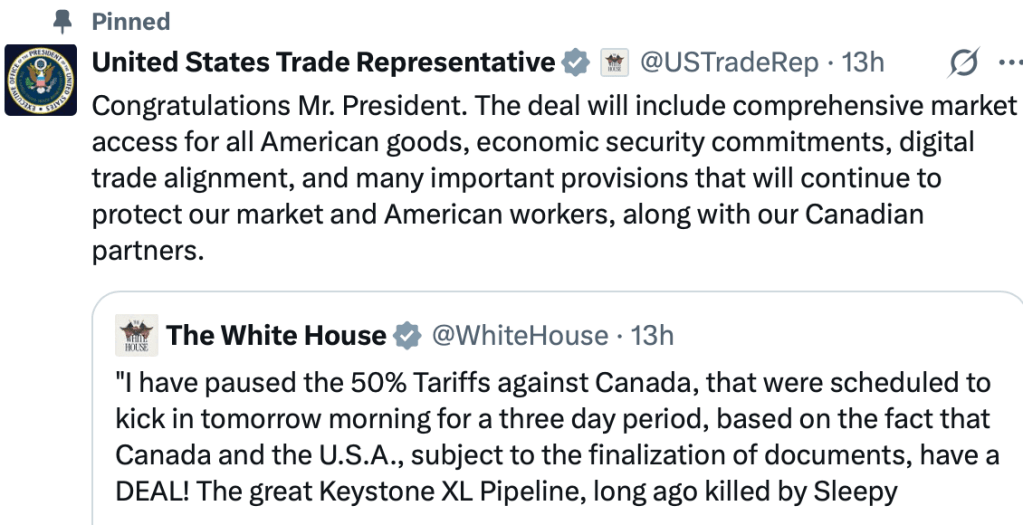
The US Trade Representative will add Bill 109 to its list of American grievances over Canada regulating Hollywood streamers and Big Tech, to be tabled in CUSMA negotiations this spring. (When coincidentally the 2026 Québec election might be called).
So too there must inevitably be an impasse between the Mark Carney government and Québec over legislative jurisdiction. Though brief by comparison, Bill 109 is almost a carbon copy of Bill C-11. Until the Supreme Court says otherwise, Ottawa has exclusive jurisdiction over online broadcasting.
Québec’s culture minister Mathieu Lacombe has been pretending there’s nothing jurisdictional to talk about with Ottawa. According to the minister, there’s no conflict, only concurrent federal and provincial powers to do the same thing. Good luck with that. A caveat: he might have a provincial claim to the regulation of home screens on Smart TVs and streaming devices.
The Québec law is founded on a provincially claimed right to cultural discovery —props to that boldness. Importantly, all of the bill’s cultural measures are focussed on French language content, not Canadian French language content, so the political framing is more linguistic than cultural.
Mess with this if you dare, Ottawa.
From here, things will move slowly at first.
Québec will establish the minister’s Discoverability Office and begin drafting streamer requirements for French language content.
The CAQ’s Lacombe will find out if the streamers are willing to take up his offer to negotiate bespoke agreements in order to avoid cookie cutter regulations set by the province.
On video streaming, he will no doubt benchmark his regulations or voluntary agreements with streamers against the outcomes reached in France since 2021.
Despite a framework EU law that proposes a 30% catalogue minimum (numbers of shows), the French implementation of that policy focusses instead on production investments in French language content, based on a range of 20% to 25% of a streamer’s national operating revenues. So far, the result has been bigger budgets rather than a proliferation of mid-budget shows.
On other hand Lacombe could just stick with catalogue quotas, as the CRTC is expected to announce its own federal expenditure quotas soon.
As the Québec legislation doesn’t require the cash contributions to Canadian media funds that the streamers hate so much in the federal scheme, a deal with Netflix focussing on French language video catalogues doesn’t seem out of the question.
A deal with Spotify to do something dramatic to increase rock bottom consumption of French language music would be tougher.
Unless Lacombe’s process moves at lightning speed, CUSMA talks and the Québec election will intervene.
***
If you don’t have school age kids, you might have missed the seismic Big Tech event that just shook Australia: its government has banned social media accounts for children under age 16.
The Australian communications minister Anika Wells is the first politician in a liberal democracy to tell social media companies, “time’s up.” Apparently so, even Elon Musk says he will obey the law.
There’s a brief explainer in the New York Times on how harmful social media can be for teens and how we got to the point that Big Tech’s safety half-measures have worn out the patience of legislators.
Still, a ban. Wow. As our federal justice minister Sean Fraser eyes a revised online harms bill, what would be interesting is an opinion poll on a ban, taken from Canadian parents of tweeners and teenagers, parsed out separately for age and gender of the children.
***
In last weekend’s post, I speculated that Donald Trump would have some fun with the $87 billion USD Netflix-Warner Brothers merger deal, given his donor ties to the losing bidder, Paramount.
The next business day after Netflix officially announced its winning bid, and media analysts had their say on the prospects for Netflix obtaining the Trump administration’s anti-trust vetting, Paramount unveiled its Plan B: a $108 billion hostile takeover bid for all of Warner Brothers Discovery properties.
Warner Brothers has a week to respond but Paramount CEO David Ellison has already signalled an improved second bid is ready to go.
Among Paramount’s financial backers are the CEO’s dad and second richest man in the world, Larry Ellison, and various gulf state sovereign wealth funds. Oh, and President Trump’s son-in-law Jared Kushner.
The Ellison-Gulf-Kushner bid includes Warner Brothers’ television entertainment channels and the cable news network CNN.
Ellison-the-younger’s Paramount recently bought the CBS news network and appointed the Free Press’ Bari Weiss as CEO. Pa Ellison is also the key investor in the bid to buy TikTok’s US operations.
***
A significant AI content licensing deal has been struck between the IP-rich Disney and OpenAI, the developers of Chat GPT and the video-creation app Sora.
The deal will allow Sora subscribers to create videos with Disney’s classic animated film characters. Imagine making a birthday video card for your kids featuring them with their preferred cuddly creature or action hero.
As reported by The New York Times: “Sora users will be able to make videos with more than 200 characters from Disney’s library, including from “Encanto,” “Frozen,” “Moana,” “Toy Story,” “Zootopia,” “Inside Out” and other animated movies. Animated or illustrated versions of Marvel characters like Deadpool, Iron Man and Black Panther will also be available, along with “Star Wars” characters like Darth Vader and Princess Leia.”
Given all of the chatter about AI companies scraping copyrighted content, the Disney-OpenAI deal will set expectations that licensing deals are the way for Big Tech to make peace with content producers, especially the biggest ones. (Oddly the reporting on the deal noted Disney’s $1B USD investment in OpenAI but was mum on the value of licensing payments that Disney can expect).
The Hollywood Reporterhas a good analysis of the deal, the gist of which is Disney isn’t going to rest on its IP laurels while other content companies get rich on AI monetization.
More broadly, the slow drip of licensing deals between AI and content companies might, in the news journalism space, begins to look like the years leading up to Australia’s NewsMedia bargaining code and the Canadian Online News Act: AI companies cherry pick the biggest and most popular news outlets for licensing deals while those left behind look to governments for action on content scraping and monetization.
***
If you would like regular notifications of future posts from MediaPolicy.ca you can follow this site by signing up under the Follow button in the bottom right corner of the home page;
or sign up for a free subscription to MediaPolicy.ca on Substack;
MediaPolicy previously made the observation that while Culture and Identity Minister Steven Guilbeault rejects any further trade concessions to Donald Trump on cultural legislation, we haven’t heard from Mark Carney. And probably won’t. The PM is shying away from those kind of red lines as he transitions rhetorically from “elbows up” to bended knee.
Those of you who recall your history might remember that, according to reports, Canada’s theatrical film legislation was the very last thing on the negotiating table when Brian Mulroney and Ronald Reagan agreed to Free Trade deal number one in 1987. It didn’t go our way.
It’s good to educate ourselves in anticipation of similar cliffhangers. Last weekend the Globe and Mail’s arts staff writers went all out with a collection of stories about the challenges for Canadian artists and media producers as Canada’s trade relationship with the United States wobbles.
Kelly Nestruck wrote about how television production, stage shows and museum exhibitions are going to manage when access to their main export market, the United States, could be up for grabs.
Brad Wheeler invitedRheostatics’ Dave Bidini to riff on his new album, as well as elbows-up nationalism (“Bumper sticker nationalism is not interesting to me,” says Bidini).
Josh O’Kane looked at the desperate state of Canadian-owned book publishing.
Eric Andrew-Gee explained the warm hearth of Québec’s cultural nationalism to anglophones (“The price of having a culture to protect is constant fretting about the state of that culture”).
And last of all Barry Hertz broached the sensitive topic of whether collectively we are up to supporting Canadian culture at all.
The poll says that 87% of Canadians now support the Liberals’ Online Streaming Act Bill C-11 (up from 67% in May 2022). As for having a fight over Canadian culture with Trump, 68% of Canadians say yes, only 13% say throw it under the bus (the rest don’t know).
It’s true that half of Pollara’s respondents had no clue about C-11 in the first place, but the pollster’s “statement” polling below suggests Canadians’ values are nevertheless strongly aligned with defending cultural legislation.
***
In last weekend’s post, MediaPolicy summarized CBC President Marie-Philippe Bouchard’s plan for reinvigorating the public broadcaster. Her two biggest points were “more local” and “more diversity.”
Bouchard’s line on ‘more local’ —-she keeps using the word “proximity” to capture both geography and audience affinity with content —- is that digital technology means the CBC can pivot back to local without having to build new stations.
Sitting next to Bouchard, CBC’s Regional Services GM Jean Francois Rioux also emphasized affinity. Canadians want to see people “like me” or “like us” on CBC. They also want other Canadians to see and hear their concerns on the national stage that CBC provides.
There are others who have a different take on affinity, and they mean ideological affinity, code for “more conservatism” on CBC.
Bouchard treads delicately on this one, although in her Commons appearance she thoughtfully suggested that the CBC’s retreat to major cities as a response to budget cuts in the 1990s probably meant that coverage skewed to metropolitan values, which can feel “more centre and left” to anyone living in the “more centre or right” hinterland of Canada.
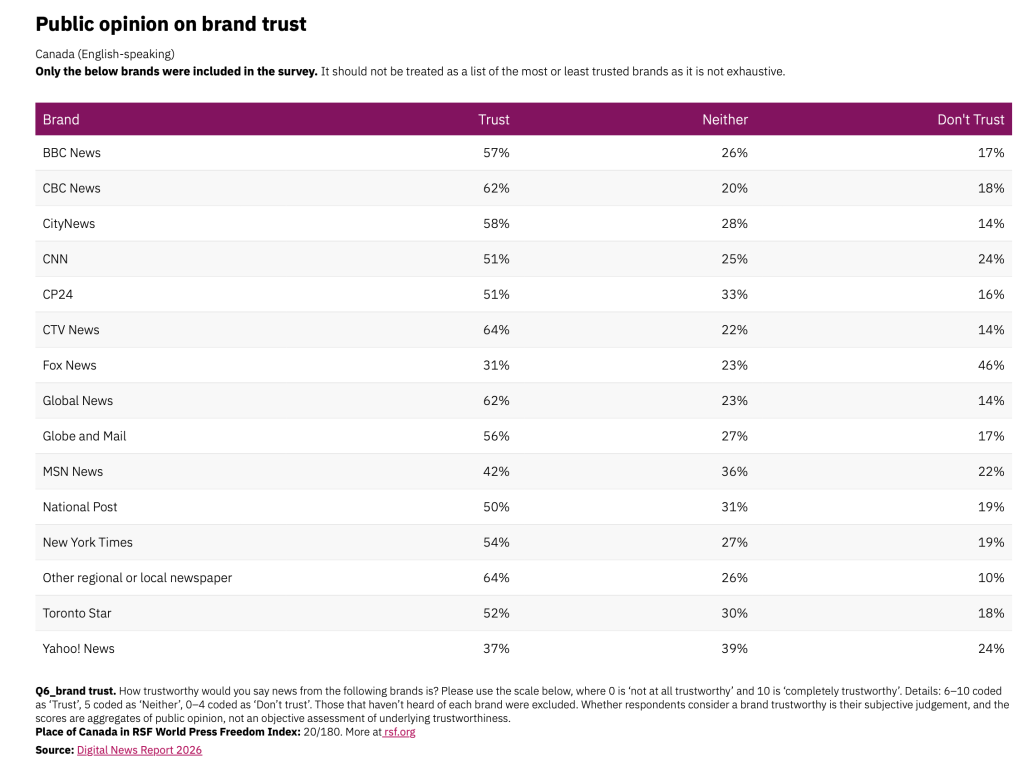
Bouchard was also interviewed by CBC reporter Jayme Poisson on her October 16th Frontburner podcast. Poisson poked reasonably hard on a number of sore points. On ideological diversity, Poisson pointed out that although CBC’s “trust” rating tops the charts, CTV and Global score better with conservative listeners. Maybe more opinion coverage is what’s needed?
Bouchard didn’t immediately bite on the suggestion —- avoiding a debate over whether big-c Conservatives are treated fairly in CBC coverage— but said what was needed was consistent inclusiveness in CBC content:
Well, I mean, there’s all sorts of ways to make people feel reflected and included. It starts by being in the communities where they are. It also means including a more diverse set of points of view. If that’s possible. And it’s also about being constant about it. Not just during an election period or during a specific period of time. It’s just to have that reliable approach to a diversity of points of view.
That sounds like a shift in content curation as a conscious effort. The execution will be the hard part.
***
A public broadcaster that offers affinity as broadly as possible (my new description of being “highly trusted”) is something we need to keep our democracy glued together. It’s important that everyone is motivated to check in with at least one media source that tells them about all tribes, not just their own.
Wikipedia does something similar. The popular website is quietly just there in our Google Search results. If you read it critically, you’ll get both the uncontroversial facts and the contentious points, the latter helpfully linked to content that you can read and then draw your own conclusions.
That’s unless Wikipedia is a woke, left-wing mind control machine, which is how it gets disparaged these days by the MAGA movement. To that point, Elon Musk says he’s about to release his politically recalibrated competitor to Wikipedia.
Here’s an interesting read from the Washington Post about the political campaign against Wikipedia lead by co-founder Larry Sanders.
***
If you would like regular notifications of future posts from MediaPolicy.ca you can follow this site by signing up under the Follow button in the bottom right corner of the home page;
or sign up for a free subscription to MediaPolicy.ca on Substack;
The ka-ching is the responsibility of the Google-appointed gatekeeper, the Canadian Journalism Collective, to decide who gets what.
The conservative website The Hub gets $22,248 and is donating it to the March of Dimes charity. The Western Standard, operated by former Wildrose Party MLA Derek Fildebrandt, is down for $68,377. Rebel News didn’t apply.
None of that is surprising. The Hub and the Western Standard were previously vetted by the Canada Revenue Agency as Qualified Canadian Journalism Organizations, becoming eligible for federal news subsidies or reader tax credits (but not necessarilycollecting them). Rebel Newswas not.
An unusual outcome of the Canadian Journalism Collective’s distribution was that the CJC approved the licensing cash for the current affairs website The Conversation (sub nom the Academic Journalism Society) after the CRA rejected it as ineligible for the QCJO subsidy program. The CRA’s rejection (on the recommendation of its independent advisory panel) was upheld by the Federal Court of Appeal in 2024.
The difference in result appears to be how the CJC is interpreting what it means to produce “original news.” That’s a requirement under both the CRA guidelines for QCJO and the Online News Act regulation 2023-276 for Google news payments.
But the difference seems to be that CRA guidelines explicitly require first-hand news gathering “such as independent research, interviews, and fieldwork. For example, a news article orreport about an event would be original if it is written or reported by a journalist and is based on first-hand knowledge that journalist gained by conducting independent research, attending or witnessing the event, or interviewing people who organized, attended, or witnessed the event.”
The CJC guidelines are far less precise. Tersely, “news content should be original, produced on an ongoing basis.”
I did my best to get the Canadian Journalism Collective to explain how it arrived at a different assessment than the Canada Revenue Agency of whether The Conversation is now producing original news with first hand reporting, or if the CJC rules are somehow more forgiving.
All I got was that the CJC’s eligibility criteria was applied and the news content submitted by The Conversation, like all applicant news organizations, will be reviewed each time there is a new cash distribution.
The Conversation’s parent organization, the Academic Journalism Society, has an unusual structure. Its newsroom consists of staff editors who collaborate with university professors who do the writing, based on the academic work of others or their own scholarly writing.
AJS funding comes 80% from participating universities and 20% from readers, philanthropists or government programs. But its financial structure is not an obstacle to qualifying for either QCJO or Google funds. It still comes down to whether the content is original. The QCJO program requires first-hand reporting but it’s unclear if the Google cash distributed by the CJC requires it. In the end I couldn’t get a satisfactory answer.
It’s important to get that answer, in fact it’s vital.
If there is no requirement for first-hand reporting activity, then news organizations are either aggregators of first-hand reporting done by other newsrooms and contribute nothing of their own, or they are opinion websites.
Opinion is cheap to produce and plentiful in supply. Do we need to underwrite opinion writing, or in the case of the Online News Act, devote Parliamentary bandwidth to wresting cash out of the hands of Big Tech?
In a sea of online opinion, commentary and blather, talk is cheap. Meanwhile the far more costly endeavour of news gathering is the value proposition that journalism offers to the public. Looking in the mirror, MediaPolicy.ca isn’t “original news” and deserves no subsidy or special favour.
And there are more good reasons to draw the line between news gathering and opinion.
The Online News Act was opposed by some as an unwarranted state intervention into the ecosystem of online information that Google and social media platforms have provided.
Sure, the monopolistic platforms Google and Meta exploit their market power in content distribution, stiffing news organizations on fair (or any) licensing payments.
But to critics of the Online News Act, this was justified by the overriding public interest in free information, benefiting both liberal democracy and public education.
On the other hand, what the EU, Australia, and Canada did with their legislative intervention on behalf of news organizations was to carve out news journalism from the unregulated Internet as a special case because of the public interest in, well, political and educational information.
As I said, news gathering is the value proposition of journalism.
I could be wrong of course. When Scott White moved on from his role as editor of The Conversation a year ago, he published acri de coeur on LinkedIn. The gist was that the CRA ruling against his news outlet was narrow minded and rooted in legacy thinking.
In an academic article published earlier this year, Nicole Blanchett and her co-writers suggested that “rigid journalism definitions risk excluding hybrid platforms like The Conversation Canada, limiting innovation and diverse voice in public discourse.”
Not to be coy about it, the authors speculated that the troubles encountered by The Conversation should be seen through the lens of legacy media defending its turf:
Answers to these [research] questions were primarily analyzed through boundary work. Boundary work is at play “when the goal is expansion of authority or expertise into domains claimed by other professions or occupations” (Gieryn, 1983, p. 791). Specific to journalism, it includes “expansion” of journalistic practice that can lead to the attempted “expulsion” of outside actors or inside agitators, as a means to protect the professional “autonomy” of journalists (Carlson, 2015, p. 9). As media startups look to attract the same eyeballs as legacy organizations, “efforts to restrict or extend access to technologies, reporting resources, or press credentials are all acts of boundary work that are simultaneously material and discursive in nature. As such, talk about journalism cannot be isolated from practice and context” (Carlson & Lewis, 2019, p. 132).
If you would like regular notifications of future posts from MediaPolicy.ca you can follow this site by signing up under the Follow button in the bottom right corner of the home page;
or sign up for a free subscription to MediaPolicy.ca on Substack;
The Canadian Pressreported last week that the US State Department has an opinion on Canada’s respect for the independence of the press and freedom of expression. And it isn’t good. In fact, we got the MAGA raspberry.
The US produces “country reports” every year to satisfy US Congress that its foreign aid is going to the right place or, in our case, that we’re a suitable trading partner.
Some context first: the Report is a compliance document for Congress. It was not written for us. If the Report’s allegations against Canada happen to line up with Congressional trade complaints against the Online Streaming Act and the Online News Act, that’s part of the compliance.
Trade irritants or not, the Report picks up the vocabulary of Canadian opponents of public broadcasting, federal aid to journalism and any manner of mandatory payments to support Canadian news journalism such as the Broadcasting Act and the Online News Act. It’s “discriminatory,” it’s “censorship.”
The State Department’s special contribution to the debate is it’s view that our federal government’s $10 million enrichment of existing Canadian media funds to support news reporting in minority communities smacks of “DEI” and discriminates against white journalists.
Not that we needed the State Department to remind us, but the Report goes on to list incidents that occurred in 2024 which, in Washington’s opinion, raise “significant human rights issues including credible reports of serious restrictions on freedom of expression and media freedom, including unjustified arrests or prosecutions of journalists and activists.”
The Report gets one right, off the top, by reminding us that in January 2024 the RCMP arrested Indigenous journalist Brandi Morin when she refused to leave the federal police force’s inflated “media exclusion zone” at an Indigenous protest she was covering for Ricochet Media. What the Americans might have added was that this is hardly the RCMP’s first offence on media exclusion zones. The Crown withdrew the charges and the RCMP’s Civilian Review committee took Morin’s side and an apology was issued.
Another incident cited may or may not clear the bar of a “credible” report of press freedoms violated, that will be up to a judge if lawsuits proceed.
The State Department takes at face value the allegations raised by Rebel News against a venue landlord and a Liberal MP that Rebel was wrongly arm-twisted into paying $37,000 in security costs for a MAGA-themed rally it organized in Toronto, headlined by the US President’s son.
Canada doesn’t do country reports on American freedoms. It’s probably just as well. But the United Nations does. All UN signatories to the Convention of Human Rights participate in a five-year “peer review” of each other that includes press freedoms.
Here are a few items that might come up:
During street protests against the immigration-related arrests in Los Angeles in June, an LAPD officer deliberately aimed and shot an on-camera news journalist with a rubber bullet, hitting her in the foot.
The Federal Communications Commission initiated an investigation of Media Matters, a left-leaning critic of right-wing media, Elon Musk’s X platform and the Republican Party. A federal judge issued an injunction against the investigation on the grounds of 1st amendment rights of free speech.
US Congress withdrew all federal funding from the Corporation for Public Broadcasting, accounting for 15% of the overall financing of NPR and PBS. House Republican Marjorie Taylor Greene stated that Congress was acting because of alleged liberal bias.
While running for President, Donald Trump proposed that the FCC pull the broadcasting licenses of CNN, NBC, ABC and CBS because of their news coverage of him (although the FCC only licenses local stations, not cable news).
The President also sued CBS, alleging that a 60 Minutes interview with Democratic presidential candidate Kamala Harris had been edited and sanitized to her advantage.
The Trump lawsuit resulted in a $16 million settlement without any admission of wrongdoing from the network.
However credible news reports suggested that the FCC might have struck down the $8 billion sale of CBS-parent Paramount to Skydance were it not for a last-minute agreement between Paramount and the FCC that the new owners would scrutinize the CBS newsroom for “multiple viewpoints” and abolish all DEI hiring and personnel policies. According to the President, Paramount committed to providing him with $20 million in free advertising and public service announcements although that was refuted by Skydance.
***
As noted above, the State Department Report repeatedly criticizes the Online News Act and the Canadian Press story on the Report states that “Prime Minister Mark Carney indicated last week he is open to repealing the legislation.”
The CP and Post descriptions of Carney’s thoughts on repeal are based on a question and answer session with Kelowna Now.
Here is the reporter’s question:
“Bill C-18 stands in our [publication’s] way to get back onto Facebook and Instagram, are the Liberals looking at an alternative or rescinding that so that we can get that news [about wildfires] back on those platforms?
And here is Carney’s answer:
I’ll say this Steve thank you for the question. First thing and one of the things that we have done —and I will answer your specific question, but let me make a point on something we have done, and you may not like this part of the answer but I am going to give it to you— which is that one of the roles of CBC-Radio Canada is to provide unbiased, local, immediate information particularly in regards in situations such as you are referring to. And that’s why we made the commitment to invest and reinforce and actually change the governance of CBC-Radio Canada to ensure that they are providing those essential services.
Now to your specific question. Personally, this government is a big believer in the value of what you do. I’m going to use you as the representation in local news. And the importance for ensuring that that is disseminated as widely and as quickly as possible. So we will look for avenues to do that and I understand your question and it’s part of our thinking around that, thank you.
If we parse closely, the important nuance here is that Carney said he is “looking for avenues to do that and it’s part of our thinking around that.”
Grammatically, the “that” refers both todisseminating local news (especially in light of his comments about CBC-Radio Canada) and “in response to the question” which refers to “rescinding” and/or “alternatives” (or “avenues”). It’s hard to tell what he meant or whether he intended the ambiguity.
If Trump puts enough pressure on Carney, would the Prime Minister cave like he did on the DST ? Unlike the unimplemented DST, the $100 million in Google money is the bird in hand, not in the bush. The mandatory news licensing payments are already in the bank accounts of over a hundred Canadian online news outlets.
I have a long article to recommend: a New York Times feature that tells the story of Donald Trump’s lawsuit against Paramount’s CBS, the FCC’s approval of the Paramount-Skydance merger and the cancellation of Stephen Colbert’s The Late Show on CBS.
The reporting is based on embargoed access to Paramount owner Sheri Redstone. It’s sympathy for Redstone is not subtle, but it’s an informing read anyway.
***
If you would like regular notifications of future posts from MediaPolicy.ca you can follow this site by signing up under the Follow button in the bottom right corner of the home page; or sign up for a free subscription to MediaPolicy.ca on Substack; or follow @howardalaw on X or Howard Law on LinkedIn.
I can be reached by e-mail at howard.law@bell.net.
This blog post is copyrighted by Howard Law, all rights reserved. 2025.
The CBC has a hip two-minute cut-for-social video explainer narrated by the tattoo-embossed Nick Parker.
And for another take, here’s Paul Wells interviewing Canadian tax expert Allison Christians.
President Trump has promised to re-announce tariffs this week. Carry on Canada.
***
Two months ago when Donald Trump blurted out his desire to tariff US movies filmed abroad he got a tepid response from the supposed beneficiaries, Hollywood studios and the Big Tech streamers.
That’s because the studios and streamers make so many movies in Canada, at a competitive and government-subsidized cost, with world class quality.
What Hollywood really wanted was production subsidies from the US federal government, but so far that has not happened.
Now California is stepping up to the plate. Governor Gavin Newsom is prepared to double existing state subsidies to the tune of $750 million, quite a slice of the pie in what is otherwise a major austerity budget for the state.
***
The Canadian Press has reported that Justice Minister Sean Fraser is having a close look at the federal Liberals’ online harms legislation before re-tabling it.
Bill C-63 died on the order table when Mark Carney called a federal election in March. The core of the Online Harms Bill was to require social media platforms to establish content safety codes, legislation that polling suggests is a winner.
The add-ons to the bill were more controversial. The opportunity for private citizens to file anti-hate complaints against each other under federal human rights legislation, abolished by Parliament in 2012, is to be revived.
And the anti-hate provisions in the Criminal Code are to be strengthened with more severe punishments. MediaPolicy offered some perspective on that, here and here.
Prior to the election, then Justice Minister Arif Virani reluctantly split the controversial from the core elements of the bill into separate legislation. Neither bill was taken up by Parliamentary committees in the months leading up to the election call.
The CP story quotes the new Minister as wanting to make his own “fresh consideration of the path forward.”
There are two 15-minute weekend reads on media that I can recommend.
In his personal blog “Fagstein,” the Montreal Gazette’s Steve Faguy has posted a short history of the CRTC’s decades long struggle to keep local television news solvent.
He’s done a great job. I know how hard it was as I tried to do the same in a shorter space in chapter six of my book on the Online Streaming Act. Faguy’s post is the learning resource that has been missing.
The other read is a feature story from the Globe and Mail’s Josh O’Kane. He’s updated his whodunnit reporting on the cyber-theft of $10 million from FACTOR, the music funding organization that distributes dollars contributed by government, radio stations and (subject to a court appeal) music streaming companies to Canadian musicians.
***
If you would like regular notifications of future posts from MediaPolicy.ca you can follow this site by signing up under the Follow button in the bottom right corner of the home page;
or sign up for a free subscription to MediaPolicy.ca on Substack;
Mark Carney’s shock repeal of Canada’s digital services tax on the eve of Canada Day was greeted by a gloating fan-dance by President Trump’s press secretary who claimed that “Carney and Canada caved to Donald Trump and the United States of America.”
In a brief news interview the Prime Minister suggested that the corporate tax measure, designed to capture offshoring of Canadian revenues by US tech companies, was never going to be in the final trade deal that he is working on with Donald Trump. MediaPolicy expressed its view on all of this in Monday’s post.
This might end up as a historic moment of humiliation, pending future events.
The backlash against Carney has come from all sides. He may be fortunate that Parliament is not in session and his minority government doesn’t have to face the music until the Fall. No doubt, that was his calculation.
Today the Toronto Star published an open letter signed by Canadians for Digital Sovereignty who describe themselves as “a group of patriotic Canadians and civil society organizations who care deeply about the future of Canada.” The letter expresses the concern that backing off the digital services tax will embolden Trump to press other trade demands, in particular where Big Tech and Hollywood are involved.
Carney might regard some coalition members as the usual suspects in public policy matters affecting digital and cultural sovereignty, but the inclusion of others suggest a broader opposition that ought to disquiet the Prime Minister.
The members of the coalition hail from English speaking Canada. From what I have seen on social media, their French-speaking counterparts in Québec are angered by Carney’s DST climb-down and their displeasure will be expressed.
Here’s the Open Letter:
Open Letter: Canada cannot afford to concede more to foreign tech giants
Dear Prime Minister Carney and Minister Champagne,
We are a group of patriotic Canadians and civil society organizations who care deeply about the future of Canada. We are disappointed by the government’s decision yesterday to both halt collection of the Digital Services Tax and eventually repeal the Digital Services Tax Act. As a result, on Canada Day, foreign tech giants will enjoy an immediate $2.5 billion windfall and a $7.2 billion tax break over the next 5 years. While we recognize the difficult choices facing the government, we feel that we cannot ‘build Canada strong’ while surrendering ever more of our digital sovereignty and security.
We urge the Government of Canada to:
(i) Find ways to use foreign tech giants’ massive untaxed profits to fund homegrown alternatives, despite proposing that Parliament repeal the Digital Services Tax Act
(ii) Strengthen Canada’s digital sovereignty in trade negotiations and in undertaking a reset of Canada’s forward digital policy agenda, and
(iii) Make no further concessions to foreign tech giants, including on legislation passed by Parliament (the Online StreamingAct, Online News Act) or in addressing urgent matters including combatting online harms, regulating artificial intelligence, ensuring the integrity of the information environment (including for health information), protecting privacy, among other measures to rein in foreign tech giants’ negative impacts on our economy and society.
Foreign tech giants, especially U.S.-based companies, have made hundreds of billions of dollars in Canada in recent decades and yet have not paid their fair share in taxes. Many enjoy tax breaks on digital advertising paid for by Canadians thanks to a loophole in the Income Tax Act. We are one of the largest digital markets in the world, with a highly online population, skilled workers, and innovative companies. Yet in 2023 alone, U.S. tech giants made $20.7 billion in Canada from distributing online content. U.S. tech giants are crushing domestic competition, dominating our markets and imposing a range of externalities on Canadians. They profit from the amplification of online harms, including the spread of false and manipulated information, hurting the mental and physical health of children along with all Canadians. They are eroding the economic basis for the professional news media and feeding the toxification of our increasingly digital public sphere upon which our democracy depends.
The Digital Services Tax is a modest yet much-needed measure that will ensure foreign tech giants are more fairly taxed and held accountable for their enormous power over Canada’s society and economy. We are disturbed to see the alignment of CEOs of Alphabet, Meta, Apple, Amazon and X Corp. with the current U.S. administration’s agenda, which threatens Canada’s political and economic independence.
Rather than repealing the DST, we urge you to consider how foreign tech giants’ massive unfair profits in Canada could be taxed to invest in Canada’s digital sovereignty, building homegrown alternatives to U.S. monopolies. At many times in our history, Canada has invested to build communications infrastructure in the national interest. Canadian companies can help build platforms, networks, and tools that reflect Canadian values, strengthen our cultural and information ecosystems, and nourish our diversity as a country with two official languages and three founding peoples – Indigenous, French, and English – so that Canadians in communities across our far-flung country can better serve their own needs to communicate and connect.
We note that the U.K. did not make concessions to their digital services tax to get a trade deal with the US.
We stand ready to help our government, to inform and rally Canadians to help build our digital sovereignty and a better digital society.
Regards,
Organizational signatories
ACTRA National Amanda Todd Legacy Society Broadbent Institute Canadian Anti-Monopoly Project Canadian Centre for Policy Alternatives Canadian Centre for Child Protection Canadian Federation of Nurses Unions Canadian Medical Association Canadian Media Guild Canadians for Tax Fairness Centre for Media, Technology and Democracy Children’s Healthcare Canada Community Radio Fund of Canada The Dais Documentary Organization of Canada Friends of Canadian Media Goodbot Society Inspiring Healthy Futures Open Media Pediatric Chairs of Canada Reset Tech Unifor National & Local 87-M
Individual signatories Mike Ananny, former advisor to Canadian Heritage on the future of CBC/Radio-Canada, and Associate Professor of Communication and Journalism, University of Southern California
The Right Honourable Adrienne Clarkson, CC
Linda McQuaig, author and journalist
Taylor Owen, Director of the Centre for Media, Technology and Democracy and Associate Professor at McGill University
John Ralston Saul, CC
Leslie Regan Shade, Professor Emerita, Faculty of Information, University of Toronto
Paul Valée, CEO of Tehama.io
Dwayne Winseck, Director Global Media and Internet Concentration Project, and Professor School of Journalism and Communication, Carleton University
***
If you would like regular notifications of future posts from MediaPolicy.ca you can follow this site by signing up under the Follow button in the bottom right corner of the home page;
or sign up for a free subscription to MediaPolicy.ca on Substack;
After years of calling the shots as a business CEO and bank governor, the Prime Minister is discovering how tough it is to play the weaker hand when negotiating —-well, trying to negotiate—- with a bully like the United States.
Trump not only wanted the DST to be cancelled, he demanded on Sunday morning it be repealed as a condition of further negotiations over tariffs, trade and continental security. On Sunday evening Canada folded.
Carney cancelled the DST literally hours before the Silicon Valley titans were obliged to send us about a couple of billion dollars in corporate tax remittances, after years of Canada delaying the tax in the hope of coming up with an alternative measure to address the problem of US tech giants reducing their global tax bill by offshoring revenues earned in Canada and countless other jurisdictions. A deal with former President Joe Biden fell through because US Congress would not ratify it.
The rapid chain of events on Sunday had a whiff of Kabuki theatre: it’s plausible that weeks ago Carney made the decision to clear ballast from his trade agenda, much as he did with a carbon tax he once endorsed, but he needed Trump’s threat of walking away from the trade talks to do so. Whether Carney and Canada got anything from Trump in exchange for this unilateral concession we may never know.
It’s an understatement to say there is a disturbing pattern taking hold. Canada spent $1.3 billion on border security to rebuff Trump’s first round of trade tariffs triggered on the phony pretext of fentanyl smuggling.
We enacted and then suspended most of our retaliatory tariffs in hopes of expedited trade negotiations.
We joined hands with NATO allies to click our heels at Trump’s demand that NATO countries more than double their defence spending to 5% of GDP.
And as a ten out of ten on the cringe scale, who can forget Ontario Premier Doug Ford’s bumbling bluff to cut electrical power exports to the United States.
Carney is gambling that Trump won’t see the DST climb-down as weakness and be emboldened. If Canada was the European Union of 400 million souls, an ocean away from the US, the Prime Minister might have chosen a different strategy.
What’s the right way for Carney to play this in the next few weeks?
I spent my trade union career negotiating against powerful companies, usually playing the weaker hand unless the rank and file were angry enough, for a long enough period of time, to face down their employers. One of the key responsibilities of the negotiator is to figure out your own strength.
This is Carney’s challenge. How resilient are Canadians in our collective commitment to economic defence against the Trump onslaught? We get riled up by Trump’s “51st state” threats. But are we tough enough for a grinding trade war of attrition that lasts until Trump’s economy tanks and he has to face mid-term voters next year?
This is a question that the Prime Minister must ask himself every day. It is a question we must ask ourselves.
Our first test of bargaining solidarity is for our politicians, especially our provincial premiers. I suppose we could ask them to just shut up and let the winner of the federal election speak for Canada and certainly not head south to cut their own deal with the US President at Mar-a-Lago.
But voters expect their elected officials to speak up for their constituencies —-Alberta Premier Danielle Smith has every right to remind us that the oil patch is as important as the auto industry— or else they will no longer be elected officials. But there is a line to be drawn and respected.
The same test of solidarity can be expected of non-elected political agents. The chorus of domestic critics of the tax on Uber, Google, and the other digital titans has mischaracterized the tax as just another cynical cash-grab from Big Tech companies that are better left unregulated.
Canadian journalists have tried to correct that misimpression, reporting on the DST as a story of global tax policy. The story is that Canada was a relative latecomer to the international consensus among OECD nations that US Big Tech was offshoring revenues earned in other countries to tax havens like Ireland and that national digital taxes were the best way to combat it until the cheating stopped.
Most European Union nations have already implemented their digital services taxes. While the US President still has those levies in his trade crosshairs, any changes will come at the negotiating table where the EU can pursue a solution to the offshoring problem. In a recent announcement, US Treasury Secretary Scott Bessent said that the US was prepared to mirror OECD/G20 nations’ tax policies on a minimum corporate tax even though the US will not ratify a tax treaty on the matter.
The details of this recent understanding between the OECD and the US are still hazy.
The EU is keeping its DSTs, for now, because it has some things that Canada doesn’t. Like, the EU nations’ DSTs were already implemented and they had not delayed them out of good will as Canada did. Like the trade of EU nations is less exposed to the United States than Canada’s is. Like, the EU can fall back on an internal trading bloc of 400 million.
The EU will discover, as Canada is, that a solid front at the bargaining table is the only way to defend economic opportunity and political sovereignty against Trump’s trade war.
If it’s all over quickly because we can’t keep a grip on our internal solidarity, we will have lost the trade war. And losing the trade war could mean losing our country.
***
If you would like regular notifications of future posts from MediaPolicy.ca you can follow this site by signing up under the Follow button in the bottom right corner of the home page;
or sign up for a free subscription to MediaPolicy.ca on Substack;
The future of the Canadian Broadcasting Corporation hangs in the balance, waiting for the verdict of thumbs up or down. Live. Or die.
We know where the two major political parties stand on this.
If Pierre Poilievre wins a majority in the April 28th federal election he will move quickly to “defund” English-language CBC services. An omnibus bill will remove legal impediments in the Broadcasting Act and his budget will eliminate up to $1 billion in federal spending. If he has that Parliamentary majority don’t be surprised if he also breaks his campaign promise and slashes the Radio-Canada budget, to fend off a caucus revolt over sparing Québec.
Meanwhile the Carney Liberals will be for “saving” a “new” CBC. Voters in Québec expect no less. And in English Canada there are NDP supporters to be poached.
We’ll see if it gets any more complicated than that, but I doubt it. “Defund” or “save.” That’s the choice.
Naive souls like myself would have preferred to have framed this choice within a thorough public debate, even a royal commission, to investigate what it means to defund, save or reinvent the CBC.
There’s a public appetite for this thoughtfulness. It’s worth remembering that an October 2024 poll put the hard core “defund” forces at only 11% of Canadians. An earlier poll found that 76% of Canadians want to keep the CBC but half of that support wants to see “changes.” Heavens knows what “changes” means. That’s where a more considered public policy debate might have helped.
The stale polls on public satisfaction with the CBC may no longer matter. Donald Trump moves the opinions of Canadian voters in a tweet. Fighting off his annexation plan without a CBC: what a scenario that is.
My hat is off to the grass roots campaigns to save the CBC; not just the Friends of Canadian Media‘s cheeky campaign to “FU__ the CBC,” but also the chat groups popping up on Facebook and Reddit.
But now having the benefit of the views of others, I have something to say that’s a little different.
The Senator (“don’t call me Senator,” he likes to say) ticks a lot of boxes for me. He’s a Canadian cultural sovereigntist. He asks more questions than he makes speeches. He’s unfailingly civil. Like most of the Independent Caucus senators appointed by Justin Trudeau, he carries on Senate business in a collegial and non-partisan manner despite his Liberal connections.
Having said that, I don’t agree with everything he recommends. But he got the big stuff right.
***
Cardozo’s big idea is this: cultural sovereignty is essential to Canada. And the CBC is at the heart of a news and media ecosystem that delivers this sovereignty to Canadians. The CBC employs a third of the country’s journalists and is by far the biggest spender on televised Canadian dramas and comedies set in locales across the country.
To agree with Cardozo’s view, you have to let go of the notion that a free market in news and cultural content — a free North American market– is sufficient to nourish and defend our cultural independence. It also means giving up on the argument that the existence of the CBC is only justified where there is a demonstrated “market failure” of Canadian media, like our far north. That’s a journey into the black hole of “which market?” and “how much failure?” from which I suggest no light will escape.
Cultural minorities in Canada have always understood in the pits of their stomachs what cultural sovereignty means to them. It means survival. It means to breathe. Francophones in Québec and the rest of Canada get it. Indigenous peoples get it. Anglophones in Québec, too.
Us garden variety English-Canadians, not so much. American culture is everywhere and tasty too. Until recently, the Americans kept their crazy politics on the other side of the border, so why worry? Vancouver’s sassy libertarian YouTuber J.J.McCullough liked to say we are cultural “North Americans” and “I’m fine with that.” It’s not an uncommon opinion.
Then Donald Trump announced his plans to reduce our economy to rubble and annex us. Or just turn us (and Greenland) into a vassal state.
The crazy politics have now swept across the border. As Senator Cardozo says in his report, the times demand an independent Canadian media ecosystem. It’s unlikely any Canadian disagrees. The CBC is the key institution in that ecosystem, he says, and the polls suggest Canadians agree with that too.
Cardozo recalls that the 1928 report of the Aird royal commission proposed a cross-country network of publicly owned Canadian radio stations —later christened the CBC— as essential to defending our popular culture and democratic spaces from being dominated by American voices. If anything, the situation a century later is far more urgent.
***
Here’s the Cardozo plan.
First, forget more money for the CBC, at least for now in this moment of national crisis. That means putting off the widely applauded proposal that the CBC relinquish it’s $270 million cut of the advertising market, which would be a 14% reduction of its finances when we need the CBC the most.
I admire the Senator’s pragmatism but would prefer to rephrase his idea as “let’s get the CBC house in order before we ask Canadian taxpayers for more money.”
Second, make a big bet on local news. No more thoughts and prayers about the growing pockets of news poverty and news deserts in rural and small town Canada, but action lead by the public broadcaster shifting resources away from national news coverage and “radically reducing the budget of national headquarters (Toronto, Montréal and Ottawa).”
In advocating for local programming, Cardozo has picked up on the points made in this country by the Michener Foundation and the Friends of Canadian Media and in the US by Rebuild Local News. Our democracy is fraying because of political polarization fuelled by national politics, while Canadians’ less polarized engagement with local democracy and community events is threatened by the financial precarity of local news outlets.
Public opinion polls repeatedly say that Canadians “trust” local news above all media sources. There’s a craving there to be satisfied.
Cardozo’s proposal for the CBC to double down on local news is compelling. But there are many devils in the details. One is whether this is a good time to cannibalize the CBC national news budget at a time of national emergency. Another is how to divert the CBC’s journalism resources into local markets without elbowing private media outlets in the face. That might have been what the CBC just did by expanding its local coverage into local markets with its $7 million in “Google money.”
The senator’s report does have a practical idea that could be put to good use: “sharing content.”
There have long been proposals for the CBC to share its editorial content with private news outlets, waiving copyright. That could go much deeper with a bigger CBC commitment to joint investigations with private news outlets in local markets. Or the CBC could take a page out of the BBC’s book: the 165-journalist Local Democracy Reporting Service that assigns BBC-paid journalists to work for local news outlets.
Next, the third Cardozo idea is really several issues rolled into one: how to drain the political venom about the CBC out of the public sphere. That means confronting issues of public trust, alleged bias, and accountability.
It must be said first that the griping about “CBC bias” doesn’t measure up to the facts.
Repeat after me: CBC News is the country’s most trusted news source. The slightly overweight negative trust ratings suggest the “defunder” hostility is taken into account.
from Pollara Poll, July 2024
But citing this impressive verdict on the CBC’s trustworthiness is not a get-out-of-jail-free card for its journalism. When you report in the opinion minefields of Gaza, pipelines, and (insert controversial issue here), mistakes are going to loom large. Doing better, more disciplined news reporting is an ongoing project for any news organization. Being publicly owned, the CBC has a higher bar to meet.
Cardozo has some good suggestions.
He’d like the CBC to regularly commission and publish external audits of its news coverage. It won’t convince the CBC haters, but it’s useful if it’s something that CBC managers would go to bed worrying about. I imagine they already do. But Cardozo would make this an important tool in public accountability and transparency.
He’d also like to see more debating of public issues on CBC platforms to foster a stronger Canadian culture of intellectual curiosity and tolerance of different opinions. Amen to that.
Another of his proposals is to eliminate the CBC’s in-house editorial Ombud as the arbiter of public complaints, rerouting critics to the industry-administered Canadian Broadcast Standards Council instead.
I’m not thrilled by this idea. There’s too big a volume of complaints to dump them on someone else’s desk. The Ombud reports are quite fair, if you read them. And you can always appeal to the CRTC. Cardozo acknowledges this an optics issue.
But the elephant in the room is that too many Canadians view the CBC as —how shall we say—- insufficiently representative of what makes them feel Canadian.
Too urban. Too central Canadian. Too insulated from those that pay the tax bill.
You can dismiss these dyspeptic public attitudes if you want. After all, the polling supports a far higher degree of satisfaction than dissatisfaction. For sure, some of CBC hating is a culture war cynically fomented by political foes who want to diminish mainstream media, the better to fill that void with right-wing opinion.
But we have a historic opportunity to make popular satisfaction with the CBC deeper and wider if we face the dyspepsia head on.
Cardozo’s big idea (and others including the government’s expert committee have proposed it too) is to implement a version of the British practice of a social contract between the public broadcaster and the people’s elected representatives.
That negotiated BBC charter secures multi-year funding for an eleven-year term, freed from the gyrations of annual government budgets, in return for specific performance expectations. At the expiry of the charter term, it’s judgment day for the public broadcaster.
A CBC charter would be about more than long-term planning and financial stability. It could be a new and different way to make the CBC accountable to the people and for it to feel real in doing so.
Contrast the charter idea to the accountability we have today. Currently the Broadcasting Act provides apple-pie policy objectives for the CBC, but few specifics. The Prime Minister handpicks the President of the corporation to manage the place for five years. The CRTC weighs in with five-year licensing conditions for the CBC to earmark spending for different programming genres. The last time around the CRTC botched it and was directed by cabinet to try again.
This type of governance of the CBC might hit the right balance of accountability versus keeping the ruling party’s mitts off of programming decisions and the day-to-day management of the corporation. But it does nothing to make Canadians feel that it’s “our” CBC.
A CBC charter would be better. Going in that new direction still retains a threat to the CBC’s independence from government: which political party will be in power when the charter expires and is up for renewal? The BBC just dodged that bullet when an election expelled “defunder” Conservatives and welcomed a Labour government. But Cardozo would argue it’s still better than our current approach. It is.
MediaPolicy has two other ideas to institutionalize more public confidence in the CBC.
First, move CBC headquarters from Toronto to Winnipeg. Sounds crazy, I know, but hear me out.
Much of the disaffection with the CBC is articulated as the public broadcaster being a central Canadian hyper-urban “woke” institution. Fairly or not.
So “leafy downtown Toronto”.” So “île des génies.”
The gloss on that critique is that the CBC’s programming content gets torqued towards audiences and advertising dollars in the Toronto and Montréal television markets.
And one can only add this respectfully: a staff of journalists and content creators living in big cities are naturally inclined to be culturally simpatico with the urban neighbourhoods where they reside. That’s a problem for a national institution.
Moving headquarters and staff anywhere is a big, hugely expensive deal. It’s a lot to ask in the name of moving the needle on staff culture and assuaging hinterland hostility to the Toronto and Montréal metropoli. And if it’s done, it should be gradually and without hemorrhaging experience and talent.
The second MediaPolicy idea is even more out of the box, but bear with me.
We should legislate a constituent assembly of randomly chosen CBC listeners, readers and viewers ——200 from one end of the country to the other—- to convene every two years and publish its assessment of the CBC’s performance and direction. This would be especially helpful in shining a light on what Cardozo describes as the CBC’s “blind spots.”
In the corporate world, they call these shareholder meetings. In the public world, they call them town halls. A constituent assembly would give CBC managers and elected politicians better feedback than high-level polling results. It would offer cogent (or not) thoughts about the CBC from Main Street Canada.
***
The idea of a robust CBC anchoring an independent (of the US) Canadian media is of the moment. “To let it go,” says Cardozo of defunding, “would allow for the complete domination by America of our communications system.”
It’s commonplace to observe that American-owned social media platforms are the perfect conduit for misinformation to flood into Canada in a prolonged Trump campaign to destabilize and annex us. It’s also hard to ignore that the Republican blueprint to move the US much further to the right, the Heritage Foundation’s Project 2025,advocates the elimination of government funding to public broadcasting on the explicit basis that it’s “left-wing.”
But there are still those that would argue that a strong Canadian media can and should do without the CBC except in localities where audiences are so sparse that the private news enterprises can’t succeed.
That’s tied in to yet a longer discussion of the financial viability of Canadian news reporting (as opposed to news opinionating) and whether to continue federal subsidies to news journalism.
The same policy conundrum applies to non-news programming. With Canadian private broadcasters so pinched that they are demanding relief from CRTC mandates to produce local news and Canadian entertainment content, how big a cultural hole might there be to fill if the CBC isn’t there to do it?
***
If the CBC survives and isn’t defunded by the next government, there’s an opportunity to make profound changes, as outlined in this post.
But even without big changes, the new President of the CBC Marie-Philippe Bouchard has an inbox full of strategic and programming decisions to make right away.
Forty million Canadians have forty million opinions on how to do that, some of them based on nothing more than our idiosyncratic cultural tastes and technological preferences.
Bouchard must manage unreasonable and unmeetable expectations with tough management decisions on complex questions.
Should the CBC stay on every major media platform, treating each as equally important? Or should it make bigger bets on fewer digital channels?
Would we be better off with one CBC Radio network instead of two, despite the strong ratings?
Should the CBC invest more of its television drama budget in high-budget iconic Canadian shows or keep faith with charming serials in authentic local settings?
Should the CBC find its way back into sports, avoiding the unaffordable price tags of big league programming rights?
If the CBC puts more into local news, what programming is going to get less?
These are management decisions that almost none of the forty million have an educated opinion, informed by a detailed knowledge of audience data and budget dollars.
As Richard Stursberg signed off on his advice to the new president Bouchard, “good luck.”
***
That’s the MediaPolicy view.
Let me close by recalling that one of the experts MediaPolicy interviewed in December, Peter Menzies, may have nailed it when he said the CBC’s “biggest problem is not that – at least for the English part – so many Conservatives want to kill it, it’s that a large number of people just don’t care if it lives or dies.”
I doubt that’s true any more, thanks to Donald Trump’s plan for Canada. But if the next election keeps the CBC alive, instead of killing it, a rebirth of the public broadcaster is an historic opportunity not to be squandered.
***
If you would like regular notifications of future posts from MediaPolicy.ca you can follow this site by signing up under the Follow button in the bottom right corner of the home page;
or sign up for a free subscription to MediaPolicy.ca on Substack;